Paper II — Q3
(a) Discuss the role of D. R. Gadgil in economic planning and development in India. (20 marks) (b) Explain the role of public…
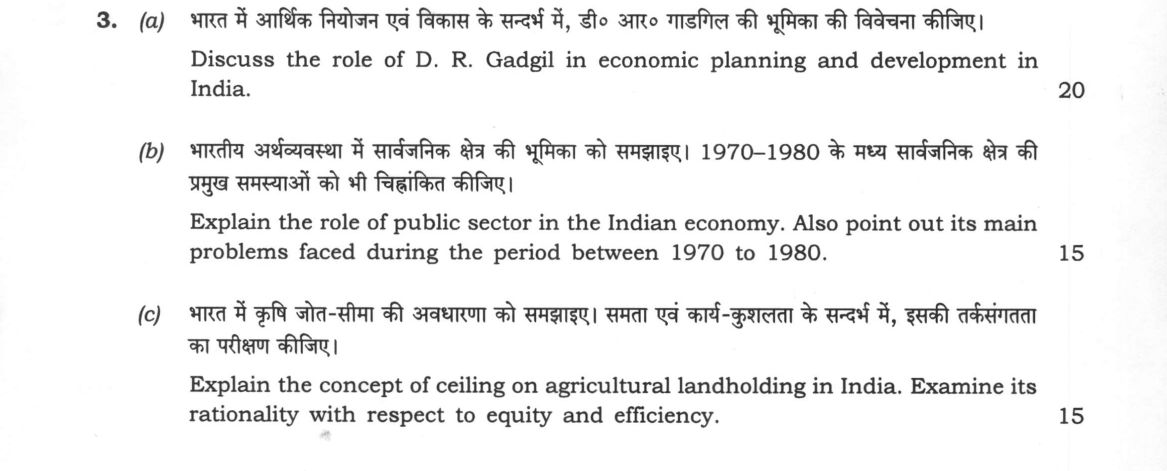
Discuss the role of D. R. Gadgil in economic planning and development in India. 20 marks
Explain the role of public sector in the Indian economy. Also point out its main problems faced during the period between 1970 to 1980. 15 marks
Explain the concept of ceiling on agricultural landholding in India. Examine its rationality with respect to equity and efficiency. 15 marks
हिंदी में प्रश्न पढ़ें
भारत में आर्थिक नियोजन एवं विकास के संदर्भ में, डी० आर० गाडगिल की भूमिका की विवेचना कीजिए। (20 अंक)
भारतीय अर्थव्यवस्था में सार्वजनिक क्षेत्र की भूमिका को समझाइए। 1970-1980 के मध्य सार्वजनिक क्षेत्र की प्रमुख समस्याओं को भी चिह्नित कीजिए। (15 अंक)
भारत में कृषि जोत-सीमा की अवधारणा को समझाइए। समता एवं कार्य-कुशलता के संदर्भ में, इसकी तर्कसंगतता का परीक्षण कीजिए। (15 अंक)
Model answer
Written by UPSC Answer Check against this question's marking rubric, to the expected length. UPSC does not publish answers for Mains — this is one way to score well, not an official key.
Indian economic planning post-independence sought to balance rapid industrialization, regional equity, and agrarian restructuring through state-directed institutions and legislative interventions.
D. R. Gadgil in Economic Planning and Development
Dhananjay Ramchandra Gadgil made foundational contributions to Indian planning, serving as the Deputy Chairman of the Planning Commission from 1967 to 1971. Gadgil offered a sustained critique of the heavy-industry-oriented Mahalanobis model, arguing that it neglected agriculture, generated inadequate employment, and aggravated rural-urban disparities. He advocated for employment-oriented, bottom-up planning, insisting that economic growth must be anchored in decentralized regional frameworks.
His most enduring contribution to fiscal federalism was the Gadgil Formula (1969), approved by the National Development Council. It established an objective, criteria-based mechanism for allocating central plan assistance to states—factoring in population, per capita income, tax effort, and special state problems—thereby curbing discretionary political transfers.
In rural development, Gadgil was an architect of India’s cooperative movement. He helped establish the Pravara Cooperative Sugar Factory in Maharashtra, demonstrating how farmer-owned agro-processing could democratize capital. Through the Gadgil Committee on Agricultural Finance (1944) and his work on decentralized credit planning, he laid the structural blueprints for primary cooperative credit institutions and local-level planned development.
Role and Problems of the Public Sector (1970–1980)
The public sector was conceptualized under the 1956 Industrial Policy Resolution to capture the commanding heights of the economy. During the 1950s and 1960s, it successfully created a basic capital goods and infrastructure base (steel, power, heavy machinery), generated formal non-agricultural employment, and catalyzed balanced regional development by locating massive plants in backward regions like Bhilai and Rourkela.
However, during the 1970–1980 decade, the public sector faced acute structural crises: Managerial autonomy eroded under excessive bureaucratic and ministerial control, resulting in red tape and delays. Enterprises suffered from persistent low capacity utilization and technological obsolescence due to import restrictions and lack of modernization investments. A rigid administered pricing regime created a price-cost scissors, forcing public utilities to sell below cost, triggering massive financial losses. The state adopted a policy of nationalizing private "sick units" (notably through the National Textile Corporation), converting the public sector into a repository of unviable firms and compounding fiscal strain.
Land Ceilings: Equity, Efficiency, and Implementation
Agricultural land ceiling legislation specifies the maximum statutory acreage an individual or family may legally own, with the surplus vested in the state for redistribution to landless and marginal farmers. Following the 1972 National Guidelines, the family became the standard operational unit, establishing lower ceilings for perennial irrigated double-cropped land (10–18 acres) compared to dry land (up to 54 acres).
From an equity perspective, ceilings aimed to dismantle feudal land concentration, empower depressed agrarian classes, and establish social justice. In efficiency terms, proponents cited the inverse farm-size productivity relationship, arguing that smaller, family-managed farms achieve higher land productivity through intensive labor use. Conversely, critics noted that ceilings promote farm fragmentation, obstruct modern mechanization, discourage long-term capital investment, and disallow economies of scale.
Empirically, ceiling laws suffered from widespread evasion via fraudulent benami transactions, fictitious family partitions, and prolonged litigation. While states like West Bengal (alongside Operation Barga) and Kerala recorded notable success due to strong political will and tenant mobilization, implementation in states like Bihar and Uttar Pradesh largely failed due to administrative collusion with the landed elite.
A cohesive planning approach requires reconciling scale efficiencies in industry with decentralization, localized cooperative institutions, and targeted asset redistribution to sustain growth alongside social equity.
What "Discuss" is asking you to do
Lay the issue out from more than one side — how it arose, what is claimed for it, what is held against it, and where it now stands. UPSC attaches discuss to broad topics with several live dimensions, so coverage of the dimensions earns more than the strength of your opinion.
Structure that answers it
Set the issue up → the case as it is made → the case against → the dimension both sides leave out → where the balance now lies
Where marks are lost
Listing facts with no thread between them, or arguing one side throughout and calling it a discussion.
How this answer will be evaluated
Approach
Framework: UPSC Economics Paper II. (a) discuss: intro > 3-4 dimensions > example > balanced close | (b) explain: definition/context > points in order > small example > short close | (c) examine: intro > how/why with reasoning > evidence > conclusion Full marks: Comprehensive, well-structured, with specific examples and references.
Key points expected
- Identify Gadgil's role in the Planning Commission
- Discuss his work on regional planning and development
- Mention his contributions to environmental economics
- Reference his role in the 1991 economic reforms
- Define the role of the public sector in the Indian economy
- Explain the problems faced by the public sector in 1970-1980
- Mention the impact of the 1970s economic crisis on the public sector
- Discuss the role of the public sector in industrialization
Evaluation rubric
Each sub-part is marked on its own, against the marks and word limit printed on the paper.
- (a) Evaluate D.R. Gadgil's specific contributions to Indian economic planning and development. 20 marks
discuss— intro → 3-4 dimensions → example → balanced close
Must cover
- Identify Gadgil's role in the Planning Commission
- Discuss his work on regional planning and development
- Mention his contributions to environmental economics
- Reference his role in the 1991 economic reforms
Loses marks
- General discussion of economic planning without specific reference to Gadgil
- Confusing D.R. Gadgil with other economists
- Lack of specific examples of his contributions
Earns more
- Mention his work on the National Commission on Agriculture
- Reference his book 'The Indian Economy'
- Discuss his role in the National Commission on Population
- Mention his work on the National Commission on Sustainable Development
Extra mark
- Reference his specific reports or papers
- Mention his role in the National Commission on the Status of Women
- (b) Explain the role of the public sector in the Indian economy and its problems in 1970-1980. 15 marks
explain— definition/context → points in order → small example → short close
Must cover
- Define the role of the public sector in the Indian economy
- Explain the problems faced by the public sector in 1970-1980
- Mention the impact of the 1970s economic crisis on the public sector
- Discuss the role of the public sector in industrialization
Loses marks
- General discussion of the public sector without specific reference to 1970-1980
- Lack of specific examples of problems faced
- Confusing the public sector with the private sector
Earns more
- Mention the role of the public sector in infrastructure development
- Discuss the role of the public sector in poverty alleviation
- Mention the role of the public sector in employment generation
- Discuss the role of the public sector in regional development
Extra mark
- Reference specific public sector enterprises
- Mention specific policies or reforms
- (c) Explain the concept of ceiling on agricultural landholding and its rationality. 15 marks
examine— intro → how/why with reasoning → evidence → conclusion
Must cover
- Define the concept of ceiling on agricultural landholding
- Explain the rationale for land ceiling
- Discuss the impact of land ceiling on equity
- Discuss the impact of land ceiling on efficiency
Loses marks
- General discussion of land reform without specific reference to land ceiling
- Lack of specific examples of impact on equity and efficiency
- Confusing land ceiling with other land reform measures
Earns more
- Mention the Land Ceiling Act
- Discuss the role of land ceiling in poverty alleviation
- Mention the role of land ceiling in agricultural productivity
- Discuss the role of land ceiling in social justice
Extra mark
- Reference specific land ceiling policies
- Mention specific examples of land ceiling implementation
Practice this exact question
Write your answer and it is marked point by point against the model answer above — what you covered, what you missed, what you got wrong.
Evaluate my answer →More from Economics 2023 Paper II
- Q1 Answer the following questions in about 150 words each: (a) Land system during the Britis…
- Q2 (a) Explain the main features of money and credit policies in India during the pre-Indepe…
- Q3 (a) Discuss the role of D. R. Gadgil in economic planning and development in India. (20 m…
- Q4 (a) Explain the main causes of inequality in income distribution in India and examine how…
- Q5 Answer the following questions in about 150 words each: (a) Distinguish between explicit…
- Q6 (a) Discuss the characteristic features of Agreement on Agriculture (AOA) under Uruguay R…