Paper II — Q4
(a) Explain the main causes of inequality in income distribution in India and examine how it affects welfare of the society. (20…
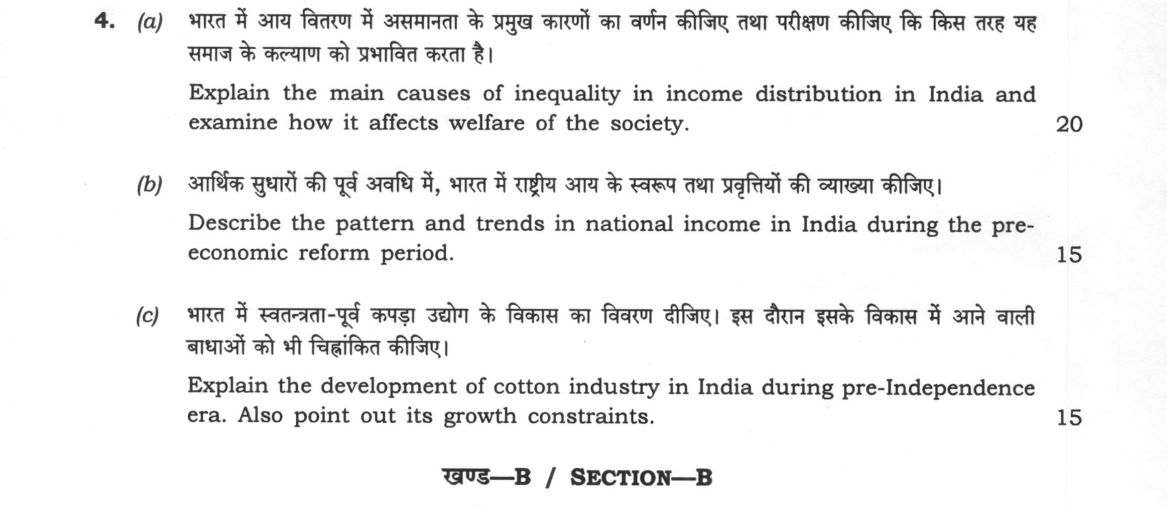
Explain the main causes of inequality in income distribution in India and examine how it affects welfare of the society. 20 marks
Describe the pattern and trends in national income in India during the pre-economic reform period. 15 marks
Explain the development of cotton industry in India during pre-Independence era. Also point out its growth constraints. 15 marks
हिंदी में प्रश्न पढ़ें
भारत में आय वितरण में असमानता के प्रमुख कारणों का वर्णन कीजिए तथा परीक्षण कीजिए कि किस तरह यह समाज के कल्याण को प्रभावित करता है। (20 अंक)
आर्थिक सुधारों की पूर्व अवधि में, भारत में राष्ट्रीय आय के स्वरूप तथा प्रवृत्तियों की व्याख्या कीजिए। (15 अंक)
भारत में स्वतंत्रता-पूर्व कपड़ा उद्योग के विकास का विवरण दीजिए। इस दौरान इसके विकास में आने वाली बाधाओं को भी चिह्नित कीजिए। (15 अंक)
Model answer
Written by UPSC Answer Check against this question's marking rubric, to the expected length. UPSC does not publish answers for Mains — this is one way to score well, not an official key.
Income inequality in India stems from deeply entrenched structural, institutional, and technological factors that systematically skew income distribution.
Causes of Income Inequality and Welfare Impacts
Colonial land revenue systems entrenched skewed land ownership patterns, leaving a vast class of landless agricultural laborers. Caste-based occupational segregation historically restricted marginalized groups to low-income, informal labor, a divide perpetuated today by unequal access to quality education and healthcare. Geographically, uneven industrial and infrastructure investment has widened regional disparities between peninsular and hinterland states. Structurally, the dominance of the informal sector (employing over 80% of the workforce) depresses real wages and deprives workers of social security. Furthermore, modern technological change favors skilled labor, disproportionately rewarding capital and tertiary-sector professionals while stagnating unorganized, low-skilled wages.
These dynamics adversely affect societal welfare. Because lower-income deciles possess a higher marginal propensity to consume than the rich, concentrated income results in reduced aggregate demand, suppressing broader industrial expansion. Severe income deprivation translates directly into health and nutrition deficits, such as high rates of child stunting and wasting. Consequently, underfunded public endowments trap vulnerable households in intergenerational poverty traps, causing diminished social mobility. Over time, extreme disparities erode trust in public institutions, weakening social cohesion and triggering social unrest and conflict.
Trends in National Income in the Pre-Reform Era
During the pre-1991 period, India’s national income trajectory was defined by state-led industrialization and heavy planning:
India experienced a modest GDP expansion averaging around 3.5% per annum between 1950 and 1980, famously characterized as the Hindu rate of growth. Because annual population growth exceeded 2%, per capita income growth remained sluggish at roughly 1.3% per year, preventing any rapid eradication of poverty.
The sectoral composition shifted unusually: the share of agriculture in national income fell steadily from over 55% in the early 1950s to roughly 31% by 1990. However, instead of undergoing a standard industrial transition, output shifted largely toward the services sector, while agriculture continued to shoulder nearly two-thirds of the labor force. Furthermore, economic expansion faced persistent savings and investment constraints. Although domestic savings rates rose from approximately 10% of GDP in the 1950s to over 20% by the 1980s via public sector mobilization and bank nationalization, high capital-output ratios and inefficient capital allocation under the import-substitution regime constrained overall output growth.
Cotton Industry in Pre-Independence India and Its Constraints
The development of India’s modern factory sector began with the early mechanization of the cotton industry in Bombay (1854) and later in Ahmedabad. This expansion was powered by indigenous Parsi and Gujarati entrepreneurship, utilizing mercantile capital accumulated from the raw cotton and opium trade with China. The sector experienced major wartime expansion during World War I and World War II, as disruption in maritime trade checked British imports while military procurements surged. However, these phases were invariably followed by post-war decline and stagnation due to intense foreign competition, inflation, and obsolete machinery.
The growth of the indigenous cotton textile industry was systematically constrained by colonial policy:
- British tariff policy and free trade imperialism, under which revenue duties on imported goods were either eliminated or matched by countervailing excise duties on Indian cloth (such as the 1896 excise duty) to protect competition from Lancashire mills.
- The complete absence of a domestic capital goods industry, forcing Indian mill owners to import expensive plant, machinery, and spare parts from the United Kingdom.
- Colonial trade networks that prioritized raw cotton exports to Britain, frequently creating domestic supply shortages and inflating input costs for local mills.
- Discriminatory railway freight rates, which subsidized the movement of imported manufactured goods inland and raw materials to ports, while imposing higher tariffs on the internal transit of domestically produced textiles.
Addressing these historical structural imbalances requires targeted fiscal redistribution, major investments in human capital, and the creation of productive, labor-intensive manufacturing to achieve broad-based, equitable economic development.
What "Explain" is asking you to do
Make the working of something clear — what sets it off, what follows from what, and what it produces. Explain is the Commission's mechanism word: it dominates the technical papers and the “explain why” stems, where the marks sit in the causal chain and not in the label.
Structure that answers it
State what it is → the initiating condition → the chain of cause, step by step → an instance where it plays out → what the chain produces
Where marks are lost
Describing what something looks like instead of why it works that way. Naming the stages without linking them reads as description too.
How this answer will be evaluated
Approach
Framework: UPSC Economics Paper II. (a) explain: definition/context > points in order > small example > short close | (b) describe: define > structure or process in order > labelled diagram > significance | (c) explain: definition/context > points in order > small example > short close Full marks: Comprehensive, data-driven, with clear structure and specific examples.
Key points expected
- Structural causes: land ownership, caste, education
- Policy causes: industrialization, urban bias
- Impact on welfare: health, education, social mobility
- Linkage between inequality and social development
- Definition of pre-reform period (1950-1991)
- Trend in GDP growth (low/stagnant)
- Sectoral composition: agriculture vs industry
- Role of Five Year Plans and planning commission
Evaluation rubric
Each sub-part is marked on its own, against the marks and word limit printed on the paper.
- (a) Causes of income inequality and its impact on social welfare. 20 marks
explain— definition/context → points in order → small example → short close
Must cover
- Structural causes: land ownership, caste, education
- Policy causes: industrialization, urban bias
- Impact on welfare: health, education, social mobility
- Linkage between inequality and social development
Loses marks
- Listing causes without explaining the mechanism
- Ignoring the 'welfare' aspect of the question
- Verbal answer without structural analysis
Earns more
- Reference to Gini coefficient or Lorenz curve
- Mention of specific schemes (e.g., MGNREGA)
- Data from NSSO or Census
- Reference to Amartya Sen's capability approach
Extra mark
- Specific Gini coefficient data for India
- Reference to specific Supreme Court judgment on equality
- (b) Pattern and trends in national income pre-reform (1950-1991). 15 marks
describe— define → structure or process in order → labelled diagram → significance
Must cover
- Definition of pre-reform period (1950-1991)
- Trend in GDP growth (low/stagnant)
- Sectoral composition: agriculture vs industry
- Role of Five Year Plans and planning commission
Loses marks
- Confusing pre-reform with post-reform period
- Focusing on current trends instead of historical
- Lack of specific data or examples
Earns more
- Mention of 'Hindu rate of growth'
- Reference to specific Five Year Plan data
- Comparison with other developing nations
- Mention of import substitution industrialization
Extra mark
- Specific GDP growth rate figures for the period
- Reference to specific economic survey data
- (c) Development of cotton industry pre-Independence and its constraints. 15 marks
explain— definition/context → points in order → small example → short close
Must cover
- Historical development: British colonial era
- Role of raw cotton export to UK
- Growth constraints: infrastructure, capital, technology
- Impact of colonial policies on industry
Loses marks
- Focusing on post-Independence development
- Ignoring the 'constraints' part of the question
- Lack of historical context
Earns more
- Mention of specific regions (e.g., Bombay, Ahmedabad)
- Reference to specific colonial policies
- Comparison with British cotton industry
- Mention of specific entrepreneurs (e.g., Birla, Tata)
Extra mark
- Specific data on cotton production/export
- Reference to specific historical documents or reports
Practice this exact question
Write your answer and it is marked point by point against the model answer above — what you covered, what you missed, what you got wrong.
Evaluate my answer →More from Economics 2023 Paper II
- Q1 Answer the following questions in about 150 words each: (a) Land system during the Britis…
- Q2 (a) Explain the main features of money and credit policies in India during the pre-Indepe…
- Q3 (a) Discuss the role of D. R. Gadgil in economic planning and development in India. (20 m…
- Q4 (a) Explain the main causes of inequality in income distribution in India and examine how…
- Q5 Answer the following questions in about 150 words each: (a) Distinguish between explicit…
- Q6 (a) Discuss the characteristic features of Agreement on Agriculture (AOA) under Uruguay R…
- Q7 (a) Briefly explain the growth and structure of India's foreign trade in the post-liberal…