Paper I — Q1
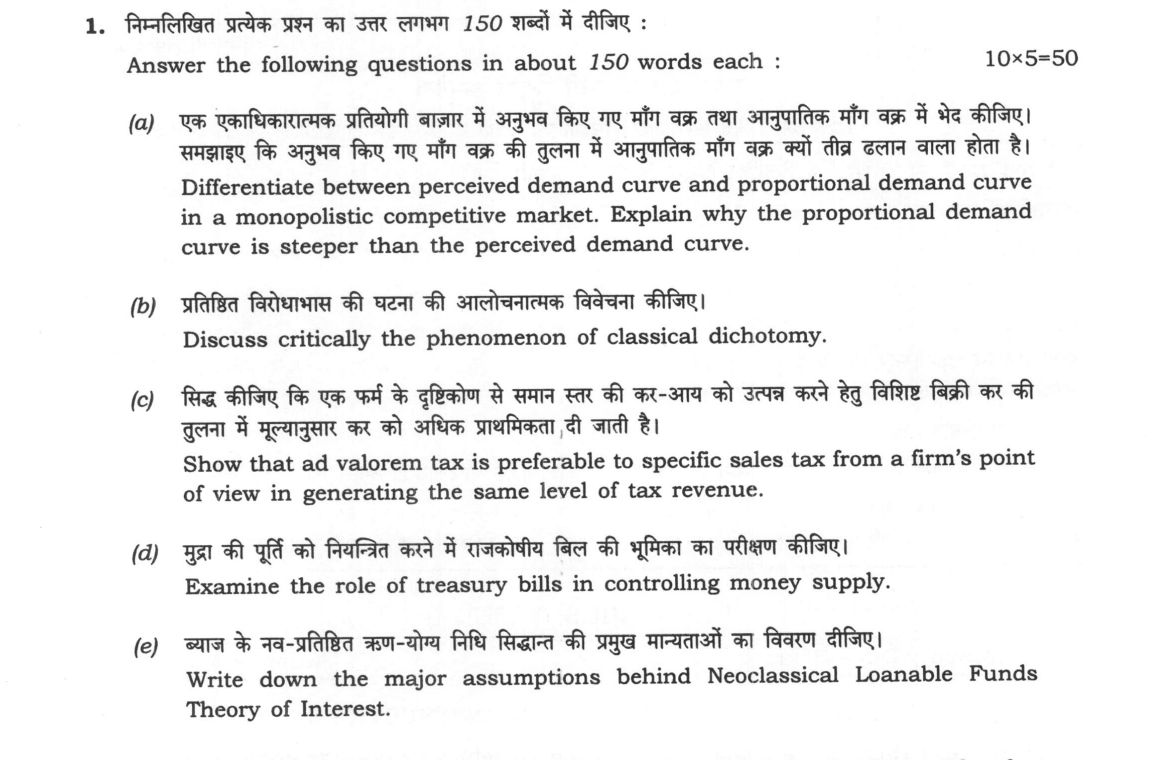
Answer the following questions in about 150 words each: (a) Differentiate between perceived demand curve and proportional demand…
Answer the following questions in about 150 words each:
Differentiate between perceived demand curve and proportional demand curve in a monopolistic competitive market. Explain why the proportional demand curve is steeper than the perceived demand curve. 10 marks
Discuss critically the phenomenon of classical dichotomy. 10 marks
Show that ad valorem tax is preferable to specific sales tax from a firm's point of view in generating the same level of tax revenue. 10 marks
Examine the role of treasury bills in controlling money supply. 10 marks
Write down the major assumptions behind Neoclassical Loanable Funds Theory of Interest. 10 marks
हिंदी में प्रश्न पढ़ें
निम्नलिखित प्रत्येक प्रश्न का उत्तर लगभग 150 शब्दों में दीजिए :
एक एकाधिकारात्मक प्रतियोगी बाजार में अनुभव किए गए माँग वक्र तथा आनुपातिक माँग वक्र में भेद कीजिए। समझाइए कि अनुभव किए गए माँग वक्र की तुलना में आनुपातिक माँग वक्र क्यों तीव्र ढलान वाला होता है। (10 अंक)
प्रतिष्ठित विरोधाभास की घटना की आलोचनात्मक विवेचना कीजिए। (10 अंक)
सिद्ध कीजिए कि एक फर्म के दृष्टिकोण से समान स्तर की कर-आय को उत्पन्न करने हेतु विशिष्ट बिक्री कर की तुलना में मूल्यानुसार कर को अधिक प्राथमिकता दी जाती है। (10 अंक)
मुद्रा की पूर्ति को नियंत्रित करने में राजकोषीय बिल की भूमिका का परीक्षण कीजिए। (10 अंक)
ब्याज के नव-प्रतिष्ठित ऋण-योग्य निधि सिद्धांत की प्रमुख मान्यताओं का विवरण दीजिए। (10 अंक)
Model answer
Written by UPSC Answer Check against this question's marking rubric, to the 150-word length. UPSC does not publish answers for Mains — this is one way to score well, not an official key.
(a) Perceived vs. Proportional Demand Curve
In Edward Chamberlin’s model of monopolistic competition, the distinction between the perceived demand curve (dd) and the proportional demand curve (DD) arises from individual firm expectations versus collective market realities.
The perceived demand curve (dd) reflects an individual firm’s subjective expectation of sales when it changes its price, assuming all rival firms keep their prices unchanged. Consequently, dd is highly price-elastic because the firm expects to gain or lose substantial market share through cross-brand substitution.
Conversely, the proportional demand curve (DD) traces the actual sales of the firm when all competing firms change their prices simultaneously by the same magnitude. Here, each firm retains its proportional share (1/n) of the total market demand.
The proportional demand curve is steeper than the perceived demand curve because when the entire industry alters prices concurrently, the cross-firm substitution effect is eliminated. A price reduction along DD expands sales solely through total market expansion, whereas a price reduction along dd captures both market expansion and rival customers. Thus, DD possesses lower price elasticity of demand and is strictly steeper than dd.
(b) Classical Dichotomy
The classical dichotomy asserts the strict separation of real variables (relative prices, output, real wages, and employment) from nominal variables (general price level, nominal wages, and money supply). Real variables are determined exclusively in the real sector by factor endowments, technology, and consumer preferences, while nominal variables are determined in the monetary sector via the Quantity Theory of Money (MV = PY). Money is viewed as a mere "veil", exhibiting neutrality in the long run.
Critically, this dichotomy was shown to be logically inconsistent by Don Patinkin. Patinkin demonstrated that classical theory committed an error by assuming the demand for goods depends only on relative prices while simultaneously asserting that the absolute price level is determined by the money market. He resolved this through the "Real Balance Effect": a change in nominal money balances (M/P) alters real wealth, directly impacting the demand for real goods and invalidating the strict dichotomy.
Furthermore, John Maynard Keynes rejected the dichotomy by establishing the monetary transmission mechanism. Money affects the real economy through liquidity preference and the rate of interest, which in turn governs real investment, aggregate output, and employment, confirming that money is non-neutral, particularly in the short run.
(c) Ad Valorem vs. Specific Sales Tax
From a firm’s perspective, an ad valorem tax (t) is strictly preferable to a specific tax (s) when both generate an identical amount of tax revenue for the government.
Let inverse demand be P(q) with marginal revenue MR(q), and marginal cost be MC(q). Under a specific tax s, the net price received by the firm is P(q) - s, yielding effective marginal revenue MRₛ = MR(q) - s. Under an ad valorem tax rate t, the net price is (1 - t)P(q), yielding effective marginal revenue MRₜ = (1 - t)MR(q) = MR(q) - t · MR(q).
To generate the same tax revenue T at an output q, the rates must satisfy s · q = t · P(q) · q, which implies s = t · P(q).
For any downward-sloping demand curve, price exceeds marginal revenue (P(q) > MR(q)). Substituting s into the marginal revenue equations gives: t · P(q) > t · MR(q) implies s > t · MR(q) implies MRₜ > MRₛ
Because the ad valorem tax takes a fixed percentage of price rather than a fixed nominal amount, the tax per unit automatically declines as the firm expands output and lowers price. Consequently, the net demand curve faced by the firm under an ad valorem tax is more price-elastic. The firm experiences lower output restriction, charges a lower consumer price, causes smaller deadweight loss, and retains higher producer surplus and profits compared to an equivalent specific tax.
(d) Treasury Bills and Money Supply Control
Treasury Bills (T-bills)—issued in tenors of 91, 182, and 364 days—are vital instruments of indirect monetary control utilized by the Reserve Bank of India (RBI).
First, the RBI regulates primary liquidity (M₀) through Open Market Operations (OMOs) involving outright sales and purchases of T-bills. Selling T-bills absorbs reserve money from commercial banks, curbing their credit-creation capacity, whereas purchasing T-bills injects high-powered money into the banking system.
Second, under the Liquidity Adjustment Facility (LAF), T-bills serve as primary sovereign collateral for repo and reverse repo operations, allowing the central bank to modulate daily liquidity surpluses or deficits in the interbank market.
Third, T-bills are deployed in sterilization operations. Under the Market Stabilization Scheme (MSS), the RBI issues T-bills to mop up excess domestic liquidity generated from foreign exchange market interventions, preventing inflationary expansion of broad money (M₃).
Finally, T-bill yields establish the risk-free benchmark at the short end of the sovereign yield curve, facilitating effective monetary transmission of the policy repo rate to commercial bank deposit and lending rates.
(e) Assumptions of Neoclassical Loanable Funds Theory
The Neoclassical Loanable Funds Theory of interest, developed by Knut Wicksell and extended by Dennis Robertson, Gunnar Myrdal, and Irving Fisher, determines the equilibrium rate of interest by the supply and demand for loanable funds. The major assumptions are:
- Perfect Competition: Financial, factor, and commodity markets operate under perfect competition, ensuring interest rates adjust flexibly to clear the market.
- Full Employment and Closed Economy: The economy operates at full employment in a closed macroeconomic framework without cross-border capital mobility.
- Integration of Monetary and Real Factors: The theory synthesizes real factors (productivity of capital and thrift) with monetary factors (bank credit, dishoarding, and cash balances).
- Supply Composition: Total supply of loanable funds is an increasing function of the rate of interest, consisting of planned savings (S), net additions to bank credit (Δ M), and dishoarding of past balances (DH).
- Demand Composition: Total demand for loanable funds is a decreasing function of the rate of interest, consisting of gross investment demand (I), intended hoarding (H), and consumption dissaving (DS).
- Constant Price Level: The general price level is assumed stable during the market-clearing period.
- Equilibrium Condition: The natural equilibrium rate of interest is attained where total supply equals total demand: S + Δ M + DH = I + H + DS.
What "Differentiate" is asking you to do
Fix the criteria on which the two differ and apply each criterion to both, so the pair can no longer be mixed up. Differentiate stems usually carry a further task attached — describe the mechanism, set out the principles, discuss the applications — and that task carries its own marks.
Structure that answers it
Criterion 1 applied to both → criterion 2 → criterion 3 → summary line or table → the attached second demand answered in full
Where marks are lost
Two standalone definitions placed side by side, leaving the reader to extract the difference. The second common loss is running out of space before the attached task, which is often worth as much as the differentiation.
How this answer will be evaluated
Approach
Framework: Monopolistic Competition, Classical Dichotomy, Public Finance, Monetary Policy, Interest Theory. (a) compare: paired headings or table > key differences > significance > conclusion | (b) critique: the claim > its strengths > its weaknesses > your judgment | (c) justify: claim > 3-4 reasons > evidence > conclusion | (d) examine: intro > how/why with reasoning > evidence > conclusion | (e) enumerate: list the items in order > one line each > no commentary Full marks: Clear definitions, correct models/diagrams, logical derivation, and critical analysis.
Key points expected
- Define perceived demand curve (Dd)
- Define proportional demand curve (dd)
- Explain slope difference via rival price cuts
- Mention kinked demand curve context
- Define classical dichotomy
- Explain neutrality of money
- Mention Fisher's equation of exchange
- Discuss Keynesian critique
Evaluation rubric
Each sub-part is marked on its own, against the marks and word limit printed on the paper.
- (a) Differentiate perceived vs proportional demand curves and explain the slope difference. · 150 words
compare— paired headings or table → key differences → significance → conclusion
Must cover
- Define perceived demand curve (Dd)
- Define proportional demand curve (dd)
- Explain slope difference via rival price cuts
- Mention kinked demand curve context
Loses marks
- Confusing Dd with dd
- Failing to explain the slope difference
- Verbal answer without a diagram
Earns more
- Diagram with Dd and dd curves
- Reference to Chamberlin's model
- Explanation of price rigidity
Extra mark
- Reference to Robinson's model
- (b) Critically discuss the classical dichotomy between real and monetary sectors. · 150 words
critique— the claim → its strengths → its weaknesses → your judgment
Must cover
- Define classical dichotomy
- Explain neutrality of money
- Mention Fisher's equation of exchange
- Discuss Keynesian critique
Loses marks
- Failing to mention the critique
- Confusing real and nominal variables
- Ignoring the role of money
Earns more
- Reference to Classical Quantity Theory
- Mention of real vs nominal variables
- Discussion of long-run vs short-run
Extra mark
- Reference to Friedman's monetarist view
- (c) Show ad valorem tax is preferable to specific tax for a firm generating same revenue. · 150 words
justify— claim → 3-4 reasons → evidence → conclusion
Must cover
- Define ad valorem tax
- Define specific tax
- Compare impact on firm's profit
- Show ad valorem is less distortionary
Loses marks
- Failing to compare the two taxes
- Ignoring the firm's perspective
- Verbal answer without derivation
Earns more
- Mathematical derivation of tax burden
- Reference to incidence of tax
- Discussion of price elasticity
Extra mark
- Reference to Lerner index
- (d) Examine the role of treasury bills in controlling money supply. · 150 words
examine— intro → how/why with reasoning → evidence → conclusion
Must cover
- Define treasury bills
- Explain open market operations
- Link T-bills to money supply control
- Mention RBI's role
Loses marks
- Failing to link T-bills to money supply
- Ignoring the mechanism of OMOs
- Verbal answer without a model
Earns more
- Explanation of discount rate
- Reference to liquidity management
- Discussion of interest rate impact
Extra mark
- Reference to recent RBI policy
- (e) Write down the major assumptions behind Neoclassical Loanable Funds Theory of Interest. · 150 words
enumerate— list the items in order → one line each → no commentary
Must cover
- Define Loanable Funds Theory
- List assumption of full employment
- List assumption of perfect capital market
- List assumption of exogenous money supply
Loses marks
- Failing to list the assumptions
- Confusing with Keynesian theory
- Verbal answer without a list
Earns more
- Mention of saving and investment
- Reference to Hoernle's theory
- Discussion of interest rate determination
Extra mark
- Reference to Keynesian critique
Practice this exact question
Write your answer and it is marked point by point against the model answer above — what you covered, what you missed, what you got wrong.
Evaluate my answer →More from Economics 2024 Paper I
- Q1 Answer the following questions in about 150 words each: (a) Differentiate between perceiv…
- Q2 (a) Derive Pareto optimality conditions in production in a two commodities-two factors-tw…
- Q3 (a) Explain the concept of underemployment equilibrium with graphical illustration. Why f…
- Q4 (a) Describe the mechanism of credit creation by commercial banks and its implications on…