Paper I — Q3
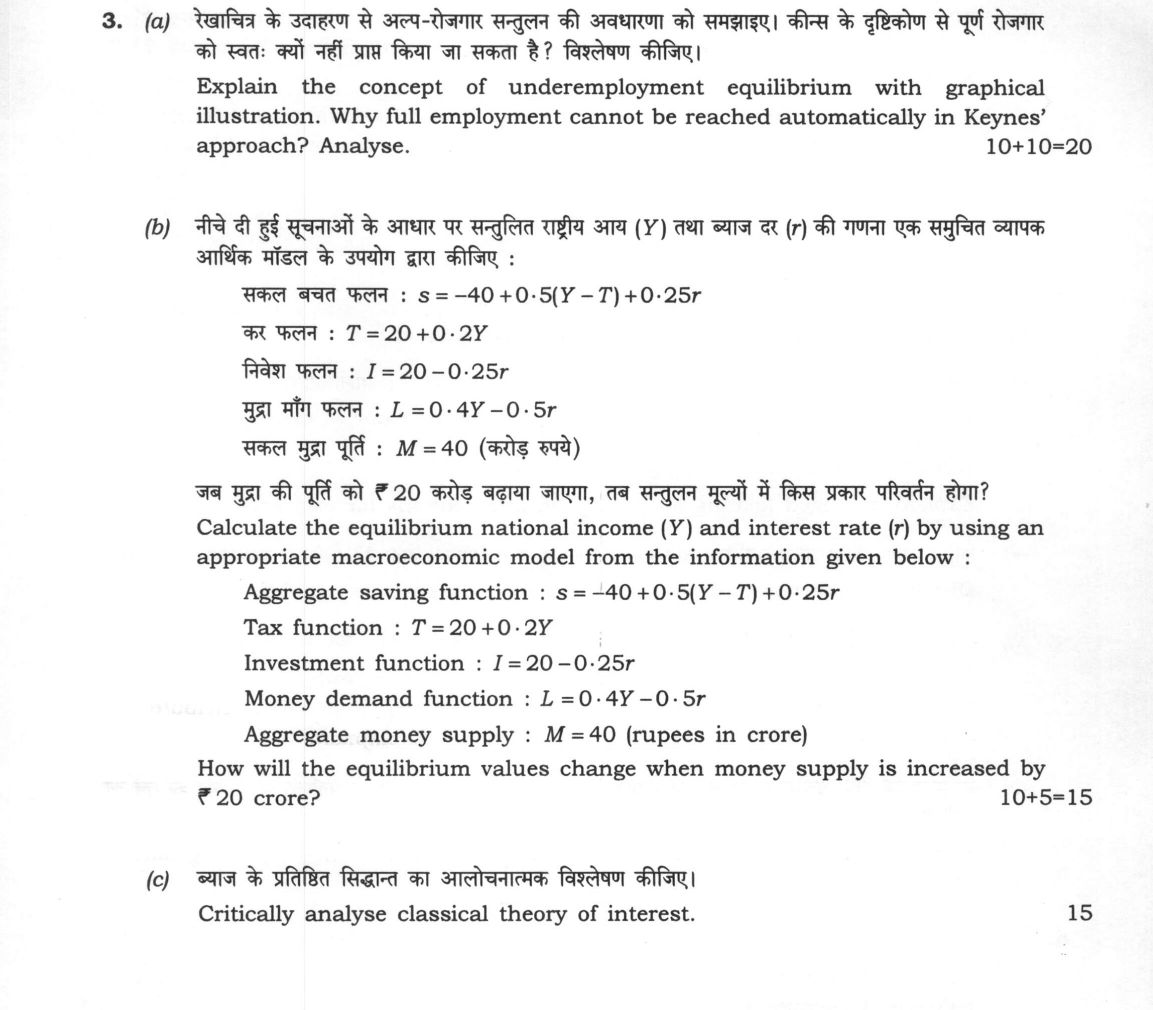
(a) Explain the concept of underemployment equilibrium with graphical illustration. Why full employment cannot be reached…
Explain the concept of underemployment equilibrium with graphical illustration. Why full employment cannot be reached automatically in Keynes' approach? Analyse. (10+10=20 marks)
Calculate the equilibrium national income (Y) and interest rate (r) by using an appropriate macroeconomic model from the information given below:
Aggregate saving function: s = -40+0.5(Y-T)+0.25r Tax function: T = 20+0.2Y Investment function: I = 20-0.25r Money demand function: L = 0.4Y-0.5r Aggregate money supply: M = 40 (rupees in crore)
How will the equilibrium values change when money supply is increased by ₹ 20 crore? (10+5=15 marks)
Critically analyse classical theory of interest. 15 marks
हिंदी में प्रश्न पढ़ें
रेखाचित्र के उदाहरण से अल्प-रोजगार संतुलन की अवधारणा को समझाइए। कौंस के दृष्टिकोण से पूर्ण रोजगार को स्वतः क्यों नहीं प्राप्त किया जा सकता है ? विस्लेषण कीजिए। (10+10=20 अंक)
नीचे दी हुई सूचनाओं के आधार पर संतुलित राष्ट्रीय आय (Y) तथा ब्याज दर (r) की गणना एक समुचित व्यापक आर्थिक मॉडल के उपयोग द्वारा कीजिए :
सकल बचत फलन : s = -40+0.5(Y-T)+0.25r कर फलन : T = 20+0.2Y निवेश फलन : I = 20-0.25r मुद्रा मांग फलन : L = 0.4Y-0.5r सकल मुद्रा पूर्ति : M = 40 (करोड़ रुपये)
जब मुद्रा की पूर्ति को ₹ 20 करोड़ बढ़ाया जाएगा, तब संतुलन मूल्यों में किस प्रकार परिवर्तन होगा? (10+5=15 अंक)
ब्याज के प्रतिष्ठित सिद्धांत का आलोचनात्मक विस्लेषण कीजिए। (15 अंक)
Model answer
Written by UPSC Answer Check against this question's marking rubric, to the expected length. UPSC does not publish answers for Mains — this is one way to score well, not an official key.
Part (a): Underemployment equilibrium
Classical theory assumes Say’s Law: supply creates its own demand, so output adjusts to full employment through flexible wages and prices. Keynes rejects this. In a 45° diagram, the 45° line represents Y=AE; the aggregate demand line AE=C+I+G is drawn with positive intercept and slope less than one. Its intersection with the 45° line gives equilibrium Y*. If Y* lies to the left of full-employment output Yf, the economy is in underemployment equilibrium. At Y*, planned spending equals output, so firms have no incentive to expand; at Yf, AE<Y, inventories accumulate and output falls back to Y*. The gap between Y* and Yf is the unemployment gap. Because AE is determined by consumption, investment and government spending, a fall in any component shifts AE down and lowers Y*, not merely wages. Thus equilibrium need not be full employment.
Full employment is not automatic because effective demand can be deficient. Money wages are downward rigid due to contracts, unions, minimum wages and expectations, so labour cannot be cleared by wage cuts. Even if wages fall, the liquidity trap can make money demand highly interest-elastic, so rate cuts may not lower r enough. Investment may be insensitive to interest because expectations, capacity and credit conditions dominate. The paradox of thrift shows that higher saving can reduce income and aggregate demand, not increase investment. Hence Say’s Law breaks down and policy is needed.
Part (b): IS–LM equilibrium
With no G given, take G=0. Goods-market equilibrium requires S+T=I. Substituting T: S=-40+0.5(Y-20-0.2Y)+0.25r=0.4Y+0.25r-50. Hence S+T=0.6Y+0.25r-30. Equating to I=20-0.25r gives 0.6Y+0.5r=50, or 6Y+5r=500, i.e. Y=83.33-0.833r, the IS curve. The IS curve is downward sloping because a lower r raises I and hence Y. Money-market equilibrium gives M=L: 40=0.4Y-0.5r, or 4Y-5r=400, i.e. Y=100+1.25r, the LM curve. The LM curve is upward sloping because a higher Y raises transaction demand for money, requiring a higher r to keep the money market in equilibrium. Solving, 10Y=900, so Y=90 crore and r=-8%. The negative rate is a direct arithmetic result of the given functions; it does not affect the comparative-static result.
When M rises to 60, LM becomes 60=0.4Y-0.5r, or 4Y-5r=600. The LM curve shifts right. Solving with 6Y+5r=500 gives 10Y=1100, so Y=110 crore and r=-32%. Thus monetary expansion raises equilibrium income and lowers the interest rate, confirming the Keynesian view that money affects real output when the economy is below full employment.
Part (c): Classical interest theory
Classical theory treats interest as the price that equilibrates saving and investment in a full-employment loanable-funds market. Saving is a function of positive interest as reward for abstinence; investment is a function of negative interest as cost of capital. The critique is that this reasoning is circular: it assumes full employment and then derives interest from the intersection of saving and investment, but if effective demand is short, saving and investment need not determine a positive rate. The classical loanable-funds diagram also presumes a fixed full-employment output, so the saving and investment schedules are drawn at Yf; if output is below Yf, the schedules shift, making the original intersection irrelevant. It also ignores the speculative motive for holding money. Keynes shows that money demand depends on transactions, precautionary and speculative motives, and interest is the reward for parting with liquidity, not merely abstinence. Without a fixed money supply and speculative demand, the classical model can be indeterminate. Empirically, in India after the 2008 crisis, despite RBI easing, private investment remained weak, showing that lower rates do not automatically raise investment. Hence Keynes’s liquidity preference better explains interest and supports active monetary and fiscal policy. Together, underemployment equilibrium, IS–LM monetary transmission and liquidity preference show that macroeconomics must start from effective demand, not full-employment adjustment.
What "Analyse" is asking you to do
Break the subject into its working parts and show how they act on each other. The marks are in the interconnections — which factor drives which, and what the resulting structure explains — not in the inventory of factors.
Structure that answers it
Define the whole → separate it into its parts → show which part drives which → what that interaction produces → what the structure implies
Where marks are lost
A flat list of causes with no account of which drives which. An answer of neatly separated headings, each self-contained, scores as description.
How this answer will be evaluated
Approach
Framework: Keynesian IS-LM Model. (a) explain: definition/context > points in order > small example > short close | (b) derive: given > assumptions > stepwise derivation > result > check | (c) discuss: intro > 3-4 dimensions > example > balanced close Full marks: Comprehensive, accurate, and well-structured answers with clear diagrams and derivations.
Key points expected
- Underemployment equilibrium definition
- Keynesian view on full employment
- IS-LM model derivation
- Equilibrium Y and r calculation
- Effect of money supply increase
- Classical theory of interest explanation
- Critique of classical theory
Evaluation rubric
Each sub-part is marked on its own, against the marks and word limit printed on the paper.
- (a) Define underemployment equilibrium and explain why full employment is not automatic in Keynesian theory. 20 marks
explain— definition/context → points in order → small example → short close
Must cover
- Graphical illustration of underemployment equilibrium
- Explanation of sticky wages/prices
- Role of aggregate demand in determining output
- Distinction from classical full employment
Loses marks
- Verbal answer without diagram
- Confusing underemployment with unemployment
- Ignoring the role of aggregate demand
Earns more
- Mention of marginal propensity to consume
- Reference to multiplier effect
- Discussion of liquidity preference
- Comparison with Say's Law
Extra mark
- Reference to Keynes' General Theory
- Mention of effective demand
- (b) Calculate equilibrium Y and r using IS-LM model, then show change with increased money supply. 15 marks
derive— given → assumptions → stepwise derivation → result → check
Must cover
- Derivation of IS curve equation
- Derivation of LM curve equation
- Solving for equilibrium Y and r
- Recalculation with M=60
Loses marks
- Skipping algebraic steps
- Incorrect substitution of tax function
- Failing to recalculate with new M
Earns more
- Correct substitution of T into S
- Clear labeling of IS and LM equations
- Step-by-step algebraic manipulation
- Comparison of old and new equilibrium
Extra mark
- Graphical representation of IS-LM shift
- Mention of fiscal/monetary policy implications
- (c) Critically analyze the classical theory of interest, highlighting its assumptions and limitations. 15 marks
discuss— intro → 3-4 dimensions → example → balanced close
Must cover
- Explanation of classical theory of interest
- Assumptions of full employment
- Role of savings and investment
- Critique of the theory
Loses marks
- One-sided analysis without critique
- Ignoring the role of money
- Failing to mention full employment assumption
Earns more
- Mention of marginal productivity of capital
- Reference to time preference
- Comparison with Keynesian theory
- Discussion of liquidity preference
Extra mark
- Reference to specific classical economists
- Mention of modern critiques
Practice this exact question
Write your answer and it is marked point by point against the model answer above — what you covered, what you missed, what you got wrong.
Evaluate my answer →More from Economics 2024 Paper I
- Q1 Answer the following questions in about 150 words each: (a) Differentiate between perceiv…
- Q2 (a) Derive Pareto optimality conditions in production in a two commodities-two factors-tw…
- Q3 (a) Explain the concept of underemployment equilibrium with graphical illustration. Why f…
- Q4 (a) Describe the mechanism of credit creation by commercial banks and its implications on…
- Q5 Answer the following questions in about 150 words each: (a) Critically examine 'per capit…
- Q6 (a) Discuss the elasticity approach and absorption approach for adjustments in balance of…