Paper I — Q2
(a) Derive Pareto optimality conditions in production in a two commodities-two factors-two producers framework. Show that Pareto…
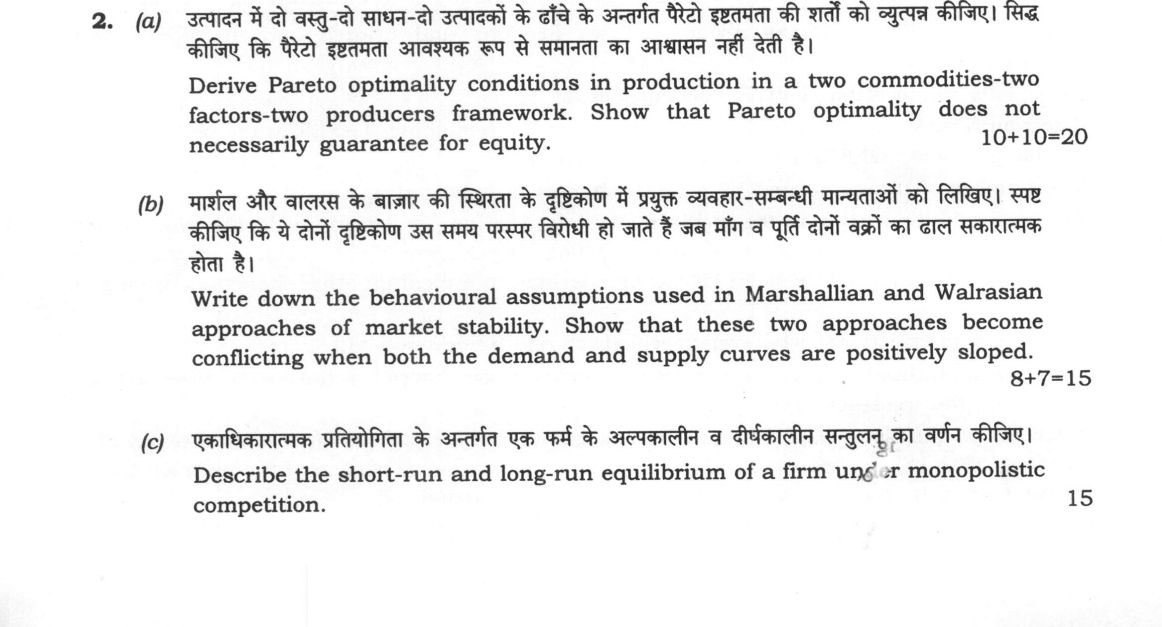
Derive Pareto optimality conditions in production in a two commodities-two factors-two producers framework. Show that Pareto optimality does not necessarily guarantee for equity. (10+10=20 marks)
Write down the behavioural assumptions used in Marshallian and Walrasian approaches of market stability. Show that these two approaches become conflicting when both the demand and supply curves are positively sloped. (8+7=15 marks)
Describe the short-run and long-run equilibrium of a firm under monopolistic competition. 15 marks
हिंदी में प्रश्न पढ़ें
उत्पादन में दो वस्तु-दो साधन-दो उत्पादकों के ढाँचे के अंतर्गत पैरेटो इष्टतमता की शर्तों को व्युत्पन्न कीजिए। सिद्ध कीजिए कि पैरेटो इष्टतमता आवश्यक रूप से समानता का आश्वासन नहीं देती है। (10+10=20 अंक)
मार्शल और वालरस के बाजार की स्थिरता के दृष्टिकोण में प्रयुक्त व्यवहार-संबंधी मान्यताओं को लिखिए। स्पष्ट कीजिए कि ये दोनों दृष्टिकोण उस समय परस्पर विरोधी हो जाते हैं जब माँग व पूर्ति दोनों वक्रों का ढाल सकारात्मक होता है। (8+7=15 अंक)
एकाधिकारात्मक प्रतियोगिता के अंतर्गत एक फर्म के अल्पकालीन व दीर्घकालीन संतुलन का वर्णन कीजिए। (15 अंक)
Model answer
Written by UPSC Answer Check against this question's marking rubric, to the expected length. UPSC does not publish answers for Mains — this is one way to score well, not an official key.
(a)(i) In a two-commodity X,Y, two-factor L,K, two-producer framework, let X=f(L₁,K₁), Y=g(L₂,K₂), with L₁+L₂=L̄ and K₁+K₂=K̄. Pareto optimality in production requires that no reallocation of factors can raise one commodity without lowering the other. Equivalently, the X- and Y-isoquants must be tangent in the Edgeworth box. For cost minimisation by each producer, minimise wL₁+rK₁ subject to f(L₁,K₁)=X̄; the first-order condition is ∂f/∂L₁ ÷ ∂f/∂K₁ = w/r. Similarly, ∂g/∂L₂ ÷ ∂g/∂K₂ = w/r. Hence MRTS(LK) in X = MRTS(LK) in Y = w/r. With many producers of each good, the same MRTS equality holds across all factor uses. For full Pareto efficiency including product mix, maximise U(X,Y) subject to T(X,Y)=0. This gives MRS(XY) = MRT(XY) = MC_X/MC_Y = P_X/P_Y under perfect competition. Validity requires convex technologies, divisible factors and no externalities.
(a)(ii) Pareto optimality is only an efficiency condition. The contract curve contains all tangency points, and every point on it is Pareto optimal. Moving along the contract curve changes the distribution of outputs and factor rewards without violating efficiency. For two persons, allocations (10,0) and (5,5) can both lie on the utility possibility frontier; (10,0) may be Pareto efficient yet grossly inequitable. Ownership of factors determines which efficient point is attained. Thus Pareto optimality does not necessarily guarantee equity.
(b)(i) Marshallian stability assumes quantity adjustment. Let Pᵈ(Q) be demand price and Pˢ(Q) supply price. If Pᵈ>Pˢ, firms expand output; if Pᵈ<Pˢ, they contract. Thus dQ/dt=k[Pᵈ(Q)−Pˢ(Q)]. Stability requires Pᵈ′(Q)<Pˢ′(Q). Walrasian stability assumes price adjustment through tâtonnement. Let D(P), S(P) be demand and supply. If D>S, price rises; if D<S, price falls. Thus dP/dt=k[D(P)−S(P)]. Stability requires D′(P)<S′(P).
(b)(ii) Let both curves be positively sloped: Pᵈ(Q)=a+bQ, Pˢ(Q)=c+dQ, with b,d>0. Marshallian stability needs b<d. In price form, D(P)=(P−a)/b and S(P)=(P−c)/d. Walrasian stability needs 1/b<1/d, i.e. d<b. Hence Marshallian requires demand price curve flatter than supply price curve, while Walrasian requires supply curve flatter than demand curve. Therefore the two approaches conflict when both demand and supply curves are positively sloped; if b=d, the test is neutral.
(c) Monopolistic competition assumes many firms, differentiated products, free entry/exit, downward-sloping demand for each firm, and U-shaped AC and MC.
Short-run equilibrium: the firm maximises π=(P−AC)Q, where P=P(Q). The first-order condition is MR=MC. Price is read from the demand curve at Q*. Since demand slopes down, P>MR=MC, so P>MC. Profit may be positive if P>AC or negative if P<AC. Entry/exit does not occur in the short run.
Long-run equilibrium: free entry eliminates supernormal profit, and free exit removes losses. Each firm’s demand curve shifts until it is tangent to AC. The conditions are MR=MC and P=AC, giving zero economic profit. Because demand is downward-sloping, tangency occurs at Q*<Q_min, where AC is not minimum. Hence P>MC and there is excess capacity, while product differentiation provides variety. If losses exist, exit shifts demand up/right until P=AC. Thus long-run monopolistic competition has zero profit but neither allocative nor productive efficiency.
What "Derive" is asking you to do
Reach the stated expression from a starting relation, justifying every step. The destination is printed in the question, so only the route earns marks, and the assumptions you work under are part of that route.
Structure that answers it
Assumptions and notation defined → starting relation or governing equation → each step with its justification → the required expression → limiting case or boundary check
Where marks are lost
Writing the standard result first and fitting three lines to it, which an examiner reads at a glance. Marks also go on assumptions left unstated — lossless medium, small amplitude, errors independent with zero mean — and on symbols used before they are defined, even when the question says usual notations.
How this answer will be evaluated
Approach
Framework: Microeconomic Theory: Welfare Economics and Market Structure. (a) derive: given > assumptions > stepwise derivation > result > check | (b) explain: definition/context > points in order > small example > short close | (c) describe: define > structure or process in order > labelled diagram > significance Full marks: Rigorous derivation of MRT=MRTS; clear logical proof of Marshall-Walras conflict; precise diagrams for monopolistic competition.
Key points expected
- Define production possibility frontier (PPF) in 2-commodity, 2-factor space
- Derive MRT = MRTS condition for production efficiency
- State that Pareto optimality is independent of initial endowments
- Provide a counter-example showing unequal distribution of output
- Define Marshallian assumption: Quantity adjusts, price fixed
- Define Walrasian assumption: Price adjusts, quantity fixed
- Show Marshallian stability condition: Slope of S > Slope of D
- Show Walrasian stability condition: Slope of D > Slope of S
Evaluation rubric
Each sub-part is marked on its own, against the marks and word limit printed on the paper.
- (a) Derive production Pareto optimality conditions and demonstrate the inequity of the resulting allocation. 20 marks
derive— given → assumptions → stepwise derivation → result → check
Must cover
- Define production possibility frontier (PPF) in 2-commodity, 2-factor space
- Derive MRT = MRTS condition for production efficiency
- State that Pareto optimality is independent of initial endowments
- Provide a counter-example showing unequal distribution of output
Loses marks
- Confusing production efficiency with exchange efficiency
- Failing to explicitly state the 2-commodity/2-factor assumption
- Asserting equity without a logical counter-example
Earns more
- Use Edgeworth box for production (contract curve)
- Distinguish between technical efficiency and social welfare
- Reference the First Fundamental Theorem of Welfare Economics
Extra mark
- Mention the Second Fundamental Theorem of Welfare Economics
- Reference a specific economist (e.g., Samuelson or Hicks)
- (b) List Marshallian and Walrasian stability assumptions and prove their conflict under positive slopes. 15 marks
explain— definition/context → points in order → small example → short close
Must cover
- Define Marshallian assumption: Quantity adjusts, price fixed
- Define Walrasian assumption: Price adjusts, quantity fixed
- Show Marshallian stability condition: Slope of S > Slope of D
- Show Walrasian stability condition: Slope of D > Slope of S
Loses marks
- Failing to distinguish between price and quantity adjustment
- Using standard downward-sloping demand curves for the conflict proof
- Vague description of 'stability' without mathematical conditions
Earns more
- Use a diagram with a positively sloped supply curve
- Explicitly state the 'conflict' as a logical contradiction
- Mention the 'cobweb model' context
Extra mark
- Reference the specific 'Marshallian vs Walrasian' debate in literature
- Mention the 'speculative' nature of the supply curve
- (c) Describe short-run and long-run equilibrium conditions for a monopolistically competitive firm. 15 marks
describe— define → structure or process in order → labelled diagram → significance
Must cover
- Define monopolistic competition (many firms, differentiated product)
- Short-run: MR = MC and P > MC (positive profit or loss)
- Long-run: Entry/Exit drives P = AC (zero economic profit)
- Show the 'excess capacity' or 'tangency' condition in long-run
Loses marks
- Treating the firm as a price taker (perfect competition)
- Failing to show the long-run adjustment process (entry/exit)
- Confusing short-run profit maximization with long-run equilibrium
Earns more
- Draw the demand curve shifting until it is tangent to AC
- Explain the role of non-price competition (advertising)
- Compare the long-run outcome with perfect competition
Extra mark
- Reference the Chamberlin or Robinson model
- Mention the 'kinked demand curve' if relevant to the specific context
Practice this exact question
Write your answer and it is marked point by point against the model answer above — what you covered, what you missed, what you got wrong.
Evaluate my answer →More from Economics 2024 Paper I
- Q1 Answer the following questions in about 150 words each: (a) Differentiate between perceiv…
- Q2 (a) Derive Pareto optimality conditions in production in a two commodities-two factors-tw…
- Q3 (a) Explain the concept of underemployment equilibrium with graphical illustration. Why f…
- Q4 (a) Describe the mechanism of credit creation by commercial banks and its implications on…
- Q5 Answer the following questions in about 150 words each: (a) Critically examine 'per capit…