Paper I — Q5
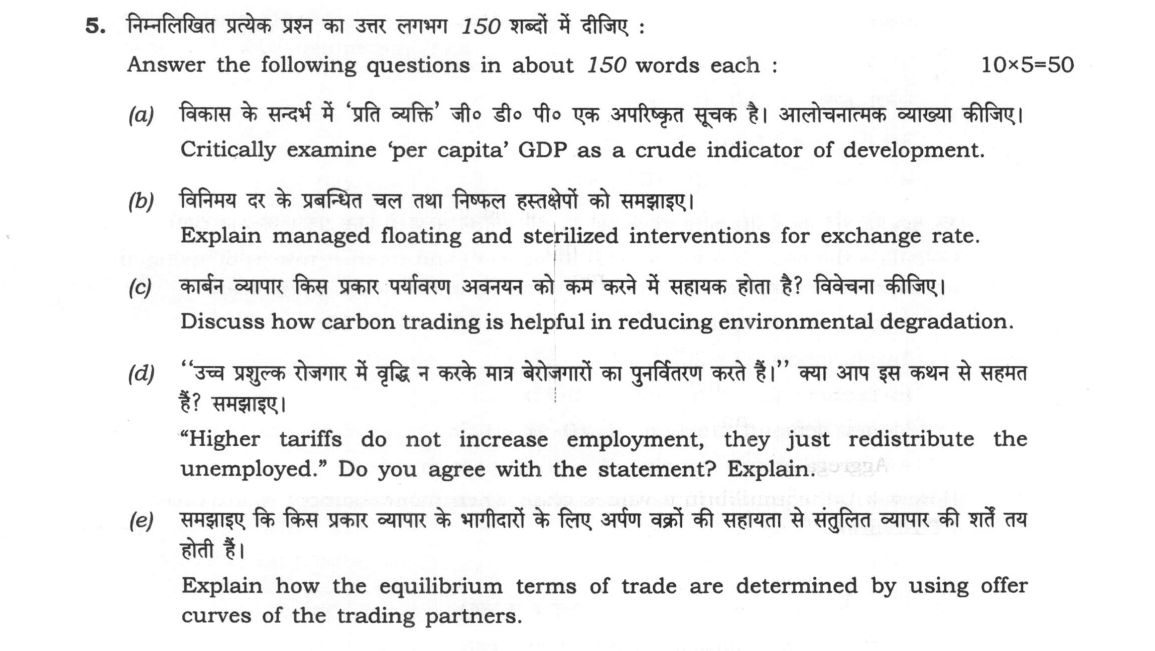
Answer the following questions in about 150 words each: (a) Critically examine 'per capita' GDP as a crude indicator of…
Answer the following questions in about 150 words each:
Critically examine 'per capita' GDP as a crude indicator of development. 10 marks
Explain managed floating and sterilized interventions for exchange rate. 10 marks
Discuss how carbon trading is helpful in reducing environmental degradation. 10 marks
"Higher tariffs do not increase employment, they just redistribute the unemployed." Do you agree with the statement? Explain. 10 marks
Explain how the equilibrium terms of trade are determined by using offer curves of the trading partners. 10 marks
हिंदी में प्रश्न पढ़ें
निम्नलिखित प्रत्येक प्रश्न का उत्तर लगभग 150 शब्दों में दीजिए :
विकास के सन्दर्भ में 'प्रति व्यक्ति' जी० डी० पी० एक अपरिष्कृत सूचक है। आलोचनात्मक व्याख्या कीजिए। (10 अंक)
विनिमय दर के प्रबन्धित चल तथा निष्फल हस्तक्षेपों को समझाइए। (10 अंक)
कार्बन व्यापार किस प्रकार पर्यावरण अवनयन को कम करने में सहायक होता है? विवेचना कीजिए। (10 अंक)
"उच्च प्रशुल्क रोजगार में वृद्धि न करके मात्र बेरोजगारों का पुनर्वितरण करते हैं।" क्या आप इस कथन से सहमत हैं? समझाइए। (10 अंक)
समझाइए कि किस प्रकार व्यापार के भागीदारों के लिए अर्पण वक्रों की सहायता से सन्तुलित व्यापार की शर्तें तय होती हैं। (10 अंक)
Model answer
Written by UPSC Answer Check against this question's marking rubric, to the 150-word length. UPSC does not publish answers for Mains — this is one way to score well, not an official key.
(a) Per capita GDP Per capita GDP is a useful, comparable measure of average income and long-run growth, but it is a crude development indicator because it compresses welfare into one number. It ignores income distribution: two countries with same per capita GDP can have very different Gini coefficients, and growth may accrue to a small elite. It also excludes non-market activities such as unpaid care, subsistence production and household labour, and it does not subtract environmental externalities, so resource depletion and pollution can raise GDP while lowering well-being. It further misses human development dimensions captured by HDI, such as health, education and capability. It also overlooks social exclusion and institutional quality. India’s GDP rank has often been higher than its HDI rank, showing that income growth alone does not guarantee development; Bhutan’s GNH highlights alternative welfare metrics. Thus per capita GDP is a necessary but insufficient signal of development.
(b) Managed floating and sterilized intervention Managed floating is a hybrid exchange-rate regime in which the market determines the rate, but the central bank intervenes within a band or to prevent excessive volatility. In unsterilized intervention, buying or selling foreign exchange changes the monetary base: buying currency raises domestic money supply, while selling reduces it. Sterilized intervention offsets this monetary effect using open-market operations: if the central bank buys foreign currency and injects rupees, it sells government securities to absorb liquidity; if it sells foreign currency and drains rupees, it buys securities to restore money supply. In India, the Reserve Bank of India has used foreign-exchange swaps, repo operations and open-market operations to smooth rupee movements while protecting the monetary stance and price stability. This is especially relevant when capital flows are volatile. Sterilization preserves monetary policy independence but can be costly, limited by reserves and credibility, and may fail if expectations dominate.
(c) Carbon trading Carbon trading reduces environmental degradation by putting a price on emissions and allowing firms to meet a cap at lowest cost. Under cap-and-trade, a regulator sets an aggregate emissions ceiling and distributes or auctions allowances; firms that cut emissions cheaply can sell surplus allowances to higher-cost emitters. This creates carbon price discovery and incentives for abatement, energy efficiency and low-carbon investment. Theoretically, it applies the Coase theorem: when property rights are well defined and transaction costs are low, bargaining leads to efficient allocation of pollution rights. In reality, transaction costs are non-zero, so market design, monitoring and enforcement matter. A binding cap is essential; a loose cap merely redistributes allowances and compliance costs. India’s Perform, Achieve and Trade scheme for energy efficiency and carbon markets under the Energy Conservation Act, 2022, illustrate this logic; debates over EU ETS linkage show the need for compatible standards.
(d) Tariffs and employment The statement is broadly correct under full-employment assumptions, but not universally. Tariffs raise the price of imported goods, making domestic import-competing sectors more profitable. In the Specific Factors Model, labour moves from export or unprotected sectors to the protected sector, raising its wage and employment, while other sectors lose workers; total employment need not rise if the economy is at full capacity. The Stolper-Samuelson theorem is relevant to factor rewards, not aggregate jobs: protection can raise the return to the factor used intensively in the protected sector and lower returns elsewhere. Tariffs may increase aggregate employment only under Keynesian unemployment, fixed exchange rates and no retaliation, by stimulating domestic demand; with retaliation, exchange-rate effects and misallocation, they can reduce welfare, and tariff-induced growth that worsens terms of trade may even become immiserizing. India’s auto and Trump steel tariffs show sectoral gains offset by consumer losses.
(e) Offer curves and terms of trade Offer curves, or reciprocal demand curves, show the quantities of one good a country is willing to export in exchange for imports of another good. Each curve traces exports offered against imports demanded at different terms of trade. The equilibrium terms of trade are determined where the two offer curves intersect: at that point, the quantity of goods A is willing to export equals the quantity B is willing to import, and vice versa. This is Mill’s equation of international demand, where the value of exports equals the value of imports. If a country’s offer curve shifts outward due to growth, technical change or rising demand for foreign goods, the equilibrium terms of trade move in favour of the country whose demand for imports is relatively less elastic. Thus offer curves explain how relative demand, supply and growth determine the international price ratio.
What "Critically examine" is asking you to do
Test the proposition the question puts to you and return a finding on how far it holds. Examine stems carry a claim, or ask whether something has happened, and expect evidence weighed both ways before the extent is stated — often with remedial measures attached. “Critically” is not a section added at the end: name the yardstick you are judging by — the evidence, the stated objective, a constitutional principle, a rival explanation — and let a verdict close each part of the body. Where the question quotes a claim, that verdict must land on the claim itself, accepted, qualified or rejected, and not on the theme in general.
Structure that answers it
Restate the claim as the question frames it → evidence that supports it → evidence that undercuts it → the conditions under which it holds → verdict on how far it stands
Where marks are lost
Merits in one paragraph, demerits in the next, and a conclusion calling for a balanced and holistic approach. That is a survey with the judgement left out and it holds the answer in the middle band. The opposite error is reading “critically” as permission to attack — and with the odd pairings, critically describe or critically explain, the exposition still carries most of the marks, the judgement being a layer on it rather than a substitute for it.
How this answer will be evaluated
Approach
Framework: UPSC Economics Paper 1 (International Economics & Development). (a) critique: the claim > its strengths > its weaknesses > your judgment | (b) explain: definition/context > points in order > small example > short close | (c) discuss: intro > 3-4 dimensions > example > balanced close | (d) comment: context > arguments both sides > judgment > close | (e) explain: definition/context > points in order > small example > short close Full marks: Precise definitions, clear logical flow, and specific examples or diagrams where applicable.
Key points expected
- Define per capita GDP as an average measure
- Identify failure to capture income distribution
- Mention exclusion of non-market activities
- Note neglect of qualitative factors (health/education)
- Define managed float as a hybrid regime
- Describe central bank use of reserves to influence rate
- Define sterilization as offsetting domestic money supply
- Explain the open market operation used for sterilization
Evaluation rubric
Each sub-part is marked on its own, against the marks and word limit printed on the paper.
- (a) Assess the limitations of per capita GDP as a development metric. · 150 words
critique— the claim → its strengths → its weaknesses → your judgment
Must cover
- Define per capita GDP as an average measure
- Identify failure to capture income distribution
- Mention exclusion of non-market activities
- Note neglect of qualitative factors (health/education)
Loses marks
- Treating GDP as a perfect proxy for welfare
- Ignoring the 'per capita' normalization aspect
Earns more
- Reference to Human Development Index (HDI)
- Mention of Gini coefficient for inequality
- Distinction between growth and development
Extra mark
- Citation of Amartya Sen's capability approach
- Reference to Green GDP or ecological footprint
- (b) Define managed floating and the mechanism of sterilized intervention. · 150 words
explain— definition/context → points in order → small example → short close
Must cover
- Define managed float as a hybrid regime
- Describe central bank use of reserves to influence rate
- Define sterilization as offsetting domestic money supply
- Explain the open market operation used for sterilization
Loses marks
- Confusing managed float with fixed peg
- Failing to explain the domestic monetary offset
Earns more
- Mention of 'dirty float' as a synonym
- Distinction between sterilized and unsterilized intervention
- Reference to interest rate parity conditions
Extra mark
- Example of a specific country's policy (e.g., India/China)
- Mention of the 'trilemma' or impossible trinity
- (c) Analyze the mechanism of carbon trading in reducing environmental degradation. · 150 words
discuss— intro → 3-4 dimensions → example → balanced close
Must cover
- Define carbon trading as a cap-and-trade system
- Explain the creation and trading of emission permits
- Describe the price signal incentivizing reduction
- Link the mechanism to aggregate emission targets
Loses marks
- Confusing carbon tax with carbon trading
- Ignoring the 'cap' component of the system
Earns more
- Mention of the Kyoto Protocol's Clean Development Mechanism
- Reference to the EU Emissions Trading System (ETS)
- Discussion of cost-effectiveness for firms
Extra mark
- Mention of specific carbon credit prices or volumes
- Reference to the Paris Agreement's Article 6
- (d) Evaluate the claim that tariffs only redistribute unemployment. · 150 words
comment— context → arguments both sides → judgment → close
Must cover
- State the argument regarding protected vs. export sectors
- Explain the 'job creation' effect in protected industries
- Explain the 'job loss' effect in export/competing sectors
- Provide a balanced judgment on net employment impact
Loses marks
- One-sided argument without considering export sectors
- Ignoring the static vs. dynamic efficiency trade-off
Earns more
- Reference to the 'infant industry' argument
- Mention of consumer price effects (inflation)
- Discussion of retaliation and trade wars
Extra mark
- Citation of specific trade war data (e.g., US-China)
- Reference to specific economists (e.g., Krugman)
- (e) Derive equilibrium terms of trade using offer curves. · 150 words
explain— definition/context → points in order → small example → short close
Must cover
- Define offer curves (import offer and export offer)
- Describe the axes (exports vs. imports)
- Identify equilibrium as the intersection of curves
- Explain the slope of the intersection as the TOT
Loses marks
- Failing to identify the intersection point as equilibrium
- Confusing offer curves with supply/demand curves
Earns more
- Mention of the 'terms of trade' as the price ratio
- Reference to the 'contract curve' or 'bilateral' equilibrium
- Explanation of how shifts in curves change TOT
Extra mark
- Reference to the 'reciprocal demand' theory (Marshall)
- Mention of the 'terms of trade' elasticity
Practice this exact question
Write your answer and it is marked point by point against the model answer above — what you covered, what you missed, what you got wrong.
Evaluate my answer →More from Economics 2024 Paper I
- Q2 (a) Derive Pareto optimality conditions in production in a two commodities-two factors-tw…
- Q3 (a) Explain the concept of underemployment equilibrium with graphical illustration. Why f…
- Q4 (a) Describe the mechanism of credit creation by commercial banks and its implications on…
- Q5 Answer the following questions in about 150 words each: (a) Critically examine 'per capit…
- Q6 (a) Discuss the elasticity approach and absorption approach for adjustments in balance of…
- Q7 (a) Explain how the structural transformation, in the economy, takes place with surplus l…
- Q8 (a) Describe the major components used in Human Development Index (HDI) by the United Nat…