Paper I — Q6
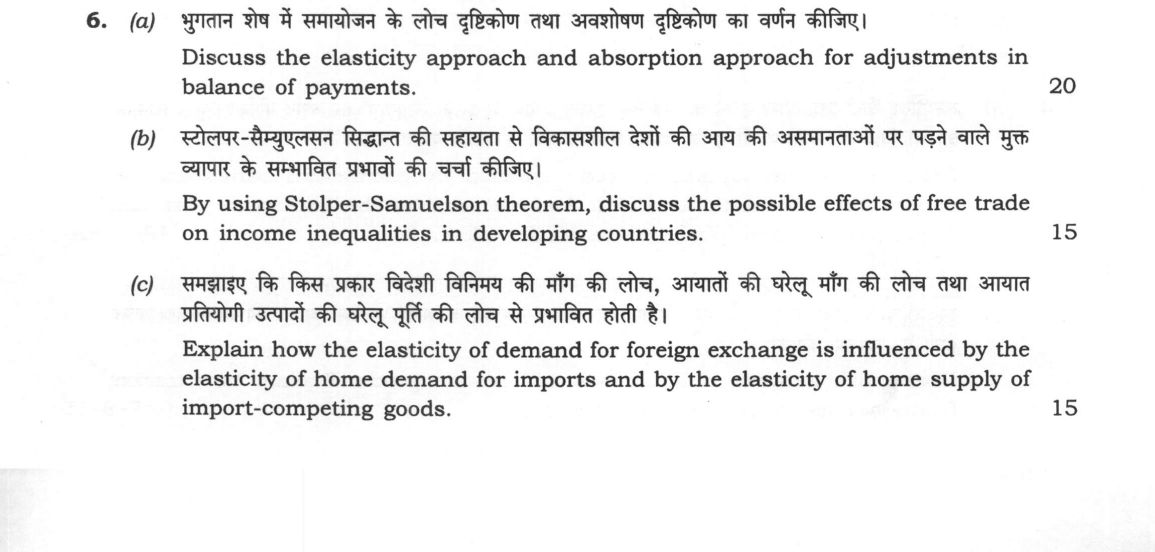
(a) Discuss the elasticity approach and absorption approach for adjustments in balance of payments. (20 marks) (b) By using…
Discuss the elasticity approach and absorption approach for adjustments in balance of payments. 20 marks
By using Stolper-Samuelson theorem, discuss the possible effects of free trade on income inequalities in developing countries. 15 marks
Explain how the elasticity of demand for foreign exchange is influenced by the elasticity of home demand for imports and by the elasticity of home supply of import-competing goods. 15 marks
हिंदी में प्रश्न पढ़ें
भुगतान शेष में समायोजन के लोच दृष्टिकोण तथा अवशोषण दृष्टिकोण का वर्णन कीजिए। (20 अंक)
स्टोलपर-सैमुएल्सन सिद्धान्त की सहायता से विकासशील देशों की आय की असमानताओं पर पड़ने वाले मुक्त व्यापार के सम्भावित प्रभावों की चर्चा कीजिए। (15 अंक)
समझाइए कि किस प्रकार विदेशी विनिमय की माँग की लोच, आयातों की घरेलू माँग की लोच तथा आयात प्रतियोगी उत्पादों की घरेलू पूर्ति की लोच से प्रभावित होती है। (15 अंक)
Model answer
Written by UPSC Answer Check against this question's marking rubric, to the expected length. UPSC does not publish answers for Mains — this is one way to score well, not an official key.
Adjustments in the Balance of Payments (BOP) are traditionally analyzed through price, income, and monetary mechanisms.
Elasticity and Absorption Approaches to BOP Adjustment
The Elasticity Approach, rooted in the Marshall-Lerner condition, focuses on the relative price mechanism. A currency devaluation improves the trade balance only if the sum of price elasticities of demand for exports and imports exceeds unity (|ηₓ| + |ηₘ| > 1), assuming perfectly elastic supplies. In the short run, due to contractual rigidities and delivery lags, these elasticities are low (|ηₓ| + |ηₘ| < 1), leading to an initial deterioration of the trade balance before it improves, tracing out the J-curve effect.
In contrast, Sidney Alexander’s Absorption Approach emphasizes national income aggregates. Defining the current account balance as B = Y - A (where Y is domestic output and A = C + I + G is domestic absorption), a BOP deficit (B < 0) implies that total absorption exceeds domestic output (A > Y). Devaluation can correct a deficit only if it expands output relative to absorption (dY > dA). Under full employment, devaluation merely causes inflation unless supplemented by expenditure-reducing policies (fiscal and monetary contraction) alongside expenditure-switching policies (devaluation redirecting demand to domestic goods).
While the elasticity approach provides microeconomic, short-run price insights, the absorption approach provides macroeconomic, income-determined conditions. These are synthesized in the Monetary Approach, which treats BOP disequilibria as stock adjustments where real absorption shifts reflect excess money demand or supply.
Stolper-Samuelson Theorem and Inequality in Developing Countries
The Stolper-Samuelson theorem, derived from the Heckscher-Ohlin framework, demonstrates that a rise in the relative price of a good increases the real return to the factor used intensively in its production, while lowering the real return to the scarce factor.
In developing countries, which are typically labor-abundant and capital-scarce, free trade should increase the relative price of labor-intensive goods. Theoretically, this raises real wages and reduces capital returns, thereby compressing income inequality.
However, empirical realities in developing nations often diverge due to structural frictions:
The factor endowment structure is non-homogenous. Distinguishing between skilled and unskilled labor shows that trade liberalization induces capital-goods imports embedded with skill-biased technical change, widening the skilled-unskilled wage premium. Furthermore, large informal sectors with labor market dualism prevent factor price equalization. For instance, in post-1991 India, trade liberalization coincided with a rising wage share for skilled white-collar labor and capital, while real wages in unorganized, unskilled segments stagnated, leading to widened income disparity rather than the convergence predicted by basic theory.
Elasticity of Demand for Foreign Exchange
The demand for foreign exchange (Q_fx) is derived from the demand for imports (M). Since imports represent the gap between domestic demand (D) and domestic supply of import-competing goods (S), we have M = D(P) - S(P).
Differentiating with respect to the exchange rate (R, price of foreign currency) yields the elasticity of demand for foreign exchange (η_fx): η_fx = η_d (D/M) + εₛ (S/M) where η_d is the price elasticity of home demand for imports, εₛ is the price elasticity of home supply of import-competing goods, and D/M and S/M represent domestic demand and supply weighted against total imports.
Economically, as the exchange rate depreciates, domestic demand for imports contracts via η_d, while domestic import-competing firms expand output via εₛ. A higher domestic supply elasticity εₛ enables domestic producers to rapidly substitute foreign goods, steepening the reduction in foreign exchange demanded.
For India, fostering domestic supply elasticity through production-linked incentives (PLI) reduces structural import dependence. Combining high domestic supply responsiveness with targeted expenditure policies ensures that trade policy stabilizes foreign exchange demand while mitigating structural inequalities.
What "Discuss" is asking you to do
Lay the issue out from more than one side — how it arose, what is claimed for it, what is held against it, and where it now stands. UPSC attaches discuss to broad topics with several live dimensions, so coverage of the dimensions earns more than the strength of your opinion.
Structure that answers it
Set the issue up → the case as it is made → the case against → the dimension both sides leave out → where the balance now lies
Where marks are lost
Listing facts with no thread between them, or arguing one side throughout and calling it a discussion.
How this answer will be evaluated
Approach
Framework: International Economics: Balance of Payments Adjustment & Trade Theory. (a) discuss: intro > 3-4 dimensions > example > balanced close | (b) discuss: intro > 3-4 dimensions > example > balanced close | (c) explain: definition/context > points in order > small example > short close Full marks: Clear models, correct derivations, named economists, policy implications, and balanced discussion.
Key points expected
- Define Marshall-Lerner condition for elasticity approach
- Define absorption approach (A = Y - I) and identity
- Distinguish price (exchange rate) vs quantity (income) effects
- State assumptions for each approach (e.g., J-curve, full employment)
- State Stolper-Samuelson theorem (factor price changes with trade)
- Identify factor endowments in developing countries (labor-abundant)
- Predict effect on labor vs capital income
- Link to income inequality (Gini coefficient or wage gap)
Evaluation rubric
Each sub-part is marked on its own, against the marks and word limit printed on the paper.
- (a) Compare elasticity and absorption approaches to BoP adjustment. 20 marks
discuss— intro → 3-4 dimensions → example → balanced close
Must cover
- Define Marshall-Lerner condition for elasticity approach
- Define absorption approach (A = Y - I) and identity
- Distinguish price (exchange rate) vs quantity (income) effects
- State assumptions for each approach (e.g., J-curve, full employment)
Loses marks
- Confusing elasticity of demand with elasticity of supply
- Treating both approaches as identical mechanisms
- Ignoring the role of exchange rate in elasticity approach
Earns more
- Mention J-curve effect in elasticity approach
- Link absorption approach to fiscal/monetary policy
- Compare speed of adjustment in both approaches
- Mention Mundell-Fleming context for policy mix
Extra mark
- Name Robinson (1947) for elasticity approach
- Name Alexander (1952) for absorption approach
- (b) Apply Stolper-Samuelson theorem to free trade effects on income inequality in developing countries. 15 marks
discuss— intro → 3-4 dimensions → example → balanced close
Must cover
- State Stolper-Samuelson theorem (factor price changes with trade)
- Identify factor endowments in developing countries (labor-abundant)
- Predict effect on labor vs capital income
- Link to income inequality (Gini coefficient or wage gap)
Loses marks
- Assuming all developing countries are labor-abundant without qualification
- Ignoring the role of skill levels in factor endowment
- Confusing trade with capital mobility effects
Earns more
- Mention Heckscher-Ohlin theorem as prerequisite
- Discuss skill-biased technological change as counter-argument
- Reference empirical evidence from India or Brazil
- Mention Leamer's critique of factor content
Extra mark
- Name Stolper and Samuelson (1941) explicitly
- Cite specific study on Indian wage inequality post-liberalization
- (c) Explain how elasticity of demand for foreign exchange is influenced by home demand for imports and home supply of import-competing goods. 15 marks
explain— definition/context → points in order → small example → short close
Must cover
- Define elasticity of demand for foreign exchange
- Link to elasticity of home demand for imports
- Link to elasticity of home supply of import-competing goods
- Show how substitution between imports and domestic goods affects FX demand
Loses marks
- Ignoring the supply side of import-competing goods
- Treating FX demand as independent of domestic production
- Confusing elasticity of demand with elasticity of supply
Earns more
- Use algebraic or graphical representation of the relationship
- Mention role of cross-price elasticity
- Discuss implications for devaluation policy
- Reference Mundell's work on devaluation
Extra mark
- Name Mundell (1963) for devaluation theory
- Cite specific example of import-competing industry (e.g., textiles)
Practice this exact question
Write your answer and it is marked point by point against the model answer above — what you covered, what you missed, what you got wrong.
Evaluate my answer →More from Economics 2024 Paper I
- Q3 (a) Explain the concept of underemployment equilibrium with graphical illustration. Why f…
- Q4 (a) Describe the mechanism of credit creation by commercial banks and its implications on…
- Q5 Answer the following questions in about 150 words each: (a) Critically examine 'per capit…
- Q6 (a) Discuss the elasticity approach and absorption approach for adjustments in balance of…
- Q7 (a) Explain how the structural transformation, in the economy, takes place with surplus l…
- Q8 (a) Describe the major components used in Human Development Index (HDI) by the United Nat…