Paper I — Q7
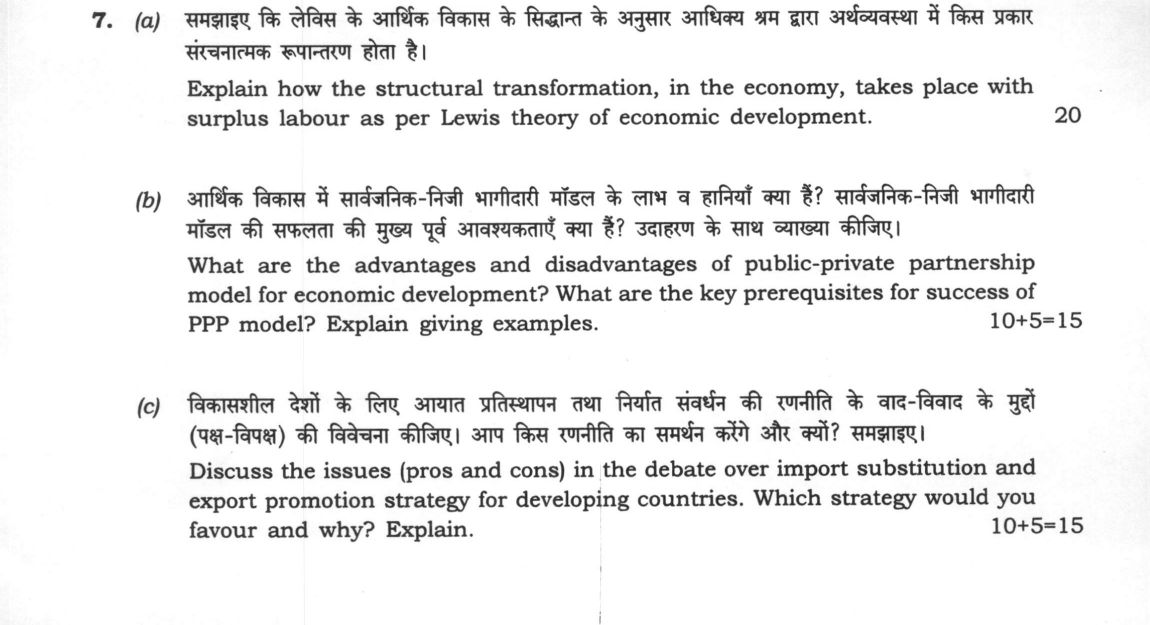
(a) Explain how the structural transformation, in the economy, takes place with surplus labour as per Lewis theory of economic…
Explain how the structural transformation, in the economy, takes place with surplus labour as per Lewis theory of economic development. 20 marks
What are the advantages and disadvantages of public-private partnership model for economic development? What are the key prerequisites for success of PPP model? Explain giving examples. (10+5=15 marks)
Discuss the issues (pros and cons) in the debate over import substitution and export promotion strategy for developing countries. Which strategy would you favour and why? Explain. (10+5=15 marks)
हिंदी में प्रश्न पढ़ें
समझाइए कि लेविस के आर्थिक विकास के सिद्धांत के अनुसार आधिक्य श्रम द्वारा अर्थव्यवस्था में किस प्रकार संरचनात्मक रूपांतरण होता है। (20 अंक)
आर्थिक विकास में सार्वजनिक-निजी भागीदारी मॉडल के लाभ व हानियाँ क्या हैं? सार्वजनिक-निजी भागीदारी मॉडल की सफलता की मुख्य पूर्व आवश्यकताएँ क्या हैं? उदाहरण के साथ व्याख्या कीजिए। (10+5=15 अंक)
विकासशील देशों के लिए आयात प्रतिस्थापन तथा निर्यात संवर्धन की रणनीति के बाद-विवाद के मुद्दों (पक्ष-विपक्ष) की विवेचना कीजिए। आप किस रणनीति का समर्थन करेंगे और क्यों? समझाइए। (10+5=15 अंक)
Model answer
Written by UPSC Answer Check against this question's marking rubric, to the expected length. UPSC does not publish answers for Mains — this is one way to score well, not an official key.
Economic development fundamentally entails structural transformation, shifting resources from low-productivity traditional activities to high-productivity modern sectors.
Lewis Model of Structural Transformation
W. Arthur Lewis conceptualises a dual economy comprising a traditional subsistence sector characterized by disguised unemployment with near-zero marginal productivity of labour, and an expanding modern capitalist sector. Structural transformation begins because modern industry can draw an unlimited supply of rural labour at a constant institutional wage, pegged slightly above the rural subsistence wage to cover migration costs.
As the capitalist sector employs this cheap labour alongside capital, it generates an economic surplus, defined as total product minus wages paid. The causal engine of growth is the reinvestment of this surplus into productive capital. Reinvestment expands capital stock, raising the marginal product of labour and shifting the industrial labour demand curve outward. This absorbs further surplus agricultural labour, driving rapid output growth and widening productivity divergence between sectors. This dynamic persists until rural surplus labour is exhausted at the "Lewis turning point." Beyond this junction, the labour supply curve becomes upward sloping, agricultural wages rise to match marginal productivity, agriculture commercializes, and the economy integrates into a unified modern market.
Public-Private Partnerships: Dynamics and Prerequisites
Public-Private Partnerships (PPPs) advance economic development by bridging public infrastructure deficits without overburdening sovereign fiscal balances, shifting design and operational risks to the private partner, and enhancing project efficiency through superior managerial expertise. Conversely, PPPs risk regulatory capture, involve protracted renegotiation costs, generate fiscal contingent liabilities, and impose high user-fee burdens that threaten equitable access.
As highlighted by the Vijay Kelkar Committee, key prerequisites for PPP success include transparent and competitive bidding, balanced risk-allocation frameworks, independent sector regulators, robust dispute-resolution mechanisms, and viable revenue models supported by Viability Gap Funding. For example, the Delhi International Airport (GMR-DIAL) project demonstrated significant operational efficiency and capital mobilisation, whereas contractual rigidities in the Mumbai Metro Line 1 and fuel-supply misallocations in thermal projects like GMR Kakinada exposed the perils of flawed risk sharing and inadequate regulatory mechanisms.
Import Substitution versus Export Promotion
Import Substitution Industrialisation (ISI) protects domestic infant industries, saves scarce foreign exchange, and nurtures domestic inter-sectoral backward and forward linkages. However, protracted ISI engenders rent-seeking, technological obsolescence, uncompetitive cost structures, and chronic balance of payments distress, as observed during India’s pre-1991 inward-looking planning era. Conversely, Export Promotion (EP) forces domestic producers to achieve scale economies, adhere to global price-quality discipline, and integrate modern foreign technologies, though it leaves domestic output susceptible to external demand shocks and international protectionism.
A policy favoring sequential pragmatism is superior to an absolute choice. Developing countries achieve optimal transformation by employing initial, time-bound domestic capacity building that rapidly transitions into aggressive outward orientation, as demonstrated by the East Asian economies. India's post-1991 growth acceleration confirms this trajectory. A forward-looking approach must synthesize strategic domestic capability building in key sunrise sectors through targeted incentives like the Production Linked Incentive (PLI) scheme with deep integration into Global Value Chains (GVCs).
What "Explain" is asking you to do
Make the working of something clear — what sets it off, what follows from what, and what it produces. Explain is the Commission's mechanism word: it dominates the technical papers and the “explain why” stems, where the marks sit in the causal chain and not in the label.
Structure that answers it
State what it is → the initiating condition → the chain of cause, step by step → an instance where it plays out → what the chain produces
Where marks are lost
Describing what something looks like instead of why it works that way. Naming the stages without linking them reads as description too.
How this answer will be evaluated
Approach
Framework: Lewis Two-Sector Model. (a) explain: definition/context > points in order > small example > short close | (b) critically evaluate: positives > negatives/limits > conditions/safeguards > conclusion | (c) discuss: intro > 3-4 dimensions > example > balanced close Full marks: Precise mechanism with named economists and specific examples
Key points expected
- Define surplus labor in subsistence sector
- Explain zero marginal product assumption
- Describe labor transfer to modern sector
- Explain capital accumulation and wage gap
- List advantages of PPP model
- List disadvantages of PPP model
- Identify key prerequisites for success
- Provide specific examples
Evaluation rubric
Each sub-part is marked on its own, against the marks and word limit printed on the paper.
- (a) Mechanism of structural transformation via surplus labor transfer. 20 marks
explain— definition/context → points in order → small example → short close
Must cover
- Define surplus labor in subsistence sector
- Explain zero marginal product assumption
- Describe labor transfer to modern sector
- Explain capital accumulation and wage gap
Loses marks
- Confusing surplus labor with unemployment
- Ignoring capital accumulation role
- Verbal description without mechanism
Earns more
- Mention Lewis turning point
- Reference dual economy structure
- Discuss productivity differences
- Mention Rostow's stages
Extra mark
- Draw Lewis model diagram
- Cite specific Lewis 1954 paper
- (b) Pros/cons of PPP model and success prerequisites. 15 marks
critically evaluate— positives → negatives/limits → conditions/safeguards → conclusion
Must cover
- List advantages of PPP model
- List disadvantages of PPP model
- Identify key prerequisites for success
- Provide specific examples
Loses marks
- Generic advantages without context
- Ignoring risk allocation issues
- No specific examples provided
Earns more
- Mention risk sharing mechanism
- Discuss infrastructure financing
- Reference Indian PPP projects
- Mention contract management
Extra mark
- Cite specific Indian PPP project
- Reference World Bank PPP guidelines
- (c) Import substitution vs export promotion debate and preference. 15 marks
discuss— intro → 3-4 dimensions → example → balanced close
Must cover
- Explain import substitution strategy
- Explain export promotion strategy
- Discuss pros and cons of each
- State preference with justification
Loses marks
- One-sided argument without balance
- No clear preference stated
- Ignoring historical context
Earns more
- Mention infant industry argument
- Discuss comparative advantage
- Reference specific country examples
- Mention trade liberalization
Extra mark
- Cite specific country success/failure
- Reference WTO agreements
Practice this exact question
Write your answer and it is marked point by point against the model answer above — what you covered, what you missed, what you got wrong.
Evaluate my answer →More from Economics 2024 Paper I
- Q4 (a) Describe the mechanism of credit creation by commercial banks and its implications on…
- Q5 Answer the following questions in about 150 words each: (a) Critically examine 'per capit…
- Q6 (a) Discuss the elasticity approach and absorption approach for adjustments in balance of…
- Q7 (a) Explain how the structural transformation, in the economy, takes place with surplus l…
- Q8 (a) Describe the major components used in Human Development Index (HDI) by the United Nat…