Paper I — Q4
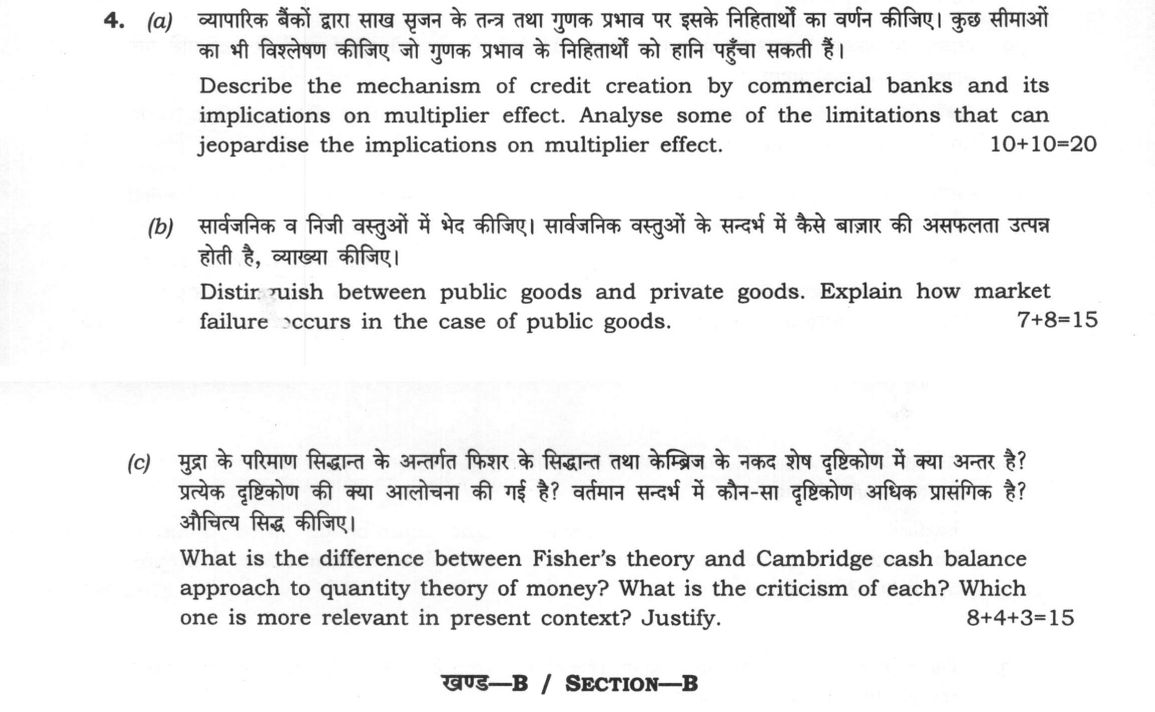
(a) Describe the mechanism of credit creation by commercial banks and its implications on multiplier effect. Analyse some of the…
Describe the mechanism of credit creation by commercial banks and its implications on multiplier effect. Analyse some of the limitations that can jeopardise the implications on multiplier effect. (10+10=20 marks)
Distinguish between public goods and private goods. Explain how market failure occurs in the case of public goods. (7+8=15 marks)
What is the difference between Fisher's theory and Cambridge cash balance approach to quantity theory of money? What is the criticism of each? Which one is more relevant in present context? Justify. (8+4+3=15 marks)
हिंदी में प्रश्न पढ़ें
व्यापारिक बैंकों द्वारा साख सृजन के तंत्र तथा गुणक प्रभाव पर इसके निहितार्थों का वर्णन कीजिए। कुछ सीमाओं का भी विस्लेषण कीजिए जो गुणक प्रभाव के निहितार्थों को हानि पहुंचा सकती हैं। (10+10=20 अंक)
सार्वजनिक व निजी वस्तुओं में भेद कीजिए। सार्वजनिक वस्तुओं के संदर्भ में कैसे बाजार की असफलता उत्पन्न होती है, व्याख्या कीजिए। (7+8=15 अंक)
मुद्रा के परिमाण सिद्धान्त के अन्तर्गत फिशर के सिद्धान्त तथा कैम्ब्रिज के नकद शेष दृष्टिकोण में क्या अन्तर है? प्रत्येक दृष्टिकोण की क्या आलोचना की गई है? वर्तमान सन्दर्भ में कौन-सा दृष्टिकोण अधिक प्रासंगिक है? औचित्य सिद्ध कीजिए। (8+4+3=15 अंक)
Model answer
Written by UPSC Answer Check against this question's marking rubric, to the expected length. UPSC does not publish answers for Mains — this is one way to score well, not an official key.
Credit Creation and the Multiplier Effect
Commercial banks create secondary deposits through fractional reserve banking. When a primary cash deposit enters the banking system, the bank retains a legally mandated proportion as reserves (Cash Reserve Ratio or CRR) and lends out the residual excess reserves. As borrowers spend these funds, the money is redeposited into the banking system, generating derivative deposits that permit subsequent rounds of lending. The theoretical credit multiplier is given by m = 1/CRR, meaning broad money (M₃) expands to a multiple of high-powered reserve money (M₀).
However, the real-world multiplier is constrained by several systemic leakages. First, the currency drain—the ratio of currency held by the public to bank deposits—removes liquidity from the intermediation chain, a significant factor in cash-intensive informal economies. Second, banks frequently hold excess reserves above regulatory requirements during economic downturns due to heightened risk aversion. Third, a shortage of creditworthy borrowers, often exacerbated by corporate balance sheet distress or high Non-Performing Assets (NPAs), impairs credit off-take despite surplus liquidity. Finally, central bank regulatory interventions, such as adjusting the CRR, Statutory Liquidity Ratio (SLR), or mopping up liquidity through the Standing Deposit Facility (SDF), directly alter the reserve base and restrict the multiplier's expansion.
Public Goods, Private Goods, and Market Failure
Economic goods are classified along two dimensions: rivalry (whether one person's consumption diminishes availability for others) and excludability (whether non-payers can be prevented from consuming the good). Private goods are both rivalrous and excludable (e.g., manufactured consumer goods), allowing competitive markets to allocate them efficiently where price equals marginal cost (P = MC). Public goods are non-rivalrous and non-excludable (e.g., national defence, public sanitation). Impure public goods display partial characteristics, categorized into common-pool resources (rivalrous but non-excludable) and club goods (non-rivalrous but excludable).
Market failure occurs in public goods due to the free-rider problem. Because exclusion is impossible, rational consumers have an incentive to conceal their true willingness to pay, hoping others will bear the cost. This non-revelation of preferences eliminates the price signal necessary for private producers to recover costs. Since private marginal revenue falls to zero despite high social marginal benefit, private markets underprovide or entirely fail to supply pure public goods. Consequently, collective provision financed through progressive taxation becomes necessary, as demonstrated by state-funded physical infrastructure and India's Digital Public Infrastructure (DPI).
Fisher's vs. Cambridge Approach to Quantity Theory of Money
Irving Fisher’s equation of exchange (MV = PT) represents a transactions-based flow approach. It treats money exclusively as a medium of exchange, assuming that transaction velocity (V) and transaction volume (T) are exogenous and fixed by institutional factors in the long run. In contrast, the Cambridge cash-balance approach (M = kPY) formulated by Marshall and Pigou is a stock approach. It emphasizes money’s role as a store of value, where k represents the subjective proportion of nominal income (PY) that economic agents choose to hold in liquid cash.
Both theories face significant criticisms. Fisher’s framework is mechanistic, failing to account for interest rate variations, portfolio choice, and short-run output adjustments. The Cambridge formulation, while introducing behavioral micro-foundations, remains static by treating k as relatively stable, thereby overlooking the volatile speculative demand for money during financial crises.
In the contemporary context, the Cambridge approach is distinctly more relevant. By modeling the demand for money as a behavioral choice determined by income, wealth, and opportunity costs, it provided the conceptual bridge to Keynesian liquidity preference theory. Modern central banking, including the Reserve Bank of India’s Flexible Inflation Targeting (FIT) regime, does not target mechanical monetary aggregates; rather, it calibrates the policy repo rate to influence subjective liquidity demand, asset prices, and aggregate expenditure.
Synthesis
Effective macroeconomic management requires synchronizing these mechanisms. Bank credit creation depends on addressing balance sheet distress alongside proactive liquidity adjustments via the Liquidity Adjustment Facility (LAF). Simultaneously, addressing market failures requires fiscal provisioning of public infrastructure, while monetary policy relies on Cambridge-style behavioral interest-rate transmission to achieve price stability and sustainable growth.
What "Analyse" is asking you to do
Break the subject into its working parts and show how they act on each other. The marks are in the interconnections — which factor drives which, and what the resulting structure explains — not in the inventory of factors.
Structure that answers it
Define the whole → separate it into its parts → show which part drives which → what that interaction produces → what the structure implies
Where marks are lost
A flat list of causes with no account of which drives which. An answer of neatly separated headings, each self-contained, scores as description.
How this answer will be evaluated
Approach
Framework: Monetary Economics: Credit Creation, Public Goods, Quantity Theory of Money. (a) describe: define > structure or process in order > labelled diagram > significance | (b) compare: paired headings or table > key differences > significance > conclusion | (c) compare: paired headings or table > key differences > significance > conclusion Full marks: Precise definitions, clear diagrams/tables, specific examples, and well-reasoned analysis of limitations/criticisms.
Key points expected
- Define credit creation and money multiplier formula (1/rr)
- Step-by-step process of deposit creation (T-account or table)
- Link between credit creation and aggregate demand/multiplier
- List at least 3 limitations (e.g., cash leakage, excess reserves)
- Define public goods (non-excludable, non-rival)
- Define private goods (excludable, rival)
- Explain the free-rider problem
- Explain why private markets under-provide public goods
Evaluation rubric
Each sub-part is marked on its own, against the marks and word limit printed on the paper.
- (a) Mechanism of credit creation, multiplier effect, and its limitations. 20 marks
describe— define → structure or process in order → labelled diagram → significance
Must cover
- Define credit creation and money multiplier formula (1/rr)
- Step-by-step process of deposit creation (T-account or table)
- Link between credit creation and aggregate demand/multiplier
- List at least 3 limitations (e.g., cash leakage, excess reserves)
Loses marks
- Confusing credit creation with money supply
- Failing to link credit creation to the multiplier effect
- Listing limitations without explaining how they reduce the multiplier
Earns more
- Diagram showing the deposit creation process
- Distinction between primary and secondary deposits
- Mention of RBI's role in setting reserve ratios
Extra mark
- Reference to current CRR/SLR rates in India
- Mention of fractional reserve banking concept
- (b) Differences between public and private goods, and market failure for public goods. 15 marks
compare— paired headings or table → key differences → significance → conclusion
Must cover
- Define public goods (non-excludable, non-rival)
- Define private goods (excludable, rival)
- Explain the free-rider problem
- Explain why private markets under-provide public goods
Loses marks
- Confusing public goods with merit goods
- Failing to explain the mechanism of market failure
- Vague definitions of excludability and rivalry
Earns more
- Table comparing public and private goods
- Examples of public goods (e.g., national defense, street lights)
- Mention of government intervention (taxation, provision)
Extra mark
- Distinction between pure public goods and quasi-public goods
- Reference to specific Indian public good (e.g., highways, defense)
- (c) Differences between Fisher and Cambridge approaches, criticisms, and relevance. 15 marks
compare— paired headings or table → key differences → significance → conclusion
Must cover
- State Fisher's equation (MV=PT) and its focus on velocity
- State Cambridge equation (M=kPY) and its focus on demand for money
- List at least 2 differences (e.g., stock vs flow, velocity vs k)
- Critique of Fisher (velocity constant assumption) and Cambridge (k constant assumption)
Loses marks
- Confusing the two equations or their variables
- Failing to provide specific criticisms of each theory
- Vague justification of relevance without linking to modern context
Earns more
- Explanation of why velocity is unstable in modern economies
- Mention of Keynes's critique of both theories
- Justification of Cambridge approach's relevance (focus on money demand)
Extra mark
- Reference to modern monetary theory or liquidity preference
- Mention of specific economists (e.g., Marshall, Pigou for Cambridge)
Practice this exact question
Write your answer and it is marked point by point against the model answer above — what you covered, what you missed, what you got wrong.
Evaluate my answer →More from Economics 2024 Paper I
- Q1 Answer the following questions in about 150 words each: (a) Differentiate between perceiv…
- Q2 (a) Derive Pareto optimality conditions in production in a two commodities-two factors-tw…
- Q3 (a) Explain the concept of underemployment equilibrium with graphical illustration. Why f…
- Q4 (a) Describe the mechanism of credit creation by commercial banks and its implications on…
- Q5 Answer the following questions in about 150 words each: (a) Critically examine 'per capit…
- Q6 (a) Discuss the elasticity approach and absorption approach for adjustments in balance of…
- Q7 (a) Explain how the structural transformation, in the economy, takes place with surplus l…