Paper I — Q8
(a) A 6·6 kV, three-phase, star-connected, cylindrical-rotor alternator develops rated voltage on open circuit with a field…
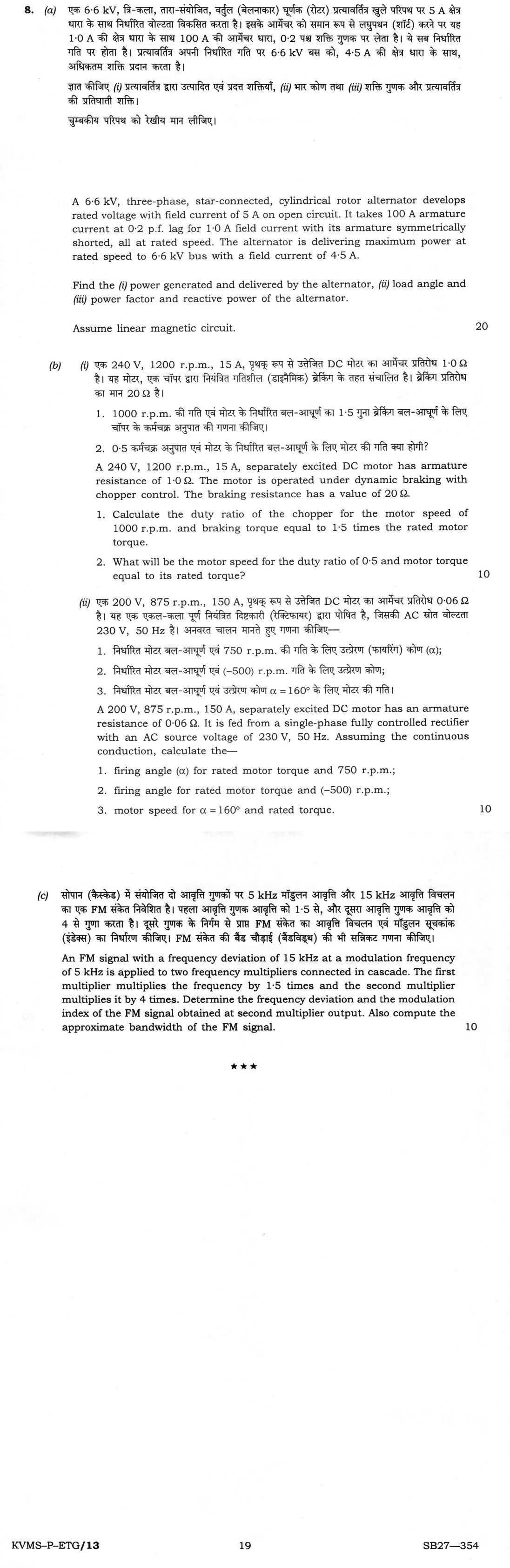
A 6·6 kV, three-phase, star-connected, cylindrical-rotor alternator develops rated voltage on open circuit with a field current of 5 A. With its armature short-circuited through equal impedances, it takes an armature current of 100 A at 0·2 power factor lagging, with a field current of 1·0 A. All this occurs at rated speed. At its rated speed, the alternator delivers maximum power to a 6·6 kV bus with a field current of 4·5 A.
Find (i) the powers generated and delivered by the alternator, (ii) the load angle, and (iii) the power factor and the reactive power of the alternator.
Assume the magnetic circuit to be linear. 20 marks
A 240 V, 1200 r.p.m., 15 A, separately excited DC motor has armature resistance of 1·0 Ω. The motor is operated under dynamic braking with chopper control. The braking resistance has a value of 20 Ω.
1. Calculate the duty ratio of the chopper for the motor speed of 1000 r.p.m. and braking torque equal to 1·5 times the rated motor torque.
2. What will be the motor speed for the duty ratio of 0·5 and motor torque equal to its rated torque? 10 marks
A 200 V, 875 r.p.m., 150 A, separately excited DC motor has an armature resistance of 0·06 Ω. It is fed from a single-phase fully controlled rectifier with an AC source voltage of 230 V, 50 Hz. Assuming the continuous conduction, calculate the—
1. firing angle (α) for rated motor torque and 750 r.p.m.;
2. firing angle for rated motor torque and (–500) r.p.m.;
3. motor speed for α = 160° and rated torque. 10 marks
An FM signal with a frequency deviation of 15 kHz at a modulation frequency of 5 kHz is applied to two frequency multipliers connected in cascade. The first multiplier multiplies the frequency by 1.5 times and the second multiplier multiplies it by 4 times. Determine the frequency deviation and the modulation index of the FM signal obtained at second multiplier output. Also compute the approximate bandwidth of the FM signal. 10 marks
हिंदी में प्रश्न पढ़ें
एक 6·6 kV, त्रि-कला, तारा-संयोजित, बहुल (बेलनाकार) घूर्णक (रोटर) प्रत्यावर्तित्र खुले परिपथ पर 5 A क्षेत्र धारा के साथ निर्धारित वोल्टता विकसित करता है। इसके आर्मेचर को समान रूप से लघुपथन (शार्ट) करने पर यह 1·0 A की क्षेत्र धारा के साथ 100 A की आर्मेचर धारा, 0·2 पश्च शक्ति गुणक पर लेता है। ये सब निर्धारित गति पर होता है। प्रत्यावर्तित्र अपनी निर्धारित गति पर 6·6 kV बस को, 4·5 A की क्षेत्र धारा के साथ, अधिकतम शक्ति प्रदान करता है।
ज्ञात कीजिए (i) प्रत्यावर्तित्र द्वारा उत्पादित एवं प्रदत्त शक्तियाँ, (ii) भार कोण तथा (iii) शक्ति गुणक और प्रत्यावर्तित्र की प्रतिघाती शक्ति।
चुम्बकीय परिपथ को रेखीय मान लीजिए। (20 अंक)
एक 240 V, 1200 r.p.m., 15 A, पृथक् रूप से उत्तेजित DC मोटर का आर्मेचर प्रतिरोध 1·0 Ω है। यह मोटर, एक चॉपर द्वारा नियंत्रित गतिशील (डाइनैमिक) ब्रेकिंग के तहत संचालित है। ब्रेकिंग प्रतिरोध का मान 20 Ω है।
1. 1000 r.p.m. की गति एवं मोटर के निर्धारित बल-आघूर्ण का 1·5 गुना ब्रेकिंग बल-आघूर्ण के लिए चॉपर के कर्मचक्र अनुपात की गणना कीजिए।
2. 0·5 कर्मचक्र अनुपात एवं मोटर के निर्धारित बल-आघूर्ण के लिए मोटर की गति क्या होगी? (10 अंक)
एक 200 V, 875 r.p.m., 150 A, पृथक् रूप से उत्तेजित DC मोटर का आर्मेचर प्रतिरोध 0·06 Ω है। यह एक एकल-कला पूर्ण नियंत्रित दिष्टकारी (रेक्टिफायर) द्वारा पोषित है, जिसकी AC स्रोत वोल्टता 230 V, 50 Hz है। अनवरत चालन मानते हुए गणना कीजिए—
1. निर्धारित मोटर बल-आघूर्ण एवं 750 r.p.m. की गति के लिए उत्तेजन (फायरिंग) कोण (α);
2. निर्धारित मोटर बल-आघूर्ण एवं (–500) r.p.m. गति के लिए उत्तेजन कोण;
3. निर्धारित मोटर बल-आघूर्ण एवं उत्तेजन कोण α = 160° के लिए मोटर की गति। (10 अंक)
सोपान (कैस्केड) में संयोजित दो आवृत्ति गुणकों पर 5 kHz मॉडुलन आवृत्ति और 15 kHz आवृत्ति विचलन का एक FM संकेत निवेशित है। पहला आवृत्ति गुणक आवृत्ति को 1.5 से, और दूसरा आवृत्ति गुणक आवृत्ति को 4 से गुणा करता है। दूसरे गुणक के निर्गम से प्राप्त FM संकेत का आवृत्ति विचलन एवं मॉडुलन सूचकांक (इंडेक्स) का निर्धारण कीजिए। FM संकेत की बैंड चौड़ाई (बैंडविड्थ) की भी सन्निकट गणना कीजिए। (10 अंक)
Model answer
Drafted with AI by UPSC Answer Check against this question's marking rubric, to the expected length. UPSC does not publish answers for Mains — this is one way to score well, not an official key. How we build rubrics and answers.
(a) Alternator delivering maximum power to the bus (20 marks)
Synchronous impedance. The phase voltage is V = 6600/√3 = 3810.5 V. The open-circuit test gives E = 3810.5 V at I_f = 5 A. With a linear magnetic circuit the emf is proportional to field current, so at 1.0 A the emf is 762.1 V. In the short-circuit test this emf drives 100 A through Z_s (the terminal voltage is zero), so
Z_s = 762.1/100 = 7.62 Ω, at an angle θ = cos⁻¹ 0.2 = 78.46° (the SC power factor is 0.2 lag).
Hence R_a = Z_s cos θ = 7.62 × 0.2 = 1.524 Ω and X_s = Z_s sin θ = 7.467 Ω. The generated emf at I_f = 4.5 A is E = 4.5 × 762.1 = 3429.5 V per phase.
Condition for maximum power. The alternator has emf E∠δ, the bus is V∠0 and the impedance is Z_s∠θ. The power delivered to the bus per phase is
P = (VE/Z_s) cos(θ − δ) − (V²/Z_s) cos θ,
which is maximum when δ = θ. So the load angle is δ = 78.5°.
(i) Power delivered and power generated. At δ = θ,
P_del/phase = (V/Z_s)(E − V cos θ) = 500 × (3429.5 − 762.1) = 1.334 MW, so the three-phase power delivered is P = 4.00 MW.
The armature current follows from the phasor difference: E∠δ = 3429.5∠78.46° = 685.9 + j3360.2 V, so E − V = −3124.6 + j3360.2 = 4588.5∠132.9° V, and
I = (E − V)/Z_s = 4588.5/7.62 = 602.1 A, at an angle 132.9° − 78.46° = 54.5° relative to V, so the current leads the bus voltage by 54.5°.
The armature copper loss is 3I²R_a = 3 × 602.1² × 1.524 = 1.66 MW, so the power generated (developed by the emf) is
P_gen = 4.00 + 1.66 = 5.66 MW.
(Check: 3 E I cos(78.46° − 54.46°) = 3 × 3429.5 × 602.1 × cos 24.0° = 5.66 MW.)
(ii) Load angle. δ = 78.5°, equal to the impedance angle θ.
(iii) Power factor and reactive power. The power factor is cos 54.5° = 0.581 leading. The apparent power is S = 3VI = 3 × 3810.5 × 602.1 = 6.88 MVA, so the reactive power is Q = S sin 54.5° = 5.60 MVAr. Since the current leads, the alternator is under-excited (E = 3429.5 V < V = 3810.5 V) and absorbs 5.60 MVAr from the bus while delivering 4.00 MW.
(b)(i) Chopper-controlled dynamic braking of a separately excited DC motor (10 marks)
Constants. At rated load, E = V − I_aR_a = 240 − 15 × 1.0 = 225 V at 1200 rpm, so Kφ = 225/1200 = 0.1875 V per rpm. In dynamic braking the motor acts as a generator feeding the braking resistor R_B = 20 Ω with the chopper connected across it. When the chopper is on it shorts R_B, so with duty ratio δ the effective braking resistance is (1 − δ)R_B, and
E = I_a [R_a + (1 − δ) R_B].
1. Speed 1000 rpm and braking torque 1.5 times rated. The torque is proportional to armature current (constant flux), so I_a = 1.5 × 15 = 22.5 A. E = 0.1875 × 1000 = 187.5 V. Then
187.5/22.5 = 8.333 Ω = 1 + 20(1 − δ), so 1 − δ = 0.3667 and δ = 0.633.
2. Duty ratio 0.5 and rated torque. I_a = 15 A, and R_total = 1 + 0.5 × 20 = 11 Ω, so E = 15 × 11 = 165 V and
N = 165/0.1875 = 880 rpm.
(b)(ii) DC motor fed from a single-phase fully controlled rectifier (10 marks)
Constants. At rated load E = 200 − 150 × 0.06 = 191 V at 875 rpm, so Kφ = 191/875 = 0.2183 V per rpm. The supply peak is V_m = 230√2 = 325.3 V. In continuous conduction the average output voltage of the fully controlled single-phase bridge is
V_dc = (2V_m/π) cos α = 207.07 cos α.
The armature equation is V_dc = E + I_aR_a, and rated torque means I_a = 150 A, with I_aR_a = 9 V.
1. Rated torque, 750 rpm. E = 0.2183 × 750 = 163.7 V, so V_dc = 163.7 + 9 = 172.7 V and cos α = 172.7/207.07 = 0.834, giving α = 33.5°.
2. Rated torque, −500 rpm. E = −0.2183 × 500 = −109.1 V, so V_dc = −109.1 + 9 = −100.1 V and cos α = −0.4836, giving α = 118.9°. V_dc is negative while I_a is positive, so the converter works in the inverting mode (regenerative braking of the reversed motor).
3. α = 160°, rated torque. V_dc = 207.07 cos 160° = −194.6 V, so E = V_dc − I_aR_a = −194.6 − 9 = −203.6 V and
N = −203.6/0.2183 = −933 rpm (i.e. 933 rpm in the reverse direction).
(c) Frequency deviation, modulation index and bandwidth after multipliers (10 marks)
A frequency multiplier multiplies the carrier frequency, and hence the frequency deviation, by its factor, but leaves the modulating frequency unchanged. The overall factor is 1.5 × 4 = 6.
- Frequency deviation at the output: Δf = 6 × 15 kHz = 90 kHz.
- Modulating frequency: f_m = 5 kHz, unchanged.
- Modulation index: β = Δf/f_m = 90/5 = 18 (the original index of 3 multiplied by 6).
- Carson's rule bandwidth: BW ≈ 2(Δf + f_m) = 2(90 + 5) = 190 kHz.
How this answer will be evaluated
Evaluation rubric
Each sub-part is marked on its own, against the marks and word limit printed on the paper.
- (a) For a 6.6 kV star alternator (OC: 5 A for rated voltage; SC: 100 A at 0.2 pf lag for 1.0 A) delivering maximum power to a 6.6 kV bus with I_f = 4.5 A, find (i) the power generated and delivered, (ii) the load angle and (iii) the power factor and reactive power. 20 marks
Must cover
- V = 3810.5 V/phase; E ∝ I_f so E = 3429.5 V at 4.5 A
- Z_s = 7.62 Ω at 78.46°, R_a = 1.524 Ω, X_s = 7.47 Ω
- Maximum power delivered when δ = θ = 78.5°; P_del = 4.00 MW
- P_gen = 5.66 MW (I = 602 A, copper loss 1.66 MW); pf 0.581 leading; Q ≈ 5.6 MVAr absorbed
Loses marks
- Neglecting R_a and taking δ = 90°.
- Confusing power generated with power delivered.
- Taking the power factor as lagging or 0.2.
Earns more
- Power-transfer expression P = (VE/Z_s)cos(θ − δ) − (V²/Z_s)cos θ.
- Stating that the alternator is under-excited and absorbs reactive power.
Extra mark
- Cross-check of P_gen by 3EI cos(angle between E and I)
- (b)(i) For a 240 V, 1200 rpm, 15 A separately excited DC motor (R_a = 1 Ω) in chopper-controlled dynamic braking with R_B = 20 Ω, find (1) the duty ratio for 1000 rpm at 1.5 times rated braking torque and (2) the speed for duty ratio 0.5 at rated torque. 10 marks
Must cover
- Kφ = 225/1200 = 0.1875 V/rpm
- Effective braking resistance (1 − δ)R_B and E = I_a[R_a + (1 − δ)R_B]
- 1.5 × rated torque gives I_a = 22.5 A; δ = 0.633
- δ = 0.5 at rated torque gives E = 165 V, N = 880 rpm
Loses marks
- Using R_B alone (no chopper factor).
- Taking δ as the off-time fraction without saying so.
- Using E = V − I_aR_a with V = 240 V in braking.
Earns more
- Statement of the chopper connection (across R_B) and the meaning of δ.
Extra mark
- Torque check T ∝ I_a at constant flux
- (b)(ii) For a 200 V, 875 rpm, 150 A separately excited DC motor (R_a = 0.06 Ω) fed from a single-phase fully controlled rectifier (230 V, 50 Hz, continuous conduction), find α for rated torque at 750 rpm, α for rated torque at −500 rpm, and the speed at α = 160° with rated torque. 10 marks
Must cover
- V_dc = (2V_m/π) cos α = 207.07 cos α; Kφ = 0.2183 V/rpm
- 750 rpm: V_dc = 172.7 V, α = 33.5°
- −500 rpm: V_dc = −100.1 V, α = 118.9° (inverting mode)
- α = 160°: V_dc = −194.6 V, N ≈ −933 rpm
Loses marks
- Using the RMS voltage 230 V in place of 2V_m/π.
- Omitting the I_aR_a drop.
- Positive speed for α = 160°.
Earns more
- Use of V_dc = E + I_aR_a with I_a = 150 A in each case.
- Comment on the operating quadrant or converter mode.
Extra mark
- Discussion that the negative speed means reversed rotation with regenerative operation
- (c) An FM signal with 15 kHz deviation at 5 kHz modulating frequency passes through frequency multipliers of 1.5 and 4 in cascade; find the output deviation, modulation index and approximate bandwidth. 10 marks
Must cover
- Overall multiplication factor 6
- Deviation 6 × 15 = 90 kHz; f_m stays 5 kHz
- Modulation index β = 90/5 = 18
- Carson's rule BW = 2(Δf + f_m) = 190 kHz
Loses marks
- Multiplying f_m by 6 as well.
- Using BW = 2f_m.
- Adding the factors 1.5 + 4.
Earns more
- Statement that multipliers scale deviation and carrier but not the modulating frequency.
Extra mark
- Original modulation index 3 multiplied by 6
What "Solve" is asking you to do
Choose the method, then carry it through to a final answer. Identifying what kind of problem this is and why that method applies is the first thing marked; a correct figure arrived at invisibly earns almost nothing.
Structure that answers it
Given data and what is required → method chosen, with the reason it applies → set-up (equation, circuit, free body, trial balance) → working, step by step → answer with units and any condition of validity
Where marks are lost
Doing the middle steps mentally and writing only the result. In mathematics papers, a further loss comes from giving a decimal where the exact value in surds or fractions was wanted, or from skipping the justification a part explicitly asks for.
Practice this exact question
Write your answer and it is marked point by point against the model answer above — what you covered, what you missed, what you got wrong.
Evaluate my answer →More from Electrical Engineering 2026 Paper I
- Q5 (a) For the circuit given in the figure below, the input voltage signal is given by V_in…
- Q6 (a) Design a MOD-6 synchronous DOWN counter using J-K flip-flops. (20 marks) (b) A three-…
- Q7 (a) Design a Programmable Logic Array (PLA) for a combinational logic circuit that comput…
- Q8 (a) A 6·6 kV, three-phase, star-connected, cylindrical-rotor alternator develops rated vo…