Paper I — Q5
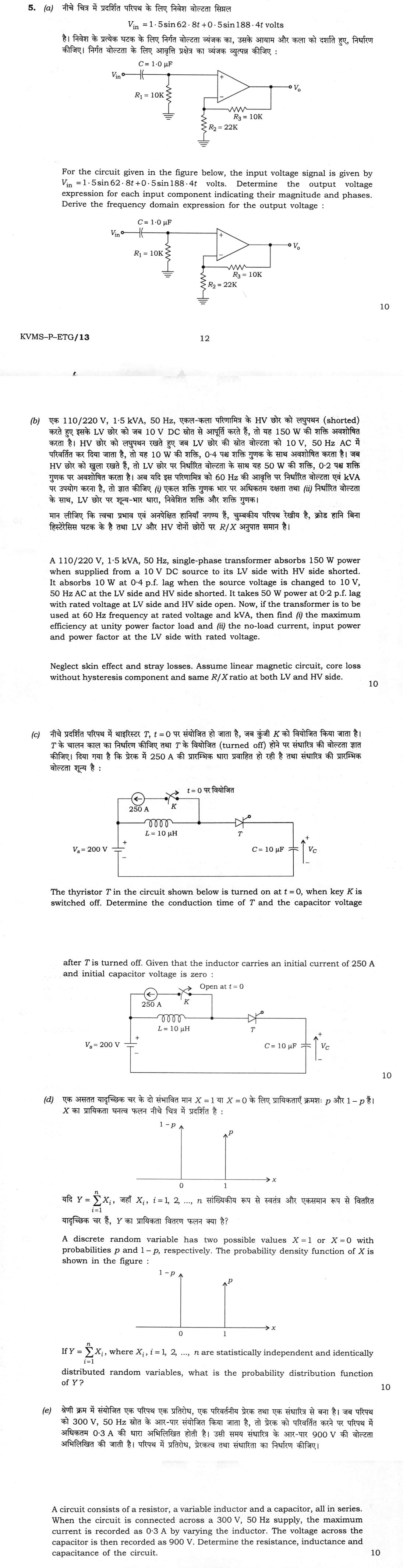
(a) For the circuit given in the figure below, the input voltage signal is given by V_in = 1·5 sin 62·8t + 0·5 sin 188·4t…
For the circuit given in the figure below, the input voltage signal is given by V_in = 1·5 sin 62·8t + 0·5 sin 188·4t volts. Determine the output voltage expression for each input component indicating their magnitude and phases. Derive the frequency domain expression for the output voltage : 10 marks
A 110/220 V, 1·5 kVA, 50 Hz, single-phase transformer absorbs 150 W power when supplied from a 10 V DC source to its LV side with HV side shorted. It absorbs 10 W at 0·4 p.f. lag when the source voltage is changed to 10 V, 50 Hz AC at the LV side and HV side shorted. It takes 50 W power at 0·2 p.f. lag with rated voltage at LV side and HV side open. Now, if the transformer is to be used at 60 Hz frequency at rated voltage and kVA, then find (i) the maximum efficiency at unity power factor load and (ii) the no-load current, input power and power factor at the LV side with rated voltage.
Neglect skin effect and stray losses. Assume linear magnetic circuit, core loss without hysteresis component and same R/X ratio at both LV and HV side. 10 marks
The thyristor T in the circuit shown below is turned on at t = 0, when key K is switched off. Determine the conduction time of T and the capacitor voltage after T is turned off. Given that the inductor carries an initial current of 250 A and initial capacitor voltage is zero : 10 marks
A discrete random variable has two possible values X = 1 or X = 0 with probabilities p and 1 – p, respectively. The probability density function of X is shown in the figure :
[Figure : impulses versus x — height 1 – p at x = 0 and height p at x = 1]
If Y = ∑ᵢ₌₁ⁿ Xᵢ, where Xᵢ, i = 1, 2, ..., n are statistically independent and identically distributed random variables, what is the probability distribution function of Y ? 10 marks
A circuit consists of a resistor, a variable inductor and a capacitor, all in series. When the circuit is connected across a 300 V, 50 Hz supply, the maximum current is recorded as 0·3 A by varying the inductor. The voltage across the capacitor is then recorded as 900 V. Determine the resistance, inductance and capacitance of the circuit. 10 marks
हिंदी में प्रश्न पढ़ें
नीचे चित्र में प्रदर्शित परिपथ के लिए निवेश वोल्टता सिग्नल V_in = 1·5 sin 62·8t + 0·5 sin 188·4t volts है। निवेश के प्रत्येक घटक के लिए निर्गत वोल्टता व्यंजक का, उसके आयाम और कला को दर्शाते हुए, निर्धारण कीजिए। निर्गत वोल्टता के लिए आवृत्ति प्रक्षेत्र का व्यंजक व्युत्पन्न कीजिए : (10 अंक)
एक 110/220 V, 1·5 kVA, 50 Hz, एकल-कला परिणामित्र के HV छोर को लघुपथन (shorted) करते हुए इसके LV छोर को जब 10 V DC स्रोत से आपूर्ति करते हैं, तो यह 150 W की शक्ति अवशोषित करता है। HV छोर को लघुपथन रखते हुए जब LV छोर को स्रोत वोल्टता को 10 V, 50 Hz AC में परिवर्तित कर दिया जाता है, तो यह 10 W की शक्ति, 0·4 पश्च शक्ति गुणक के साथ अवशोषित करता है। जब HV छोर को खुला रखते हैं, तो LV छोर पर निर्धारित वोल्टता के साथ यह 50 W की शक्ति, 0·2 पश्च शक्ति गुणक पर अवशोषित करता है। अब यदि इस परिणामित्र को 60 Hz की आवृत्ति पर निर्धारित वोल्टता एवं kVA पर उपयोग करना है, तो ज्ञात कीजिए (i) एकल शक्ति गुणक भार पर अधिकतम दक्षता तथा (ii) निर्धारित वोल्टता के साथ, LV छोर पर शून्य-भार धारा, निवेशित शक्ति और शक्ति गुणक।
मान लीजिए कि त्वचा प्रभाव एवं अनपेक्षित हानियाँ नगण्य हैं, चुम्बकीय परिपथ रेखीय है, क्रोड हानि बिना हिस्टेरेसिस घटक के है तथा LV और HV दोनों छोरों पर R/X अनुपात समान है। (10 अंक)
नीचे प्रदर्शित परिपथ में थाइरिस्टर T, t = 0 पर संयोजित हो जाता है, जब कुंजी K को वियोजित किया जाता है। T के चालन काल का निर्धारण कीजिए तथा T के वियोजित (turned off) होने पर संधारित्र की वोल्टता ज्ञात कीजिए। दिया गया है कि प्रेरक में 250 A की प्रारम्भिक धारा प्रवाहित हो रही है तथा संधारित्र की प्रारम्भिक वोल्टता शून्य है :
(t = 0 पर वियोजित) (10 अंक)
एक असतत यादृच्छिक चर के दो संभावित मान X = 1 या X = 0 के लिए प्रायिकताएँ क्रमशः p और 1 – p हैं। X का प्रायिकता घनत्व फलन नीचे चित्र में प्रदर्शित है :
[चित्र : x के सापेक्ष आवेग रेखाएँ — x = 0 पर ऊंचाई 1 – p तथा x = 1 पर ऊंचाई p]
यदि Y = ∑ᵢ₌₁ⁿ Xᵢ, जहाँ Xᵢ, i = 1, 2, ..., n सांख्यिकीय रूप से स्वतंत्र और एकसमान रूप से वितरित यादृच्छिक चर हैं, Y का प्रायिकता वितरण फलन क्या है? (10 अंक)
एक परिपथ में एक प्रतिरोधक, एक परिवर्ती प्रेरक तथा एक संधारित्र, सभी श्रेणी में संयोजित हैं। जब परिपथ को 300 V, 50 Hz की आपूर्ति के आर-पार जोड़ा जाता है, तो प्रेरक को परिवर्तित करके अधिकतम धारा 0·3 A दर्ज की जाती है। तत्पश्चात संधारित्र के आर-पार वोल्टता 900 V दर्ज की जाती है। परिपथ का प्रतिरोध, प्रेरकत्व तथा धारिता ज्ञात कीजिए। (10 अंक)
Model answer
Drafted with AI by UPSC Answer Check against this question's marking rubric, to the expected length. UPSC does not publish answers for Mains — this is one way to score well, not an official key. How we build rubrics and answers.
(a) Op-amp high-pass non-inverting amplifier (10 marks)
The input reaches the non-inverting terminal through C and R₁ to ground, a high-pass network, and the op-amp is a non-inverting amplifier with feedback R₃ and R₂ to ground.
Frequency-domain expression. The voltage at the non-inverting input is
V₊ = V_in · R₁/(R₁ + 1/jωC) = V_in · jωR₁C/(1 + jωR₁C).
The gain of the amplifier is 1 + R₃/R₂ = 1 + 10/22 = 1.4545, so
Vₒ(jω) = 1.4545 · jωR₁C/(1 + jωR₁C) · V_in(jω), with R₁C = 10 kΩ × 1 μF = 0.01 s and corner ω_c = 1/R₁C = 100 rad/s.
The magnitude is 1.4545 ωR₁C/√(1 + (ωR₁C)²) and the phase is 90° − tan⁻¹(ωR₁C), a phase lead.
Component 1: 1.5 sin 62.8t. ωR₁C = 0.628, so the high-pass magnitude is 0.628/√(1 + 0.394) = 0.532 and the phase is 90° − 32.1° = +57.9°. The gain is 1.4545 × 0.532 = 0.774, so the output is 1.5 × 0.774 = 1.16 V:
v₁ = 1.16 sin(62.8t + 57.9°) V.
Component 2: 0.5 sin 188.4t. ωR₁C = 1.884, so the magnitude is 1.884/√(1 + 3.549) = 0.883 and the phase is 90° − 62.0° = +28.0°. The gain is 1.4545 × 0.883 = 1.285, so the output is 0.5 × 1.285 = 0.642 V:
v₂ = 0.642 sin(188.4t + 28.0°) V.
By superposition the output is vₒ(t) = 1.16 sin(62.8t + 57.9°) + 0.642 sin(188.4t + 28.0°) V. The lower-frequency component is attenuated more and given the larger phase lead, as expected of a high-pass network.
(b) Transformer behaviour at 60 Hz from the tests (10 marks)
Parameters (LV side). The rated LV current is 1500/110 = 13.64 A.
- DC test: the LV winding resistance is R₁ = V²/P = 10²/150 = 0.667 Ω (no skin effect, so the same resistance applies at 50 and 60 Hz).
- Short-circuit test: I_sc = P/(V cos φ) = 10/(10 × 0.4) = 2.5 A, so Z_eq = 10/2.5 = 4 Ω, R_eq = 10/2.5² = 1.6 Ω and X_eq = √(4² − 1.6²) = 3.67 Ω at 50 Hz. (This R_eq = 1.6 Ω includes the HV winding referred to the LV side, 1.6 − 0.667 = 0.93 Ω.)
- Open-circuit test at rated LV voltage: I₀ = 50/(110 × 0.2) = 2.273 A, with working component I_w = I₀ cos φ = 0.4545 A (R₀ = 242 Ω) and magnetising component I_μ = I₀ sin φ = 2.227 A (X₀ = 49.4 Ω) at 50 Hz.
Frequency scaling. With no hysteresis the core loss is purely eddy-current loss, proportional to f²Bₘ². For a given voltage Bₘ ∝ V/f, so Pₑ ∝ V² and is independent of frequency. At rated voltage the core loss is 50 W at 60 Hz as at 50 Hz. Copper loss depends on current only.
(i) Maximum efficiency at unity power factor. At rated current the copper loss is 13.64² × 1.6 = 297.5 W. Maximum efficiency occurs when the copper loss equals the core loss, at a load fraction
x = √(P_core/P_cu,fl) = √(50/297.5) = 0.41.
The output is 0.41 × 1500 × 1 = 615 W, the total loss is 50 + 50 = 100 W, and
η_max = 615/(615 + 100) = 86.0%.
(ii) No-load quantities at 60 Hz, rated voltage on the LV side. The magnetising reactance rises in proportion to frequency, X₀ = 49.4 × 1.2 = 59.3 Ω, so I_μ = 110/59.3 = 1.856 A. The working component is unchanged, I_w = 50/110 = 0.4545 A. Hence
- no-load current I₀ = √(1.856² + 0.4545²) = 1.91 A;
- input power = 50 W (the no-load copper loss, about 2.4 W, is included in the measured figure and is small);
- power factor = 50/(110 × 1.91) = 0.238 lag.
(c) Thyristor commutation in an L–C circuit (10 marks)
When K opens and T is turned on at t = 0, the loop is Vₛ, L, T and C in series, with i(0) = 250 A and v_C(0) = 0:
L di/dt + v_C = Vₛ and i = C dv_C/dt.
The resonant frequency is ω₀ = 1/√(LC) = 1/√(10 × 10⁻⁶ × 10 × 10⁻⁶) = 10⁵ rad/s and the characteristic impedance is Z₀ = √(L/C) = 1 Ω.
Current. i(t) = I₀ cos ω₀t + [(Vₛ − v_C(0))/Z₀] sin ω₀t = 250 cos ω₀t + 200 sin ω₀t A. This can be written i(t) = 320.2 cos(ω₀t − 38.66°), a sinusoid of peak 320.2 A (= √(250² + 200²)).
Conduction time. T conducts until the current falls to zero: ω₀t − 38.66° = 90°, so ω₀t = 128.66° = 2.2455 rad and
t_c = 2.2455/10⁵ = 22.5 μs.
Capacitor voltage. v_C(t) = Vₛ (1 − cos ω₀t) + I₀Z₀ sin ω₀t = 200 (1 − cos ω₀t) + 250 sin ω₀t. At ω₀t = 128.66°, cos = −0.6247 and sin = 0.7809, so
v_C = 200 × 1.6247 + 250 × 0.7809 = 324.9 + 195.2 = 520 V.
Equivalently, at i = 0 the capacitor voltage is Vₛ + Z₀ × I_peak = 200 + 320.2 = 520 V. After T turns off the capacitor holds this voltage, since it has no discharge path.
(d) Distribution of a sum of Bernoulli variables (10 marks)
X is Bernoulli with P(X = 1) = p and P(X = 0) = 1 − p, with density f_X(x) = (1 − p)δ(x) + pδ(x − 1). For independent, identically distributed X₁, …, Xₙ, the moment generating function of Y = ΣXᵢ is the product of the individual ones:
M_Y(s) = [M_X(s)]ⁿ = (1 − p + p eˢ)ⁿ = Σₖ C(n, k) pᵏ (1 − p)^(n−k) e^(ks).
This is the moment generating function of the binomial distribution, so Y ~ B(n, p). Equivalently, Y counts the successes in n independent trials: a particular pattern with k ones has probability pᵏ(1 − p)^(n−k), and there are C(n, k) such patterns. Hence
P(Y = k) = C(n, k) pᵏ (1 − p)^(n−k), k = 0, 1, …, n,
with density f_Y(y) = Σₖ C(n, k) pᵏ (1 − p)^(n−k) δ(y − k) and distribution function F_Y(y) = Σₖ₌₀^⌊y⌋ C(n, k) pᵏ (1 − p)^(n−k) for 0 ≤ y ≤ n (0 below 0 and 1 above n).
The mean and variance follow from linearity and independence: E[Y] = np and Var[Y] = np(1 − p). For large n the distribution tends to a Gaussian by the central limit theorem.
(e) Series R–L–C circuit at resonance (10 marks)
Varying L gives the maximum current when the circuit is at resonance, X_L = X_C, where the impedance is purely resistive and equal to R. So
R = V/I_max = 300/0.3 = 1000 Ω.
At resonance the capacitor voltage is V_C = I X_C, so
X_C = 900/0.3 = 3000 Ω and X_L = X_C = 3000 Ω.
With ω = 2π × 50 = 314.16 rad/s,
- C = 1/(ωX_C) = 1/(314.16 × 3000) = 1.06 μF;
- L = X_L/ω = 3000/314.16 = 9.55 H.
The quality factor is Q = X_C/R = 3, consistent with V_C = QV = 900 V.
How this answer will be evaluated
Evaluation rubric
Each sub-part is marked on its own, against the marks and word limit printed on the paper.
- (a) For the op-amp circuit (series C = 1 μF, R₁ = 10 kΩ to ground at the non-inverting input, R₃ = 10 kΩ feedback with R₂ = 22 kΩ to ground), derive the frequency-domain output expression and find the output for V_in = 1.5 sin 62.8t + 0.5 sin 188.4t. 10 marks
Must cover
- High-pass RC at the input, R₁C = 0.01 s, ω_c = 100 rad/s
- Non-inverting gain 1 + R₃/R₂ = 1.4545; V_o/V_in = 1.4545 jωR₁C/(1 + jωR₁C)
- 1.16 sin(62.8t + 57.9°) for the first component
- 0.642 sin(188.4t + 28.0°) for the second component; phase lead in both
Loses marks
- Treating the circuit as a low-pass network or as an inverting amplifier.
- Using gain R₃/R₂ instead of 1 + R₃/R₂.
- Giving a phase lag instead of a lead.
Earns more
- Magnitude and phase of the high-pass factor computed at each frequency.
- Superposition of the two output components.
Extra mark
- Interpretation of the corner frequency and the effect on the low-frequency component
- (b) From the DC, short-circuit and open-circuit tests on a 110/220 V, 1.5 kVA, 50 Hz transformer, find its behaviour at 60 Hz: (i) maximum efficiency at unity power factor and (ii) no-load current, input power and power factor at the LV side with rated voltage. 10 marks
Must cover
- R₁ = 0.667 Ω from the DC test; R_eq = 1.6 Ω and X_eq = 3.67 Ω from the short-circuit test
- I₀ = 2.273 A at 50 Hz, R₀ = 242 Ω, X₀ = 49.4 Ω
- Eddy-current core loss is independent of frequency at constant voltage: 50 W at 60 Hz
- η_max = 86.0% at x = 0.41; I₀(60 Hz) = 1.91 A, 50 W, power factor 0.238 lag
Loses marks
- Scaling the core loss as f or f^1.6 despite the absence of hysteresis.
- Using the same magnetising current at 60 Hz as at 50 Hz.
- Using the wrong full-load current (rated HV rather than LV current).
Earns more
- Statement that X₀ scales with f while R₀ (the loss component) does not.
- Copper loss at full load 297.5 W and the equality of copper and core loss.
Extra mark
- Noting that the copper loss does not change with frequency, as skin effect is neglected
- (c) Find the conduction time of thyristor T and the capacitor voltage after turn-off for the L–C circuit with V_s = 200 V, L = 10 μH, C = 10 μF, initial inductor current 250 A and zero capacitor voltage. 10 marks
Must cover
- ω₀ = 10⁵ rad/s and Z₀ = √(L/C) = 1 Ω
- i(t) = 250 cos ω₀t + 200 sin ω₀t A, peak about 320 A
- Conduction time until i = 0: 22.5 μs
- v_C = V_s(1 − cos ω₀t) + I₀Z₀ sin ω₀t = 520 V at turn-off
Loses marks
- Taking V_s/Z₀ as the amplitude without the initial current.
- Calculating t as a quarter cycle (15.7 μs).
- Reporting v_C as 200 V or zero.
Earns more
- Alternative form i = 320.2 cos(ω₀t − 38.66°).
- Check v_C = V_s + Z₀I_peak.
Extra mark
- Statement that the capacitor holds the voltage after the thyristor turns off
- (d) If X is Bernoulli with P(X = 1) = p and Y = ΣXᵢ for n independent, identically distributed copies, find the probability distribution of Y. 10 marks
Must cover
- Y is binomial B(n, p), justified from the product of moment generating functions or by counting successes
- P(Y = k) = C(n, k) pᵏ (1 − p)^(n−k), k = 0, 1, …, n
- Distribution function F_Y(y) as the sum of the pmf up to ⌊y⌋
- E[Y] = np, Var[Y] = np(1 − p)
Loses marks
- Calling the distribution Poisson or geometric.
- Omitting the combinatorial factor.
- Giving the mean and variance as np and np without the (1 − p) factor.
Earns more
- Density written with delta functions at k = 0, …, n.
- Justification of the C(n, k) factor by counting.
Extra mark
- Gaussian limit for large n by the central limit theorem
- (e) Find R, L and C of a series circuit on 300 V, 50 Hz for which the maximum current on varying L is 0.3 A and the capacitor voltage is then 900 V. 10 marks
Must cover
- Maximum current means series resonance, X_L = X_C
- R = 300/0.3 = 1000 Ω
- X_C = 900/0.3 = 3000 Ω = X_L
- C = 1.06 μF and L = 9.55 H; Q = 3
Loses marks
- Taking the impedance at resonance as 900/0.3 = 3000 Ω.
- Using ω = 50 instead of 2π × 50.
- Reporting X_C and X_L but not C and L.
Earns more
- Checking V_C = QV.
Extra mark
- Statement of the quality factor as a check
What "Calculate" is asking you to do
Apply the standard formula or schedule to data the question has already supplied — a table of readings, cost records, a balance sheet — and produce the number. The method is rarely in doubt; the marks sit in the named intermediate quantities, each of which has to appear as a labelled line.
Structure that answers it
Data as given → formula or standard treatment, named → substitution → each intermediate, labelled → result with units
Where marks are lost
Omitting an intermediate the marking scheme pays for separately, or rounding at an intermediate line so the final figure drifts. In commerce and accountancy, any figure in a statement that no numbered working note supports is treated as unearned.
Practice this exact question
Write your answer and it is marked point by point against the model answer above — what you covered, what you missed, what you got wrong.
Evaluate my answer →More from Electrical Engineering 2026 Paper I
- Q2 (a) (i) Find the values of R and C in the figure shown below, so that V_b = 3V_a, also V̄…
- Q3 (a) (i) For the circuit shown below, steady state is achieved with switch K open. At t =…
- Q4 (a) (i) The continuous-time signal x(t) = cos(20πt + π/4) is ideally sampled at a rate of…
- Q5 (a) For the circuit given in the figure below, the input voltage signal is given by V_in…
- Q6 (a) Design a MOD-6 synchronous DOWN counter using J-K flip-flops. (20 marks) (b) A three-…
- Q7 (a) Design a Programmable Logic Array (PLA) for a combinational logic circuit that comput…
- Q8 (a) A 6·6 kV, three-phase, star-connected, cylindrical-rotor alternator develops rated vo…