Paper I — Q2
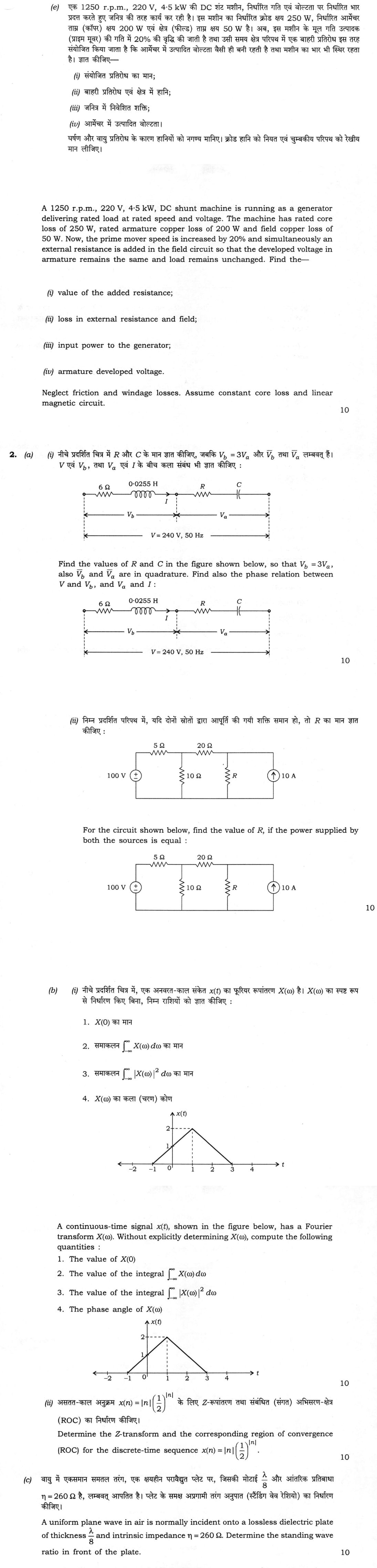
(a) (i) Find the values of R and C in the figure shown below, so that V_b = 3V_a, also V̄_b and V̄_a are in quadrature. Find also…
Find the values of R and C in the figure shown below, so that V_b = 3V_a, also V̄_b and V̄_a are in quadrature. Find also the phase relation between V and V_b, and V_a and I : 10 marks
For the circuit shown below, find the value of R, if the power supplied by both the sources is equal :
[Circuit : 5 Ω, 20 Ω, 10 Ω, R, 100 V (+), 10 A (↑)] 10 marks
A continuous-time signal x(t), shown in the figure below, has a Fourier transform X(ω). Without explicitly determining X(ω), compute the following quantities : 1. The value of X(0) 2. The value of the integral ∫₋∞^∞ X(ω) dω 3. The value of the integral ∫₋∞^∞ |X(ω)|² dω 4. The phase angle of X(ω)
[Diagram : x(t) versus t, triangular peak at (1, 2) with base from (–1, 0) to (3, 0)] 10 marks
Determine the Z-transform and the corresponding region of convergence (ROC) for the discrete-time sequence x(n) = |n| (1/2)^|n|. 10 marks
A uniform plane wave in air is normally incident onto a lossless dielectric plate of thickness λ/8 and intrinsic impedance η = 260 Ω. Determine the standing wave ratio in front of the plate. 10 marks
हिंदी में प्रश्न पढ़ें
नीचे प्रदर्शित चित्र में R और C के मान ज्ञात कीजिए, जबकि V_b = 3Vₐ और V̄_b तथा V̄ₐ लम्बवत् हैं। V एवं V_b, तथा Vₐ एवं I के बीच कला संबंध भी ज्ञात कीजिए : (10 अंक)
निम्न प्रदर्शित परिपथ में, यदि दोनों स्रोतों द्वारा आपूर्ति की गयी शक्ति समान हो, तो R का मान ज्ञात कीजिए :
[परिपथ : 5 Ω, 20 Ω, 10 Ω, R, 100 V (+), 10 A (↑)] (10 अंक)
नीचे प्रदर्शित चित्र में, एक अनवरत-काल संकेत x(t) का फूरियर रूपांतरण X(ω) है। X(ω) का स्पष्ट रूप से निर्धारण किए बिना, निम्न राशियों को ज्ञात कीजिए :
1. X(0) का मान
2. समाकलन ∫₋∞^∞ X(ω) dω का मान
3. समाकलन ∫₋∞^∞ |X(ω)|² dω का मान
4. X(ω) का कला (चरण) कोण
[आरेख : x(t) बनाम t, शिखर (1, 2), के आधार बिन्दु (-1, 0) और (3, 0) के साथ] (10 अंक)
असतत-काल अनुक्रम x(n) = |n| (1/2)^|n| के लिए Z-रूपांतरण तथा संबंधित (संगत) अभिसरण-क्षेत्र (ROC) का निर्धारण कीजिए। (10 अंक)
वायु में एकसमान समतल तरंग, एक क्षयहीन परावैद्युत प्लेट पर, जिसकी मोटाई λ/8 और आंतरिक प्रतिबाधा η = 260 Ω है, लम्बवत् आपतित है। प्लेट के समक्ष अग्रगामी तरंग अनुपात (स्टैंडिंग वेव रेशियो) का निर्धारण कीजिए। (10 अंक)
Model answer
Drafted with AI by UPSC Answer Check against this question's marking rubric, to the expected length. UPSC does not publish answers for Mains — this is one way to score well, not an official key. How we build rubrics and answers.
(a)(i) Series R–C design with Vb = 3Va and quadrature (10 marks)
The reactance of the coil is X_L = 2π × 50 × 0.0255 = 8.01 ≈ 8 Ω, so the first section has impedance Z_b = 6 + j8, with |Z_b| = 10 Ω and an angle of tan⁻¹(8/6) = 53.13° (V_b leads I). The second section is Zₐ = R − jX_C, with Vₐ lagging I by φₐ = tan⁻¹(X_C/R).
Magnitude condition. The same current I flows in both, so V_b = 3Vₐ means |Zₐ| = |Z_b|/3 = 10/3 = 3.333 Ω.
Quadrature condition. V_b leads I by 53.13° and Vₐ lags I by φₐ, so the angle between them is 53.13° + φₐ = 90°, giving φₐ = 36.87°. Then
- R = |Zₐ| cos 36.87° = 3.333 × 0.8 = 2.67 Ω;
- X_C = |Zₐ| sin 36.87° = 3.333 × 0.6 = 2.00 Ω, so C = 1/(2π × 50 × 2) = 1.592 × 10⁻³ F = 1592 μF (≈ 1.59 mF).
Current and phase relations. The total impedance is Z = (6 + 2.667) + j(8 − 2) = 8.667 + j6 Ω, with |Z| = 10.54 Ω and angle tan⁻¹(6/8.667) = 34.70°. Hence I = 240/10.54 = 22.77 A, V_b = 227.7 V and Vₐ = 75.9 V. Check: √(227.7² + 75.9²) = 240 V, as it must be for quadrature phasors.
- V and V_b: V leads I by 34.70° and V_b leads I by 53.13°, so V lags V_b by 18.43° (tan⁻¹(Vₐ/V_b) = tan⁻¹(1/3)).
- Vₐ and I: Vₐ lags I by 36.87°, since the section is R–C. It follows that V leads Vₐ by 71.57°.
(a)(ii) Value of R for equal source powers (10 marks)
Let V₁ be the node voltage across the 10 Ω resistor and V₂ the node voltage across R (both above ground). The current source drives V₂.
Node 1: (V₁ − 100)/5 + V₁/10 + (V₁ − V₂)/20 = 0, that is 4(V₁ − 100) + 2V₁ + (V₁ − V₂) = 0, so 7V₁ − V₂ = 400.
Node 2: (V₂ − V₁)/20 + V₂/R = 10.
Equal powers. The 100 V source delivers Pᵥ = 100 × (100 − V₁)/5 = 20(100 − V₁). The 10 A source delivers Pᵢ = 10 V₂. Setting Pᵥ = Pᵢ gives 2000 − 20V₁ = 10V₂, that is V₂ = 200 − 2V₁.
Substituting into the node-1 equation: 7V₁ − 200 + 2V₁ = 400, so 9V₁ = 600, V₁ = 66.67 V and V₂ = 66.67 V. No current flows in the 20 Ω resistor, and node 2 gives V₂/R = 10, so
R = 66.67/10 = 6.67 Ω (= 20/3 Ω).
Check: Pᵥ = 20 × 33.33 = 666.7 W and Pᵢ = 10 × 66.67 = 666.7 W.
(b)(i) Fourier-transform properties of a triangular pulse (10 marks)
The pulse rises from 0 at t = −1 to 2 at t = 1 and falls to 0 at t = 3, with x(0) = 1. It is symmetric about t = 1.
- X(0) is the area under x(t): X(0) = ∫x(t) dt = ½ × 4 × 2 = 4.
- ∫X(ω) dω. From the inverse transform x(t) = (1/2π) ∫X(ω) e^jωt dω, at t = 0: ∫X(ω) dω = 2π x(0) = 2π.
- ∫|X(ω)|² dω. By Parseval's theorem this is 2π ∫x²(t) dt. The left half gives ∫(t + 1)² dt from −1 to 1 = 8/3, and the right half is the same: total 16/3. Hence ∫|X(ω)|² dω = 2π × 16/3 = 32π/3 ≈ 33.5.
- Phase of X(ω). Write x(t) = g(t − 1), where g(t) is a real even triangle (peak 2, half-width 2). Then G(ω) is real, and by the time-shift property X(ω) = G(ω) e^−jω. Here G(ω) = 4 sin²ω/ω² ≥ 0, so the phase is ∠X(ω) = −ω (linear, with slope −1 rad per rad/s), with no jumps of π.
(b)(ii) Z-transform of x(n) = |n|(1/2)^|n| (10 marks)
Split the sequence into a right-sided part (n ≥ 0) and a left-sided part (n < 0). For n ≥ 0 the term is n(1/2)ⁿ, and for n < 0, with n = −m, it is m(1/2)^m.
Right-sided part. Using Σ n aⁿ z⁻ⁿ = a z⁻¹/(1 − a z⁻¹)² with a = 1/2:
X₁(z) = (½ z⁻¹)/(1 − ½ z⁻¹)² = ½ z/(z − ½)² = 2z/(2z − 1)², for |z| > 1/2.
Left-sided part. Σₘ≥1 m (z/2)^m = (z/2)/(1 − z/2)² = 2z/(z − 2)², for |z| < 2.
The two-sided transform is the sum:
X(z) = 2z/(2z − 1)² + 2z/(z − 2)² = 2z(5z² − 8z + 5)/[(2z − 1)²(z − 2)²],
with the region of convergence the annulus 1/2 < |z| < 2, the intersection of the two parts. Check: at z = 1 (inside the ROC) X(1) = 2 + 2 = 4, equal to Σ|n|(1/2)^|n| = 2 × 2 = 4. The unit circle is inside the ROC, so the Fourier transform exists.
(c) Standing-wave ratio in front of a lossless dielectric slab (10 marks)
The slab has air on both sides, so it is terminated in η₀ = 377 Ω. Taking the thickness λ/8 as measured in the dielectric, its electrical length is βd = (2π/λ)(λ/8) = π/4 (45°), so tan βd = 1. The input impedance seen at the front face is
Z_in = η (η₀ + jη tan βd)/(η + jη₀ tan βd) = 260 (377 + j260)/(260 + j377) = 243.0 − j92.4 Ω.
The reflection coefficient at the front face, with air (η₀) in front, is
Γ = (Z_in − η₀)/(Z_in + η₀) = (−134.0 − j92.4)/(620.0 − j92.4), with |Γ| = 162.8/626.9 = 0.260.
Alternatively, in closed form |Γ| = (η₀² − η²)/√[4η²η₀² + (η² + η₀²)²] = 74 522/287 077 = 0.260.
The standing-wave ratio in front of the plate is
S = (1 + |Γ|)/(1 − |Γ|) = 1.260/0.740 ≈ 1.70.
At a quarter-wave thickness the slab would reflect more strongly, and at half-wave thickness not at all; at λ/8 the reflection is intermediate, with about 6.7% of the incident power reflected (|Γ|² = 0.067).
How this answer will be evaluated
Evaluation rubric
Each sub-part is marked on its own, against the marks and word limit printed on the paper.
- (a)(i) Find R and C in the series circuit (6 Ω + 0.0255 H, then R and C; 240 V, 50 Hz) so that V_b = 3V_a with V_b and V_a in quadrature; state the phase relations of V with V_b and of V_a with I. 10 marks
Must cover
- X_L ≈ 8 Ω, Z_b = 6 + j8 = 10 Ω at 53.13°; |Z_a| = 10/3 Ω from V_b = 3V_a
- Quadrature: 53.13° + φ_a = 90°, so φ_a = 36.87°
- R = 2.67 Ω, X_C = 2 Ω, C ≈ 1592 μF
- V lags V_b by 18.43° (I = 22.77 A, V leads I by 34.7°); V_a lags I by 36.87°
Loses marks
- Using C = 1/(ωX_C) with the wrong X_C.
- Reversing lead and lag in the phase relations.
- Taking V_b and V_a in phase or opposition instead of quadrature.
Earns more
- Verification √(V_b² + V_a²) = 240 V.
- Stating the direction (lag or lead) of each relation.
Extra mark
- Phasor diagram of V, V_b, V_a and I
- (a)(ii) Find R in the two-source circuit (100 V with 5 Ω, 10 Ω, 20 Ω, R, 10 A source) so that the two sources supply equal power. 10 marks
Must cover
- Node equations at the 10 Ω node and the R node
- P_v = 100(100 − V₁)/5 and P_i = 10 V₂, set equal
- V₁ = V₂ = 66.67 V, so no current in 20 Ω
- R = 20/3 ≈ 6.67 Ω, with both powers 666.7 W
Loses marks
- Taking power supplied by the current source as 10² × R.
- Sign error in the current from the voltage source.
- Answering R in ohms without a verification of power balance.
Earns more
- Verification of equal powers at the end.
Extra mark
- Observation that the 20 Ω resistor carries no current
- (b)(i) For the triangular pulse, without finding X(ω), evaluate X(0), ∫X(ω)dω, ∫|X(ω)|²dω and the phase of X(ω). 10 marks
Must cover
- X(0) = area = 4
- ∫X(ω)dω = 2πx(0) = 2π
- ∫|X|²dω = 2π∫x²dt = 2π × 16/3 = 32π/3 by Parseval
- Phase = −ω: pulse is an even triangle shifted by 1, so X = G(ω)e^(−jω) with G real and non-negative
Loses marks
- Using x(1) = 2 in place of x(0) = 1 for the integral of X.
- Forgetting the 2π factor in the Parseval relation.
- Giving the phase as +ω or omitting it.
Earns more
- Each property is named: DC value, inverse transform at t = 0, Parseval, time shift.
- Correct integral ∫x²dt = 16/3.
Extra mark
- Confirming G(ω) = 4 sin²ω/ω² ≥ 0
- (b)(ii) Determine the two-sided Z-transform of x(n) = |n|(1/2)^|n| and its ROC. 10 marks
Must cover
- Split into causal part n(1/2)ⁿ and anti-causal part with n < 0
- Right part 2z/(2z − 1)², |z| > 1/2; left part 2z/(z − 2)², |z| < 2
- X(z) = 2z/(2z−1)² + 2z/(z−2)² = 2z(5z² − 8z + 5)/[(2z − 1)²(z − 2)²]
- ROC is the annulus 1/2 < |z| < 2, including the unit circle
Loses marks
- Giving only a right-sided ROC |z| > 1/2.
- Applying the causal formula to the whole sequence.
- Omitting the left-sided ROC |z| < 2.
Earns more
- Check X(1) = 4 = Σ|n|(1/2)^|n|.
Extra mark
- Statement that the unit circle in the ROC implies the DTFT exists
- (c) Find the standing-wave ratio in front of a λ/8 lossless dielectric slab of intrinsic impedance 260 Ω in air. 10 marks
Must cover
- Termination is η₀ = 377 Ω (air on both sides); electrical length π/4
- Z_in = η(η₀ + jη tan βd)/(η + jη₀ tan βd) ≈ 243 − j92.4 Ω
- |Γ| = |Z_in − η₀|/|Z_in + η₀| ≈ 0.26
- SWR = (1 + |Γ|)/(1 − |Γ|) ≈ 1.70
Loses marks
- Terminating the slab with 260 Ω instead of 377 Ω.
- Using tan βd with βd = π/8 or π/2.
- Reporting |Γ| or Z_in but not the SWR.
Earns more
- Stating that the thickness is taken in the dielectric wavelength.
- Closed-form check of |Γ| by the second route.
Extra mark
- About 6.7% of the incident power is reflected
What "Solve" is asking you to do
Choose the method, then carry it through to a final answer. Identifying what kind of problem this is and why that method applies is the first thing marked; a correct figure arrived at invisibly earns almost nothing.
Structure that answers it
Given data and what is required → method chosen, with the reason it applies → set-up (equation, circuit, free body, trial balance) → working, step by step → answer with units and any condition of validity
Where marks are lost
Doing the middle steps mentally and writing only the result. In mathematics papers, a further loss comes from giving a decimal where the exact value in surds or fractions was wanted, or from skipping the justification a part explicitly asks for.
Practice this exact question
Write your answer and it is marked point by point against the model answer above — what you covered, what you missed, what you got wrong.
Evaluate my answer →More from Electrical Engineering 2026 Paper I
- Q1 (a) For the circuit shown below, if the power loss in 1 Ω resistor is 16 W, find the valu…
- Q2 (a) (i) Find the values of R and C in the figure shown below, so that V_b = 3V_a, also V̄…
- Q3 (a) (i) For the circuit shown below, steady state is achieved with switch K open. At t =…
- Q4 (a) (i) The continuous-time signal x(t) = cos(20πt + π/4) is ideally sampled at a rate of…
- Q5 (a) For the circuit given in the figure below, the input voltage signal is given by V_in…