Paper II — Q1
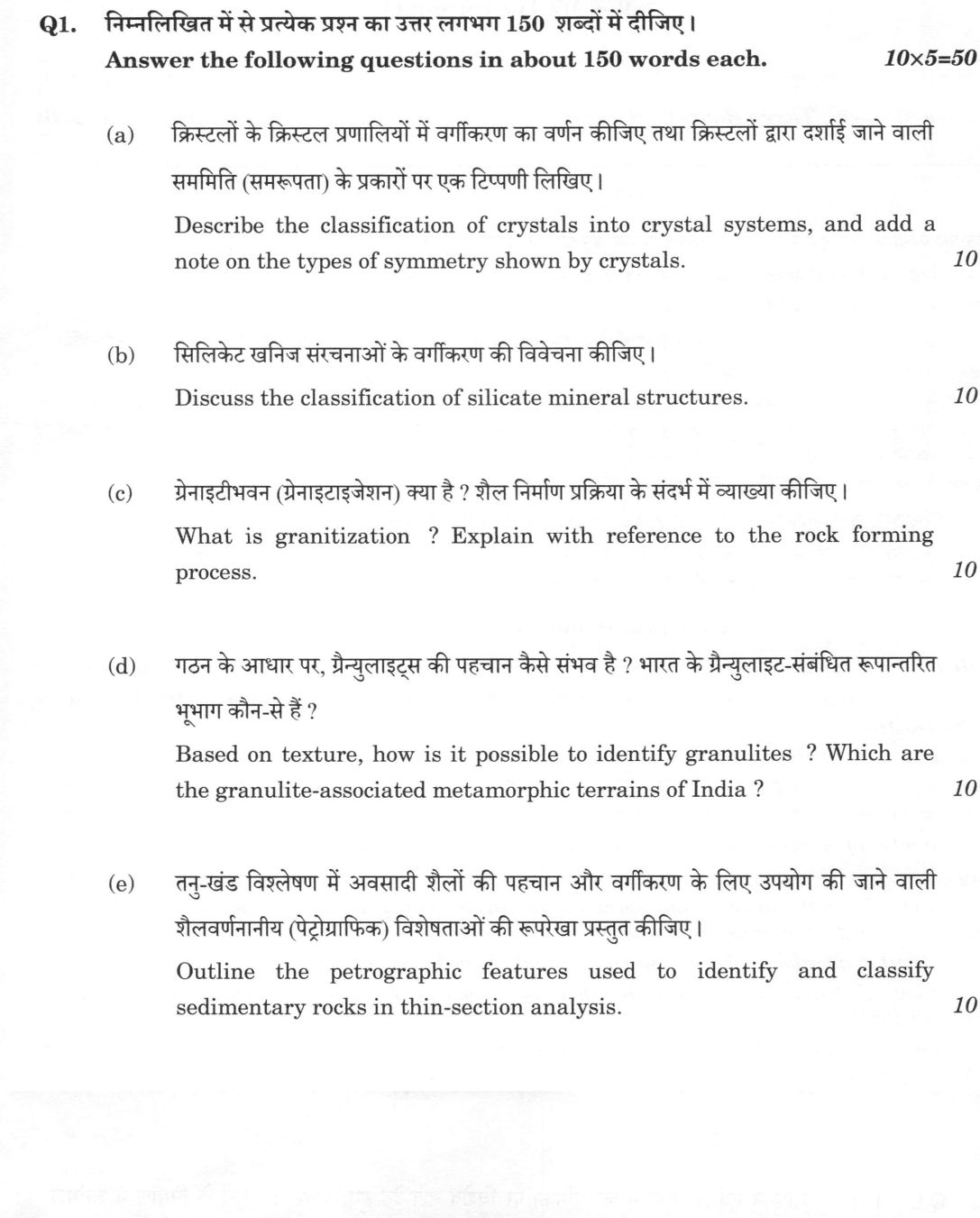
(a) Describe the classification of crystals into crystal systems, and add a note on the types of symmetry shown by crystals. (10…
Answer the following questions in about 150 words each.
Describe the classification of crystals into crystal systems, and add a note on the types of symmetry shown by crystals. 10 marks
Discuss the classification of silicate mineral structures. 10 marks
What is granitization ? Explain with reference to the rock forming process. 10 marks
Based on texture, how is it possible to identify granulites ? Which are the granulite-associated metamorphic terrains of India ? 10 marks
Outline the petrographic features used to identify and classify sedimentary rocks in thin-section analysis. 10 marks
हिंदी में प्रश्न पढ़ें
निम्नलिखित में से प्रत्येक प्रश्न का उत्तर लगभग 150 शब्दों में दीजिए।
क्रिस्टलों के क्रिस्टल प्रणालियों में वर्गीकरण का वर्णन कीजिए तथा क्रिस्टलों द्वारा दर्शाई जाने वाली सममिति (समरूपता) के प्रकारों पर एक टिप्पणी लिखिए। (10 अंक)
सिलिकेट खनिज संरचनाओं के वर्गीकरण की विवेचना कीजिए। (10 अंक)
ग्रेनाइटीभवन (ग्रेनाइटाइजेशन) क्या है ? शैल निर्माण प्रक्रिया के संदर्भ में व्याख्या कीजिए। (10 अंक)
गठन के आधार पर, ग्रैन्युलाइट्स की पहचान कैसे संभव है ? भारत के ग्रैन्युलाइट-संबंधित रूपान्तरित भूभाग कौन-से हैं? (10 अंक)
तनु-खंड विश्लेषण में अवसादी शैलों की पहचान और वर्गीकरण के लिए उपयोग की जाने वाली शैलवर्णनात्मक (पेट्रोग्राफिक) विशेषताओं की रूपरेखा प्रस्तुत कीजिए। (10 अंक)
Model answer
Drafted with AI by UPSC Answer Check against this question's marking rubric, to the 150-word length. UPSC does not publish answers for Mains — this is one way to score well, not an official key. How we build rubrics and answers.
(a) Crystal systems and symmetry (10 marks)
Crystals are grouped into seven systems by their axial lengths (a, b, c) and interaxial angles (α, β, γ), which follow from their symmetry.
- Cubic: a = b = c; all angles 90°; four 3-fold axes.
- Tetragonal: a = b ≠ c; all 90°; one 4-fold axis.
- Hexagonal: a = b ≠ c; α = β = 90°, γ = 120°; one 6-fold axis (trigonal has a 3-fold axis).
- Orthorhombic: a ≠ b ≠ c; all 90°; three 2-fold axes.
- Monoclinic: a ≠ b ≠ c; α = γ = 90° ≠ β; one 2-fold axis.
- Triclinic: a ≠ b ≠ c; no angle 90°; at most a centre.
Symmetry elements. These are the plane of symmetry, the axis of symmetry (2, 3, 4 and 6-fold) and the centre of symmetry. Together they give 32 crystal classes.
(b) Structural classification of silicates (10 marks)
Silicates are classified by how the SiO₄ tetrahedra are linked, that is, their degree of polymerisation.
- Nesosilicates (isolated tetrahedra, Si:O = 1:4): olivine (Mg,Fe)₂SiO₄, garnet.
- Sorosilicates (paired, Si₂O₇, 2:7): epidote.
- Cyclosilicates (rings, Si₆O₁₈, 1:3): beryl Be₃Al₂Si₆O₁₈, tourmaline.
- Inosilicates: single chains (SiO₃, 1:3), pyroxenes such as augite; double chains (Si₄O₁₁, 4:11), amphiboles such as hornblende.
- Phyllosilicates (sheets, Si₂O₅, 2:5): micas (muscovite), clay minerals, chlorite.
- Tectosilicates (framework, SiO₂, 1:2): quartz, feldspars, feldspathoids; Al replaces some Si in feldspars.
The more shared oxygens, the higher the Si:O ratio and the greater the stability and hardness.
(c) Granitization (10 marks)
Granitization is the process by which solid rocks are transformed into granite without melting, by the introduction and removal of chemical constituents, so it is a form of metasomatism.
Mechanism. Ions of Na, K, Si and Al diffuse through intergranular fluids and along grain boundaries, migrating in fronts ahead of the change. Fe, Mg and Ca are removed as a "basic front", while Si, Na and K arrive as a "granite front". Porphyroblasts of feldspar grow in the old rock.
Evidence. Relict structures such as bedding and foliation continue into granite, and there are gradational contacts, no chilled margins, and the lack of room for a large magma body.
The magmatists, led by N. L. Bowen, argue from experiments that granite crystallises from melt. Most granites are magmatic, but granitisation is accepted for migmatites and some granite gneisses in deep crust.
(d) Granulites: texture and Indian terrains (10 marks)
Identification. Granulites are high-grade rocks of the granulite facies (T above about 700°C). They are medium to coarse, dry rocks with a granoblastic texture: equigranular grains with straight, polygonal boundaries meeting at about 120°. Feldspar and quartz are often elongated in flattened grains (granulitic gneissic banding). Orthopyroxene (hypersthene) with clinopyroxene, plagioclase and garnet is the diagnostic mineral assemblage. Hydrous minerals such as biotite and hornblende are scarce.
Indian terrains.
- Southern Granulite Terrane: Nilgiri, Madras (Pallavaram), Palni, Shevaroy and Biligirirangan hills, and the Kerala Khondalite Belt.
- Eastern Ghats Belt (khondalites, charnockites).
- Central Indian Tectonic Zone (Sausar belt).
- Parts of the Chotanagpur Gneissic Complex.
(e) Petrographic features of sedimentary rocks (10 marks)
Sedimentary rocks are identified and classified in thin section by texture and composition.
- Texture: grain size, sorting, roundness and sphericity, grain contacts and packing (grain-supported or matrix-supported), and fabric.
- Composition: framework grains (quartz, feldspar, lithics), matrix (grains below 30 μm) and cement (calcite, silica, iron oxide).
- Classification: sandstones by Folk or Dott/Pettijohn schemes in a QFL diagram (quartz arenite, arkose, lithic arenite, greywacke); carbonates by Folk (allochems and micrite or sparite) and Dunham (mudstone to grainstone).
- Diagenetic features: compaction, cementation, replacement, dissolution and porosity type (intergranular, moldic, vuggy).
Together these show source, transport, environment and burial.
How this answer will be evaluated
Evaluation rubric
Each sub-part is marked on its own, against the marks and word limit printed on the paper.
- (a) Describe the classification of crystals into crystal systems and add a note on the types of symmetry (10 marks, about 150 words). 10 marks · 150 words
Must cover
- Seven systems with axial relations and angles: cubic, tetragonal, hexagonal (with trigonal), orthorhombic, monoclinic, triclinic
- Basis of classification: symmetry, in particular the characteristic axes
- Symmetry elements: plane, axes (2, 3, 4, 6-fold), centre
- 32 crystal classes
Loses marks
- Fewer than six systems.
- Confusing plane and axis of symmetry.
Earns more
- Correct interaxial angles for each system.
Extra mark
- Inversion axes or the 230 space groups
- (b) Discuss the classification of silicate mineral structures (10 marks, about 150 words). 10 marks · 150 words
Must cover
- Basis: linkage and polymerisation of SiO₄ tetrahedra
- Six classes: nesosilicates, sorosilicates, cyclosilicates, inosilicates (single and double chain), phyllosilicates, tectosilicates
- Si:O ratio or anion group for each class
- Mineral example for each class
Loses marks
- Listing classes without minerals.
- Wrong Si:O ratios.
Earns more
- Correct formulae of examples.
Extra mark
- Role of Al substitution in tectosilicates
- (c) What is granitization? Explain with reference to the rock-forming process (10 marks, about 150 words). 10 marks · 150 words
Must cover
- Definition: transformation of solid rock into granite without melting, by metasomatism
- Mechanism: ionic diffusion, migrating fronts, basic front and granite front
- Evidence: relict structures, gradational contacts, no chilled margins, room problem
- Magmatic versus granitization debate (Bowen)
Loses marks
- Equating granitization with partial melting or anatexis.
- One-sided treatment of the controversy.
Earns more
- Balanced closing view on where granitization applies.
Extra mark
- Reference to migmatites and Read's transformist view
- (d) Based on texture, how are granulites identified? Which are the granulite-associated metamorphic terrains of India? (10 marks, about 150 words). 10 marks · 150 words
Must cover
- Granulite facies, high temperature, dry
- Granoblastic texture with polygonal grain boundaries at about 120°
- Diagnostic assemblage: orthopyroxene with clinopyroxene, plagioclase and garnet
- Indian terrains: Southern Granulite Terrane, Eastern Ghats, Central Indian Tectonic Zone, Chotanagpur
Loses marks
- No Indian terrains named.
- Describing schistose texture.
Earns more
- Named localities within the Southern Granulite Terrane.
Extra mark
- Charnockite and khondalite as granulite types
- (e) Outline the petrographic features used to identify and classify sedimentary rocks in thin-section analysis (10 marks, about 150 words). 10 marks · 150 words
Must cover
- Textural features: grain size, sorting, rounding, packing
- Composition: framework grains, matrix and cement
- Classification: QFL scheme for sandstones and Folk or Dunham for carbonates
- Diagenetic and porosity features
Loses marks
- Describing igneous textures.
- No classification scheme named.
Earns more
- Named rock types from each scheme.
Extra mark
- Provenance and environment inference
What "Describe" is asking you to do
Give a full, ordered account of the thing named — its parts, stages or mechanism — in the sequence in which it actually exists or occurs. Most describe questions come from the science optionals, where the marks sit in correct technical detail and, where the stem says so, a labelled diagram.
Structure that answers it
One-line identification of the subject → the parts or stages in their real order, each with its defining detail → labelled diagram where the subject is structural → closing line on function or significance
Where marks are lost
Loose general prose where the examiner is ticking named parts, correct terminology and their sequence; and in the General Studies papers, turning to evaluation before the description is finished.
Practice this exact question
Write your answer and it is marked point by point against the model answer above — what you covered, what you missed, what you got wrong.
Evaluate my answer →More from Geology 2026 Paper II
- Q1 Answer the following questions in about 150 words each. (a) Describe the classification o…
- Q2 (a) Describe common minerals of igneous and metamorphic rocks, and the diagnostic feature…
- Q3 (a) Discuss the petrogenesis of carbonatite rocks. (15 marks) (b) What is metasomatic rep…
- Q4 (a) Discuss the primary processes involved in the formation of sedimentary rocks, emphasi…