Paper II — Q2
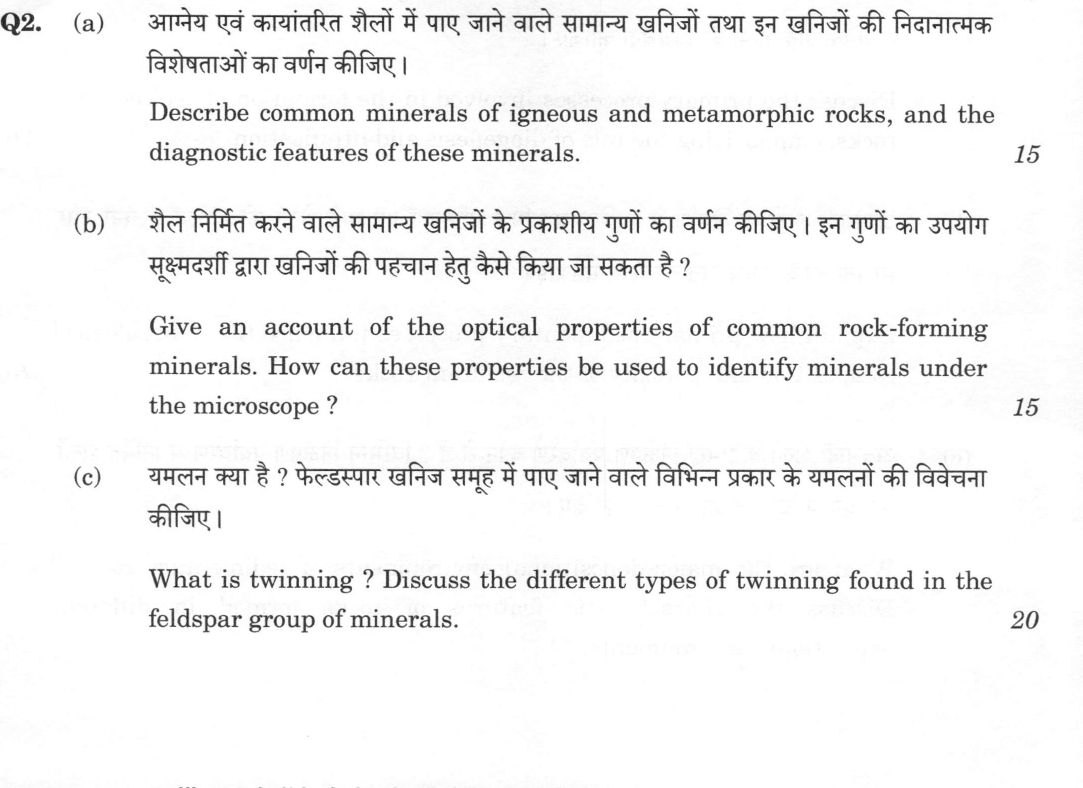
(a) Describe common minerals of igneous and metamorphic rocks, and the diagnostic features of these minerals. (15 marks) (b)…
Describe common minerals of igneous and metamorphic rocks, and the diagnostic features of these minerals. 15 marks
Give an account of the optical properties of common rock-forming minerals. How can these properties be used to identify minerals under the microscope ? 15 marks
What is twinning ? Discuss the different types of twinning found in the feldspar group of minerals. 20 marks
हिंदी में प्रश्न पढ़ें
आग्नेय एवं कायांतरित शैलों में पाए जाने वाले सामान्य खनिजों तथा इन खनिजों की निदानात्मक विशेषताओं का वर्णन कीजिए। (15 अंक)
शैल निर्मित करने वाले सामान्य खनिजों के प्रकाशीय गुणों का वर्णन कीजिए। इन गुणों का उपयोग सूक्ष्मदर्शी द्वारा खनिजों की पहचान हेतु कैसे किया जा सकता है? (15 अंक)
यमलन क्या है? फेल्डस्पार खनिज समूह में पाए जाने वाले विभिन्न प्रकार के यमलनों की विवेचना कीजिए। (20 अंक)
Model answer
Drafted with AI by UPSC Answer Check against this question's marking rubric, to the expected length. UPSC does not publish answers for Mains — this is one way to score well, not an official key. How we build rubrics and answers.
(a) Common minerals of igneous and metamorphic rocks and their diagnostic features (15 marks)
Igneous rocks.
- Quartz (SiO₂): colourless, no cleavage, low relief, first-order grey to white, undulose extinction, uniaxial positive.
- Orthoclase and microcline (KAlSi₃O₈): low relief, cloudy from alteration to clay, two cleavages at about 90°; Carlsbad twin in orthoclase and tartan twinning in microcline; biaxial negative.
- Plagioclase (NaAlSi₃O₈–CaAl₂Si₂O₈): polysynthetic albite twinning, zoning, inclined extinction that varies with anorthite content.
- Biotite: brown, strongly pleochroic, one perfect cleavage, "bird's-eye" extinction.
- Muscovite: colourless, one cleavage, bright second- to third-order colours.
- Hornblende: green to brown, pleochroic, two cleavages at 56° and 124°, extinction 15–25°.
- Augite: pale green or colourless, two cleavages at about 87° and 93°, extinction up to 45°.
- Olivine (Mg,Fe)₂SiO₄: colourless, high relief, no cleavage, irregular cracks, altering to serpentine.
Metamorphic rocks.
- Garnet: pale pink, very high relief, isotropic, no cleavage, euhedral or poikiloblastic.
- Staurolite: yellow, pleochroic, twinned as a cross.
- Kyanite: colourless, high relief, two cleavages, elongated blades.
- Sillimanite: prisms and fibrolite needles.
- Andalusite: pinkish, pleochroic, square section, chiastolite cross.
- Chlorite: green, anomalous blue or brown interference colours.
- Epidote, tremolite–actinolite, talc, wollastonite, diopside and calcite are diagnostic of low-grade, contact and calcareous rocks.
(b) Optical properties of rock-forming minerals and their use in identification (15 marks)
Optical properties.
- Plane-polarised light: colour, pleochroism, habit, cleavage, relief (refractive index against the mounting balsam, 1.54) and the Becke line, alteration and inclusions.
- Crossed polars: isotropic or anisotropic behaviour; birefringence, shown by interference colour on the Michel-Lévy chart (a 0.03 mm section of quartz shows first-order grey to white); extinction, whether parallel, inclined or symmetrical, and extinction angle; twinning and zoning; sign of elongation with the gypsum plate.
- Convergent light (conoscopic): the interference figure shows whether the mineral is uniaxial or biaxial, its optic sign and 2V.
Method of identification.
- Observe first in plane-polarised light, noting colour, pleochroism, relief, cleavage and habit.
- Insert the analyser and note birefringence, extinction, twins and zoning.
- Use the conoscopic figure on suitable grains to find uniaxial or biaxial character and sign.
- Compare the whole set with tables of properties, for example quartz (uniaxial positive, low relief) against plagioclase (twinned, biaxial).
(c) Twinning and twin types in feldspars (20 marks)
Twinning. Twinning is the symmetric intergrowth of two or more crystal parts related by a symmetry operation, reflection across a twin plane or rotation about a twin axis, that is not a symmetry of the single crystal. Twin elements are the twin plane, the twin axis and the composition plane. Twins may be contact or penetration, simple or repeated (polysynthetic or cyclic), and may arise by growth, by deformation or by transformation, for example when a monoclinic form inverts to a triclinic one.
Feldspar twin laws.
- Carlsbad: penetration, simple, twin axis parallel to c; common in orthoclase, sanidine and plagioclase; it divides a crystal into two halves.
- Baveno: contact twin on the plane {021}.
- Manebach: contact twin on the plane {001}.
- Albite: polysynthetic twin on {010}, the most common twin in plagioclase, with fine parallel lamellae.
- Pericline: twin axis parallel to b, composition plane the rhombic section; lamellae are also polysynthetic.
- Combined albite and pericline twinning gives the cross-hatched, "tartan" pattern that is diagnostic of microcline.
Significance. Albite twinning identifies plagioclase and, with the extinction angle, gives the anorthite content (Michel-Lévy method). Carlsbad and albite twins are often found together in the same crystal. The lack of twinning helps to recognise untwinned potassium feldspar and quartz. Tartan twinning marks microcline formed by inversion.
How this answer will be evaluated
Evaluation rubric
Each sub-part is marked on its own, against the marks and word limit printed on the paper.
- (a) Describe the common minerals of igneous and of metamorphic rocks and the diagnostic features of these minerals (15 marks). 15 marks
Must cover
- Igneous minerals: quartz, feldspars, micas, hornblende, augite, olivine, each with diagnostic properties
- Metamorphic minerals: garnet, staurolite, kyanite, sillimanite, andalusite, chlorite and others
- Diagnostic features such as colour, relief, cleavage, twinning, extinction and birefringence
- Both rock classes covered
Loses marks
- Covering only igneous or only metamorphic minerals.
- Listing names without diagnostic features.
Earns more
- Composition or formula given for the main minerals.
- Look-alikes distinguished, for example microcline from orthoclase.
Extra mark
- Index minerals linked to metamorphic grade
- (b) Give an account of the optical properties of common rock-forming minerals and how they are used to identify minerals under the microscope (15 marks). 15 marks
Must cover
- Plane-polarised properties: colour, pleochroism, relief, cleavage, habit
- Crossed-polar properties: birefringence and interference colour, extinction angle, twinning
- Conoscopic figure: uniaxial or biaxial, optic sign, 2V
- Stepwise identification routine
Loses marks
- Describing hand-specimen properties only.
- No account of how the properties are used.
Earns more
- Michel-Lévy chart and thickness of the section mentioned.
- Example of applying the routine to a named mineral.
Extra mark
- Becke line test and use of the gypsum plate
- (c) What is twinning? Discuss the different types of twinning found in the feldspar group of minerals (20 marks). 20 marks
Must cover
- Definition of twinning and the twin elements: plane, axis, composition plane
- Kinds of twins: contact, penetration, simple, polysynthetic, cyclic; and their origin
- Feldspar laws: Carlsbad, Baveno, Manebach, albite, pericline
- Combined albite and pericline (tartan) twinning in microcline, with the petrographic significance
Loses marks
- Defining twinning without naming the feldspar laws.
- Giving the wrong twin plane for albite or Manebach.
Earns more
- Twin plane or axis given for each law.
- Significance stated: plagioclase composition and microcline recognition.
Extra mark
- Origin of twinning by growth, deformation and inversion
What "Describe" is asking you to do
Give a full, ordered account of the thing named — its parts, stages or mechanism — in the sequence in which it actually exists or occurs. Most describe questions come from the science optionals, where the marks sit in correct technical detail and, where the stem says so, a labelled diagram.
Structure that answers it
One-line identification of the subject → the parts or stages in their real order, each with its defining detail → labelled diagram where the subject is structural → closing line on function or significance
Where marks are lost
Loose general prose where the examiner is ticking named parts, correct terminology and their sequence; and in the General Studies papers, turning to evaluation before the description is finished.
Practice this exact question
Write your answer and it is marked point by point against the model answer above — what you covered, what you missed, what you got wrong.
Evaluate my answer →More from Geology 2026 Paper II
- Q1 Answer the following questions in about 150 words each. (a) Describe the classification o…
- Q2 (a) Describe common minerals of igneous and metamorphic rocks, and the diagnostic feature…
- Q3 (a) Discuss the petrogenesis of carbonatite rocks. (15 marks) (b) What is metasomatic rep…
- Q4 (a) Discuss the primary processes involved in the formation of sedimentary rocks, emphasi…
- Q5 Answer the following questions in about 150 words each. (a) How is the 'Law of the Sea' r…