Paper II — Q3
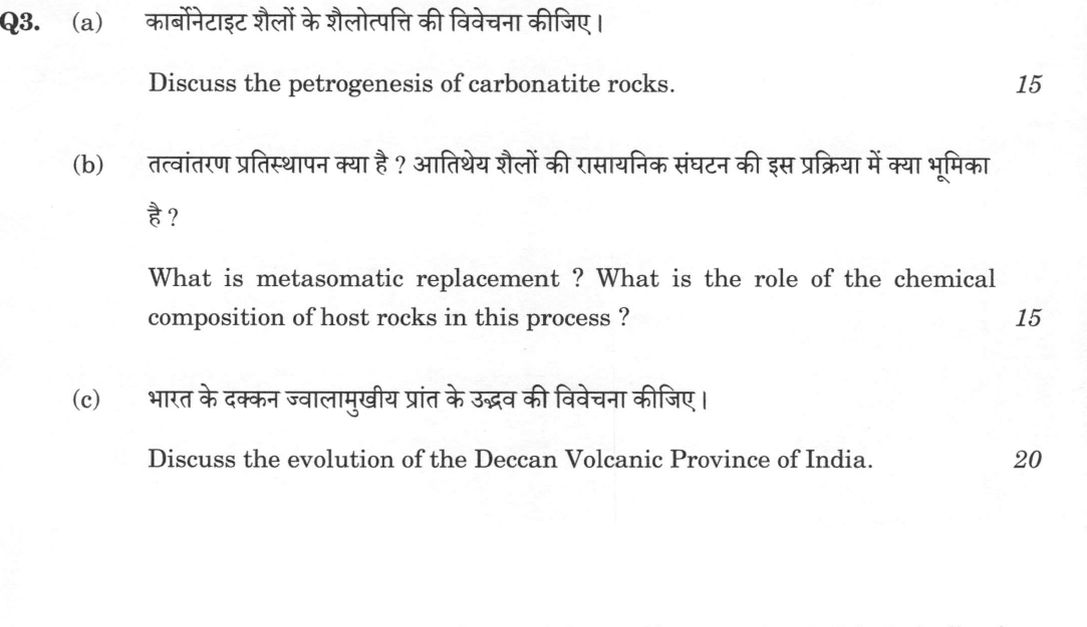
(a) Discuss the petrogenesis of carbonatite rocks. (15 marks) (b) What is metasomatic replacement ? What is the role of the…
Discuss the petrogenesis of carbonatite rocks. 15 marks
What is metasomatic replacement ? What is the role of the chemical composition of host rocks in this process ? 15 marks
Discuss the evolution of the Deccan Volcanic Province of India. 20 marks
हिंदी में प्रश्न पढ़ें
कार्बोनेटाइट शैलों के शैलोत्पत्ति की विवेचना कीजिए। (15 अंक)
तत्वांतरण प्रतिस्थापन क्या है? आतिथेय शैलों की रासायनिक संघटन की इस प्रक्रिया में क्या भूमिका है? (15 अंक)
भारत के दक्कन ज्वालामुखीय प्रांत के उद्भव की विवेचना कीजिए। (20 अंक)
Model answer
Drafted with AI by UPSC Answer Check against this question's marking rubric, to the expected length. UPSC does not publish answers for Mains — this is one way to score well, not an official key. How we build rubrics and answers.
(a) Petrogenesis of carbonatites (15 marks)
Definition and classification. Carbonatites are igneous rocks with more than 50% primary carbonate minerals and less than 20% SiO₂. They are classed by the dominant carbonate as calciocarbonatite (sövite, coarse; alvikite, fine), magnesiocarbonatite (beforsite, dolomite), ferrocarbonatite and natrocarbonatite. The last is known only from the active volcano Oldoinyo Lengai, Tanzania.
Setting and association. They occur in stable continental cratons and rifts, often as ring complexes and plugs with alkaline silicate rocks (nephelinite, ijolite, melilitite), and are surrounded by a halo of alkali metasomatism called fenitisation. They are rich in Nb, REE, P, Sr, Ba and F.
Models of origin.
- Primary mantle melt: a very small degree of partial melting of carbonated peridotite at depths of more than about 80–100 km produces carbonatite liquid directly.
- Liquid immiscibility: a carbonated silicate melt, such as nephelinite or melilitite, separates at crustal levels into a silicate liquid and a carbonate liquid.
- Fractional crystallisation: a carbonated alkaline silicate magma crystallises olivine, pyroxene and melilite until a residual carbonate liquid is left.
Evidence. Sr, Nd and C–O isotopes are mantle-like, with δ¹³C about −5‰, which supports a mantle source. Experiments support both immiscibility and low-degree mantle melting. Most workers accept that no single model fits all carbonatites. Indian examples are Amba Dongar (Gujarat, related to the Deccan), Sung Valley (Meghalaya), Sevattur and Hogenakal (Tamil Nadu) and Newania (Rajasthan).
(b) Metasomatic replacement and the role of host rock (15 marks)
Metasomatic replacement. It is the process in which hydrothermal or other fluids dissolve the minerals of a rock and simultaneously deposit new ones, volume for volume, with a change in bulk chemistry but with the original texture and structure preserved. Lindgren's rule states that the change occurs without change in volume.
Criteria of recognition.
- Pseudomorphs and relict minerals.
- Preservation of bedding, fossils and other structures across the new mineral.
- Irregular, sharp replacement fronts and ore that cuts across the bedding.
- No open-space filling features such as comb structure or vugs.
Role of host-rock composition.
- Reactive carbonate rocks (limestone, dolomite) neutralise acid fluids, so replacement ore bodies of Pb–Zn–Cu and skarns (garnet–pyroxene–wollastonite) form there, along contacts with granite.
- Reducing hosts, such as carbonaceous shale, graphite or pyrite-bearing rocks, precipitate metals such as gold, uranium and copper, because they reduce the metal-bearing fluid.
- Inert, chemically resistant hosts (quartzite, massive granite) resist replacement, so mineralisation stays in veins along fractures.
- Feldspar-rich rocks alter to sericite and clay, giving disseminated ores.
The host thus controls the site, the mineral and the shape of the deposit.
(c) Evolution of the Deccan Volcanic Province (20 marks)
Extent, volume and age. The Deccan Traps cover about 500,000 km² today, though the original area was over 1.5 million km², with a volume of about 1 million km³ or more, and a thickness of over 2 km in the Western Ghats. Most of the lava erupted in about one million years around 66 Ma, close to the Cretaceous–Palaeogene boundary (chron 29R).
Origin. India passed over the Réunion mantle plume as it drifted north after leaving Gondwana. The plume head melted and the crust was rifted, with the Seychelles separating from India about 62 Ma. Fissure eruptions along the Narmada–Tapi rift, the west coast fault and dyke swarms fed the lava.
Stratigraphy and petrology. The Deccan Basalt Group is divided into the Kalsubai, Lonavala, Wai and Salsette subgroups, with formations such as Khandala, Bushe, Poladpur, Ambenali and Mahabaleshwar. The lavas are mainly tholeiitic basalts, with minor picrite, alkaline rocks and rhyolite. Flows are compound pahoehoe and aa, laid in horizontal sheets 10–50 m thick, separated by red boles and by intertrappean beds carrying freshwater fossils.
Sub-provinces. Western Ghats, Malwa, Mandla, Kachchh and Saurashtra, and Narmada–Tapi.
Consequences. Volcanic CO₂ and SO₂ affected climate, and the eruptions are widely discussed as one factor in the end-Cretaceous extinction, alongside the Chicxulub impact. The lava has weathered to black cotton soil (regur) and laterite, and formed the plateaux and scarp of the Western Ghats. Later erosion and the Deccan aquifers are of economic importance.
How this answer will be evaluated
Evaluation rubric
Each sub-part is marked on its own, against the marks and word limit printed on the paper.
- (a) Discuss the petrogenesis of carbonatite rocks (15 marks). 15 marks
Must cover
- Definition and classification: over 50% carbonate; calcio-, magnesio-, ferro- and natrocarbonatite
- Three models: primary mantle melt, liquid immiscibility, fractional crystallisation
- Isotopic and geochemical evidence, such as mantle-like Sr, Nd and C–O isotopes and enrichment in Nb and REE
- Tectonic setting and association with alkaline silicate rocks and fenites
Loses marks
- Describing only one model as if settled.
- Treating carbonatite as a sedimentary limestone.
Earns more
- Weighing of the models against each other.
- Indian examples such as Amba Dongar.
Extra mark
- Oldoinyo Lengai as the only active natrocarbonatite volcano
- (b) What is metasomatic replacement? What is the role of the chemical composition of host rocks in this process? (15 marks). 15 marks
Must cover
- Definition: volume-for-volume replacement by fluids with change in chemistry and preservation of texture
- Recognition criteria: pseudomorphs, relict structures, irregular fronts, no open-space filling
- Reactive carbonate hosts giving replacement ore and skarn
- Reducing hosts and inert hosts, the latter giving vein-type deposits
Loses marks
- Confusing replacement with cavity filling.
- Ignoring the host-rock control asked in the second part.
Earns more
- Named mineral or ore examples for each host type.
- Explanation of why the host controls the deposit.
Extra mark
- Lindgren's volume-for-volume rule
- (c) Discuss the evolution of the Deccan Volcanic Province of India (20 marks). 20 marks
Must cover
- Extent, volume and age: about 500,000 km² now, about 1 million km³, about 66 Ma near the K–Pg boundary
- Origin: Réunion plume and rifting, fissure eruptions and dyke swarms
- Stratigraphy and petrology: Kalsubai, Lonavala, Wai and Salsette subgroups, tholeiitic basalt, pahoehoe and aa flows, red boles, intertrappean beds
- Consequences: climate and extinction debate, regur and laterite, Western Ghats
Loses marks
- Giving a wrong age, such as Permian or Jurassic.
- Ignoring the plume and rift mechanism.
Earns more
- Sub-provinces named.
- Balanced statement of the extinction link.
Extra mark
- Rajmahal Traps distinguished as an earlier province
What "Discuss" is asking you to do
Lay the issue out from more than one side — how it arose, what is claimed for it, what is held against it, and where it now stands. UPSC attaches discuss to broad topics with several live dimensions, so coverage of the dimensions earns more than the strength of your opinion.
Structure that answers it
Set the issue up → the case as it is made → the case against → the dimension both sides leave out → where the balance now lies
Where marks are lost
Listing facts with no thread between them, or arguing one side throughout and calling it a discussion.
Practice this exact question
Write your answer and it is marked point by point against the model answer above — what you covered, what you missed, what you got wrong.
Evaluate my answer →More from Geology 2026 Paper II
- Q1 Answer the following questions in about 150 words each. (a) Describe the classification o…
- Q2 (a) Describe common minerals of igneous and metamorphic rocks, and the diagnostic feature…
- Q3 (a) Discuss the petrogenesis of carbonatite rocks. (15 marks) (b) What is metasomatic rep…
- Q4 (a) Discuss the primary processes involved in the formation of sedimentary rocks, emphasi…
- Q5 Answer the following questions in about 150 words each. (a) How is the 'Law of the Sea' r…
- Q6 (a) Explain the differences between ore, ore minerals and gangue, and discuss their signi…