Paper II — Q6
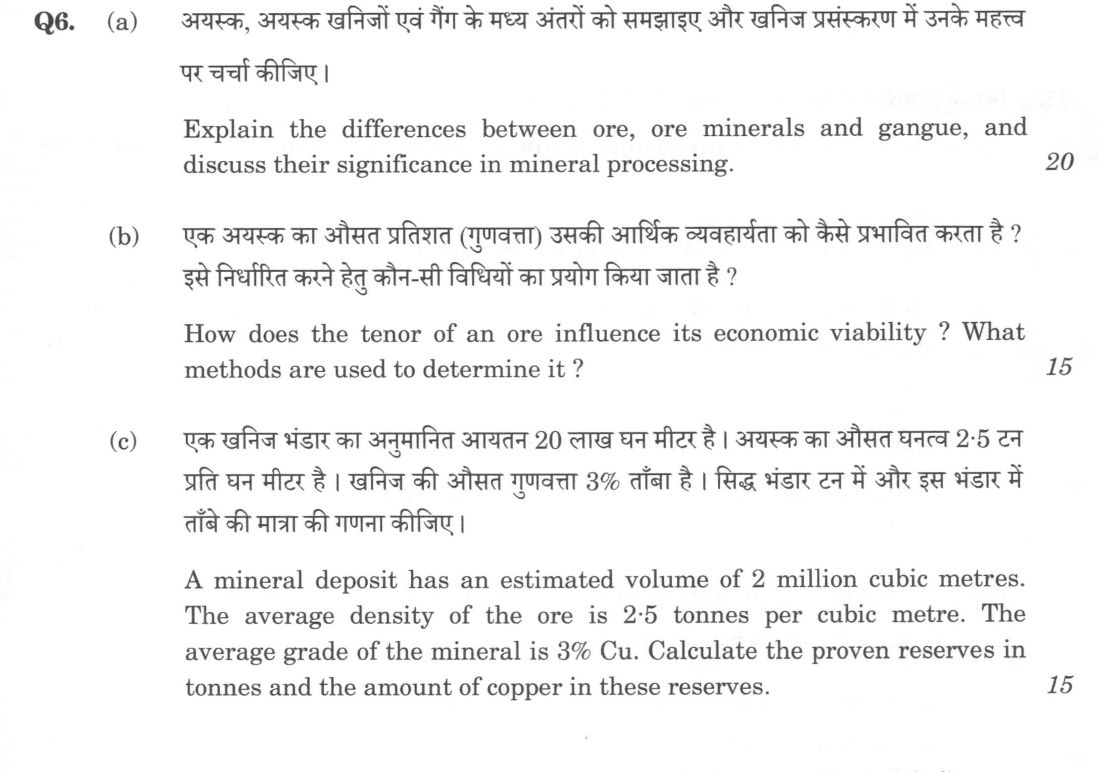
(a) Explain the differences between ore, ore minerals and gangue, and discuss their significance in mineral processing. (20…
Explain the differences between ore, ore minerals and gangue, and discuss their significance in mineral processing. 20 marks
How does the tenor of an ore influence its economic viability ? What methods are used to determine it ? 15 marks
A mineral deposit has an estimated volume of 2 million cubic metres. The average density of the ore is 2·5 tonnes per cubic metre. The average grade of the mineral is 3% Cu. Calculate the proven reserves in tonnes and the amount of copper in these reserves. 15 marks
हिंदी में प्रश्न पढ़ें
अयस्क, अयस्क खनिजों एवं गैंग के मध्य अंतरों को समझाइए और खनिज प्रसंस्करण में उनके महत्व पर चर्चा कीजिए। (20 अंक)
एक अयस्क का औसत प्रतिशत (गुणवत्ता) उसकी आर्थिक व्यवहार्यता को कैसे प्रभावित करता है? इसे निर्धारित करने हेतु कौन-सी विधियों का प्रयोग किया जाता है? (15 अंक)
एक खनिज भंडार का अनुमानित आयतन 20 लाख घन मीटर है। अयस्क का औसत घनत्व 2.5 टन प्रति घन मीटर है। खनिज की औसत गुणवत्ता 3% ताँबा है। सिद्ध भंडार टन में और इस भंडार में ताँबे की मात्रा की गणना कीजिए। (15 अंक)
Model answer
Drafted with AI by UPSC Answer Check against this question's marking rubric, to the expected length. UPSC does not publish answers for Mains — this is one way to score well, not an official key. How we build rubrics and answers.
(a) Ore, ore minerals and gangue, and their significance in mineral processing (20 marks)
Differences.
- Ore is a natural aggregate of minerals from which one or more metals can be extracted at a profit. It is an economic term, so the same rock may be ore or not depending on price, grade and technology.
- Ore minerals are the metal-bearing minerals in the ore that are of value, such as chalcopyrite (Cu), galena (Pb), sphalerite (Zn), hematite and magnetite (Fe), and chromite (Cr). This is a mineralogical term.
- Gangue is the valueless mineral matter, such as quartz, calcite and feldspar, that is mixed with the ore minerals and is discarded. The terms are relative: baryte or fluorite may be gangue in one deposit and ore in another.
Significance in mineral processing.
- Nature of the ore mineral and gangue decides the method. Liberation, by comminution (crushing and grinding), frees the ore minerals from the gangue, and the grain size and intergrowth decide how fine the grinding must be.
- Separation exploits differences in properties: gravity (density, as in jigs and tables for cassiterite and gold), magnetic (magnetite), electrostatic, and froth flotation (sulphides, with reagents).
- The result is a concentrate, rich in ore minerals, and tailings, the gangue. The concentration ratio and recovery decide the economics, since fine grinding and separation cost money.
- Smelting and refining follow, and gangue forms slag, so a high gangue content raises the cost of transport and smelting.
- Tailings must be managed for the environment, and may hold valuable by-products.
(b) Tenor of an ore: economic viability and determination (15 marks)
Definition. Tenor is the average grade of the ore, that is, the percentage (or g/t for precious metals) of the metal in the ore.
Influence on economic viability.
- Revenue per tonne rises with tenor, and a higher grade lowers the cost per unit of metal, because less rock is mined, milled and smelted.
- The cut-off grade, the minimum tenor at which a block pays for its mining and processing, separates ore from waste. A rise in the metal price lowers the cut-off and adds to reserves.
- Tenor works with tonnage and recovery: a low-grade deposit can pay if it is very large and mined cheaply (open-pit porphyry copper, at 0.4–1% Cu), whereas a small deposit needs high grade.
- By-products such as gold and silver improve viability, while deleterious elements (arsenic, sulphur, phosphorus) attract penalties.
Methods of determination.
- Sampling: channel, chip, grab and drill-core samples, with proper spacing, followed by splitting and reduction.
- Assaying: chemical, fire assay, atomic absorption, ICP and XRF, on the prepared samples.
- Estimation: tenor is the weighted average of the assays, weighted by sample length and width, using polygons, sections or geostatistics (kriging).
(c) Reserve calculation (15 marks)
Volume V = 2 million m³ = 2 × 10⁶ m³, ore density = 2.5 t/m³, and grade = 3% Cu.
(i) Proven reserves of ore.
Tonnage = volume × density = 2 × 10⁶ × 2.5 = 5 × 10⁶ tonnes, that is, 5 million tonnes of ore.
(ii) Copper in the reserves.
Contained copper = tonnage × grade = 5 × 10⁶ × 3/100 = 1.5 × 10⁵ tonnes, that is, 150,000 tonnes of copper.
The proven reserve is 5 million tonnes of ore and it contains 150,000 tonnes of copper metal, before allowing for mining and processing losses; the recoverable copper will be lower than this by the mining and metallurgical recovery.
How this answer will be evaluated
Evaluation rubric
Each sub-part is marked on its own, against the marks and word limit printed on the paper.
- (a) Explain the differences between ore, ore minerals and gangue, and discuss their significance in mineral processing (20 marks). 20 marks
Must cover
- Ore as an economic, profitable-to-extract aggregate; ore minerals as the valuable metal-bearing minerals; gangue as the valueless minerals
- Examples of each, such as chalcopyrite and galena as ore minerals and quartz and calcite as gangue
- Liberation by comminution and separation by gravity, magnetic and froth flotation
- Concentrate, tailings and slag, and the economics of concentration
Loses marks
- Treating ore, ore mineral and gangue as the same.
- No link to processing.
Earns more
- Point that the terms are relative to price and technology.
- Match of separation method to mineral.
Extra mark
- Environmental management of tailings
- (b) How does the tenor of an ore influence its economic viability? What methods are used to determine it? (15 marks). 15 marks
Must cover
- Tenor defined as average grade of the metal in the ore
- Link to viability through cut-off grade, tonnage, recovery, by-products and penalties
- Sampling methods: channel, chip, grab, core
- Assaying and estimation: chemical and instrumental assay, weighted average, geostatistics
Loses marks
- Confusing tenor with tonnage.
- No methods of determination.
Earns more
- Example of a low-grade large deposit against a high-grade small deposit.
- Weighted average by length or width.
Extra mark
- Effect of metal price on cut-off grade
- (c) A deposit has a volume of 2 million m³, ore density 2.5 t/m³ and 3% Cu. Calculate the proven reserves in tonnes and the copper in these reserves (15 marks). 15 marks
Must cover
- Tonnage = 2 × 10⁶ × 2.5 = 5 × 10⁶ tonnes
- Copper = 5 × 10⁶ × 0.03 = 1.5 × 10⁵ tonnes
- Both answers with units
- Steps of the working shown
Loses marks
- Using 3 in place of 0.03 and getting 15 million tonnes.
- Omitting units.
Earns more
- Correct conversion of the percentage.
- Statement that recoverable copper is lower after losses.
Extra mark
- Comment that these are in-place figures
What "Discuss" is asking you to do
Lay the issue out from more than one side — how it arose, what is claimed for it, what is held against it, and where it now stands. UPSC attaches discuss to broad topics with several live dimensions, so coverage of the dimensions earns more than the strength of your opinion.
Structure that answers it
Set the issue up → the case as it is made → the case against → the dimension both sides leave out → where the balance now lies
Where marks are lost
Listing facts with no thread between them, or arguing one side throughout and calling it a discussion.
Practice this exact question
Write your answer and it is marked point by point against the model answer above — what you covered, what you missed, what you got wrong.
Evaluate my answer →More from Geology 2026 Paper II
- Q3 (a) Discuss the petrogenesis of carbonatite rocks. (15 marks) (b) What is metasomatic rep…
- Q4 (a) Discuss the primary processes involved in the formation of sedimentary rocks, emphasi…
- Q5 Answer the following questions in about 150 words each. (a) How is the 'Law of the Sea' r…
- Q6 (a) Explain the differences between ore, ore minerals and gangue, and discuss their signi…
- Q7 (a) Describe Sampling. Add a note on common geological sampling methods. (15 marks) (b) E…
- Q8 (a) What are the causes of earthquakes and volcanic activities ? Discuss their mitigation…