Paper II — Q7
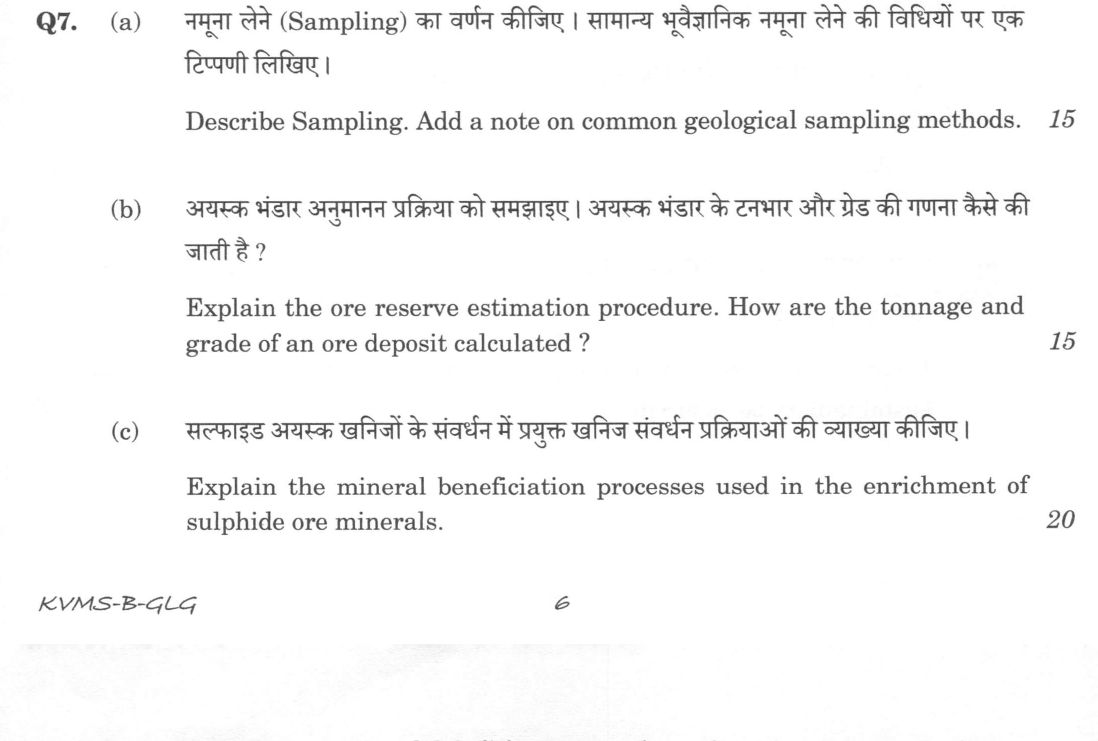
(a) Describe Sampling. Add a note on common geological sampling methods. (15 marks) (b) Explain the ore reserve estimation…
Describe Sampling. Add a note on common geological sampling methods. 15 marks
Explain the ore reserve estimation procedure. How are the tonnage and grade of an ore deposit calculated ? 15 marks
Explain the mineral beneficiation processes used in the enrichment of sulphide ore minerals. 20 marks
हिंदी में प्रश्न पढ़ें
नमूना लेने (Sampling) का वर्णन कीजिए। सामान्य भूवैज्ञानिक नमूना लेने की विधियों पर एक टिप्पणी लिखिए। (15 अंक)
अयस्क भंडार अनुमानन प्रक्रिया को समझाइए। अयस्क भंडार के टनभार और ग्रेड की गणना कैसे की जाती है? (15 अंक)
सल्फाइड अयस्क खनिजों के संवर्धन में प्रयुक्त खनिज संवर्धन प्रक्रियाओं की व्याख्या कीजिए। (20 अंक)
Model answer
Drafted with AI by UPSC Answer Check against this question's marking rubric, to the expected length. UPSC does not publish answers for Mains — this is one way to score well, not an official key. How we build rubrics and answers.
(a) Sampling and common geological sampling methods (15 marks)
Sampling. Sampling is the collection of a small part of a deposit that represents the whole, so that its grade, mineralogy and physical properties can be estimated. It is the basis of every later calculation, so the sample must be representative: each part of the deposit must have an equal chance of being included, and ore and gangue must be present in the same proportions as in the deposit. Errors from bias, contamination and poor spacing cannot be corrected later.
Sample size. The weight of a sample needed rises with the size of the largest particle and the irregularity of the mineralisation. The Richards–Czeczott relation Q = k d² (Q = minimum weight, d = diameter of the largest fragment, k = a constant that depends on the ore) shows that the weight must be reduced by crushing and splitting (coning and quartering, riffle splitting) in steps, and Gy's theory relates the fundamental error to particle size and sample mass.
Geological sampling methods.
- Grab: random pieces taken from a dump or face. It is cheap but unreliable.
- Chip: chips broken at regular points along a line or grid on the face. It is moderately reliable.
- Channel: a continuous groove of fixed width and depth cut across the face or vein, and the most reliable for surface and underground workings.
- Bulk: several tonnes, for metallurgical tests or for erratic ore.
- Core: cylinders of rock obtained by diamond drilling, reliable when recovery is high, and used for subsurface sampling.
- Sludge or cuttings: powder from percussion or rotary drilling. It is cheap, but the fines may be lost or contaminated from higher levels.
(b) Ore reserve estimation, tonnage and grade (15 marks)
Procedure.
- Collect data from geological mapping, drilling, sampling and assays, and measure the bulk density.
- Plot the data on plans and cross-sections and set the ore boundaries with a cut-off grade and minimum mining thickness.
- Divide the deposit into blocks and estimate the volume, tonnage and average grade of each.
- Sum the blocks, apply losses and dilution, and classify the reserves by confidence into proved (measured), probable (indicated) and possible (inferred), as in the UNFC system.
Tonnage. Tonnage = volume × bulk density, or volume divided by the tonnage factor (m³ per tonne). The volume of a block is the area multiplied by the thickness, from the cross-section, polygon or contour method.
Grade. The average grade is the weighted average G = Σ(gᵢwᵢ)/Σwᵢ, where gᵢ is the assay of a sample and wᵢ is the weight, taken as the sample length, thickness or tonnage. Metal content = tonnage × grade.
Estimation methods.
- Classical: the polygon (nearest-neighbour), triangle, cross-section and contour methods, and inverse-distance weighting.
- Geostatistical: kriging with a variogram, which gives the best unbiased estimate and an estimation variance.
(c) Beneficiation of sulphide ores (20 marks)
Beneficiation raises the metal content by removing gangue without changing the chemistry of the ore minerals. The flowsheet is as follows.
- Comminution and liberation: crushing (jaw, gyratory and cone crushers) and grinding (rod and ball mills) in closed circuit with cyclone classifiers frees the sulphide grains from the gangue. The grind size is set by the grain size of the intergrowth.
- Froth flotation: this is the main method for sulphides. The ground ore is made into a pulp with water, and the mineral surfaces are made hydrophobic by collectors (xanthates), while frothers (pine oil, MIBC) stabilise the air bubbles. Sulphide particles attach to the bubbles and rise into the froth, and the gangue sinks. Activators (copper sulphate for sphalerite), depressants (sodium cyanide, zinc sulphate for pyrite and sphalerite) and pH regulators (lime) give selectivity. Rougher, scavenger and cleaner stages raise recovery and grade.
- Selective (differential) flotation: for complex Cu–Pb–Zn ores, the minerals float in turn: copper and lead first with zinc and pyrite depressed, then sphalerite after activation with copper sulphate. In bulk flotation, a mixed concentrate is made and later separated.
- Dewatering: thickeners, filters and dryers produce a concentrate for smelting.
- Complementary methods: gravity methods (jigs, shaking tables, spirals, heavy-media separation) for coarse, dense galena; magnetic separation for pyrrhotite or magnetite; and hydrometallurgy, in which leaching (including bacterial leaching of low-grade copper sulphides), solvent extraction and electrowinning recover the metal.
- The tailings are thickened and stored safely.
How this answer will be evaluated
Evaluation rubric
Each sub-part is marked on its own, against the marks and word limit printed on the paper.
- (a) Describe sampling and add a note on common geological sampling methods (15 marks). 15 marks
Must cover
- Sampling defined, with the need for a representative sample
- Sample size: dependence on particle size, Richards–Czeczott Q = kd² or Gy's theory, and reduction by splitting
- Methods: grab, chip, channel, bulk, core, sludge
- Relative reliability of each method
Loses marks
- Naming methods with no comment on reliability.
- No discussion of sample size.
Earns more
- Channel identified as the most reliable surface method.
- Sources of error such as bias and contamination.
Extra mark
- Splitting by coning and quartering or riffling
- (b) Explain the ore reserve estimation procedure. How are the tonnage and grade of an ore deposit calculated? (15 marks). 15 marks
Must cover
- Steps: data collection, plotting, cut-off, blocking, calculation, classification
- Tonnage = volume × bulk density
- Weighted average grade, G = Σgw/Σw
- Estimation methods, classical and geostatistical (kriging)
Loses marks
- Giving grade as a simple average of assays.
- No estimation methods.
Earns more
- Classification into proved, probable and possible.
- Metal content = tonnage × grade.
Extra mark
- UNFC or JORC codes
- (c) Explain the mineral beneficiation processes used in the enrichment of sulphide ore minerals (20 marks). 20 marks
Must cover
- Comminution and liberation, with classification
- Froth flotation: principle and the roles of collector, frother, activator, depressant and pH
- Differential flotation for Cu–Pb–Zn ores and the cleaner and scavenger stages
- Dewatering; gravity, magnetic and hydrometallurgical methods
Loses marks
- Describing only gravity methods.
- Confusing beneficiation with smelting.
Earns more
- Named reagents such as xanthate, pine oil, copper sulphate and cyanide.
- Flowsheet order from crushing to concentrate and tailings.
Extra mark
- Bacterial leaching of low-grade sulphides
What "Describe" is asking you to do
Give a full, ordered account of the thing named — its parts, stages or mechanism — in the sequence in which it actually exists or occurs. Most describe questions come from the science optionals, where the marks sit in correct technical detail and, where the stem says so, a labelled diagram.
Structure that answers it
One-line identification of the subject → the parts or stages in their real order, each with its defining detail → labelled diagram where the subject is structural → closing line on function or significance
Where marks are lost
Loose general prose where the examiner is ticking named parts, correct terminology and their sequence; and in the General Studies papers, turning to evaluation before the description is finished.
Practice this exact question
Write your answer and it is marked point by point against the model answer above — what you covered, what you missed, what you got wrong.
Evaluate my answer →More from Geology 2026 Paper II
- Q4 (a) Discuss the primary processes involved in the formation of sedimentary rocks, emphasi…
- Q5 Answer the following questions in about 150 words each. (a) How is the 'Law of the Sea' r…
- Q6 (a) Explain the differences between ore, ore minerals and gangue, and discuss their signi…
- Q7 (a) Describe Sampling. Add a note on common geological sampling methods. (15 marks) (b) E…
- Q8 (a) What are the causes of earthquakes and volcanic activities ? Discuss their mitigation…