Paper II — Q8
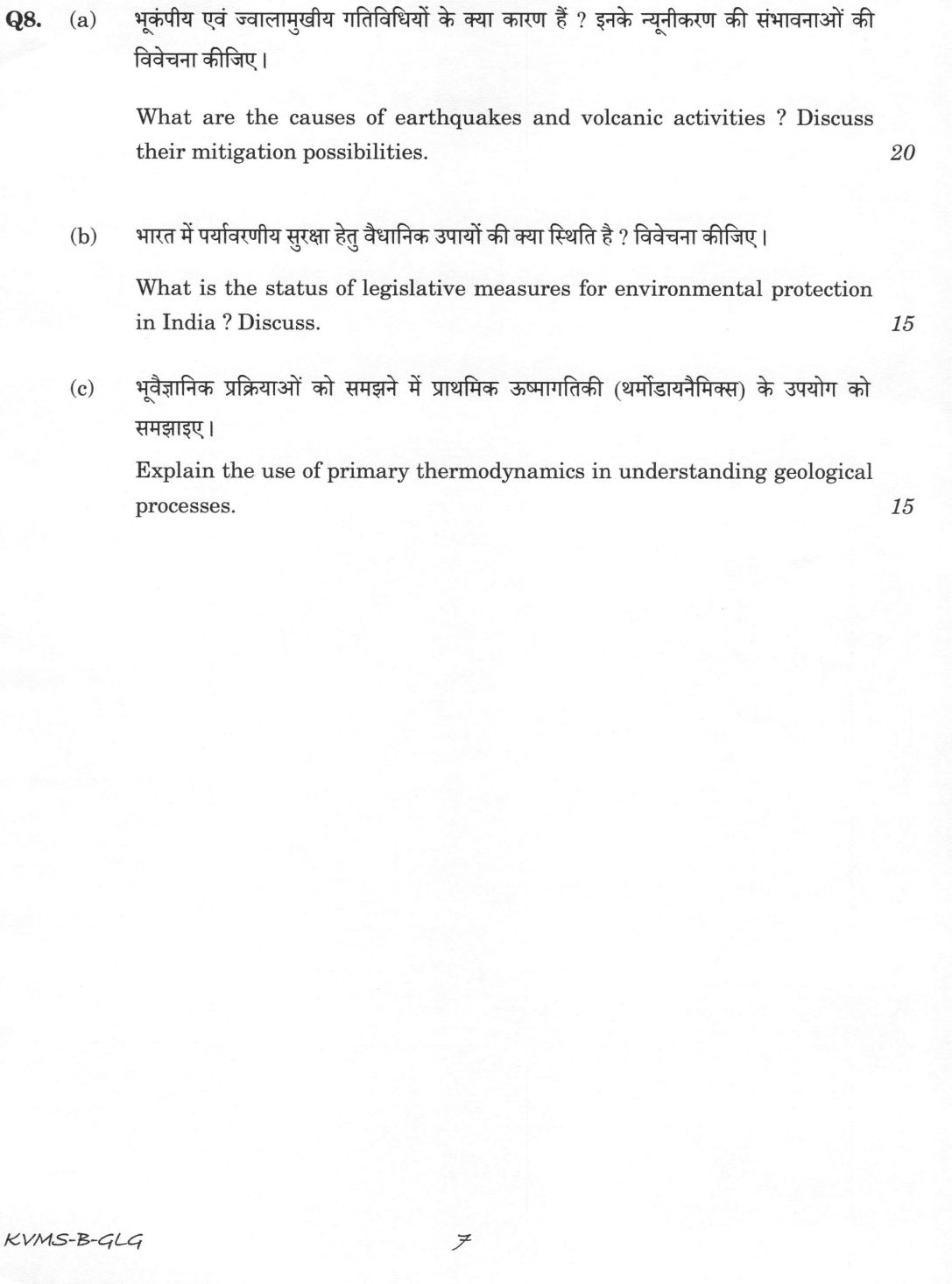
(a) What are the causes of earthquakes and volcanic activities ? Discuss their mitigation possibilities. (20 marks) (b) What is…
What are the causes of earthquakes and volcanic activities ? Discuss their mitigation possibilities. 20 marks
What is the status of legislative measures for environmental protection in India ? Discuss. 15 marks
Explain the use of primary thermodynamics in understanding geological processes. 15 marks
हिंदी में प्रश्न पढ़ें
भूकंपीय एवं ज्वालामुखीय गतिविधियों के क्या कारण हैं ? इनके न्यूनीकरण की संभावनाओं की विवेचना कीजिए। (20 अंक)
भारत में पर्यावरणीय सुरक्षा हेतु वैधानिक उपायों की क्या स्थिति है ? विवेचना कीजिए। (15 अंक)
भूवैज्ञानिक प्रक्रियाओं को समझने में प्राथमिक ऊष्मागतिकी (थर्मोडायनेमिक्स) के उपयोग को समझाइए। (15 अंक)
Model answer
Drafted with AI by UPSC Answer Check against this question's marking rubric, to the expected length. UPSC does not publish answers for Mains — this is one way to score well, not an official key. How we build rubrics and answers.
(a) Causes of earthquakes and volcanic activity and their mitigation (20 marks)
Causes of earthquakes.
- Tectonic: the sudden release of elastic strain along faults, as in the elastic-rebound theory, mostly at plate boundaries (subduction zones, transform faults, collision zones such as the Himalaya) and, less often, within plates.
- Volcanic: movement of magma and gas under a volcano.
- Induced: reservoir loading (as at Koyna), mining, deep fluid injection and nuclear tests; and collapse of caves and mines.
Causes of volcanic activity.
- Subduction zones: water released from the descending plate lowers the melting point of the mantle wedge, giving andesitic magma and arcs.
- Divergent boundaries: decompression melting of rising mantle, giving basalt at ridges and rifts.
- Hotspots and mantle plumes: hot mantle upwelling, as at Hawaii and the Deccan (Réunion).
- Eruption is driven by the buoyancy of magma and by exsolution and expansion of dissolved gases. India's only active volcano is Barren Island in the Andaman Sea.
Mitigation of earthquakes. Earthquakes cannot yet be predicted, so the measures are:
- Seismic zoning and microzonation, and land-use control on fault lines, unstable slopes and liquefiable soil.
- Earthquake-resistant design and construction under codes (IS 1893 and IS 4326), and retrofitting of old buildings.
- Early warning from seismic networks, public awareness, drills, insurance, and disaster-management plans under the NDMA.
Mitigation of volcanic hazards. Eruptions can often be forecast.
- Monitoring of seismicity, ground deformation, gas emission and temperature.
- Hazard maps and exclusion zones, evacuation plans and warning.
- Diverting lava, protecting water supply and airline routes from ash.
(b) Status of legislative measures for environmental protection in India (15 marks)
Constitutional basis. Article 48A (a directive principle) and Article 51A(g) (a fundamental duty) were added by the 42nd Amendment in 1976. The Supreme Court has read a right to a healthy environment into Article 21, and Article 253 lets Parliament legislate to implement international treaties.
Statutes and rules.
- Wildlife (Protection) Act 1972, Water (Prevention and Control of Pollution) Act 1974, Forest (Conservation) Act 1980 (as amended in 2023) and Air (Prevention and Control of Pollution) Act 1981.
- Environment (Protection) Act 1986, the umbrella act after the Bhopal gas tragedy, with the rules under it: the EIA Notification 2006, the CRZ Notification 2019, and the rules on hazardous waste, solid waste and plastic waste.
- Public Liability Insurance Act 1991, Biological Diversity Act 2002, Forest Rights Act 2006 and National Green Tribunal Act 2010.
Judicial principles. Polluter pays, the precautionary principle (Vellore Citizens' Welfare Forum), absolute liability (M.C. Mehta), the public trust doctrine and sustainable development.
Institutions. The Ministry of Environment, Forest and Climate Change, the Central and State Pollution Control Boards, and the National Green Tribunal.
Assessment. The framework is comprehensive, yet implementation is weaker: SPCBs are short of staff and resources, enforcement and compliance with EIA conditions are poor, and agencies overlap. Recent reforms that decriminalise some offences and ease clearances are debated for their effect on deterrence. The need is strong enforcement, transparent and participatory clearance, and better monitoring.
(c) Use of primary thermodynamics in understanding geological processes (15 marks)
Thermodynamics tells us which minerals and assemblages are stable under given pressure, temperature and composition.
- Free-energy criterion: Gibbs free energy G = H − TS. A reaction proceeds if ΔG < 0, and equilibrium exists when ΔG = 0, so ΔG° = −RT ln K, with ΔG = ΔH − TΔS + ΔV(P − 1).
- Clapeyron equation: dP/dT = ΔS/ΔV = ΔH/TΔV gives the slope of a reaction line in P–T space. This is used for polymorphs such as graphite and diamond, and the Al₂SiO₅ polymorphs (kyanite, sillimanite and andalusite), and for the melting curve of a mineral.
- Phase rule: F = C − P + 2 gives the degrees of freedom, and Goldschmidt's mineralogical phase rule (P ≤ C) applies to rocks in equilibrium.
- Chemical potential and activity: it controls the distribution of components between phases, and so the composition of solid solutions.
- Applications: petrogenetic grids and pseudosections for metamorphic facies; geothermobarometry, such as Fe–Mg exchange between garnet and biotite (temperature) and the GASP assemblage (pressure); oxygen fugacity buffers such as QFM; and melting relations, including eutectics and the solidus.
Limitations. Thermodynamics gives equilibrium, not rates, so kinetic barriers lead to metastable phases such as diamond and aragonite at the surface, and disequilibrium textures.
How this answer will be evaluated
Evaluation rubric
Each sub-part is marked on its own, against the marks and word limit printed on the paper.
- (a) What are the causes of earthquakes and volcanic activities? Discuss their mitigation possibilities (20 marks). 20 marks
Must cover
- Causes of earthquakes: tectonic elastic rebound, volcanic, induced and collapse
- Causes of volcanism: subduction, divergent boundaries, hotspots and plumes, with gas-driven eruption
- Earthquake mitigation: zoning, seismic design codes, retrofitting, early warning, preparedness
- Volcanic mitigation: monitoring, hazard maps, evacuation, lava diversion
Loses marks
- Answering on earthquakes alone.
- Claiming that earthquakes can be predicted reliably.
Earns more
- Indian examples such as Koyna or Barren Island.
- Both earthquakes and volcanoes covered under both causes and mitigation.
Extra mark
- Distinction between prediction and forecast
- (b) What is the status of legislative measures for environmental protection in India? Discuss (15 marks). 15 marks
Must cover
- Constitutional basis: Articles 48A, 51A(g), 21 and 253
- Principal statutes: Water Act 1974, Air Act 1981, Environment (Protection) Act 1986, Wildlife, Forest and Biodiversity Acts, NGT Act 2010
- Judicial principles: polluter pays, precaution, absolute liability, public trust
- Institutions and an assessment of implementation gaps
Loses marks
- Listing acts with no assessment of status.
- Naming wrong dates or omitting the Environment (Protection) Act 1986.
Earns more
- Rules such as the EIA Notification 2006 and CRZ Notification 2019.
- Balanced assessment of law against enforcement.
Extra mark
- Recent decriminalisation and forest-law amendments and the debate on them
- (c) Explain the use of primary thermodynamics in understanding geological processes (15 marks). 15 marks
Must cover
- Free-energy criterion: G = H − TS, ΔG < 0 for spontaneity, ΔG = 0 at equilibrium
- Clapeyron equation dP/dT = ΔS/ΔV and slopes of reaction lines, with the Al₂SiO₅ or graphite–diamond example
- Phase rule and chemical potential
- Applications: petrogenetic grids, geothermobarometry, fugacity buffers, melting; limitation by kinetics
Loses marks
- Only stating the laws with no geological use.
- Confusing thermodynamics with kinetics.
Earns more
- Named geothermobarometer such as garnet–biotite or GASP.
- Metastability as a limit to equilibrium thermodynamics.
Extra mark
- Use of ΔG° = −RT ln K
What "Discuss" is asking you to do
Lay the issue out from more than one side — how it arose, what is claimed for it, what is held against it, and where it now stands. UPSC attaches discuss to broad topics with several live dimensions, so coverage of the dimensions earns more than the strength of your opinion.
Structure that answers it
Set the issue up → the case as it is made → the case against → the dimension both sides leave out → where the balance now lies
Where marks are lost
Listing facts with no thread between them, or arguing one side throughout and calling it a discussion.
Practice this exact question
Write your answer and it is marked point by point against the model answer above — what you covered, what you missed, what you got wrong.
Evaluate my answer →More from Geology 2026 Paper II
- Q5 Answer the following questions in about 150 words each. (a) How is the 'Law of the Sea' r…
- Q6 (a) Explain the differences between ore, ore minerals and gangue, and discuss their signi…
- Q7 (a) Describe Sampling. Add a note on common geological sampling methods. (15 marks) (b) E…
- Q8 (a) What are the causes of earthquakes and volcanic activities ? Discuss their mitigation…