Paper II — Q4
(a) Discuss the primary processes involved in the formation of sedimentary rocks, emphasizing the role of diagenesis and…
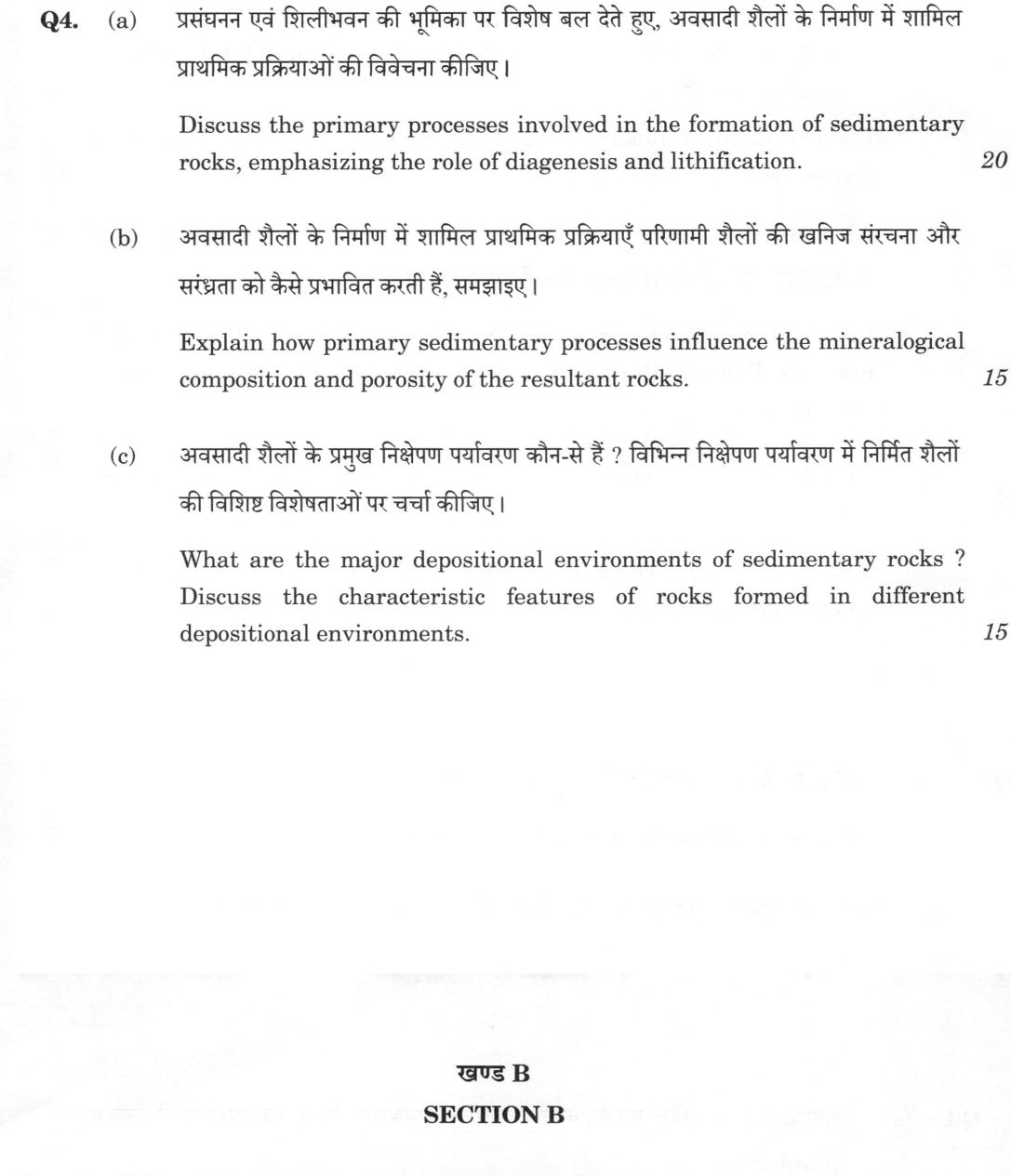
Discuss the primary processes involved in the formation of sedimentary rocks, emphasizing the role of diagenesis and lithification. 20 marks
Explain how primary sedimentary processes influence the mineralogical composition and porosity of the resultant rocks. 15 marks
What are the major depositional environments of sedimentary rocks ? Discuss the characteristic features of rocks formed in different depositional environments. 15 marks
हिंदी में प्रश्न पढ़ें
प्रसंघनन एवं शिलीभवन की भूमिका पर विशेष बल देते हुए, अवसादी शैलों के निर्माण में शामिल प्राथमिक प्रक्रियाओं की विवेचना कीजिए। (20 अंक)
अवसादी शैलों के निर्माण में शामिल प्राथमिक प्रक्रियाएँ परिणामी शैलों की खनिज संरचना और संरंध्रता को कैसे प्रभावित करती हैं, समझाइए। (15 अंक)
अवसादी शैलों के प्रमुख निक्षेपण पर्यावरण कौन-से हैं ? विभिन्न निक्षेपण पर्यावरण में निर्मित शैलों की विशिष्ट विशेषताओं पर चर्चा कीजिए। (15 अंक)
Model answer
Drafted with AI by UPSC Answer Check against this question's marking rubric, to the expected length. UPSC does not publish answers for Mains — this is one way to score well, not an official key. How we build rubrics and answers.
(a) Primary processes in the formation of sedimentary rocks, with emphasis on diagenesis and lithification (20 marks)
The formation of a sedimentary rock follows a chain: weathering, erosion, transport, deposition, and diagenesis, which ends in lithification.
- Weathering: physical (frost, thermal and salt action) and chemical (hydrolysis, oxidation, solution) breakdown of source rock into detritus and dissolved ions.
- Erosion and transport: water, wind, ice and gravity move the material. Transport rounds and sorts grains, and it removes weaker minerals such as feldspar and mica, so the sediment becomes more mature.
- Deposition: settling of grains when energy falls, and precipitation of chemical or biochemical sediments such as limestone, evaporite and chert.
Diagenesis. Diagenesis covers all physical, chemical and biological changes after burial, at low temperature (below about 200°C) and pressure, short of metamorphism. It is divided into eodiagenesis (shallow, near the surface), mesodiagenesis (deep burial) and telodiagenesis (after uplift).
- Compaction: the weight of overburden squeezes out water and reduces porosity from about 50–60% in mud to below 10% at 3–4 km. Pressure solution at grain contacts forms sutured contacts and stylolites.
- Cementation: precipitation of calcite, silica, iron oxide or clay in pores binds the grains, using material from pressure solution or pore water.
- Recrystallisation and replacement: aragonite converts to calcite, and dolomitisation and silicification replace the original minerals.
- Dissolution: removal of unstable grains or cement creates secondary porosity.
- Authigenesis: new minerals grow in place, for example glauconite, pyrite and clays.
- Organic changes: peat matures to lignite and coal, and kerogen to oil and gas.
Lithification is the conversion of loose sediment into hard rock by compaction and cementation. Diagenesis thus turns sediment into rock and controls the final porosity, permeability and reservoir quality.
(b) Effect of primary processes on mineralogy and porosity (15 marks)
Mineralogical composition.
- Provenance sets the initial mineral supply: granite gives quartz and feldspar, basalt gives lithic grains.
- Climate and relief control weathering. In warm, humid, low-relief regions, chemical weathering removes feldspar and leaves quartz and clay. In cold or arid, steep regions, feldspar survives.
- Long transport abrades soft minerals, and reworking on beaches and dunes concentrates quartz. This gives compositional maturity, the sequence being arkose and lithic arenite (immature) to quartz arenite (mature).
- Sorting by energy separates heavy minerals, sand and mud.
Porosity.
- Porosity depends on sorting, packing, rounding and matrix. Cubic packing of equal spheres gives 47.6% porosity and rhombohedral packing gives 26%, independent of grain size.
- High-energy deposits, such as beach and dune sands, are well sorted and clean, so they have high porosity and permeability. Low-energy or rapidly deposited sediments, such as greywackes, are poorly sorted with matrix filling the pores, so they have low porosity.
- Later compaction and cementation reduce porosity.
Textural maturity therefore reflects clay content, sorting and rounding, and compositional maturity reflects the quartz content.
(c) Depositional environments and characteristic features (15 marks)
Classification. The environments are continental (fluvial, alluvial fan, lacustrine, aeolian, glacial), transitional (deltaic, estuarine, lagoonal, tidal flat, beach) and marine (shelf, reef, slope and deep sea).
Characteristic features.
- Fluvial: cross-bedded sandstone, channel conglomerate, fining-upward cycles, ripples, plant fossils.
- Alluvial fan: poorly sorted, angular conglomerate and breccia from debris flows.
- Lacustrine: fine laminated shale and varves, evaporites, freshwater fossils such as fish and ostracods.
- Aeolian: well-sorted, rounded, frosted grains, with large-scale cross-bedding.
- Glacial: tillite, unsorted with striated clasts, and dropstones in varved clays.
- Deltaic: coarsening-upward sequence with topset, foreset and bottomset beds, and coal.
- Beach: well-sorted sand with low-angle cross-bedding and swash marks.
- Tidal flat: herringbone cross-bedding, flaser bedding, mud cracks.
- Reef: massive limestone with corals and algae.
- Shelf: fossiliferous limestone and shale, with hummocky cross-stratification.
- Deep sea: turbidites showing graded bedding, Bouma sequence and flute casts, and siliceous or calcareous ooze.
How this answer will be evaluated
Evaluation rubric
Each sub-part is marked on its own, against the marks and word limit printed on the paper.
- (a) Discuss the primary processes involved in the formation of sedimentary rocks, emphasising the role of diagenesis and lithification (20 marks). 20 marks
Must cover
- Chain of weathering, erosion, transport and deposition, each briefly explained
- Diagenesis defined, with its stages: eodiagenesis, mesodiagenesis, telodiagenesis
- Compaction, cementation, recrystallisation, replacement, dissolution and authigenesis with examples
- Lithification as compaction plus cementation, with its control on porosity
Loses marks
- Describing weathering and transport only.
- Confusing diagenesis with metamorphism.
Earns more
- Emphasis on diagenesis rather than a general survey.
- Pressure solution, stylolites and cement types named.
Extra mark
- Organic maturation to coal and hydrocarbons
- (b) Explain how primary sedimentary processes influence the mineralogical composition and porosity of the resultant rocks (15 marks). 15 marks
Must cover
- Provenance, climate and relief control on the mineral supply
- Transport and sorting, giving compositional and textural maturity
- Porosity controlled by packing, sorting, rounding and matrix, with cubic 47.6% and rhombohedral 26%
- High-energy against low-energy deposits, and later compaction and cementation
Loses marks
- Treating composition and porosity as unrelated to the process.
- Wrong porosity figures.
Earns more
- Rock types linked to maturity, such as arkose, greywacke and quartz arenite.
- Statement that porosity is independent of grain size for uniform spheres.
Extra mark
- Reservoir significance
- (c) What are the major depositional environments of sedimentary rocks? Discuss the characteristic features of rocks formed in different depositional environments (15 marks). 15 marks
Must cover
- Classification into continental, transitional and marine environments
- Continental features: fluvial, alluvial fan, lacustrine, aeolian, glacial
- Transitional and marine features: deltaic, beach, tidal flat, reef, shelf, deep-sea turbidites
- Diagnostic lithology, structure and fossils for each
Loses marks
- Listing environments without features.
- Placing tillite in a marine setting.
Earns more
- Sedimentary structures such as cross-bedding, graded bedding and mud cracks.
- Fossil evidence used to separate marine from freshwater.
Extra mark
- Facies-sequence ideas such as fining-upward or coarsening-upward cycles
What "Discuss" is asking you to do
Lay the issue out from more than one side — how it arose, what is claimed for it, what is held against it, and where it now stands. UPSC attaches discuss to broad topics with several live dimensions, so coverage of the dimensions earns more than the strength of your opinion.
Structure that answers it
Set the issue up → the case as it is made → the case against → the dimension both sides leave out → where the balance now lies
Where marks are lost
Listing facts with no thread between them, or arguing one side throughout and calling it a discussion.
Practice this exact question
Write your answer and it is marked point by point against the model answer above — what you covered, what you missed, what you got wrong.
Evaluate my answer →More from Geology 2026 Paper II
- Q1 Answer the following questions in about 150 words each. (a) Describe the classification o…
- Q2 (a) Describe common minerals of igneous and metamorphic rocks, and the diagnostic feature…
- Q3 (a) Discuss the petrogenesis of carbonatite rocks. (15 marks) (b) What is metasomatic rep…
- Q4 (a) Discuss the primary processes involved in the formation of sedimentary rocks, emphasi…
- Q5 Answer the following questions in about 150 words each. (a) How is the 'Law of the Sea' r…
- Q6 (a) Explain the differences between ore, ore minerals and gangue, and discuss their signi…
- Q7 (a) Describe Sampling. Add a note on common geological sampling methods. (15 marks) (b) E…