Paper I — Q1
Identify the following places marked on the map supplied to you and write a short note of about 30 words on each of them in your…
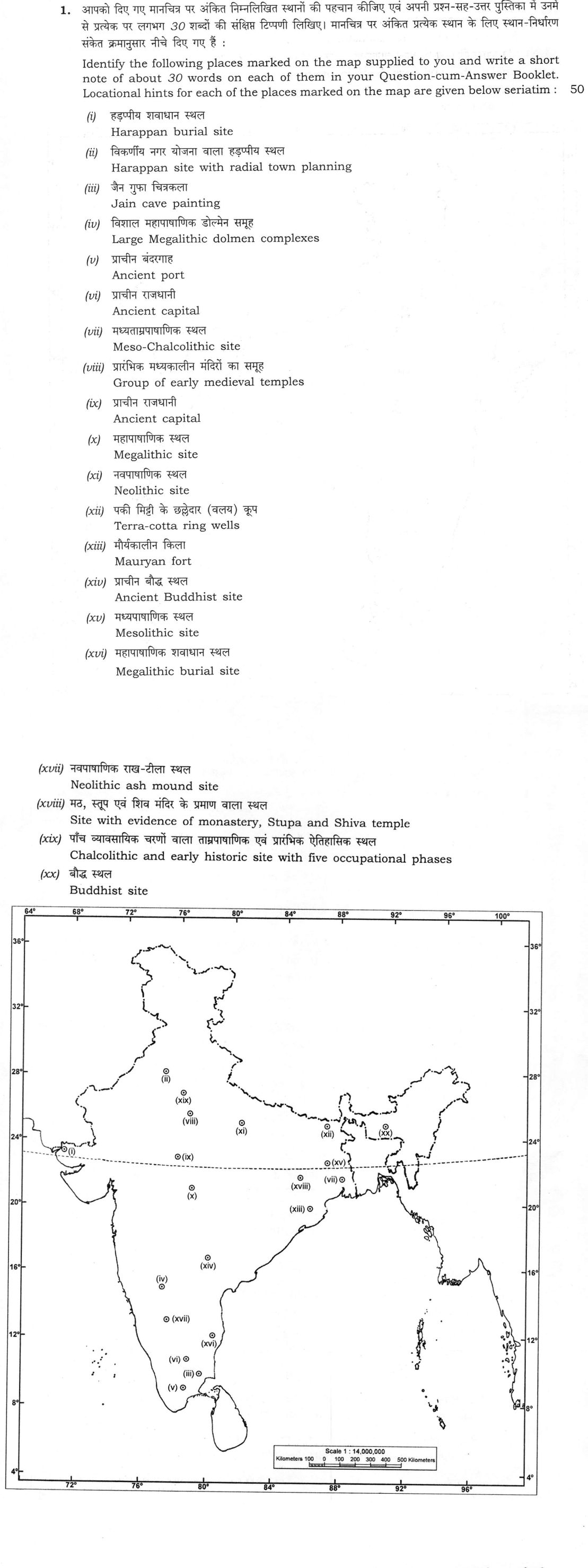
Identify the following places marked on the map supplied to you and write a short note of about 30 words on each of them in your Question-cum-Answer Booklet. Locational hints for each of the places marked on the map are given below seriatim : Harappan burial site
Harappan site with radial town planning
Jain cave painting
Large Megalithic dolmen complexes
Ancient port
Ancient capital
Meso-Chalcolithic site
Group of early medieval temples
Ancient capital
Megalithic site (xi) Neolithic site (xii) Terra-cotta ring wells (xiii) Mauryan fort (xiv) Ancient Buddhist site (xv) Mesolithic site (xvi) Megalithic burial site (xvii) Neolithic ash mound site (xviii) Site with evidence of monastery, Stupa and Shiva temple (xix) Chalcolithic and early historic site with five occupational phases (xx) Buddhist site 50 marks
हिंदी में प्रश्न पढ़ें
आपको दिए गए मानचित्र पर अंकित निम्नलिखित स्थानों की पहचान कीजिए एवं अपनी प्रश्न-सह-उत्तर पुस्तिका में उनमें से प्रत्येक पर लगभग 30 शब्दों की संक्षिप्त टिप्पणी लिखिए। मानचित्र पर अंकित प्रत्येक स्थान के लिए स्थान-निर्धारण संकेत क्रमानुसार नीचे दिए गए हैं : हड़प्पीय शवाधान स्थल
अरीय (रेडियल) नगर योजना वाला हड़प्पीय स्थल
जैन गुफा चित्रकला
विशाल महापाषाणिक डोल्मेन समूह
प्राचीन बंदरगाह
प्राचीन राजधानी
मध्यताम्रपाषाणिक स्थल
प्रारंभिक मध्यकालीन मंदिरों का समूह
प्राचीन राजधानी
महापाषाणिक स्थल (xi) नवपाषाणिक स्थल (xii) पकी मिट्टी के छल्लेदार (वलय) कूप (xiii) मौर्यकालीन किला (xiv) प्राचीन बौद्ध स्थल (xv) मध्यपाषाणिक स्थल (xvi) महापाषाणिक शवाधान स्थल (xvii) नवपाषाणिक राख-टीला स्थल (xviii) मठ, स्तूप एवं शिव मंदिर के प्रमाण वाला स्थल (xix) पाँच आवासीय चरणों वाला ताम्रपाषाणिक एवं प्रारंभिक ऐतिहासिक स्थल (xx) बौद्ध स्थल (50 अंक)
Model answer
Drafted with AI by UPSC Answer Check against this question's marking rubric, to the expected length. UPSC does not publish answers for Mains — this is one way to score well, not an official key. How we build rubrics and answers.
(i) Juna Khatiya (Kachchh, Gujarat) Early Harappan cemetery with numerous graves containing pottery and other grave goods; important evidence for Harappan funerary practices and social structure in Kachchh.
(ii) Banawali (Fatehabad, Haryana) Fortified Harappan town excavated by R. S. Bisht from 1974; its radial street plan departs from the usual grid; yielded a terracotta plough model and street soakage jars.
(iii) Sittannavasal (Pudukkottai, Tamil Nadu) Rock-cut Jaina cave (Arivar Koil) with a Pandya-period fresco-secco ceiling painting of the Samavasarana lotus tank with fish and geese; nearby Jaina stone beds bear Tamil-Brahmi inscriptions.
(iv) Hire Benakal (Koppal, Karnataka) About 400 Iron Age granite dolmens and passage-chamber tombs (c. 800–200 BCE), among the largest megalithic necropolises of south India; on UNESCO's Tentative List since 2021.
(v) Korkai (Thoothukudi, Tamil Nadu) Early Pandya port on the Tamraparni, identified with the Kolkhoi of the Periplus; famed for its pearl fishery and overseas trade; now several kilometres inland owing to silting.
(vi) Karur (Karur, Tamil Nadu) Sangam-age Chera capital (Karuvur) on the Amaravati river; a major commercial centre where Chera, Roman and punch-marked coins have been found, confirming its place in ancient trade.
(vii) Pandu Rajar Dhibi (Purba Bardhaman, West Bengal) Chalcolithic settlement in the Ajay valley excavated by P. C. Dasgupta (1962–65); yielded rice, copper objects, Black-and-Red Ware and human burials.
(viii) Batesvar–Padavali (Morena, Madhya Pradesh) Group of about 200 small sandstone Shaiva and Vaishnava temples of the Gurjara-Pratihara period (8th–10th centuries CE), re-erected by the ASI; a key example of early medieval temple architecture.
(ix) Ujjain (Ujjayini, Madhya Pradesh) Capital of the Avanti mahajanapada on the Shipra; a major political, commercial and religious centre associated with Mahakala worship, and important under the Mauryas and Guptas.
(x) Junapani–Mahurjhari (Nagpur, Maharashtra) Representative sites of Vidarbha megalithic culture; the c. 300 stone circles (cairn burials) at Junapani yielded iron tools, horse bits and black-and-red ware, illuminating Iron Age funerary practice.
(xi) Koldihwa (Prayagraj, Uttar Pradesh) Belan-valley Neolithic site excavated by G. R. Sharma; cord-impressed pottery and rice husk in potsherds; its early rice date is disputed, but it is key to early Ganga-basin farming.
(xii) Bangarh (Dakshin Dinajpur, West Bengal) Ancient Kotivarsha, a fortified early historic city occupied from the Maurya to the Pala period; excavated by K. G. Goswami (1938–41); yielded terracotta ring wells, NBPW and terracotta plaques.
(xiii) Sisupalgarh (Khordha, Odisha) Early historic fortified city excavated by B. B. Lal in 1948; a near-square rampart with gateways, dated to the Mauryan–early historic period; major evidence of planned urban defence in Kalinga.
(xiv) Nagarjunakonda (Palnadu, Andhra Pradesh) Vijayapuri, the Ikshvaku capital (3rd–4th centuries CE) and a major Buddhist centre with stupas and viharas; its limestone reliefs represent the late Amaravati school; now largely submerged by Nagarjuna Sagar.
(xv) Birbhanpur (Paschim Bardhaman, West Bengal) Type Mesolithic site of Bengal on the Damodar, excavated by B. B. Lal in 1954; yielded non-geometric microliths on quartz and chert, with post-holes suggesting simple huts.
(xvi) Pallavaram (Chengalpattu, Tamil Nadu) Megalithic burial site with urn and cist burials and black-and-red ware; also where Robert Bruce Foote found India's first recognised Palaeolithic handaxe in 1863.
(xvii) Utnur (Mahabubnagar, Telangana) Type site of the Southern Neolithic ash mounds, excavated by F. R. Allchin in 1957; the mounds are vitrified heaps of burnt cattle dung within stockaded pens, evidence of early pastoralism.
(xviii) Sirpur (Mahasamund, Chhattisgarh) Ancient Sripura, capital of the Panduvamshis of Dakshina Kosala; Buddhist viharas and a stupa stand beside the brick Lakshmana temple and the Gandheshwar Shiva temple, showing religious coexistence.
(xix) Noh (Bharatpur, Rajasthan) Excavated by R. C. Agrawala; five successive phases: Ochre Coloured Pottery, Black-and-Red Ware, Painted Grey Ware, NBPW and Kushana-Gupta, a clear cultural sequence.
(xx) Sri Surya Pahar (Goalpara, Assam) Principal Buddhist archaeological site of the Brahmaputra valley, with scores of rock-cut votive stupas alongside Jaina and Shaiva images.
How this answer will be evaluated
Evaluation rubric
Each sub-part is marked on its own, against the marks and word limit printed on the paper.
- (a) A compulsory 50-mark map question: twenty places (i)-(xx) are dotted on the printed outline map of India and a locational/typological hint is given for each seriatim. For every one of the twenty the candidate must (a) name the site correctly, (b) place it (present district and State), and (c) write a c.30-word note on its archaeological or historical significance. Nothing may be left out and nothing extra is asked. 50 marks
Must cover
- Juna Khatiya (Kachchh, Gujarat) - Early Harappan cemetery
- Banawali (Fatehabad, Haryana) - radial street plan, R. S. Bisht
- Sittannavasal (Pudukkottai, Tamil Nadu) - Pandya Jaina fresco, Samavasarana
- Hire Benakal (Koppal, Karnataka) - c. 400 dolmens
- Korkai (Thoothukudi, Tamil Nadu) - Pandya port, Kolkhoi of the Periplus
- Karur/Karuvur (Karur, Tamil Nadu) - Chera capital
- Pandu Rajar Dhibi (Purba Bardhaman, West Bengal) - Chalcolithic, P. C. Dasgupta
- Batesvar-Padavali (Morena, Madhya Pradesh) - c. 200 Pratihara temples
- Ujjain/Ujjayini (Madhya Pradesh) - Avanti mahajanapada capital
- Junapani-Mahurjhari (Nagpur, Maharashtra) - Vidarbha megaliths
- Koldihwa/Mahagara (Prayagraj, UP) - Neolithic rice, date disputed
- Bangarh/Kotivarsha (Dakshin Dinajpur, West Bengal) - ring wells, NBPW
- Sisupalgarh (Khordha, Odisha) - early historic rampart, B. B. Lal 1948
- Nagarjunakonda/Vijayapuri (Andhra Pradesh) - Ikshvaku Buddhist capital
- Birbhanpur (Paschim Bardhaman, West Bengal) - Mesolithic microliths, B. B. Lal 1954
- Pallavaram/Amirthamangalam (Tamil Nadu) - megalithic urn and cist burials
- Utnur (Mahabubnagar, Telangana)/Kupgal/Palavoy - Neolithic ash mounds, F. R. Allchin 1957
- Sitagarha/Lalitgiri/Sirpur - monastery, stupa and Shiva temple together
- Noh (Bharatpur, Rajasthan) - OCP, BRW, PGW, NBPW, Kushana: five phases
- Sri Surya Pahar (Goalpara, Assam) - rock-cut votive stupas
Loses marks
- Writing a long essay on one or two famous sites and leaving six or eight entries blank - each site carries its own marks, so a blank entry is a dead loss of 2.5 marks.
- Naming the site but omitting the present district/State, or omitting the period/culture - the note must contain name, location and significance to earn full credit.
- Confusing culture labels: calling Bagor/Birbhanpur 'Neolithic', calling an ash mound 'megalithic', or describing Sisupalgarh/Jaugada as 'Gupta' rather than Mauryan-early historic.
- Exceeding 30 words per note and running out of time before (xx); or renumbering the entries so that the examiner cannot match note to hint.
- Asserting disputed dates as fact - e.g. giving 6500 BCE for Koldihwa rice or calling the Sanauli/Sanauli-type coffin vehicles 'spoked chariots' - without flagging the dispute.
Earns more
- (iii) Jain cave painting = SITTANNAVASAL, Pudukkottai district, Tamil Nadu - Arivar Koil rock-cut Jaina temple; Pandya-period (9th century CE, reign of Srimara Srivallabha) fresco-secco ceiling painting of the Samavasarana lotus tank with fish, geese and lotus-gatherers; Eladipattam stone beds with Tamil-Brahmi. (iv) Large Megalithic dolmen complexes = HIRE BENAKAL ('Moryara Gudda'), Koppal district, Karnataka - about 400 granite dolmens/passage-chamber tombs of the Iron Age (c. 800-200 BCE); on UNESCO's Tentative List since 2021.
- (v) Ancient port = KORKAI, Thoothukudi district, Tamil Nadu - early Pandya port on the Tamraparni, the Kolkhoi of the Periplus and Ptolemy, famed for pearl fishery; now c. 6 km inland through delta progradation; excavated 1968 (accept ALAGANKULAM, Ramanathapuram district, the Vaigai-mouth port with Roman amphorae and rouletted ware, if the dot is read further north-east). (vi) Ancient capital = KARUR (Karuvur/Vanji), Karur district, Tamil Nadu - Sangam-age Chera capital on the Amaravati; Chera, Roman and punch-marked coins (accept URAIYUR, the early Chola capital at Tiruchirappalli).
- (vii) Meso-Chalcolithic site = PANDU RAJAR DHIBI, Ausgram, Purba Bardhaman district, West Bengal - Ajay-valley Chalcolithic settlement excavated 1962-65 by P. C. Dasgupta; Black-and-Red Ware, copper, rice and burials (accept MAHISDAL, Birbhum district, or BHARATPUR in the Damodar valley). (viii) Group of early medieval temples = BATESVAR (Bateshwar)-PADAVALI group, Morena district, Madhya Pradesh - c. 200 small Gurjara-Pratihara sandstone temples of the 8th-10th centuries, re-erected by the ASI (accept OSIAN, Jodhpur district, Rajasthan).
- (xi) Neolithic site = KOLDIHWA (with neighbouring Mahagara), Belan valley, Prayagraj district, Uttar Pradesh - cord-impressed handmade pottery, celts and rice husk in potsherds; G. R. Sharma's c. 6500 BCE date is widely disputed and a 2nd-millennium BCE date is now preferred (accept LAHURADEWA, Sant Kabir Nagar district, UP). (xii) Terra-cotta ring wells = BANGARH (ancient Kotivarsha/Devikot), Gangarampur, Dakshin Dinajpur district, West Bengal - fortified early historic city, Maurya to Pala, excavated by K. G. Goswami 1938-41; NBPW, terracotta plaques and ring wells (accept CHANDRAKETUGARH or CHIRAND).
- (xv) Mesolithic site = BIRBHANPUR, on the Damodar near Durgapur, Paschim Bardhaman district, West Bengal - non-geometric microlithic industry on quartz and chert, excavated by B. B. Lal in 1954; the type Mesolithic site of Bengal. (xvi) Megalithic burial site = the Chennai-Chengalpattu-Tiruvallur megalithic cemetery belt of Tamil Nadu, most probably PALLAVARAM/AMIRTHAMANGALAM (accept KUNNATTUR, PERUMBAIR or SANUR) - Iron Age cists, dolmens and urn burials with black-and-red ware and iron; Pallavaram is also where Robert Bruce Foote found India's first Palaeolithic handaxe in 1863.
- (xvii) Neolithic ash mound site = a Southern Neolithic ash mound of the Raichur-Bellary-Anantapur belt: PALAVOY (Anantapur district, Andhra Pradesh) or KUPGAL/SANGANAKALLU (Ballari district, Karnataka); ash mounds are vitrified heaps of burnt cattle-dung from cattle pens, the type-site being UTNUR (Mahabubnagar district, Telangana) excavated by F. R. Allchin in 1957 - accept any of these with the correct explanation. (xviii) Site with monastery, stupa and Shiva temple = an eastern Indian mixed complex; in the Jharkhand-Odisha belt accept SITAGARHA (Hazaribagh district, Jharkhand) or the Odisha Diamond Triangle sites LALITGIRI/UDAYAGIRI (Jajpur district); the classic textbook example of monastery + stupa + Shiva (Gandheshwar) temple is SIRPUR/Sripura, Mahasamund district, Chhattisgarh.
- (xix) Chalcolithic and early historic site with five occupational phases = NOH, Bharatpur district, Rajasthan - excavated by R. C. Agrawala (1963-67); five successive cultures: Ochre Coloured Pottery, Black-and-Red Ware, Painted Grey Ware, Northern Black Polished Ware and Kushana-Gupta (accept JODHPURA, Jaipur district, Rajasthan). (xx) Buddhist site = SRI SURYA PAHAR, Goalpara district, Assam - hillside with scores of rock-cut votive stupas together with Jaina and Shaiva images, the principal Buddhist archaeological site of the Brahmaputra valley (accept HAJO, Kamrup district, revered by Bhutanese and Tibetan Buddhists).
What "Identify" is asking you to do
Pick out the particular instances that satisfy the question's test and name them precisely, with just enough against each to show it qualifies. A wrong pick earns nothing however well written, so the selection itself is the exercise.
Structure that answers it
The test an instance has to meet → instance named → the single line showing it meets the test → the same for each further instance
Where marks are lost
Describing the instances at length while never establishing why each one belongs in the set.
Practice this exact question
Write your answer and it is marked point by point against the model answer above — what you covered, what you missed, what you got wrong.
Evaluate my answer →More from History 2026 Paper I
- Q1 Identify the following places marked on the map supplied to you and write a short note of…
- Q2 (a) Analyze the role of terrain, climate and vegetation in shaping the settlement and mov…
- Q3 (a) “The Iranian and Macedonian invasions reshaped ancient India through administrative i…
- Q4 (a) “Hoysala temple architecture marks a distinctive and innovative phase in the evolutio…