Paper I — Q4
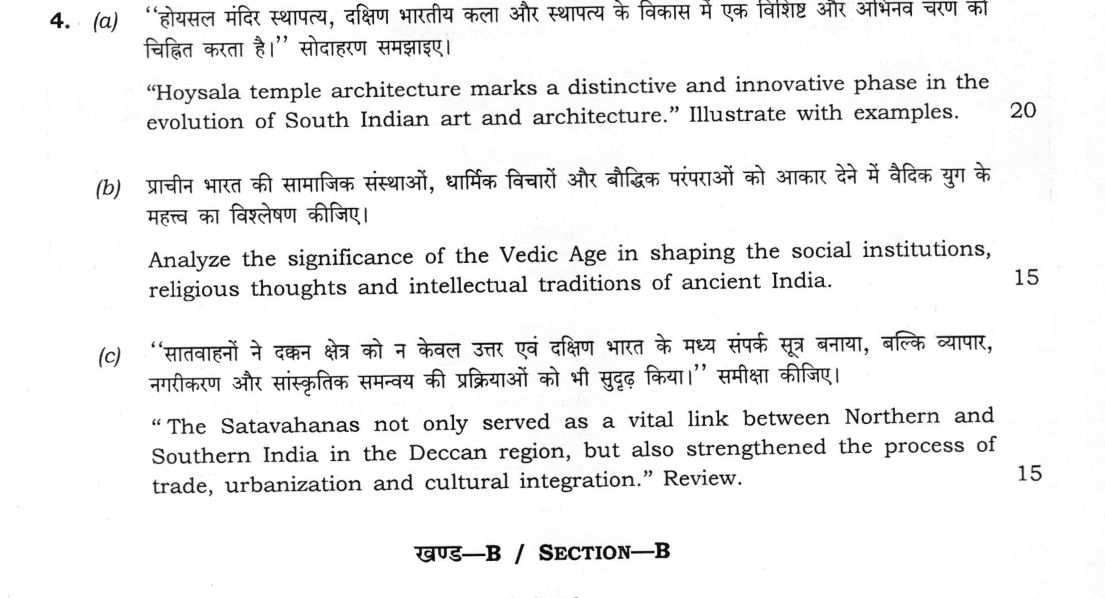
(a) “Hoysala temple architecture marks a distinctive and innovative phase in the evolution of South Indian art and architecture.”…
“Hoysala temple architecture marks a distinctive and innovative phase in the evolution of South Indian art and architecture.” Illustrate with examples. 20 marks
Analyze the significance of the Vedic Age in shaping the social institutions, religious thoughts and intellectual traditions of ancient India. 15 marks
“The Satavahanas not only served as a vital link between Northern and Southern India in the Deccan region, but also strengthened the process of trade, urbanization and cultural integration.” Review. 15 marks
हिंदी में प्रश्न पढ़ें
“होयसल मंदिर स्थापत्य, दक्षिण भारतीय कला और स्थापत्य के विकास में एक विशिष्ट और अभिनव चरण को चिह्नित करता है।” सोदाहरण समझाइए। (20 अंक)
प्राचीन भारत की सामाजिक संस्थाओं, धार्मिक विचारों और बौद्धिक परंपराओं को आकार देने में वैदिक युग के महत्व का विश्लेषण कीजिए। (15 अंक)
“सातवाहनों ने दक्खन क्षेत्र को न केवल उत्तर एवं दक्षिण भारत के मध्य संपर्क सूत्र बनाया, बल्कि व्यापार, नगरीकरण और सांस्कृतिक समन्वय की प्रक्रियाओं को भी सुदृढ़ किया।” समीक्षा कीजिए। (15 अंक)
Model answer
Drafted with AI by UPSC Answer Check against this question's marking rubric, to the expected length. UPSC does not publish answers for Mains — this is one way to score well, not an official key. How we build rubrics and answers.
(a) Hoysala temple architecture Hoysala architecture (12th-13th centuries) turned the South Indian temple from soaring mass into a richly carved, horizontally layered form, building on earlier traditions rather than inventing from nothing.
Its roots lie in the Later Chalukya (Kalyana) Vesara idiom of Lakkundi and Itagi. What was new was, first, the material: chloritic schist (soapstone), soft when quarried, allowed jewel-like carving. Second, the plan: a stellate (star-shaped) shrine set on a high jagati platform that doubles as a circumambulatory path. Third, the elevation: a moderate, stepped superstructure instead of the towering Chola vimana, with no gopurams.
Examples: the Chennakeshava temple at Belur (1117 CE), built by Vishnuvardhana, has lathe-turned pillars and some forty madanika (shalabhanjika) bracket figures. The Hoysaleshvara temple at Halebidu (Dorasamudra, c. 1121 CE) is a dvikuta (twin-shrined) temple whose base carries continuous bands of elephants, lions, horses, scrolls, makaras and hamsas, topped by friezes from the Ramayana, Mahabharata and Bhagavata. The Keshava temple at Somanathapura (1268 CE), a trikuta, was built by the general Somanatha Dandanayaka under Narasimha III and shows the fully mature stellate plan.
Two further features mark the phase. Sculptors signed their work: Mallitamma, Dasoja and his son Chavana, and Kedaroja. Patronage was plural: Jaina basadis at Shravanabelagola and Halebidu stand beside Vaishnava and Shaiva shrines.
The "Sacred Ensembles of the Hoysalas" (Belur, Halebidu, Somanathapura) became a UNESCO World Heritage Site in 2023, recognising this as a distinctive regional achievement.
(b) Significance of the Vedic Age The Vedic Age (c. 1500-600 BCE) laid lasting foundations, but its Rig Vedic (c. 1500-1000 BCE) and Later Vedic (c. 1000-600 BCE) phases must be distinguished.
Social institutions: Rig Vedic society was pastoral and tribal, with assemblies (sabha, samiti, vidatha, gana) and women composers such as Lopamudra and Ghosha. In the Later Vedic phase, as settlement spread into the Ganga-Yamuna doab (the Painted Grey Ware culture), society grew more stratified; the Purusha-sukta (Rig Veda X.90) gave varna a cosmic sanction, women's public role declined, and kingship was ritually magnified through the rajasuya, vajapeya and ashvamedha.
Religious thought: Rig Vedic worship addressed Indra, Agni and Varuna, guardian of rita (cosmic order). Later Vedic religion elaborated sacrifice in the Brahmanas, and Prajapati, Rudra and Vishnu rose in importance.
Intellectual traditions: the earliest Upanishads, Brihadaranyaka and Chandogya, set out the identity of Atman and Brahman ("tat tvam asi"); the doctrine of karma appears first in Yajnavalkya's reply to Artabhaga, while Gargi Vachaknavi and Maitreyi took part in philosophical debate. The six Vedangas systematised phonetics, ritual, grammar, etymology, metre and astronomy; Yaska's Nirukta is the classic work of etymology.
Legacy: Upanishadic questioning of ritual prepared the ground for the shramana movements and the later darshanas, while varna, yajna and Sanskrit endured for two millennia. The origins of the Vedic people remain disputed and should be presented as such.
(c) The Satavahanas: link, trade and integration The claim is largely valid, with qualifications.
A link between north and south: from Simuka, and Satakarni I (styled Dakshinapathapati in the Nanaghat inscription of his queen Naganika), the Satavahanas held the Deccan passes such as Nanaghat that joined the western ports to the plateau. Gautamiputra Satakarni defeated the Kshaharata Nahapana, as the Nashik prashasti of Gautami Balashri proclaims, and later rulers extended power to Amaravati in Andhra. Their dates (from c. 230 BCE or c. 60 BCE for Simuka to the early 3rd century CE) remain disputed.
Trade and urbanisation: the Periplus of the Erythraean Sea and Ptolemy name Sopara, Kalyan and Bharuch, and exports such as Paithan onyx and Tagara cloth. Towns grew at Pratishthana (Paithan), Tagara (Ter), Bhokardan and Kondapur. Yajna Sri Satakarni's ship-type coins suggest maritime interests, and Ushavadata's Nashik inscription (of the rival Kshaharata house) records endowments invested with weavers' guilds at Govardhana, showing guilds acting as bankers.
Cultural integration: Prakrit served for inscriptions and for Hala's Gathasattasai; kings performed Vedic sacrifices yet endowed the Buddhist sangha. The caves of Karle (whose chaitya was established by the merchant Bhutapala of Vaijayanti), Bhaja, Nashik, Bedsa and Kanheri were funded more by merchants and guilds than by kings.
Qualification: grants of revenue-free land with immunities to monks are read by R. S. Sharma as an early step towards land-grant feudalism, and by Himanshu Prabha Ray as part of a monastery-guild trading network. Integration was real, but on Brahmanical and mercantile terms.
How this answer will be evaluated
Evaluation rubric
Each sub-part is marked on its own, against the marks and word limit printed on the paper.
- (a) 'Illustrate with examples' the claim that Hoysala temple architecture was a distinctive and innovative phase in South Indian art and architecture. The answer must define what is distinctive (plan, material, elevation, sculpture, patronage), name specific temples with their patrons and dates, and place the style in relation to what preceded (Later Chalukya/Vesara) and what surrounded it (Dravida). 20 marks
Must cover
- Stellate plan and jagati platform
- Chloritic schist/soapstone
- Chennakeshava, Belur, 1117, Vishnuvardhana
- Hoysaleshvara, Halebidu (Dorasamudra), c. 1121, dvikuta
- Kesava temple, Somanathapura, 1268, trikuta, Somanatha Dandanayaka
- Madanika/shalabhanjika bracket figures
- Signed sculptors: Mallitamma, Dasoja, Chavana, Kedaroja
- Vesara idiom and the Later Chalukyas of Kalyana (Lakkundi, Itagi)
Loses marks
- Describing Hoysala temples in general adjectives ('beautiful carvings') without naming a single temple, patron or date.
- Calling the style 'Dravida' without qualification, or denying any link with the Later Chalukya Vesara tradition from which it grew.
- Attributing Somanathapura to a king rather than to the general Somanatha Dandanayaka, or dating Belur to the 13th century.
- Claiming Hoysala temples have tall gopurams - they do not; the superstructure is moderate and stepped, and in several temples it is lost.
- Ignoring the Jaina basadis and thus presenting the dynasty as exclusively Vaishnava or Shaiva.
Earns more
- Sculptural programme: continuous horizontal bands of elephants, horses, lions, makaras, hamsas and foliage running round the base, surmounted by epic and Puranic narrative friezes (Ramayana, Mahabharata, Bhagavata); the 38-42 madanika/shalabhanjika bracket figures of Belur; the practice of sculptors signing their work - Mallitamma, Dasoja and his son Chavana of Balligrama, Kedaroja.
- Placing the style: derived from and elaborating the Later Chalukya (Kalyana) Vesara of Lakkundi and Itagi rather than inventing ex nihilo; contrasting with the Chola preference for a soaring vimana and, later, gopurams; Hoysala patronage also extended to Jaina basadis at Shravanabelagola and Halebidu, showing religious plurality; 'Sacred Ensembles of the Hoysalas' (Belur, Halebidu, Somanathapura) inscribed as a UNESCO World Heritage Site in 2023.
- (b) 'Analyze' the significance of the Vedic Age under three specified heads - social institutions, religious thought and intellectual traditions - distinguishing the Rig Vedic (c. 1500-1000 BCE) from the Later Vedic (c. 1000-600 BCE) phase and assessing what of it endured in later Indian civilisation. 15 marks
Must cover
- Purusha-sukta, Rig Veda X.90
- Sabha, samiti, vidatha, gana
- Indra, Agni, Varuna, rita; Later Vedic Prajapati, Rudra, Vishnu
- Rajasuya, vajapeya, ashvamedha
- Brihadaranyaka and Chandogya Upanishads
- Yajnavalkya and Artabhaga on karma; Gargi Vachaknavi, Maitreyi
- Vedangas; Yaska's Nirukta
- Painted Grey Ware and the Ganga-Yamuna doab
- Aryan-origins debate - disputed
Loses marks
- Treating the Vedic Age as a single undifferentiated period instead of contrasting Rig Vedic and Later Vedic society, religion and polity.
- Asserting one side of the Aryan-origins controversy as proven fact.
- Claiming that the fully developed caste system, untouchability and the four ashramas existed in the Rig Vedic period.
- Citing the Bhagavad Gita, Manusmriti or the Puranas as Vedic sources.
- Describing the Upanishads without naming a single Upanishad, thinker or doctrine.
Earns more
- Position of women and family: Rig Vedic women composers and disputants - Lopamudra, Ghosha, Apala, and in the Upanishads Gargi Vachaknavi and Maitreyi; upanayana and study attested for some women; a clear decline in the Later Vedic period, with exclusion from assemblies and passages such as the Aitareya Brahmana's disparagement of daughters - the contrast must be shown, not merely asserted.
- Intellectual traditions: the Upanishads, the Brihadaranyaka and Chandogya being earliest, with the Brahman-Atman identity ('tat tvam asi'), and the first explicit doctrine of karma and transmigration in Yajnavalkya's reply to Jaratkarava Artabhaga; the six Vedangas (shiksha, kalpa, vyakarana, nirukta, chhanda, jyotisha) and Yaska's Nirukta as the beginnings of systematic grammar, etymology and astronomy.
- Legacy and its limits: Upanishadic questioning of ritual efficacy prepared the ground for the shramana traditions - Buddhism, Jainism and the Ajivikas - and for the six darshanas, while varna, yajna and Sanskrit remained organising categories for two millennia; but the question of Aryan origins (Max Muller's Indo-European model, Tilak's Arctic Home thesis, indigenous-origin arguments, and the 2019 ancient-DNA studies by Narasimhan et al. and Shinde et al.) is disputed and must be presented as such.
- (c) 'Review' a two-part claim about the Satavahanas: that they linked north and south India through the Deccan, and that they strengthened trade, urbanisation and cultural integration. Both halves must be argued from evidence - inscriptions, coins, trade texts and monuments - and the claim critically weighed. 15 marks
Must cover
- Simuka; Satakarni I; Nanaghat inscription of Naganika; Dakshinapathapati
- Gautamiputra Satakarni; Nashik prashasti of Gautami Balashri; Nahapana and the Kshaharatas
- Hala's Gathasattasai (Maharashtri Prakrit)
- Pratishthana (Paithan) and Tagara (Ter); Nanaghat pass
- Sopara, Kalyan, Bharuch; Periplus of the Erythraean Sea; Ptolemy
- Karle chaitya and Bhutapala of Vaijayanti; Nashik, Bhaja, Bedsa, Kanheri
- Ushavadata's deposit with weavers' guilds at Govardhana
- Yajna Sri Satakarni's ship-type coins; Amaravati
- R. S. Sharma on early land grants; Himanshu Prabha Ray
Loses marks
- Narrating a king-list with no evidence of trade, urbanisation or cultural change - the question is about processes.
- Confusing the Satavahanas' rivals: Nahapana was a Kshaharata (Western) Kshatrapa, not a Kushana or an Indo-Greek.
- Attributing the Karle and Nashik caves solely to royal patronage and ignoring the merchant and guild donors named in the inscriptions.
- Stating Satavahana dates with false precision when the chronology (c. 230 BCE vs c. 60 BCE for Simuka) is genuinely disputed.
- Ignoring the second half of the statement - trade, urbanisation and cultural integration - and reviewing only the 'link' claim.
Earns more
- Trade and money: the Periplus of the Erythraean Sea and Ptolemy on Deccan ports and commodities (Paithan onyx, Tagara cloth); Roman coin hoards and rouletted ware; Satavahana lead, potin and copper coinage including the ship-type coins of Yajna Sri Satakarni; the Nashik inscription of Ushavadata recording permanent endowments deposited with weavers' guilds at Govardhana, showing guilds functioning as bankers.
- Urbanisation and monuments: excavated urban settlements at Ter, Bhokardan (Bhogavardhana), Kondapur, Nevasa and Dhanyakataka; the rock-cut Buddhist complexes of Karle (great chaitya-griha endowed by Bhutapala of Vaijayanti), Bhaja, Bedsa, Nashik Pandavleni and Kanheri, whose donative inscriptions name merchants, artisans and guilds far more often than kings; the Amaravati school of sculpture.
- Cultural integration and critical assessment: Prakrit as the language of inscriptions and of Hala's Gathasattasai, matronymic royal names, simultaneous performance of Vedic sacrifices and patronage of Buddhist sangha; Gautamiputra's claim to be the 'unique Brahmana' who ended varna-samkara shows integration on Brahmanical terms; the Nashik and Karle grants of revenue-free land with immunities to monks are read by R. S. Sharma as an early step towards land-grant feudalism, and by Himanshu Prabha Ray as part of a monastery-guild trading network.
What "Illustrate" is asking you to do
Carry the point with concrete cases rather than assert it, so the examples do the work of proving it. In the technical papers illustrate is often literal — a labelled diagram, a map, a graph — and an answer without the figure has not complied with the instruction.
Structure that answers it
The point stated → example 1 with the feature it demonstrates → example 2 → example 3 or the required diagram → what the set of examples establishes
Where marks are lost
Examples named and then abandoned. A case listed without the sentence showing what it demonstrates is marked as recall of information, not as illustration.
Practice this exact question
Write your answer and it is marked point by point against the model answer above — what you covered, what you missed, what you got wrong.
Evaluate my answer →More from History 2026 Paper I
- Q1 Identify the following places marked on the map supplied to you and write a short note of…
- Q2 (a) Analyze the role of terrain, climate and vegetation in shaping the settlement and mov…
- Q3 (a) “The Iranian and Macedonian invasions reshaped ancient India through administrative i…
- Q4 (a) “Hoysala temple architecture marks a distinctive and innovative phase in the evolutio…
- Q5 Answer the following questions in about 150 words each : (a) How far can the Qutub Comple…
- Q6 (a) Critically examine the theories on the origin of the Rajputs. How do the indigenous e…
- Q7 (a) From the Portuguese merchant Domingo Paes’ description of Krishnadeva-raya’s reign, a…