Paper I — Q6
(a) Critically examine the theories on the origin of the Rajputs. How do the indigenous evidences contradict the European…
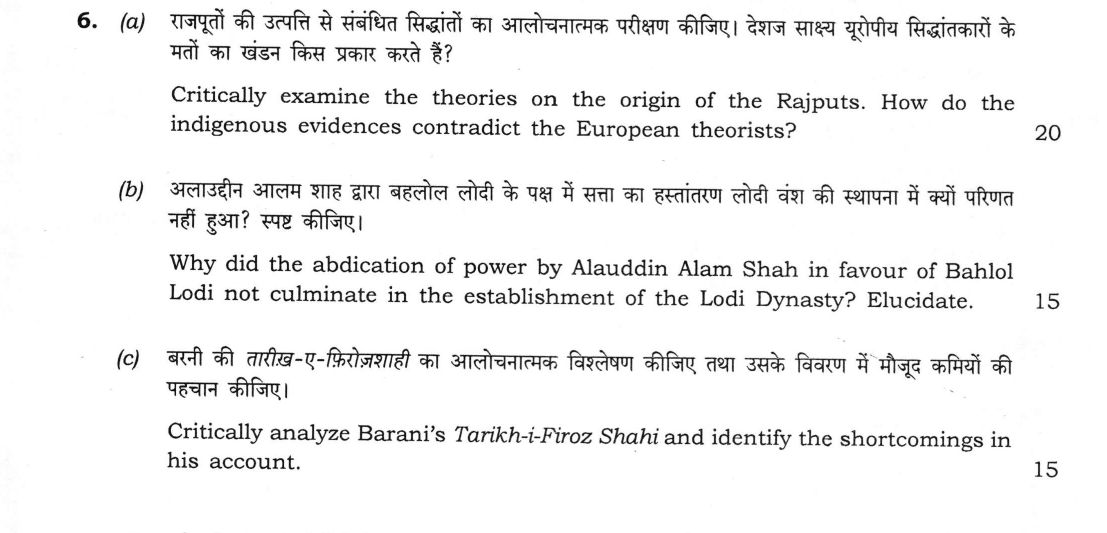
Critically examine the theories on the origin of the Rajputs. How do the indigenous evidences contradict the European theorists? 20 marks
Why did the abdication of power by Alauddin Alam Shah in favour of Bahlol Lodi not culminate in the establishment of the Lodi Dynasty? Elucidate. 15 marks
Critically analyze Barani’s Tarikh-i-Firoz Shahi and identify the shortcomings in his account. 15 marks
हिंदी में प्रश्न पढ़ें
राजपूतों की उत्पत्ति से संबंधित सिद्धांतों का आलोचनात्मक परीक्षण कीजिए। देशज साक्ष्य यूरोपीय सिद्धांतकारों के मतों का खंडन किस प्रकार करते हैं? (20 अंक)
अलाउद्दीन आलम शाह द्वारा बहलोल लोदी के पक्ष में सत्ता का हस्तांतरण लोदी वंश की स्थापना में क्यों परिणत नहीं हुआ? स्पष्ट कीजिए। (15 अंक)
बरनी की तारीख-ए-फिरोज़शाही का आलोचनात्मक विश्लेषण कीजिए तथा उसके विवरण में मौजूद कमियों की पहचान कीजिए। (15 अंक)
Model answer
Drafted with AI by UPSC Answer Check against this question's marking rubric, to the expected length. UPSC does not publish answers for Mains — this is one way to score well, not an official key. How we build rubrics and answers.
(a) Theories of Rajput origin Rajput origins have been debated along three lines: foreign, indigenous-Kshatriya and processual.
Foreign-origin theory: James Tod's Annals and Antiquities of Rajasthan (1829-32) derived the Rajputs from Scythian invaders; V. A. Smith and William Crooke, with the Indian scholar D. R. Bhandarkar, linked several clans to the Gurjaras and Hunas. They leaned on the Agnikula myth of warriors born from a sacrificial fire on Mount Abu, read as the purification of foreigners, and on Chand Bardai's Prithviraj Raso. But the Raso survives only in much later recensions, and the Agnikula story is attested early only for the Paramaras (Padmagupta's Navasahasankacharita, c. 1000), becoming a four-clan legend much later.
Indigenous evidence against the European theorists: C. V. Vaidya, G. H. Ojha and Dasharatha Sharma derived the clans from ancient Kshatriya lineages, citing the dynasties' own records. The Gwalior prashasti of Mihira Bhoja traces the Pratiharas to Lakshmana, door-keeper (pratihara) of Rama, a solar-lineage claim. Bana's Harshacharita and early inscriptions use rajaputra for a rank of landed nobility, not a race. Yet this evidence also complicates a pure Kshatriya view: the Guhilas' Atpur inscription (977 CE) calls their founder Guhadatta mahideva, a term read either as "Brahmana" or "king", and later Guhila records speak of a Brahmana-to-Kshatriya shift.
Processual explanation: B. D. Chattopadhyaya (1976) showed Rajput identity forming between the seventh and twelfth centuries through clan migration, land control, fort-building and the Kshatriya-isation of local and tribal chiefs; Dirk Kolff (1990) saw "Rajput" as an open status in a military labour market; Nandini Sinha Kapur traced this in Mewar. The Rajputs were a status group formed by social processes, not a single foreign tribe.
(b) Why Bahlol's accession was not yet a dynasty Alauddin Alam Shah, the last Sayyid, retired to Badaun in 1448, and his wazir Hamid Khan invited Bahlol Lodi, who took Delhi in 1451 as Sultan Bahlol Shah Ghazi. Yet the legal transfer conferred little real sovereignty, for three reasons.
First, the Sultanate had shrunk to little beyond Delhi and its environs. (The jibe "from Delhi to Palam" is usually told of the Mughal Shah Alam II, but it would fit the late Sayyids equally.) Bahlol had to reconquer his kingdom: campaigns against Ahmad Khan of Mewat and against Sambhal, Koil, Etawah, Rewari and Gwalior.
Second, the Sharqi Sultanate of Jaunpur contested Delhi itself from 1452; only after long wars was Husain Shah Sharqi defeated and Jaunpur annexed in 1479. Almost the whole reign was spent creating the kingdom he had nominally received.
Third, Afghan tribal ideas of kingship resisted dynastic monarchy. The Lodi, Farmuli, Lohani and Sarwani clans held large iqtas and saw the Sultan as first among equals; Bahlol reportedly refused to sit on the throne in their presence.
Dynastic monarchy really began with Sikandar Lodi (1489-1517), who centralised administration, founded Agra as a capital in 1504, introduced the gaz-i-Sikandari, audited nobles' accounts and enforced court etiquette. When Ibrahim Lodi pressed this further, the nobles revolted and Daulat Khan Lodi invited Babur, leading to Panipat in 1526, showing that the tribal conception was never fully overcome.
**(c) Barani's *Tarikh-i-Firoz Shahi*** Ziauddin Barani (c. 1285-1357), a nadim (companion) of Muhammad bin Tughlaq, completed the Tarikh-i-Firoz Shahi in 1357. It continues Minhaj-us-Siraj's Tabaqat-i-Nasiri, covering 1266 to the sixth year of Firuz Shah; his Fatawa-i-Jahandari sets out the political ideals behind it.
Value: it gives the fullest account of Balban's kingship (the sultan as zill-i-ilahi, with sijda and paibos), a unique description of Alauddin Khalji's market control (the zawabit, diwan-i-riyasat, shahna-i-mandi, granaries and the barid and munhi informers), and detailed, if hostile, evidence on Muhammad bin Tughlaq's projects.
Shortcomings: first, method. Peter Hardy (Historians of Medieval India, 1960) showed that Barani wrote history as ibrat, moral admonition, shaping events to teach lessons; his dialogues, such as Alauddin's conversation with Qazi Mughis of Bayana, are literary devices rather than records. Second, bias of three kinds: aristocratic contempt for the low-born, an orthodox Sunni outlook, and personal grievance after losing favour under Firuz, which colours his portrait of Muhammad bin Tughlaq. Third, chronology is often loose. Fourth, silences: his canvas is Delhi and the court, so the provinces, regional sultanates, peasants, artisans, merchants and women are almost absent.
Mohammad Habib, K. A. Nizami and Irfan Habib therefore use Barani only when cross-checked against coins, inscriptions, Amir Khusrau and Isami. He remains indispensable but must be read critically.
How this answer will be evaluated
Evaluation rubric
Each sub-part is marked on its own, against the marks and word limit printed on the paper.
- (a) Two linked demands: 'critically examine' the competing theories of Rajput origin (foreign/Scythian, Agnikula, indigenous Kshatriya, mixed) and then show specifically how indigenous evidence - chiefly inscriptions and the meaning of the term rajaputra - contradicts the European theorists. Modern processual explanations must also be brought in. 20 marks
Must cover
- James Tod, Annals and Antiquities of Rajasthan (1829-32) - Scythian theory
- V. A. Smith, William Crooke, D. R. Bhandarkar - Gurjara/foreign origin
- Agnikula myth; Prithviraj Raso of Chand Bardai; Navasahasankacharita of Padmagupta
- C. V. Vaidya; G. H. Ojha; Dasharatha Sharma - indigenous theory
- Gwalior prashasti of Mihira Bhoja - descent from Lakshmana the pratihara
- Atpur/Ahar inscription of 977 CE - founder Guhadatta called mahideva (Brahmana or king; disputed); later Guhila records of a Brahmana-to-Kshatriya shift
- Rajaputra as a rank in Bana's Harshacharita and inscriptions
- B. D. Chattopadhyaya (1976); Dirk Kolff (1990); Nandini Sinha Kapur
Loses marks
- Listing the theories without criticising them, although the question says 'critically examine'.
- Answering only the first half and ignoring the explicit demand about indigenous evidence versus European theorists.
- Treating the Prithviraj Raso as a contemporary twelfth-century source; its surviving recensions are much later.
- Attributing the Agnikula legend to all four clans in early inscriptions when it is epigraphically attested only in a limited form (Paramaras) and is late for the rest.
- Omitting the modern social-process literature and thus leaving the answer at a nineteenth-century level of debate.
Earns more
- The indigenous-Kshatriya school: C. V. Vaidya, Gaurishankar Hirachand Ojha and Dasharatha Sharma deriving the clans from ancient suryavamshi and chandravamshi Kshatriya lineages; complicated by the Guhilas' own records - the Atpur (Ahar) inscription of 977 CE calls the founder Guhadatta mahideva (read either as 'Brahmana' or as 'king'), and the Chittor (1274) and Achaleshwar (1285) inscriptions speak of a Brahmana-to-Kshatriya shift - and by the tribal antecedents ascribed to the Chandellas; so neither a single foreign nor a single Kshatriya origin will serve.
- The modern processual explanation: B. D. Chattopadhyaya's 1976 study showing Rajput identity emerging between the seventh and twelfth centuries through clan migration, control of land, fort-building, colonisation of new areas and the Kshatriya-isation of local and tribal chiefs; Dirk Kolff (Naukar, Rajput and Sepoy, 1990) on Rajput as an open-status identity in a military labour market; Nandini Sinha Kapur on Mewar - shifting the question from 'who were they racially' to 'how did the status group form'.
- (b) 'Elucidate' why the transfer of power by the last Sayyid ruler Alauddin Alam Shah to Bahlol Lodi did not, by itself, amount to the founding of the Lodi dynasty. The answer must show that legal transfer conferred no effective sovereignty, that Bahlol had to reconquer the Sultanate, and that Afghan tribal conceptions of shared kingship prevented dynastic consolidation until Sikandar Lodi. 15 marks
Must cover
- Alauddin Alam Shah, last Sayyid; retirement to Badaun 1448; Hamid Khan
- Bahlol Lodi takes Delhi 1451; Bahlol Shah Ghazi
- The shrunken Sultanate - little beyond Delhi and its environs (the 'Delhi to Palam' jibe properly belongs to the Mughal Shah Alam II)
- Sharqis of Jaunpur; Husain Shah Sharqi; annexation of Jaunpur 1479
- Afghan clans - Lodi, Farmuli, Lohani, Sarwani; iqtas; 'first among equals'
- Sikandar Lodi (1489-1517); Agra 1504; gaz-i-Sikandari
- Ibrahim Lodi; Daulat Khan Lodi; First Battle of Panipat 1526
Loses marks
- Treating 1451 as the simple foundation date of the Lodi dynasty and not answering the question's 'why not'.
- Confusing Alauddin Alam Shah with Alauddin Khalji, or Bahlol with Sikandar.
- Omitting the Afghan tribal theory of kingship, which is the analytical core of the answer.
- Getting the Jaunpur chronology wrong - the annexation was in 1479, not at the start of the reign.
- Turning the answer into a general survey of the Lodi Sultanate without addressing the specific paradox.
Earns more
- Sovereignty had to be reconquered: campaigns against Mewat under Ahmad Khan, and against Sambhal, Koil, Etawah, Rewari and Gwalior; and above all the long struggle with the Sharqi Sultanate of Jaunpur from 1452, ending only with the defeat of Husain Shah Sharqi and the annexation of Jaunpur in 1479 - almost the whole of Bahlol's reign was spent creating the kingdom he had nominally been given.
- Dynastic monarchy therefore begins with Sikandar Lodi (1489-1517), who centralised administration, shifted the capital to Agra in 1504, introduced the standard measure gaz-i-Sikandari, audited the nobles' accounts and enforced court etiquette; when Ibrahim Lodi pressed the same logic further, Afghan resentment produced the revolt of the nobility and Daulat Khan Lodi's invitation to Babur, leading to Panipat in 1526 - proof that the tribal conception was never fully overcome.
- (c) 'Critically analyse' Barani's Tarikh-i-Firoz Shahi and 'identify the shortcomings'. The answer must first establish what the work is - author, date, scope, unique value - and then set out its defects systematically: method, class bias, religious bias, personal animus, didactic purpose and thematic silences. 15 marks
Must cover
- Ziauddin Barani (c. 1285-1357); nadim of Muhammad bin Tughlaq
- Tarikh-i-Firoz Shahi, 1357; continues Minhaj-us-Siraj's Tabaqat-i-Nasiri; 1266 to Firuz Shah's sixth year
- Fatawa-i-Jahandari
- Balban's zill-i-ilahi, sijda and paibos
- Alauddin Khalji's zawabit, diwan-i-riyasat, shahna-i-mandi, barids/munhiyan
- Qazi Mughis of Bayana dialogue as a literary device
- Aristocratic contempt for the low-born; orthodox Sunni bias
- Peter Hardy, Historians of Medieval India (1960) - history as ibrat
Loses marks
- Summarising the political narrative of the Delhi Sultanate instead of analysing the text as a source.
- Confusing the Tarikh-i-Firoz Shahi of Barani with the work of the same name by Shams-i-Siraj Afif, which covers Firuz Shah's reign in detail.
- Attributing the Tabaqat-i-Nasiri to Barani rather than to Minhaj-us-Siraj.
- Listing 'he was biased' without specifying the three distinct biases - class, religious and personal - and their effects on particular passages.
- Failing to acknowledge the work's unique value, so the 'critical' analysis becomes mere denunciation.
Earns more
- Its indispensable value: the fullest account of Balban's theory of kingship (the sultan as zill-i-ilahi, sijda and paibos, the policy of blood and iron); the unique description of Alauddin Khalji's price-control system - the zawabit, the diwan-i-riyasat, the shahna-i-mandi, the granaries, and the barid and munhi intelligence network; and detailed, if hostile, evidence on Muhammad bin Tughlaq's experiments.
- Purpose and silences: Barani conceived history as ibrat and mau'iza - moral admonition rather than factual reconstruction - a point developed by Peter Hardy in Historians of Medieval India (1960); and his canvas is confined to Delhi and the court, so the provinces, the regional sultanates, agrarian society, artisans, merchants and women are almost entirely absent. Mohammad Habib, K. A. Nizami and Irfan Habib therefore use him only with cross-checking against coins, inscriptions, Amir Khusrau and Isami.
What "Critically examine" is asking you to do
Test the proposition the question puts to you and return a finding on how far it holds. Examine stems carry a claim, or ask whether something has happened, and expect evidence weighed both ways before the extent is stated — often with remedial measures attached. “Critically” is not a section added at the end: name the yardstick you are judging by — the evidence, the stated objective, a constitutional principle, a rival explanation — and let a verdict close each part of the body. Where the question quotes a claim, that verdict must land on the claim itself, accepted, qualified or rejected, and not on the theme in general.
Structure that answers it
Restate the claim as the question frames it → evidence that supports it → evidence that undercuts it → the conditions under which it holds → verdict on how far it stands
Where marks are lost
Merits in one paragraph, demerits in the next, and a conclusion calling for a balanced and holistic approach. That is a survey with the judgement left out and it holds the answer in the middle band. The opposite error is reading “critically” as permission to attack — and with the odd pairings, critically describe or critically explain, the exposition still carries most of the marks, the judgement being a layer on it rather than a substitute for it.
Practice this exact question
Write your answer and it is marked point by point against the model answer above — what you covered, what you missed, what you got wrong.
Evaluate my answer →More from History 2026 Paper I
- Q3 (a) “The Iranian and Macedonian invasions reshaped ancient India through administrative i…
- Q4 (a) “Hoysala temple architecture marks a distinctive and innovative phase in the evolutio…
- Q5 Answer the following questions in about 150 words each : (a) How far can the Qutub Comple…
- Q6 (a) Critically examine the theories on the origin of the Rajputs. How do the indigenous e…
- Q7 (a) From the Portuguese merchant Domingo Paes’ description of Krishnadeva-raya’s reign, a…
- Q8 (a) Analyze the influence of Persian traditions on the development of architecture and pa…