Paper I — Q8
(a) Analyze the influence of Persian traditions on the development of architecture and painting under the Mughals. To what extent…
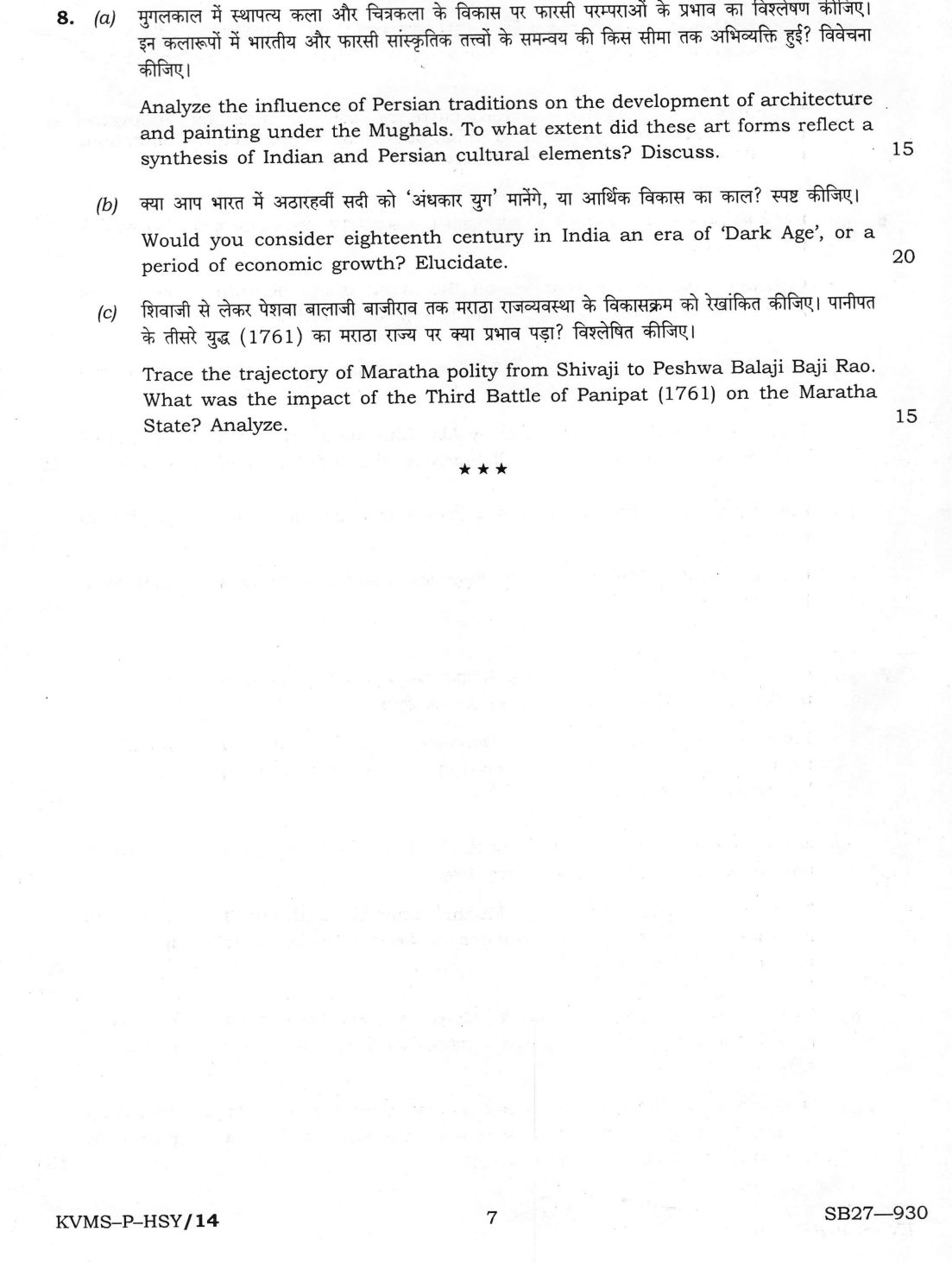
Analyze the influence of Persian traditions on the development of architecture and painting under the Mughals. To what extent did these art forms reflect a synthesis of Indian and Persian cultural elements? Discuss. 15 marks
Would you consider eighteenth century in India an era of 'Dark Age', or a period of economic growth? Elucidate. 20 marks
Trace the trajectory of Maratha polity from Shivaji to Peshwa Balaji Baji Rao. What was the impact of the Third Battle of Panipat (1761) on the Maratha State? Analyze. 15 marks
हिंदी में प्रश्न पढ़ें
मुगलकाल में स्थापत्य कला और चित्रकला के विकास पर फारसी परम्पराओं के प्रभाव का विश्लेषण कीजिए। इन कलारूपों में भारतीय और फारसी सांस्कृतिक तत्वों के समन्वय की किस सीमा तक अभिव्यक्ति हुई? विवेचना कीजिए। (15 अंक)
क्या आप भारत में अठारहवीं सदी को 'अंधकार युग' मानेंगे, या आर्थिक विकास का काल? स्पष्ट कीजिए। (20 अंक)
शिवाजी से लेकर पेशवा बालाजी बाजीराव तक मराठा राजव्यवस्था के विकासक्रम को रेखांकित कीजिए। पानीपत के तीसरे युद्ध (1761) का मराठा राज्य पर क्या प्रभाव पड़ा? विश्लेषित कीजिए। (15 अंक)
Model answer
Drafted with AI by UPSC Answer Check against this question's marking rubric, to the expected length. UPSC does not publish answers for Mains — this is one way to score well, not an official key. How we build rubrics and answers.
(a) Persian traditions and Mughal synthesis Persian traditions supplied the grammar of Mughal art, but Indian craftsmen and patrons reshaped it into a synthesis.
Architecture: from Timurid Iran came the charbagh garden, the pishtaq portal framing an iwan, the double dome, the hasht-bihisht (eight paradises) plan and glazed tilework (kashi-kari). Humayun's tomb (1562-71), designed by Mirak Mirza Ghiyas and built after Humayun's death under his widow Hamida Banu Begum and Akbar, is the first full expression. Yet it uses Indian red sandstone with white marble and chhatris. Fatehpur Sikri (1571-85) is more Indian still: the trabeate Panch Mahal and bracketed pavilions stand beside the Persian-style Buland Darwaza (1601). Itimad-ud-Daula's tomb (1622-28), built by Nur Jahan, introduced white marble with extensive pietra dura (parchin kari). The Taj Mahal (1632-53; chief architect Ustad Ahmad Lahauri, calligrapher Amanat Khan) joins a Persian charbagh, bulbous double dome and pishtaq to Indian chhatris and jalis, with the tomb placed at the garden's end.
Painting: the atelier was founded by the Safavid masters Mir Sayyid Ali and Abd-us-Samad, brought by Humayun, and began with the Persian-style Hamzanama (1562-77) and the Tutinama. Indian painters such as Daswanth, Basawan, Miskin, Lal and Mukund brought movement, crowded narrative and Indian subjects, notably in the Razmnama (1584-86), the Persian Mahabharata. Under Jahangir, Ustad Mansur (Nadir-ul-Asr) painted naturalistic flora and fauna.
The synthesis was deep but court-bound: when Aurangzeb withdrew patronage, artists dispersed to Rajput, Pahari, Awadh and Patna workshops, carrying the fusion outward.
(b) The eighteenth century: Dark Age or growth? The question divides two schools.
The decline view: Jadunath Sarkar (Fall of the Mughal Empire) and William Irvine saw political anarchy, sharpened by Nadir Shah's sack of Delhi (1739), Ahmad Shah Abdali's invasions, the Third Battle of Panipat (1761) and, later, the Bengal famine of 1770. Structural explanations deepened this: Satish Chandra's jagirdari crisis, Irfan Habib's agrarian crisis of over-assessment and revolt, M. Athar Ali's shortage of jagirs after the Deccan conquests (questioned by J. F. Richards), and Karen Leonard's "great firm" thesis of bankers turning away from the empire.
The revisionist view: Muzaffar Alam (The Crisis of Empire in Mughal North India, 1986) and C. A. Bayly (Rulers, Townsmen and Bazaars, 1983) showed regional elites, towns and merchant groups prospering as power devolved. Frank Perlin traced proto-industrial growth, Andre Wink the Maratha "fitna" as a political system, and Prasannan Parthasarathi relatively high weaver incomes in the south. The successor states built revenue, armies and trade: Murshid Quli Khan's Bengal and the Jagat Seths; Awadh under Saadat Khan and Safdar Jang, later the cultural centres of Faizabad and Lucknow; Nizam-ul-Mulk's Hyderabad (1724); Haidar Ali and Tipu Sultan's state trading and new-model army in Mysore; Marthanda Varma's Travancore; and the Sikh misls.
Verdict: the century was one of imperial collapse but regional reconstruction, not a uniform Dark Age. Growth was real but uneven, and warfare and invasion damaged the north. The fragmentation was exploited by the English East India Company after Plassey (1757) and through the dual government in Bengal (1765-72), whose famine of 1770 marks the darker turn that came with colonial rule.
(c) Maratha polity from Shivaji to Balaji Baji Rao; Panipat The polity moved from Chhatrapati-centred kingship to a Peshwa-led confederacy.
Shivaji was crowned at Raigad on 6 June 1674. He ruled through the Ashta Pradhan, drew on Malik Ambar's revenue methods and Annaji Datto's survey, paid many officers in cash rather than hereditary grants, and levied chauth and sardeshmukhi beyond his swaraj.
Crisis followed: Sambhaji was executed in 1689; Rajaram resisted from Jinji and Tarabai led the twenty-seven-year war against Aurangzeb. Shahu, released in 1707, won at Khed, and the house split between Satara and Kolhapur.
The Peshwas then took the lead. Balaji Vishwanath's agreement with the Sayyid brothers (1719) won Mughal recognition of Maratha claims. Bajirao I defeated the Nizam at Palkhed (1728), raided Delhi (1737), won at Bhopal (1737-38), and his brother Chimaji Appa took Bassein (1739). Great sardars (Scindia, Holkar, Gaekwad, Bhonsle, Pawar) carved out regional bases. After Shahu's death, the Sangola agreement (1750) confirmed Peshwa supremacy at Pune under Balaji Baji Rao.
Panipat (14 January 1761): Sadashivrao Bhau and the heir Vishwasrao were killed with much of the army and officer class; the protectorate over Delhi and the bid to succeed the Mughals collapsed, and Balaji Baji Rao died in June 1761. Yet Maratha power did not end: Madhavrao I (1761-72) recovered much territory, and Shah Alam II returned to Delhi under Maratha escort in 1772. But the sardars grew more autonomous, and the English, victorious at Buxar (1764), gained most from the vacuum.
How this answer will be evaluated
Evaluation rubric
Each sub-part is marked on its own, against the marks and word limit printed on the paper.
- (a) Two linked demands: 'analyse' the influence of Persian traditions on Mughal architecture AND painting, and then 'discuss' to what extent these art forms express a synthesis of Indian and Persian cultural elements. Both art forms must be covered, the Persian element identified precisely, and the degree of synthesis judged rather than assumed. 15 marks
Must cover
- Charbagh, pishtaq, iwan, double dome, hasht-bihisht, kashi-kari
- Humayun's tomb 1562-71, Mirak Mirza Ghiyas, Hamida Banu Begum
- Fatehpur Sikri 1571-85; Panch Mahal; Buland Darwaza 1601
- Itimad-ud-Daula's tomb 1622-28; pietra dura/parchin kari; Nur Jahan
- Taj Mahal 1632-53; Ustad Ahmad Lahauri; Amanat Khan
- Mir Sayyid Ali and Abd-us-Samad; Humayun
- Hamzanama 1562-77; Tutinama; Razmnama 1584-86
- Daswanth, Basawan, Miskin, Ustad Mansur (Nadir-ul-Asr)
Loses marks
- Covering architecture only and leaving painting unaddressed, although the question names both.
- Treating Mughal art as simply 'Persian art in India' and never showing the Indian contribution, which is the second half of the question.
- Attributing Humayun's tomb to Humayun himself as patron, or the Taj Mahal to Ustad Isa rather than Ustad Ahmad Lahauri.
- Dating pietra dura to Akbar's reign; it appears in India first at Itimad-ud-Daula's tomb in the 1620s.
- Listing monuments without analysing which feature is Persian and which Indian - the analysis, not the list, carries the marks.
Earns more
- The mature fusion: Itimad-ud-Daula's tomb at Agra (1622-28), built by Nur Jahan for her father, the first Mughal building entirely of marble and the first with extensive pietra dura (parchin kari); the Taj Mahal (1632-53, chief architect Ustad Ahmad Lahauri, calligrapher Amanat Khan), where a Persian charbagh, bulbous double dome and pishtaq are combined with Indian chhatris, jalis and the tomb placed at the end rather than the centre of the garden; the Jama Masjid of Delhi (1650-56).
- Indianisation and the limits of synthesis: Hindu painters such as Daswanth, Basawan, Miskin, Lal and Mukund; Indian subject matter through the Razmnama translation of the Mahabharata (1584-86), the Ramayana and the Harivamsa; Ustad Mansur (Nadir-ul-Asr) and the naturalistic studies of Indian and exotic flora and fauna; European perspective and modelling after the Jesuit missions - but the synthesis was court-bound, and Aurangzeb's withdrawal of patronage dispersed the artists to the Rajput, Deccani, Awadh and Patna schools.
- (b) 'Would you consider... or...?' requires an explicit verdict on a historiographical controversy: was eighteenth-century India a 'Dark Age' of anarchy or a period of economic growth? The answer must present both the older decline thesis and the revisionist case for regional prosperity, name the historians on each side, and then take and defend a position. 20 marks
Must cover
- Jadunath Sarkar, Fall of the Mughal Empire; William Irvine
- Nadir Shah 1739; Ahmad Shah Abdali; Third Battle of Panipat 1761; Bengal famine 1770
- Satish Chandra - jagirdari crisis; Irfan Habib - agrarian crisis; M. Athar Ali; J. F. Richards
- Muzaffar Alam, The Crisis of Empire in Mughal North India (1986)
- C. A. Bayly, Rulers, Townsmen and Bazaars (1983)
- Frank Perlin - proto-industrialisation; Andre Wink; Prasannan Parthasarathi
- Successor states: Bengal (Murshid Quli Khan, Jagat Seths), Awadh, Hyderabad, Mysore, Travancore, Sikh misls
- Dual government 1765-72; Plassey 1757
Loses marks
- Narrating the political events of the century without engaging the historiographical debate the question poses.
- Refusing to give a verdict, when the question explicitly asks 'would you consider'.
- Presenting only the decline thesis and ignoring Alam, Bayly, Perlin and Parthasarathi, or the reverse.
- Attributing the jagirdari crisis to Irfan Habib and the agrarian crisis to Satish Chandra - the attributions are the other way round.
- Treating the successor states as mere rebels rather than as state-building enterprises with revenue, military and commercial policies.
Earns more
- Structural explanations of Mughal decline: Satish Chandra's jagirdari crisis and be-jagiri; Irfan Habib's agrarian crisis, in which over-assessment drove zamindars and peasants into revolt; M. Athar Ali's argument that the Deccan conquests produced a fatal shortage of jagirs for an enlarged nobility, questioned by J. F. Richards; and Karen Leonard's 'great firm' thesis on the shift of banking support away from the empire.
- The successor states as positive evidence: Murshid Quli Khan's revenue reorganisation in Bengal and the financial power of the Jagat Seths; Saadat Khan and Safdar Jang in Awadh with the cultural flowering of Faizabad and Lucknow; Nizam-ul-Mulk Asaf Jah's Hyderabad from 1724; Haidar Ali and Tipu Sultan's state trading, new-model army and commercial diplomacy in Mysore; Marthanda Varma's Travancore; the Sikh misls - regional state-building rather than mere disorder.
- (c) Two demands: 'trace the trajectory' of the Maratha polity from Shivaji to Peshwa Balaji Baji Rao - i.e. the institutional transformation from Chhatrapati-centred kingship to a Peshwa-led confederacy - and then 'analyse' the impact of the Third Battle of Panipat (1761) on the Maratha state. 15 marks
Must cover
- Shivaji's coronation at Raigad, 6 June 1674; Ashta Pradhan; chauth and sardeshmukhi
- Annaji Datto; Malik Ambar's kathi system
- Twenty-seven-year war; Rajaram at Jinji; Tarabai; Shahu released 1707; battle of Khed
- Balaji Vishwanath and the agreement with the Sayyid brothers, 1719
- Bajirao I: Palkhed 1728, Delhi raid 1737, Bhopal 1737-38, Bassein 1739
- Scindia, Holkar, Gaekwad, Bhonsle, Pawar - the confederacy
- Sangola agreement 1750; Peshwa supremacy at Pune
- Third Battle of Panipat, 14 January 1761; Sadashivrao Bhau and Vishwasrao killed
- Madhavrao I (1761-72); Shah Alam II restored to Delhi 1772; Buxar 1764
Loses marks
- Narrating battles without tracing the constitutional shift from Chhatrapati to Peshwa, which is the heart of 'trajectory of Maratha polity'.
- Omitting the Sangola agreement of 1750, the pivotal moment in that shift.
- Dating the Third Battle of Panipat to 1760 or 1762, or confusing it with the first (1526) or second (1556) battle.
- Claiming Panipat ended Maratha power outright - Madhavrao I recovered much of it within a decade; what ended was the Maratha bid for imperial succession.
- Confusing Bajirao I with Bajirao II, or Balaji Baji Rao with Balaji Vishwanath.
Earns more
- Crisis and transition: Sambhaji's capture and execution in 1689; Rajaram's resistance from Jinji and Tarabai's regency through the twenty-seven-year war with Aurangzeb, ending in 1707; Shahu's release in 1707, his victory at Khed and the consequent split of the house of Shivaji between Satara and Kolhapur.
- Panipat, 14 January 1761, and its impact: Sadashivrao Bhau and the heir-apparent Vishwasrao were killed with an enormous part of the army and the officer class; the Maratha protectorate over Delhi and the claim to succeed the Mughals collapsed, finances were ruined and Balaji Baji Rao died on 23 June 1761; Madhavrao I (1761-72) restored much territory and even reinstated Shah Alam II at Delhi in 1772, but the sardars' autonomy hardened into a confederacy of rivals, and the beneficiary of the vacuum was the English East India Company, victorious at Buxar in 1764.
What "Discuss" is asking you to do
Lay the issue out from more than one side — how it arose, what is claimed for it, what is held against it, and where it now stands. UPSC attaches discuss to broad topics with several live dimensions, so coverage of the dimensions earns more than the strength of your opinion.
Structure that answers it
Set the issue up → the case as it is made → the case against → the dimension both sides leave out → where the balance now lies
Where marks are lost
Listing facts with no thread between them, or arguing one side throughout and calling it a discussion.
Practice this exact question
Write your answer and it is marked point by point against the model answer above — what you covered, what you missed, what you got wrong.
Evaluate my answer →More from History 2026 Paper I
- Q5 Answer the following questions in about 150 words each : (a) How far can the Qutub Comple…
- Q6 (a) Critically examine the theories on the origin of the Rajputs. How do the indigenous e…
- Q7 (a) From the Portuguese merchant Domingo Paes’ description of Krishnadeva-raya’s reign, a…
- Q8 (a) Analyze the influence of Persian traditions on the development of architecture and pa…