Paper I — Q7
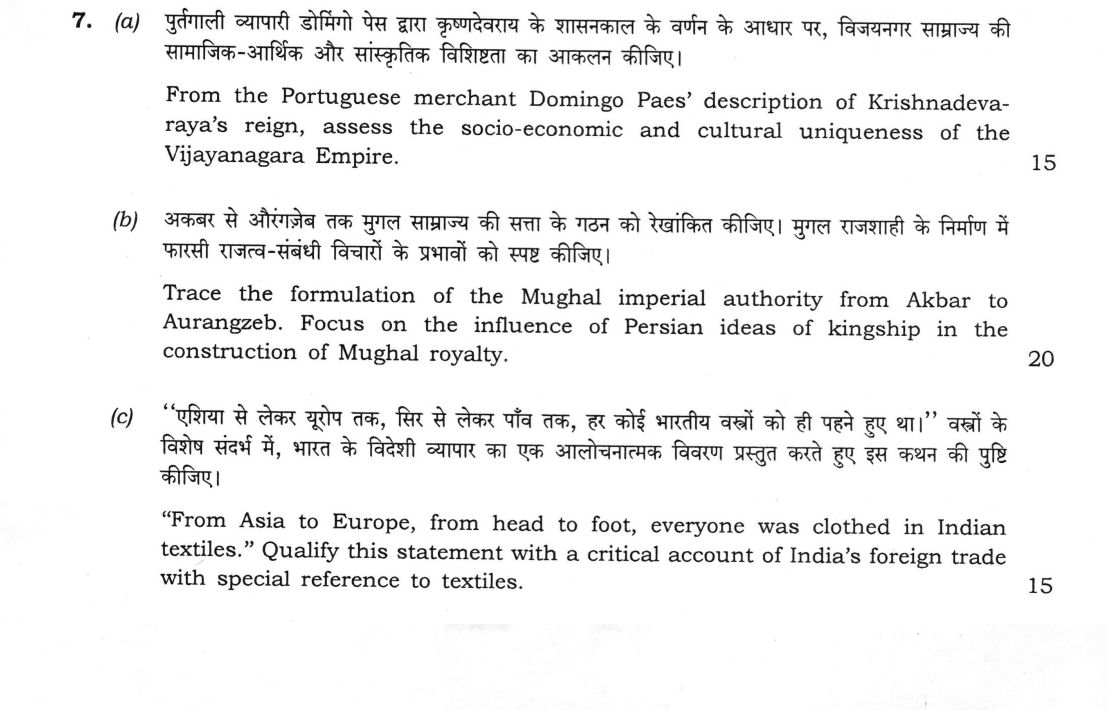
(a) From the Portuguese merchant Domingo Paes’ description of Krishnadeva-raya’s reign, assess the socio-economic and cultural…
From the Portuguese merchant Domingo Paes’ description of Krishnadeva-raya’s reign, assess the socio-economic and cultural uniqueness of the Vijayanagara Empire. 15 marks
Trace the formulation of the Mughal imperial authority from Akbar to Aurangzeb. Focus on the influence of Persian ideas of kingship in the construction of Mughal royalty. 20 marks
“From Asia to Europe, from head to foot, everyone was clothed in Indian textiles.” Qualify this statement with a critical account of India’s foreign trade with special reference to textiles. 15 marks
हिंदी में प्रश्न पढ़ें
पुर्तगाली व्यापारी डोमिंगो पेस द्वारा कृष्णदेवराय के शासनकाल के वर्णन के आधार पर, विजयनगर साम्राज्य की सामाजिक-आर्थिक और सांस्कृतिक विशिष्टता का आकलन कीजिए। (15 अंक)
अकबर से औरंगज़ेब तक मुगल साम्राज्य की सत्ता के गठन को रेखांकित कीजिए। मुगल राजशाही के निर्माण में फारसी राजत्व-संबंधी विचारों के प्रभावों को स्पष्ट कीजिए। (20 अंक)
“एशिया से लेकर यूरोप तक, सिर से लेकर पाँव तक, हर कोई भारतीय वस्त्रों को ही पहने हुए था।” वस्त्रों के विशेष संदर्भ में, भारत के विदेशी व्यापार का एक आलोचनात्मक विवरण प्रस्तुत करते हुए इस कथन की परिसीमित कीजिए। (15 अंक)
Model answer
Drafted with AI by UPSC Answer Check against this question's marking rubric, to the expected length. UPSC does not publish answers for Mains — this is one way to score well, not an official key. How we build rubrics and answers.
(a) Vijayanagara through Domingo Paes Domingo Paes, a Portuguese horse-trader at Vijayanagara c. 1520-22 in the reign of Krishnadeva Raya (1509-29), whose account Robert Sewell published in A Forgotten Empire (1900), is a vivid but partial witness.
Economy: Paes found the city "as large as Rome" and "the best provided city in the world", with markets full of grain, fruit, precious stones and horses. The import of Arabian and Persian horses through the western ports, on which Vijayanagara's cavalry depended, explains both the wealth he saw and the Portuguese interest in it.
Society and culture: his account of the nine-day Mahanavami at the Mahanavami Dibba, with the army review, wrestling, dancing and sacrifice, shows kingship performed as spectacle; he also describes the House of Victory built after the Orissa campaign. Palace women wrestled, bore sword and shield and played music (Nuniz adds astrologers and accountants), while he also notes temple dancers, slavery and sati.
Assessment: Paes must be cross-checked. Abdur Razzaq (1443) described the seven lines of fortification, and Nicolo Conti, Duarte Barbosa and Fernao Nuniz add detail on trade, revenue and military obligation. Krishnadeva Raya's Telugu Amuktamalyada sets out the royal ideal, and the nayankara (amara-nayaka) system and ayagar village officials show the institutional base. His numbers for population and army should not be taken at face value. Sewell framed the empire as a "Hindu bulwark", but Philip B. Wagoner, reading the title Hinduraya Suratrana ("Sultan among Hindu kings"), shows a court that shared Islamicate dress and courtly forms, and Burton Stein questions a centralised model. Vijayanagara's uniqueness lay in this blend of wealth, ritual kingship and cultural exchange.
(b) Mughal imperial authority and Persian kingship Mughal sovereignty was consciously constructed, drawing on Timurid descent, Persian political ethics and Islamicate mysticism.
Akbar: Abul Fazl's Akbarnama and Ain-i-Akbari presented the emperor as bearer of farr-i izadi (divine light), linked to the Alanqua legend of Timurid descent and to Shihabuddin Suhrawardi's illuminationist (Ishraqi) philosophy. Nasiruddin Tusi's Akhlaq-i Nasiri and the Persian "circle of justice" supplied the ideal of the just king, and the Persian Nauroz became a court festival. Politically, sulh-i kul (peace with all), the Ibadat Khana (1575), the abolition of jizya (1564, again in 1579), the mahzar of 1579 and the discipleship order of tauhid-i ilahi (1582) made the emperor the arbiter above sects. Akbar began the jharokha-darshan and the tuladan weighing.
Jahangir: the chain of justice, the Tuzuk-i-Jahangiri, and allegorical portraits with a halo that fused Persian farr with the European nimbus.
Shah Jahan: the title Sahib-Qiran-i Sani (second lord of the conjunction, after Timur), the Peacock Throne (1635), the Padshahnama and Shahjahanabad. He replaced prostration (sijda) with zaminbos and then the chahar taslim.
Aurangzeb: the title Alamgir and the Fatawa-i-Alamgiri marked a shift to a more juristic Islamic idiom; he ended the jharokha (1668-69) and reimposed jizya (1679).
Historiography: John F. Richards traced the formulation of authority under Akbar and Jahangir, M. Athar Ali stressed sulh-i kul, Ebba Koch read the visual programme and A. Azfar Moin the millennial, saintly kingship. Historians differ on how far Aurangzeb's narrower idiom weakened the empire's hold on a plural nobility, but the Persian inheritance clearly shaped Mughal royalty throughout.
(c) Indian textiles in world trade The quotation captures a real dominance but exaggerates it.
What and where: Dhaka muslins (malmal khas, abrawan, shabnam), Kasimbazar silk, Gujarat baftas and chintz, and Coromandel painted chintz and palampores from Masulipatnam and Pulicat reached Europe, West Asia and East Africa. Equally important was the Asian "country trade", in which Indian cloth bought South-East Asian spices.
How: the Companies worked through the dadni system of cash advances to weavers via brokers and gumashtas, and relied on Indian merchant-financiers such as Virji Vora of Surat and the Jagat Seths of Murshidabad. Because Europeans had few goods India wanted, India absorbed bullion and was called a "sink" of precious metals.
Qualifications: first, the market was not universal. England's Calico Acts (1700, 1720-21) and the French ban of 1686 shut out Indian prints to protect home industries. Second, success did not mean equal gains; weavers' bargaining power before 1757 is debated, with Prasannan Parthasarathi arguing it was considerable. Third, after Plassey the English Company's monopsony over the aurangs, compulsory advances and bans on selling to other buyers turned commerce into extraction; with Lancashire yarn and cloth, Dhaka's muslin industry decayed.
K. N. Chaudhuri, Om Prakash and Irfan Habib document this trade. Indian textiles were indeed global, but their dominance was contested by protection and later undermined by colonial control.
How this answer will be evaluated
Evaluation rubric
Each sub-part is marked on its own, against the marks and word limit printed on the paper.
- (a) 'Assess' the socio-economic and cultural distinctiveness of Vijayanagara using Domingo Paes's description of Krishnadeva Raya's reign as the point of departure. The answer must show what Paes actually reports, use it as evidence, and then assess its reliability against other travellers, indigenous sources and modern scholarship. 15 marks
Must cover
- Domingo Paes, Portuguese horse-trader, c. 1520-22; Krishnadeva Raya (1509-29)
- Robert Sewell, A Forgotten Empire (1900); Fernao Nuniz
- City 'as large as Rome'; 'best provided city in the world'
- Mahanavami festival and the Mahanavami Dibba; House of Victory
- Palace women who wrestled, bore sword and shield and played music (Paes); astrologers and accountants (Nuniz); sati
- Abdur Razzaq (1443); Nicolo Conti; Duarte Barbosa
- Amuktamalyada of Krishnadeva Raya; nayankara/amara-nayaka; ayagar
- Philip B. Wagoner, 'Sultan among Hindu Kings' (1996); Hinduraya Suratrana; Burton Stein
Loses marks
- Writing a general essay on Vijayanagara without ever using Paes's actual observations, which the question makes the starting point.
- Confusing Paes with Nuniz, Barbosa or Abdur Razzaq, or placing Paes in the reign of Achyuta Raya or Rama Raya.
- Repeating Sewell's 'Hindu bulwark against Islam' framing as settled interpretation.
- Taking Paes's figures for population, army size or wealth at face value.
- Ignoring the 'assess' instruction and offering no evaluation of the traveller's reliability or perspective.
Earns more
- Paes on society and culture: the nine-day Mahanavami (Navaratri) celebration at the Mahanavami Dibba with the review of the army, wrestling, dancing and sacrifice, functioning as a ritual of sovereignty; the House of Victory built to mark the Orissa campaign; palace women who wrestled, handled sword and shield and played music (Nuniz adds women astrologers, soothsayers and accountants - credit either, but not if Nuniz's list is attributed to Paes as though it were his); devadasis, domestic slavery and the practice of sati.
- Cross-checking with other evidence: Abdur Razzaq's account of 1443 describing seven lines of fortification, the mint and the bazaars; Nicolo Conti and Duarte Barbosa; Nuniz on revenue and military obligation; Krishnadeva Raya's own Telugu Amuktamalyada on kingship; the institutional framework of the nayankara/amara-nayaka system and the ayagar village officials; the temple-building programme (Krishna temple 1513, Hazara Rama, Vitthala) and the victory at Raichur in 1520 over Ismail Adil Shah.
- (b) Two demands: 'trace' the formulation of Mughal imperial authority from Akbar to Aurangzeb, and 'focus on' the influence of Persian ideas of kingship in constructing Mughal royalty. The answer must be chronological across four reigns and must specify the Persian, Timurid and Islamicate ideological materials used, with named texts, ceremonies and titles. 20 marks
Must cover
- Abul Fazl, Akbarnama and Ain-i-Akbari; farr-i izadi; sulh-i kul
- Mahzar of 1579; Ibadat Khana 1575; jizya abolished 1564/1579; tauhid-i ilahi 1582
- Nasiruddin Tusi, Akhlaq-i Nasiri; circle of justice; Shihabuddin Suhrawardi's Ishraqi philosophy
- Timurid descent; Alanqua light legend; Nauroz
- Jharokha-i darshan; zaminbos; tuladan; chain of justice
- Shah Jahan: Sahib-Qiran-i Sani; Peacock Throne 1635; Padshahnama; Shahjahanabad
- Aurangzeb: Alamgir; Fatawa-i-Alamgiri; jizya 1679; jharokha ended 1668
- John F. Richards; M. Athar Ali; Ebba Koch; A. Azfar Moin
Loses marks
- Narrating conquests and administration instead of the ideology of kingship, which is what 'formulation of imperial authority' means.
- Calling the tauhid-i ilahi a new religion ('Din-i Ilahi') with converts and doctrine, rather than a discipleship order.
- Attributing the abolition of jizya to Jahangir or its reimposition to Shah Jahan; the correct dates are 1564/1579 and 1679.
- Omitting the specifically Persian sources - Tusi's ethics, the circle of justice, Ishraqi illuminationism - although the question makes them the focus.
- Skipping one or more reigns; the question asks for the trajectory from Akbar to Aurangzeb.
Earns more
- Ritual and visual expression of sovereignty: Akbar's jharokha-i darshan (the emperor shown at a balcony each morning) and tuladan weighing ceremony; Jahangir's chain of justice at Agra, the Tuzuk-i-Jahangiri and the imperial nimbus in allegorical portraits fusing farr with European halo conventions; under Shah Jahan the replacement of sijda by zaminbos and then chahar taslim, the title Sahib-Qiran-i Sani, the Takht-i Murassa or Peacock Throne completed in 1635, the Padshahnama and the new capital Shahjahanabad.
- Analytical judgement with historiography: sovereignty was an ideological construction, not a given - John F. Richards on the formulation of imperial authority under Akbar and Jahangir, M. Athar Ali on sulh-i kul, Stephen Blake's patrimonial-bureaucratic model, Muzaffar Alam on the languages of political Islam, Ebba Koch on the visual programme and A. Azfar Moin on millennial and saintly kingship; the narrowing of the idiom under Aurangzeb weakened the empire's capacity to bind a plural nobility.
- (c) 'Qualify' means test the hyperbole in the quoted claim about the universality of Indian textiles by giving a critical account of India's foreign trade with special reference to textiles: what was exported, to where, by whom, on what terms, and what the limits of the claim are. 15 marks
Must cover
- Dhaka muslin - malmal khas, abrawan, shabnam; Kasimbazar silk
- Gujarat baftas and chintz; Coromandel painted chintz and palampore; Masulipatnam, Pulicat
- Country trade: cloth for South-East Asian spices
- Bullion inflow; India as a 'sink' of precious metals
- Dadni/advance system; gumashtas; Virji Vora; Jagat Seths
- Calico Acts of 1700 and 1720-21; French ban of 1686
- Post-1757 Company monopsony and the decline of Dhaka muslin
- K. N. Chaudhuri; Om Prakash; Irfan Habib; Prasannan Parthasarathi
Loses marks
- Celebrating Indian textile supremacy without qualifying the statement, which is exactly what the question asks for.
- Ignoring the Asian country trade and treating Europe as the only market.
- Confusing the Calico Acts (English protection against Indian cloth) with the later Charter Acts.
- Assuming that export success meant prosperity for weavers; the advance system and later monopsony point the other way.
- Omitting the post-1757 transformation, and hence the reason the trade collapsed.
Earns more
- Organisation of production and finance: the dadni or advance system operated through gumashtas and brokers; weaving communities such as the julahas, kaikkolars, sales and tantis; the great merchant-financiers Virji Vora, Abdul Ghafur of Surat and the Jagat Seths of Murshidabad; imperial and noble karkhanas for luxury fabrics.
- The critical turn after Plassey and the historiography: Company monopsony over the aurangs, compulsory advances, restrictions on weavers selling to other buyers and falling real wages converted commerce into extraction, and Dhaka's muslin industry decayed as Lancashire yarn and cloth entered - documented and debated by K. N. Chaudhuri (The Trading World of Asia), Om Prakash, Irfan Habib and Tapan Raychaudhuri in the Cambridge Economic History of India, Prasannan Parthasarathi on comparative weaver wages, and Sushil Chaudhury and Hameeda Hossain on Bengal.
What "Discuss" is asking you to do
Lay the issue out from more than one side — how it arose, what is claimed for it, what is held against it, and where it now stands. UPSC attaches discuss to broad topics with several live dimensions, so coverage of the dimensions earns more than the strength of your opinion.
Structure that answers it
Set the issue up → the case as it is made → the case against → the dimension both sides leave out → where the balance now lies
Where marks are lost
Listing facts with no thread between them, or arguing one side throughout and calling it a discussion.
Practice this exact question
Write your answer and it is marked point by point against the model answer above — what you covered, what you missed, what you got wrong.
Evaluate my answer →More from History 2026 Paper I
- Q4 (a) “Hoysala temple architecture marks a distinctive and innovative phase in the evolutio…
- Q5 Answer the following questions in about 150 words each : (a) How far can the Qutub Comple…
- Q6 (a) Critically examine the theories on the origin of the Rajputs. How do the indigenous e…
- Q7 (a) From the Portuguese merchant Domingo Paes’ description of Krishnadeva-raya’s reign, a…
- Q8 (a) Analyze the influence of Persian traditions on the development of architecture and pa…