Paper I — Q5
(a) How far can the Qutub Complex at Mehrauli be considered as an ideal specimen for the study on the development of architecture…
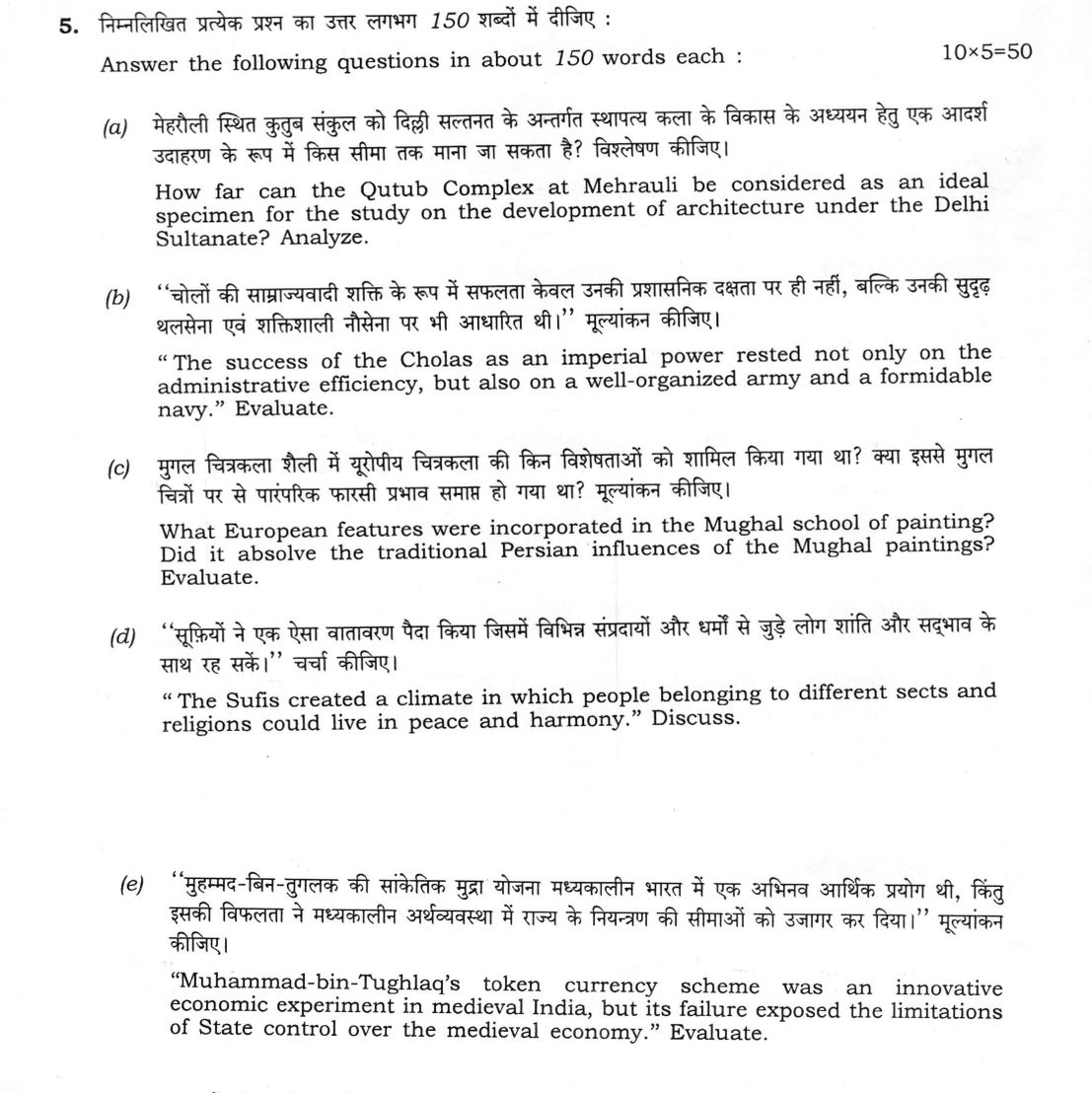
Answer the following questions in about 150 words each :
How far can the Qutub Complex at Mehrauli be considered as an ideal specimen for the study on the development of architecture under the Delhi Sultanate? Analyze. 10 marks
“The success of the Cholas as an imperial power rested not only on the administrative efficiency, but also on a well-organized army and a formidable navy.” Evaluate. 10 marks
What European features were incorporated in the Mughal school of painting? Did it absolve the traditional Persian influences of the Mughal paintings? Evaluate. 10 marks
“The Sufis created a climate in which people belonging to different sects and religions could live in peace and harmony.” Discuss. 10 marks
“Muhammad-bin-Tughlaq’s token currency scheme was an innovative economic experiment in medieval India, but its failure exposed the limitations of State control over the medieval economy.” Evaluate. 10 marks
हिंदी में प्रश्न पढ़ें
निम्नलिखित प्रत्येक प्रश्न का उत्तर लगभग 150 शब्दों में दीजिए :
मेहरौली स्थित कुतुब संकुल को दिल्ली सल्तनत के अन्तर्गत स्थापत्य कला के विकास के अध्ययन हेतु एक आदर्श उदाहरण के रूप में किस सीमा तक माना जा सकता है? विश्लेषण कीजिए। (10 अंक)
“चोलों की साम्राज्यवादी शक्ति के रूप में सफलता केवल उनकी प्रशासनिक दक्षता पर नहीं, बल्कि उनकी सुदृढ़ थलसेना एवं शक्तिशाली नौसेना पर भी आधारित थी।” मूल्यांकन कीजिए। (10 अंक)
मुगल चित्रकला शैली में यूरोपीय चित्रकला की किन विशेषताओं को शामिल किया गया था? क्या इससे मुगल चित्रों पर से पारंपरिक फारसी प्रभाव समाप्त हो गया था? मूल्यांकन कीजिए। (10 अंक)
“सूफियों ने एक ऐसा वातावरण पैदा किया जिसमें विभिन्न संप्रदायों और धर्मों से जुड़े लोग शांति और सद्भाव के साथ रह सकें।” चर्चा कीजिए। (10 अंक)
“मुहम्मद-बिन-तुगलक की सांकेतिक मुद्रा योजना मध्यकालीन भारत में एक अभिनव आर्थिक प्रयोग थी, किंतु इसकी विफलता ने मध्यकालीन अर्थव्यवस्था में राज्य के नियंत्रण की सीमाओं को उजागर कर दिया।” मूल्यांकन कीजिए। (10 अंक)
Model answer
Drafted with AI by UPSC Answer Check against this question's marking rubric, to the 150-word length. UPSC does not publish answers for Mains — this is one way to score well, not an official key. How we build rubrics and answers.
(a) The Qutb Complex as a specimen The complex is an excellent record of the Sultanate's first century, especially the shift from trabeate to arcuate building. The Quwwat-ul-Islam mosque (1192-93), built partly from temple spolia, and its screen of 1198 use corbelled arches. The Qutb Minar was begun by Aibak c. 1199 and completed by Iltutmish; Firuz Shah Tughlaq repaired it and rebuilt its upper storeys in 1368. Iltutmish's tomb (1235) shows early squinches, and Alauddin Khalji's Alai Darwaza (1311) has the first true dome, with true arches used systematically (the earliest true arch in Delhi being at Balban's tomb, c. 1287, just outside the complex). The unfinished Alai Minar records Khalji ambition. Indian motifs such as bell-and-chain and lotus on Islamic forms, and the reused Gupta-period iron pillar of Chandra, show synthesis. But the complex effectively stops with the Khaljis: it omits the austere Tughlaq style, the Lodi double dome and the provincial schools. It is ideal only for the earliest phase.
(b) Chola power: administration, army and navy All three elements mattered. Administration: the Uttaramerur inscriptions of Parantaka I (919 and 921 CE) detail the kudavolai lottery for the sabha's committees; ur, sabha and nagaram worked within nadu, valanadu and mandalam. Army: standing regiments such as the kaikkolar infantry and the velaikkarar bodyguard, with elephants and imported horses. Navy: Rajaraja I destroyed the fleet at Kandalur Salai and took northern Ceylon and the Maldives; Rajendra I led the Ganga expedition (1022-23), founding Gangaikondacholapuram, and the overseas expedition to Srivijaya and Kadaram (1025). Sea power was tied to the trade of guilds such as the Ayyavole-500, Manigramam and Anjuvannam. Yet "efficiency" needs qualification: Burton Stein's segmentary-state model, and the epigraphic work of Noboru Karashima and Y. Subbarayalu, show power resting on local bodies and ritual sovereignty more than a centralised bureaucracy, and the Srivijaya campaign is usually read as a commercial raid, not a conquest. The claim holds, with that qualification.
(c) European elements in Mughal painting European features arrived not through European painters but through prints and books brought by the Jesuit missions to Akbar (1580, 1591, 1595), notably the Antwerp (Plantin) Polyglot Bible. Mughal artists adopted linear and atmospheric perspective, chiaroscuro modelling, the halo, putti and Madonna imagery. Basawan absorbed European modelling, Kesu Das copied engravings, Abul Hasan (Nadir-uz-Zaman) copied a Durer figure, and Bichitr's Jahangir Preferring a Sufi Shaikh to Kings (c. 1615-18) uses an hourglass, cherubs and a halo. This did not absolve the Persian inheritance. The atelier was founded by the Safavid masters Mir Sayyid Ali and Abd-us-Samad, brought by Humayun; the muraqqa album with illuminated hashiya margins, the fine contour line, high viewpoint and jewel-like colour persisted, as did Persian literary cycles such as the Hamzanama (c. 1562-77). Mughal painting became a composite of Persian, Indian and European elements, not a replacement of one by another.
(d) Sufis and social harmony The claim is broadly true of the Chishtis. Muinuddin Chishti (Ajmer, d. 1236) and Nizamuddin Auliya (Delhi, d. 1325) ran khanqahs open to all, with langar, sama and a refusal of state grants, living on futuh (unsolicited gifts). The idea of wahdat-ul-wujud (unity of being), associated with Ibn Arabi, encouraged a universalist outlook. Amir Hasan Sijzi's Fawaid-ul-Fuad and Amir Khurd's Siyar-ul-Auliya record this open atmosphere; Sufi premakhyans in Hindavi, such as Mulla Daud's Chandayan (1379) and Jayasi's Padmavat (1540), used shared idioms, and Baba Farid's verses entered the Guru Granth Sahib. But the picture needs qualification. The Suhrawardis under Bahauddin Zakariya of Multan accepted land and office; Shaikh Ahmad Sirhindi upheld wahdat-ush-shuhud and stricter boundaries. Richard M. Eaton shows that conversion in Bengal followed agrarian settlement rather than Sufi missionary design, and Simon Digby traces rivalry between shaikhs and sultans. Sufis fostered harmony, but not uniformly.
(e) Muhammad bin Tughlaq's token currency The scheme (c. 1329-30) declared brass or copper tokens legal tender at par with the silver tanka. It was innovative and informed: silver was scarce, the treasury was strained by the Khurasan and Qarachil projects and the Daulatabad transfer, and precedents existed in the Chinese paper chao under Qubilai Khan and Kai-Khatu's Iranian experiment of 1294. It failed because the tokens were easily forged. Barani writes that private houses became mints; people paid taxes in tokens and hoarded silver, as Gresham's law predicts. The Sultan withdrew the tokens and redeemed them in gold and silver, leaving heaps of copper at Tughlaqabad. The failure shows the limits of state control: fiat money needs a minting monopoly, hard-to-copy coins and public confidence, which a medieval state lacked when money's value was still its metal. Barani was hostile and Ibn Battuta and Isami are indirect, so the scale may be exaggerated; Edward Thomas called the Sultan the "prince of moneyers".
How this answer will be evaluated
Evaluation rubric
Each sub-part is marked on its own, against the marks and word limit printed on the paper.
- (a) A 150-word note asking 'how far' the Qutb Complex at Mehrauli can serve as an ideal specimen for studying the development of Delhi Sultanate architecture. It requires both the case for (the complex shows the trabeate-to-arcuate transition across successive reigns) and the case against (it stops with the Khaljis and omits Tughlaq, Sayyid-Lodi and provincial styles). 10 marks · 150 words
Must cover
- Quwwat-ul-Islam mosque, 1192-93; screen of 1198; corbelled arch
- Qutb Minar begun by Aibak c. 1199, completed by Iltutmish
- Tomb of Iltutmish, 1235 - earliest squinches
- Alai Darwaza, 1311 - first true dome; true arch (cf. Balban's tomb c. 1287)
- Alai Minar (unfinished)
- Firuz Shah Tughlaq's repairs and storey of 1368
- Iron pillar of Chandra
- Omission of Tughlaq, Lodi and provincial styles
Loses marks
- Answering 'yes, it is ideal' without the counter-argument, although the question asks 'how far'.
- Crediting the Alai Darwaza's true dome and true arch to Iltutmish or Aibak instead of Alauddin Khalji (1311); citing Balban's tomb of c. 1287 as India's earliest true arch is correct and must not be treated as an error.
- Saying the Qutb Minar was built entirely by Qutbuddin Aibak - he built only the first storey.
- Treating the iron pillar as a Sultanate work; it is a Gupta-period pillar of King Chandra.
- Exceeding the 150-word limit with a descriptive tour of the monument instead of an argued evaluation.
Earns more
- It documents synthesis: Indian motifs - bell-and-chain, lotus, kalasha - carved on Islamic forms, red sandstone and marble, Quranic naskh and kufic calligraphy with arabesque, and the reuse of the 4th-century CE iron pillar of Chandra, showing how an imported idiom was executed by indigenous masons.
- The limits of the claim: the complex effectively ends with the Khaljis, so it contains nothing of the austere Tughlaq style (Tughlaqabad, Firuz Shah Kotla, batter and rubble), nothing of the Lodi double dome and octagonal tomb, and nothing of the provincial schools of Jaunpur, Bengal, Gujarat, Malwa or the Bahmanis - hence an ideal specimen only of the earliest phase.
- (b) 'Evaluate' the claim that Chola imperial success rested not only on administrative efficiency but also on a well-organised army and a formidable navy. All three elements must appear, with concrete evidence, and the answer must reach a judgement, including the revisionist doubts about Chola 'efficiency'. 10 marks · 150 words
Must cover
- Uttaramerur inscriptions, Parantaka I, 919 and 921 CE, kudavolai
- Ur, sabha/mahasabha, nagaram, nadu, valanadu, mandalam
- Kaikkolar and velaikkarar
- Rajaraja I - Ceylon, Kandalur Salai, Maldives
- Rajendra I - Ganga expedition 1022-23; Gangaikondacholapuram; Srivijaya/Kadaram expedition 1025
- Ayyavole-500, Manigramam, Anjuvannam
- Burton Stein's segmentary state; Karashima; Subbarayalu
Loses marks
- Describing only local self-government at Uttaramerur and never mentioning the army or navy, which is the point of the question.
- Dating the Srivijaya expedition to Rajaraja I instead of Rajendra I (1025), or the Ganga expedition to 1030.
- Claiming the Cholas permanently annexed Srivijaya or South-East Asia; the expedition was a raid that broke a commercial blockade.
- Offering no critical view at all, when 'evaluate' requires weighing the claim.
- Writing 400 words for a 150-word, 10-mark note and thereby losing time on later questions.
Earns more
- The army: named standing regiments, the kaikkolar infantry and the velaikkarar bodyguard bound to die with the king; elephant corps and cavalry dependent on imported West Asian and Ceylonese horses; military cantonments and regiments recorded as donors in temple inscriptions.
- Critical evaluation: naval power was inseparable from the overseas commerce of the Ayyavole-500, Manigramam and Anjuvannam guilds and from the embassies to Song China in 1015, 1033 and 1077; but Burton Stein's segmentary-state thesis and the epigraphic work of Noboru Karashima and Y. Subbarayalu caution that Chola 'administrative efficiency' rested on local self-government and ritual sovereignty rather than a centralised bureaucracy, and that the Srivijaya campaign was a commercial raid, not a conquest.
- (c) Two linked questions in 150 words: first, what European features entered Mughal painting; second, whether this displaced ('absolved') the traditional Persian influence. The answer must name the specific European devices and the route by which they arrived, and then argue that Persian conventions survived, producing a composite rather than a replacement. 10 marks · 150 words
Must cover
- Jesuit missions 1580 (Acquaviva, Monserrate), 1591, 1595 (Jerome Xavier)
- Antwerp/Plantin Polyglot Bible engravings
- Perspective, chiaroscuro, halo/nimbus, putti, Madonna
- Basawan, Kesu Das, Abul Hasan (Nadir-uz-Zaman), Bichitr
- Jahangir Preferring a Sufi Shaikh to Kings (Bichitr)
- Mir Sayyid Ali and Abd-us-Samad; Humayun
- Hamzanama (1562-77); muraqqa album; hashiya margins
Loses marks
- Answering only the first half and ignoring whether Persian influence was displaced.
- Claiming European painters worked in the Mughal atelier; the influence came through imported prints and engravings.
- Attributing the halo to purely Persian farr-i izadi alone without noting the European pictorial source, or vice versa - it is a fusion.
- Dating the Jesuit mission to Jahangir's reign; the first mission reached Akbar in 1580.
- Naming no artist and no painting, so the answer stays generic.
Earns more
- Named artists and works: Basawan, the most responsive to European modelling; Kesu Das, who copied European engravings; Abul Hasan (Nadir-uz-Zaman), who copied a Durer figure; Bichitr's allegory 'Jahangir Preferring a Sufi Shaikh to Kings' (c. 1615-18) with hourglass, cherubs and halo; Manohar and Govardhan.
- Persian influence persisted, so the answer to the second question is no: the imperial atelier was founded by the Safavid masters Mir Sayyid Ali and Abd-us-Samad brought from Persia by Humayun; the muraqqa album format with illuminated hashiya margins, the calligraphic contour, the high viewpoint and flat jewel-like colour, and Persian literary cycles such as the Hamzanama (1562-77) and the Khamsa of Nizami continued - Mughal painting became a three-way composite of Persian, Indian and European elements rather than a European school.
- (d) 'Discuss' the claim that the Sufis created a climate of peace and harmony among sects and religions. A good answer substantiates the claim with named silsilas, saints, practices and literary evidence, and then qualifies it by noting orthodox and state-aligned Sufis and the modern scholarly critique of the 'Sufi as agent of harmony/conversion' model. 10 marks · 150 words
Must cover
- Chishti silsila; Muinuddin Chishti (Ajmer, d. 1236); Nizamuddin Auliya (d. 1325)
- Khanqah, langar, sama, futuh; refusal of state grants
- Wahdat-ul-wujud (Ibn Arabi) vs wahdat-ush-shuhud (Sirhindi)
- Fawaid-ul-Fuad of Amir Hasan Sijzi; Siyar-ul-Auliya of Amir Khurd
- Chandayan (1379), Mrigavati, Padmavat (1540), Madhumalati
- Baba Farid's verses in the Guru Granth Sahib
- Bahauddin Zakariya (Suhrawardi, Multan); Shaikh Ahmad Sirhindi
- Richard M. Eaton; Simon Digby
Loses marks
- Presenting all Sufis as syncretic and ignoring the Suhrawardi and Naqshbandi counter-currents.
- Confusing the silsilas - attributing the refusal of state grants to the Suhrawardis or sama to the Naqshbandis.
- Treating the Sufis as deliberate missionaries who converted the masses, a thesis questioned by Eaton.
- Naming no text - malfuzat, premakhyan or tazkira - so the answer has no evidentiary base.
- Confusing the Bhakti saints with Sufi shaikhs, or dating Nizamuddin Auliya to the Mughal period.
Earns more
- Source base: the malfuzat literature, above all Amir Hasan Sijzi's Fawaid-ul-Fuad recording Nizamuddin Auliya's conversations, and Amir Khurd's Siyar-ul-Auliya - contemporary testimony to the open, non-sectarian atmosphere of the khanqah.
- Necessary qualification: the Suhrawardis under Bahauddin Zakariya of Multan accepted wealth, land and state office; Shaikh Ahmad Sirhindi (d. 1624), the Naqshbandi Mujaddid-i-Alf-i-Sani, rejected accommodation, upheld wahdat-ush-shuhud and demanded strict sharia; and Richard M. Eaton's study of Bengal and Simon Digby's work on shaikh-sultan relations caution against the simple picture of Sufis as agents of harmony or of mass conversion.
- (e) 'Evaluate' a two-part proposition in 150 words: that Muhammad bin Tughlaq's token currency was an innovative economic experiment, and that its failure exposed the limits of state control over the medieval economy. The answer must explain the scheme, its rationale, the precise causes of failure and the lessons about state capacity, and must reach a judgement. 10 marks · 150 words
Must cover
- Token currency c. 1329-30, brass/copper at par with the silver tanka
- Chinese chao under Qubilai Khan; Kai-Khatu's Iranian experiment of 1294
- Forgery: Barani's 'every Hindu's house became a mint'
- Gresham's law - good money hoarded, bad money circulated
- Redemption in gold and silver; heaps of copper at Tughlaqabad
- Barani, Tarikh-i-Firoz Shahi; Ibn Battuta; Isami
- Edward Thomas, 'prince of moneyers'
Loses marks
- Calling the tokens 'paper currency' - they were metal tokens; paper money was the Chinese precedent only.
- Dating the scheme to 1325 or 1351, or attributing it to Firuz Shah Tughlaq.
- Accepting Barani's hostile account uncritically without noting his personal grievance against the Sultan.
- Describing the failure only as 'people made fake coins' without the underlying point about the absence of a minting monopoly and of public confidence.
- Not evaluating at all - the question asks for a judgement on state capacity, not a narrative.
Earns more
- Rationale and precedent: scarcity of silver, a treasury exhausted by the Khurasan and Qarachil expeditions, the Deccan wars and the Daulatabad transfer; and the models of the Chinese chao paper currency under Qubilai Khan and its Ilkhanid imitation by Kai-Khatu in 1294 - the experiment was informed, not whimsical.
- Evaluation and historiography: the sources are hostile (Barani's Tarikh-i-Firoz Shahi) or second-hand (Ibn Battuta, Isami), so the scale of the disaster may be overstated; Edward Thomas called the Sultan the 'prince of moneyers'; the episode demonstrates that fiat money requires a monopoly of coinage, secure minting technology and public confidence in the state - the limits of state control over a medieval economy in which the value of money was still the value of its metal.
What "Analyse" is asking you to do
Break the subject into its working parts and show how they act on each other. The marks are in the interconnections — which factor drives which, and what the resulting structure explains — not in the inventory of factors.
Structure that answers it
Define the whole → separate it into its parts → show which part drives which → what that interaction produces → what the structure implies
Where marks are lost
A flat list of causes with no account of which drives which. An answer of neatly separated headings, each self-contained, scores as description.
Practice this exact question
Write your answer and it is marked point by point against the model answer above — what you covered, what you missed, what you got wrong.
Evaluate my answer →More from History 2026 Paper I
- Q2 (a) Analyze the role of terrain, climate and vegetation in shaping the settlement and mov…
- Q3 (a) “The Iranian and Macedonian invasions reshaped ancient India through administrative i…
- Q4 (a) “Hoysala temple architecture marks a distinctive and innovative phase in the evolutio…
- Q5 Answer the following questions in about 150 words each : (a) How far can the Qutub Comple…
- Q6 (a) Critically examine the theories on the origin of the Rajputs. How do the indigenous e…
- Q7 (a) From the Portuguese merchant Domingo Paes’ description of Krishnadeva-raya’s reign, a…
- Q8 (a) Analyze the influence of Persian traditions on the development of architecture and pa…