Paper I — Q3
(a) “The Iranian and Macedonian invasions reshaped ancient India through administrative influence, political transformation and…
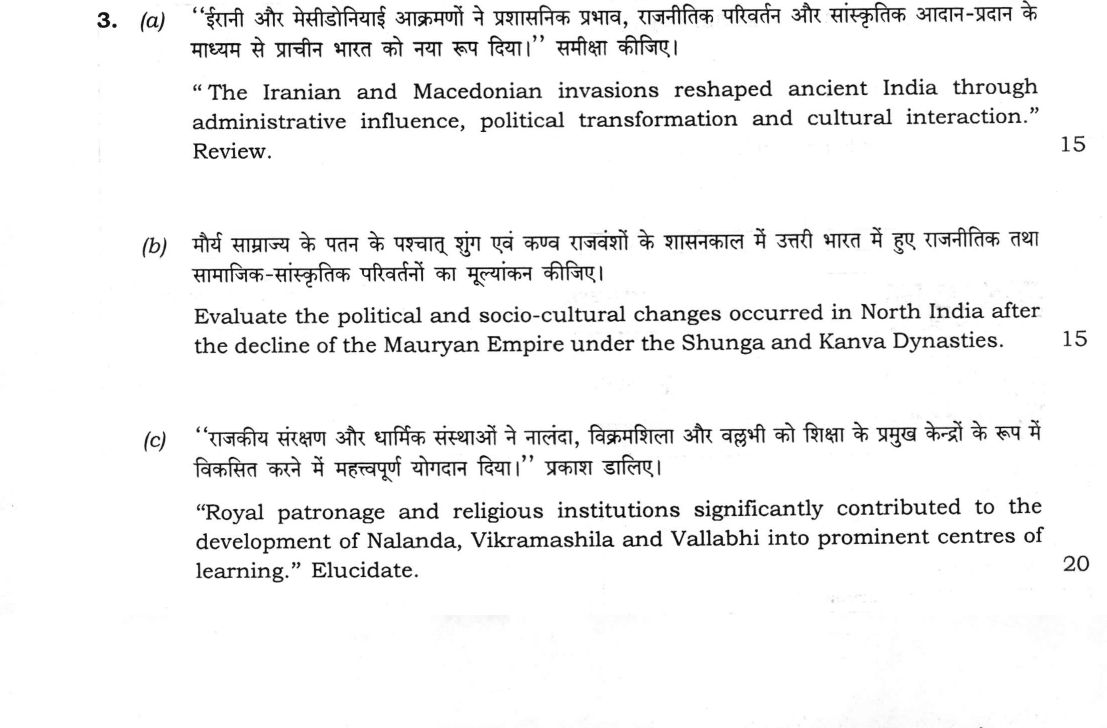
“The Iranian and Macedonian invasions reshaped ancient India through administrative influence, political transformation and cultural interaction.” Review. 15 marks
Evaluate the political and socio-cultural changes occurred in North India after the decline of the Mauryan Empire under the Shunga and Kanva Dynasties. 15 marks
“Royal patronage and religious institutions significantly contributed to the development of Nalanda, Vikramashila and Vallabhi into prominent centres of learning.” Elucidate. 20 marks
हिंदी में प्रश्न पढ़ें
‘‘ईरानी और मेसीडोनियाई आक्रमणों ने प्रशासनिक प्रभाव, राजनीतिक परिवर्तन और सांस्कृतिक आदान-प्रदान के माध्यम से प्राचीन भारत को नया रूप दिया।’’ समीक्षा कीजिए। (15 अंक)
मौर्य साम्राज्य के पतन के पश्चात् शुंग एवं कण्व राजवंशों के शासनकाल में उत्तरी भारत में हुए राजनीतिक तथा सामाजिक-सांस्कृतिक परिवर्तनों का मूल्यांकन कीजिए। (15 अंक)
‘‘राजकीय संरक्षण और धार्मिक संस्थाओं ने नालंदा, विक्रमशिला और वल्लभी को शिक्षा के प्रमुख केन्द्रों के रूप में विकसित करने में महत्त्वपूर्ण योगदान दिया।’’ प्रकाश डालिए। (20 अंक)
Model answer
Drafted with AI by UPSC Answer Check against this question's marking rubric, to the expected length. UPSC does not publish answers for Mains — this is one way to score well, not an official key. How we build rubrics and answers.
(a) Achaemenid and Macedonian impact The claim holds, but the two invasions differed sharply in depth: a two-century Achaemenid presence against a two-year Macedonian campaign.
Administrative influence: Darius I annexed the Indus region c. 518 BCE; the Behistun, Persepolis and Naqsh-i-Rustam inscriptions list Gandhara and Hindush among his provinces, and Herodotus records the Indian (20th) satrapy paying 360 talents of gold dust. The satrapy model and Aramaic, the Persian chancery script from which Kharoshthi developed, reflect this contact; the style of Ashoka's edicts and polished pillars is also linked to Persia, though their indigenous origin is argued too.
Political transformation: Alexander's campaign (327-325 BCE) won the submission of Ambhi of Taxila, defeated Porus on the Hydaspes (Jhelum) in 326 BCE and ended with the army's refusal at the Hyphasis (Beas); Nearchus then sailed from the Indus to the Persian Gulf, and Alexander died at Babylon in 323 BCE. No lasting Macedonian rule followed, but the collapse of small north-western states eased Chandragupta Maurya's rise. His treaty with Seleucus Nicator (c. 303 BCE) gained Aria, Arachosia, Gedrosia and the Paropanisadae for 500 elephants and brought Megasthenes to Pataliputra; the identification of the Greek "Sandrokottos" with Chandragupta is the "sheet anchor" of ancient Indian chronology.
Cultural interaction: routes opened for the Indo-Greek kingdoms, bilingual coinage and, much later, Hellenistic forms in Gandhara art. V. A. Smith held that "India was not Hellenized" and R. K. Mookerjee that the campaign left no permanent mark; later scholarship stresses indirect effects. Overall, the Achaemenid impact was structurally deeper.
(b) North India under the Shungas and Kanvas The period was politically one of contraction but culturally one of creative transition.
Political change: Pushyamitra Shunga, the Mauryan general, killed the last Mauryan, Brihadratha, c. 185 BCE, as Bana's Harshacharita recounts. His son Agnimitra governed from Vidisha, as Kalidasa's Malavikagnimitra shows. The north-west passed to the Indo-Greeks: Patanjali's Mahabhashya and the Yuga Purana of the Gargi Samhita describe Yavanas besieging Saketa and Madhyamika. Kharavela's Hathigumpha inscription records a raid on Magadha, whose king Bahasatimita is sometimes, doubtfully, identified with Pushyamitra. Local Mitra dynasties issued their own coins at Ayodhya, Kausambi, Mathura and Ahichchhatra. Vasudeva Kanva killed the last Shunga, Devabhuti, c. 73 BCE; the Kanvas, confined to Magadha, ended c. 28 BCE.
Socio-cultural change: Brahmanical revival is shown by the Ayodhya inscription of Dhanadeva recording Pushyamitra's two ashvamedhas. The Heliodorus pillar at Besnagar (c. 113 BCE), raised by the envoy of the Indo-Greek king Antialcidas as a Garuda-standard to Vasudeva, attests Bhagavatism and the assimilation of Yavanas. The Divyavadana story of Pushyamitra persecuting Buddhists is treated as unreliable by Romila Thapar and Etienne Lamotte; Buddhist patronage continued in the Bharhut railing and the stone casing and railing of Sanchi Stupa I, while the Sanchi gateways were added later under the Satavahanas.
Evaluation: politically fragmented, the age was formative for Sanskritic and devotional culture rather than a mere decline.
(c) Patronage and the great monasteries Royal patronage supplied endowments and security; religious institutions supplied organisation, curriculum and reputation.
Nalanda was founded by Shakraditya, identified with Kumaragupta I, and enlarged by later Guptas, Harshavardhana and the Palas; Devapala's Nalanda copper plate grants villages at the request of Balaputradeva of Suvarnadvipa for a monastery he had built. A Mahayana centre, it taught logic (hetuvidya), grammar, medicine and Brahmanical systems under teachers such as Dignaga, Dharmapala, Shilabhadra and Shantarakshita. Hiuen Tsang, who studied under Shilabhadra, and I-tsing are eyewitnesses; admission was by debate at the gate, and its library was called Dharmaganja.
Vikramashila (Antichak, Bhagalpur) was founded by the Pala king Dharmapala. It specialised in Vajrayana, admitted students through dvarapanditas (gate scholars) and produced Atisha Dipankara Srijnana, who revived Buddhism in Tibet.
Vallabhi, the capital of the Maitrakas of Saurashtra (dynasty founded by Bhattaraka c. 470 CE), was a Hinayana (Sammitiya) centre associated with Sthiramati and Gunamati, which I-tsing ranked with Nalanda. It taught secular subjects such as niti, and its alumni entered royal service. The Svetambara Jaina canon was written down at a council here under Devardhigani Kshamashramana.
Copper-plate grants of revenue-free villages gave financial security, while monastic rules supplied hostels, libraries and a graded curriculum that drew students from Tibet, China, Korea and Java. Their decline shows this dependence: Vallabhi faded after the Arab raid of c. 775 CE, and Nalanda and Vikramashila suffered in Bakhtiyar Khalji's campaigns c. 1200-1203 (Minhaj-us-Siraj's Tabaqat-i-Nasiri describes the sack of a Bihar vihara), though the Tibetan monk Dharmasvamin still found a small community at Nalanda in 1235.
How this answer will be evaluated
Evaluation rubric
Each sub-part is marked on its own, against the marks and word limit printed on the paper.
- (a) 'Review' the claim that the Achaemenid (Iranian) and Macedonian invasions reshaped ancient India under three heads - administrative influence, political transformation and cultural interaction. Both invasions must be covered separately and then assessed together, including the sceptical view that their impact has been exaggerated. 15 marks
Must cover
- Darius I, c. 518 BCE; Behistun/Persepolis/Naqsh-i-Rustam
- Herodotus: 20th satrapy, 360 talents of gold dust
- Kharoshthi from Aramaic
- Hydaspes/Jhelum, Porus, 326 BCE; Hyphasis (Beas) mutiny
- Nearchus; Alexander's death 323 BCE
- Seleucus Nicator treaty c. 303 BCE; 500 elephants; Megasthenes
- Sandrokottos = Chandragupta, sheet anchor of chronology
- V. A. Smith ('India was not Hellenized') and R. K. Mookerjee ('no permanent mark') vs later emphasis on indirect effects
Loses marks
- Treating the two invasions as one episode instead of separating a two-century occupation from a two-year campaign.
- Claiming Alexander 'conquered India' or reached the Ganga; he turned back at the Beas.
- Dating Gandhara art to Alexander instead of to the later Indo-Greek/Shaka-Kushana period.
- Asserting flatly that Ashokan pillars are Persian copies without acknowledging the indigenous-origin argument.
- Omitting the Seleucus-Chandragupta treaty and the chronological 'sheet anchor', which are the most concrete consequences.
Earns more
- Alexander's campaign 327-325 BCE: submission of Ambhi of Taxila, capture of Aornos, the battle of the Hydaspes against Porus in 326 BCE, the refusal of the army to cross the Hyphasis (Beas), Nearchus' naval voyage from the Indus to the Persian Gulf, and Alexander's death at Babylon in 323 BCE.
- Political transformation: no enduring Macedonian rule; the elimination of small north-western states opened the way for Chandragupta Maurya, whose treaty with Seleucus Nicator (c. 303 BCE) brought Aria, Arachosia, Gedrosia and the Paropanisadae to the Mauryas in exchange for 500 elephants, and produced the Megasthenes embassy; the Sandrokottos-Chandragupta synchronism is the 'sheet anchor' of ancient Indian chronology.
- Assessment and historiography: routes opened for Indo-Hellenistic contact leading to the Indo-Greek kingdoms, bilingual coinage, the Heliodorus (Besnagar) pillar and, later, Hellenistic forms in Gandhara sculpture; balanced against the minimising verdicts of V. A. Smith ('India was not Hellenized') and R. K. Mookerjee (the campaign 'left no permanent mark'), which later scholarship qualifies by stressing indirect effects - the Achaemenid impact, being two centuries long, was structurally deeper.
- (b) 'Evaluate' the political and the socio-cultural changes in north India under the Shunga and Kanva dynasties after the fall of the Mauryas - i.e. cover both dynasties, both categories of change, and deliver a judgement on whether the period was one of decline, of Brahmanical revival, or of creative transition. 15 marks
Must cover
- Pushyamitra Shunga, Brihadratha, c. 185 BCE, Harshacharita
- Agnimitra, Vidisha, Malavikagnimitra
- Devabhuti murdered by Vasudeva Kanva, c. 73 BCE; Kanvas end c. 28 BCE
- Ayodhya inscription of Dhanadeva - two ashvamedhas
- Patanjali's Mahabhashya; Yuga Purana (Gargi Samhita)
- Hathigumpha inscription of Kharavela
- Bharhut and Sanchi Stupa I railings/toranas
- Heliodorus (Besnagar) pillar, c. 113 BCE, Antialcidas, Bhagavatism
- Divyavadana persecution story - disputed (Thapar, Lamotte)
Loses marks
- Presenting the Divyavadana persecution story as established fact and concluding that the Shungas destroyed Buddhism, while ignoring Bharhut and Sanchi.
- Confusing Vasudeva Kanva (the usurper) with Vasudeva-Krishna of the Heliodorus pillar.
- Omitting the Kanvas entirely although the question names them.
- Wrong dates - e.g. 185 CE instead of BCE, or placing the Heliodorus pillar in the Gupta period.
- Writing only political narrative with no socio-cultural evaluation, or vice versa.
Earns more
- Imperial contraction and decentralisation: loss of the north-west to Indo-Greeks - Patanjali's Mahabhashya and the Yuga Purana section of the Gargi Samhita on Yavanas besieging Saketa and Madhyamika; Kharavela's Hathigumpha inscription mentioning Bahasatimita; the proliferation of local Mitra dynasties with their own coinage at Ayodhya, Kausambi, Mathura and Ahichchhatra.
- Continued Buddhist patronage and art: the Bharhut (Satna, MP) stupa railing and torana with labelled Jataka reliefs and the stone casing and ground railing of Sanchi Stupa I are Shunga work, while its four toranas were added c. 1st century BCE under Satavahana patronage (southern gateway inscription of the artisans of Siri Satakarni); the Divyavadana tradition of Pushyamitra persecuting Buddhists is treated as exaggerated or unreliable by Romila Thapar and Etienne Lamotte, though H. C. Raychaudhuri accepted a measure of hostility - present it as disputed.
- New devotional and cross-cultural currents: the Besnagar (Heliodorus) pillar near Vidisha, c. 113 BCE, set up by Heliodorus, envoy of the Indo-Greek Antialcidas, as a Garuda-standard to Vasudeva 'the god of gods', documents both the rise of Bhagavatism and the assimilation of Yavanas; evaluation - fragmentation politically, but a formative age for classical Sanskritic and devotional culture.
- (c) 'Elucidate' how two named factors - royal patronage and religious institutions - made Nalanda, Vikramashila and Vallabhi into major centres of learning. All three institutions must be treated individually with their founders, patrons, sectarian affiliation, curriculum and decline, and the two causal factors must be explicitly demonstrated, not assumed. 20 marks
Must cover
- Kumaragupta I (Shakraditya), Harshavardhana, Devapala's Nalanda copper plate, Balaputradeva of Suvarnadvipa
- Shilabhadra, Dignaga, Dharmapala, Shantarakshita
- Hiuen Tsang and I-tsing as eyewitnesses
- Dharmapala of the Palas founded Vikramashila; Antichak, Bhagalpur
- Atisha Dipankara Srijnana; dvarapanditas; Vajrayana
- Maitrakas of Vallabhi; Bhattaraka; Sthiramati and Gunamati
- Devardhigani Kshamashramana and the Vallabhi Jaina council
- Bakhtiyar Khalji c. 1200-1203; Minhaj-us-Siraj's Tabaqat-i-Nasiri
- Arab raid on Vallabhi c. 775 CE
Loses marks
- Writing only about Nalanda and giving Vikramashila and Vallabhi a line each, when the question names all three.
- Attributing Nalanda's foundation to Ashoka or to Harsha instead of Kumaragupta I, or Vikramashila to Devapala instead of Dharmapala.
- Forgetting that Vallabhi was a Hinayana and largely secular-subject centre, and treating it as a Mahayana vihara.
- Describing the destruction of Nalanda as an uncontested fact of 1193 with precise detail; the date is c. 1200-1202 and the identification of the site in the Tabaqat is debated.
- Listing facts without demonstrating the two causal factors - patronage and institutional organisation - that the question specifies.
Earns more
- Nalanda as an institution: Mahayana centre teaching logic (hetuvidya), grammar, medicine and Brahmanical systems; teachers Dignaga, Dharmapala, Shilabhadra and Shantarakshita; described at first hand by Hiuen Tsang (who studied under Shilabhadra) and I-tsing; admission by oral debate at the gate; destroyed c. 1200-1202 CE in Bakhtiyar Khalji's campaign as reported by Minhaj-us-Siraj - a UNESCO World Heritage Site since 2016.
- Vallabhi: capital of the Maitrakas of Saurashtra (dynasty founded by Bhattaraka c. 470 CE) at modern Vala, Bhavnagar district, Gujarat; a Hinayana (Sammitiya) centre which I-tsing ranked with Nalanda; Sthiramati and Gunamati taught there; visited by Hiuen Tsang c. 640; supported by Maitraka copper-plate land grants and by merchant donations; taught secular subjects such as niti and administration so that its alumni entered royal service; the Svetambara Jaina canon was written down at a council here under Devardhigani Kshamashramana; it declined after the Arab raid of c. 775 CE.
- Analytical synthesis: permanent endowments of revenue-free land (agrahara/devagrahara style grants) recorded on copper plates gave financial security; the monastic constitution supplied hostels, libraries (Nalanda's Dharmaganja with Ratnasagara, Ratnodadhi and Ratnaranjaka), a graded curriculum and debate-based pedagogy; the two together attracted students from Tibet, China, Korea, Java and Sumatra. Their fate shows the dependence: the collapse of Pala and Maitraka power destroyed the institutions.
What "Discuss" is asking you to do
Lay the issue out from more than one side — how it arose, what is claimed for it, what is held against it, and where it now stands. UPSC attaches discuss to broad topics with several live dimensions, so coverage of the dimensions earns more than the strength of your opinion.
Structure that answers it
Set the issue up → the case as it is made → the case against → the dimension both sides leave out → where the balance now lies
Where marks are lost
Listing facts with no thread between them, or arguing one side throughout and calling it a discussion.
Practice this exact question
Write your answer and it is marked point by point against the model answer above — what you covered, what you missed, what you got wrong.
Evaluate my answer →More from History 2026 Paper I
- Q1 Identify the following places marked on the map supplied to you and write a short note of…
- Q2 (a) Analyze the role of terrain, climate and vegetation in shaping the settlement and mov…
- Q3 (a) “The Iranian and Macedonian invasions reshaped ancient India through administrative i…
- Q4 (a) “Hoysala temple architecture marks a distinctive and innovative phase in the evolutio…
- Q5 Answer the following questions in about 150 words each : (a) How far can the Qutub Comple…
- Q6 (a) Critically examine the theories on the origin of the Rajputs. How do the indigenous e…