Paper II — Q1
(a) “Superior Maritime strength proved to be England's most powerful weapon in the struggle for colonial supremacy, particularly…
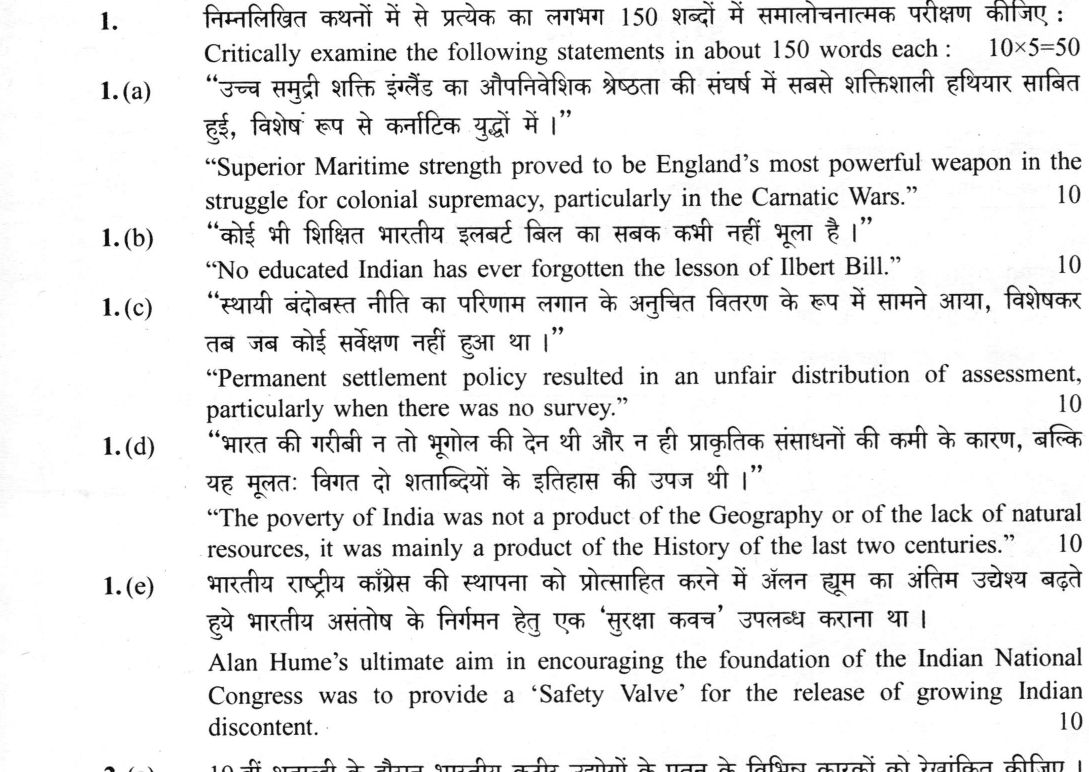
Critically examine the following statements in about 150 words each :
“Superior Maritime strength proved to be England's most powerful weapon in the struggle for colonial supremacy, particularly in the Carnatic Wars.” 10 marks
“No educated Indian has ever forgotten the lesson of Ilbert Bill.” 10 marks
“Permanent settlement policy resulted in an unfair distribution of assessment, particularly when there was no survey.” 10 marks
“The poverty of India was not a product of the Geography or of the lack of natural resources, it was mainly a product of the History of the last two centuries.” 10 marks
Alan Hume's ultimate aim in encouraging the foundation of the Indian National Congress was to provide a ‘Safety Valve’ for the release of growing Indian discontent. 10 marks
हिंदी में प्रश्न पढ़ें
निम्नलिखित कथनों में से प्रत्येक का लगभग 150 शब्दों में समालोचनात्मक परीक्षण कीजिए :
“उच्च समुद्री शक्ति इंग्लैंड का औपनिवेशिक श्रेष्ठता की संघर्ष में सबसे शक्तिशाली हथियार साबित हुई, विशेष रूप से कर्नाटिक युद्धों में।” (10 अंक)
“कोई भी शिक्षित भारतीय इलबर्ट बिल का सबक कभी नहीं भूला है।” (10 अंक)
“स्थायी बंदोबस्त नीति का परिणाम लगान के अनुचित वितरण के रूप में सामने आया, विशेषकर तब जब कोई सर्वेक्षण नहीं हुआ था।” (10 अंक)
“भारत की गरीबी न तो भूगोल की देन थी और न ही प्राकृतिक संसाधनों की कमी के कारण, बल्कि यह मूलत: विगत दो शताब्दियों के इतिहास की उपज थी।” (10 अंक)
भारतीय राष्ट्रीय काँग्रेस की स्थापना को प्रोत्साहित करने में ऐलन ह्यूम का अंतिम उद्देश्य बढ़ते हुए भारतीय असंतोष के निर्गमन हेतु एक ‘सुरक्षा वाल्व’ उपलब्ध कराना था। (10 अंक)
Model answer
Drafted with AI by UPSC Answer Check against this question's marking rubric, to the 150-word length. UPSC does not publish answers for Mains — this is one way to score well, not an official key. How we build rubrics and answers.
(a) Sea power in the Carnatic Wars Sea power was decisive but not sufficient. In the First Carnatic War (1746-48), La Bourdonnais's squadron let the French take Madras, which the Treaty of Aix-la-Chapelle (1748) returned. In the Third (1758-63), Admiral Pocock fought d'Ache's fleet in 1758-59 until the French squadron withdrew to Mauritius, leaving Lally without supplies or reinforcements; Coote then won at Wandiwash (22 January 1760) and Pondicherry fell in 1761, before the Treaty of Paris (1763). Yet other factors mattered. The English Company was autonomous and credit-worthy, while the French Company depended on a distant state that recalled Dupleix in 1754. Clive's defence of Arcot (1751) showed English land capability, and the victory at Plassey (1757) gave the English Bengal's revenues to fund the war. Lally's quarrels with colleagues weakened the French further. Historians such as G. B. Malleson and P. J. Marshall stress this mix. Naval mastery was the necessary framework; money, organisation and leadership completed it.
(b) The lesson of the Ilbert Bill Lord Ripon's law member Courtenay Ilbert introduced the Bill on 2 February 1883 to let senior Indian judges, such as Behari Lal Gupta, who had raised the anomaly, try Europeans in the districts. Europeans organised a "white mutiny" through the European and Anglo-Indian Defence Association, and the government retreated: Act III of 1884 let a European accused claim a jury at least half European. The lesson was twofold. It exposed the racial limits of British liberalism, and it showed that organised, all-India agitation, which the Europeans themselves had used, could move government. Surendranath Banerjea's Indian Association held a National Conference in Calcutta in December 1883, and the Indian National Congress followed in December 1885. The statement therefore holds for the political consciousness of the educated class. But the Bill was one catalyst among several, alongside the Vernacular Press Act, the lowered civil service age, and a decade of associational politics; it did not by itself create nationalism.
(c) Permanent Settlement and assessment without survey Lord Cornwallis made the Decennial Settlement (1789-90), prepared with John Shore, permanent on 22 March 1793 for Bengal, Bihar and Orissa. The demand was fixed at ten-elevenths of the assessed rental, leaving the zamindar one-eleventh. Because there was no cadastral survey, assessment rested on earlier collections and rent-rolls rather than measured land. Estates already heavily taxed were over-assessed and defaulted; under the Sunset Law they were auctioned, and many old zamindaris changed hands in the first decades. Others were under-assessed, and as cultivation expanded the state lost the increase to zamindars and a chain of intermediaries (patni taluqs). Ryots' rights went unrecorded, exposing them to enhanced rents and abwabs until the Bengal Rent Act X of 1859 and the Bengal Tenancy Act of 1885. The Fifth Report (1812) already noted these problems, and Ranajit Guha's A Rule of Property for Bengal traces the physiocratic ideas behind the scheme. The statement is broadly valid, though the Settlement did give the Company a stable revenue.
(d) Poverty as a product of history The statement expresses the economic-nationalist case, restated by Bipan Chandra. Dadabhai Naoroji and R. C. Dutt identified the "drain of wealth": Home Charges, salaries, pensions and profits remitted to Britain without an equivalent return. De-industrialisation hit handicraft textiles as British machine goods entered duty-free while Indian goods faced barriers in Britain. High land revenue and neglect of agriculture made famines such as those of 1876-78 and 1899-1900 lethal, and the Bengal famine of 1943 showed the same failure. Angus Maddison's estimates show India's share of world output falling sharply and per capita income almost stagnant between 1900 and 1947. Critics qualify this. Morris D. Morris argued that British rule did not cause the decline, and Tirthankar Roy stresses demography, land scarcity, climate and the resilience of some crafts. Pre-colonial India also knew famine. The best verdict is that colonial policy did not create every constraint, but it did turn structural poverty into long stagnation.
(e) The safety-valve theory of the Congress The theory rests on William Wedderburn's 1913 biography of A. O. Hume, which says Hume, alarmed by reports of unrest, wanted a safe outlet for discontent and consulted the Viceroy, Lord Dufferin. Lala Lajpat Rai (Young India, 1916) used it to attack the Moderates, and R. P. Dutt (India Today, 1940) to portray the Congress as a British device. The evidence is weaker than it seems. The reports Hume cited have never been found, and Dufferin soon turned hostile to the Congress. Indian political associations already existed, such as the Indian Association, the Poona Sarvajanik Sabha, the Madras Mahajan Sabha and the Bombay Presidency Association, and the first session in Bombay (28 December 1885), presided over by W. C. Bonnerjee with 72 delegates, grew from that base. Bipan Chandra argues that Indians used Hume as a "lightning conductor" to shield their effort from official suspicion. Hume's motive may have included a safety valve, but the Congress soon outgrew any such purpose.
How this answer will be evaluated
Evaluation rubric
Each sub-part is marked on its own, against the marks and word limit printed on the paper.
- (a) 'Critically examine' requires the candidate to both substantiate and qualify the claim that English naval supremacy was the decisive weapon in the Anglo-French contest, using the three Carnatic Wars (1746-48, 1749-54, 1758-63) as the test case. A one-sided endorsement or a flat denial both fail; the answer must weigh sea power against the other causes of French defeat. 10 marks · 150 words
Must cover
- Carnatic Wars 1746-48, 1749-54, 1758-63
- Treaty of Aix-la-Chapelle 1748
- Treaty of Paris 1763
- Dupleix
- Comte de Lally
- Admiral Pocock and Comte d'Ache
- Battle of Wandiwash, 22 January 1760
- Robert Clive and the siege of Arcot 1751
- Battle of Plassey 1757
- fall of Pondicherry 1761
Loses marks
- Confusing the sequence of wars or mis-dating Wandiwash (it is 1760, not 1761 - 1761 is the fall of Pondicherry)
- Writing a narrative of the three wars without ever addressing the 'critically examine' demand
- Attributing French defeat solely to Dupleix's recall while ignoring naval logistics and Bengal revenues
- Confusing the Carnatic Wars with the Anglo-Mysore Wars or dragging in the Battle of Buxar (1764) as a Carnatic engagement
- Asserting that Britain won at sea 'because of the Industrial Revolution' - an anachronism for the 1740s-60s
Earns more
- Institutional contrast - autonomous, credit-worthy English Company versus the state-dependent, under-funded French Company; Dupleix's recall in 1754
- A reasoned final verdict (sea power necessary but not sufficient), ideally with reference to the Mahan thesis on sea power or to historians such as G. B. Malleson / Holden Furber / P. J. Marshall
- (b) Critically examine what 'the lesson of the Ilbert Bill' actually was for educated Indians: the answer must explain the Bill of 1883, the European 'white mutiny', the 1884 compromise, and then assess the claim that the episode left a permanent mark on Indian political consciousness - including the counter-argument that its role in the founding of the Congress can be overstated. 10 marks · 150 words
Must cover
- Courtenay Peregrine Ilbert
- Lord Ripon
- 1883
- European and Anglo-Indian Defence Association
- Act III of 1884 / half-European jury compromise
- Behari Lal Gupta
- Surendranath Banerjea and the Indian Association
- Indian National Congress, December 1885
Loses marks
- Dating the Bill to 1882 or 1884 - it was introduced on 2 February 1883 and the amended Act passed in January 1884
- Saying the Bill was withdrawn - it was passed in a diluted form, not dropped
- Attributing the Bill to Lord Lytton or to Lord Dufferin instead of Ripon
- Presenting the Ilbert Bill as the single cause of the Congress's foundation with no qualification
- Omitting the European agitation altogether and writing only about Ripon's liberal reforms
Earns more
- The 'lesson' drawn by educated Indians: value of organised agitation, exposure of racial limits of British liberalism, impulse towards the Indian National Congress (December 1885) and the Indian Association's earlier National Conference (1883)
- Critical qualification that the Bill was a catalyst among several causes rather than the origin of nationalism
- (c) Critically examine the proposition that the Permanent Settlement produced an inequitable incidence of revenue demand, with specific attention to the fact that it was fixed without a cadastral survey. The answer must explain the mechanics of the 1793 settlement, show HOW the absence of survey produced over- and under-assessment, and then qualify the claim. 10 marks · 150 words
Must cover
- Lord Cornwallis
- 22 March 1793
- Decennial Settlement 1789-90
- John Shore
- ten-elevenths / one-eleventh division
- Sunset Law
- Fifth Report of 1812
- Bengal Rent Act X of 1859
- Bengal Tenancy Act 1885
- Ranajit Guha, A Rule of Property for Bengal
Loses marks
- Dating the Permanent Settlement to 1789 or 1790 without noting that those years produced the Decennial Settlement made permanent in 1793
- Claiming that the Permanent Settlement covered all of British India - it applied to Bengal, Bihar and Orissa, and later to Banaras (1795) and parts of northern Madras, not to Ryotwari or Mahalwari regions
- Confusing the Sunset Law with the doctrine of lapse or with the Sunset clause of a later Act
- Asserting bald percentages of estates sold without qualification - the figures are contested, so phrase them as estimates
- Ignoring the second half of the statement (the absence of survey) and writing a generic essay on the zamindari system
Earns more
- The ryot's position: no record of rights, abwabs, sub-infeudation (patni taluqs), remedied only partially by Bengal Rent Act X of 1859 and Bengal Tenancy Act 1885
- Critical qualification citing the Fifth Report (1812) and the historiography - Ranajit Guha's 'A Rule of Property for Bengal' (1963), Sirajul Islam, B. B. Chaudhuri, N. K. Sinha - and comparison with surveyed Ryotwari/Mahalwari tracts
- (d) Critically examine the economic-nationalist proposition, restated by Bipan Chandra, that Indian poverty was historically produced by two centuries of colonial rule rather than by geography or resource endowment. The answer must present the economic-nationalist case, the evidence, and the scholarly counter-arguments. 10 marks · 150 words
Must cover
- Dadabhai Naoroji
- drain of wealth / Home Charges
- R. C. Dutt
- de-industrialisation
- famines of 1876-78 and 1899-1900; Bengal famine 1943
- Morris D. Morris
- Tirthankar Roy
- Angus Maddison
- Bipan Chandra, History of Modern India / Freedom Struggle
Loses marks
- Turning the answer into an undifferentiated list of British 'atrocities' with no economic mechanism (drain, tariffs, revenue incidence) specified
- Quoting spectacular monetary figures for the drain as if they were settled fact - the estimates vary widely and should be attributed
- Omitting the counter-historiography entirely, which forfeits the 'critically' component
- Claiming pre-colonial India was uniformly prosperous - famine and rural poverty are amply documented for the Mughal period too
- Confusing the 1896 countervailing excise on Indian mill cloth with a protective tariff in India's favour
Earns more
- Presents the counter-historiography by name - Morris D. Morris, the Cambridge school, Tirthankar Roy - on demography, land scarcity and the limits of the de-industrialisation thesis
- Uses long-run quantitative evidence (Angus Maddison's estimates of India's falling share of world output, near-zero per capita growth 1900-47) and/or Amartya Sen's entitlement analysis to adjudicate
- (e) Critically examine the 'safety valve' theory of the Indian National Congress's origin: state what the theory claims and where it comes from, note who has used it and why, and then test it against the evidence of the Congress's actual foundation in 1885 and the modern scholarly rebuttal. 10 marks · 150 words
Must cover
- A. O. Hume
- William Wedderburn's biography, 1913
- 28 December 1885, Bombay
- W. C. Bonnerjee
- 72 delegates
- Lala Lajpat Rai, Young India (1916)
- R. P. Dutt, India Today (1940)
- Bipan Chandra - 'lightning conductor'
- Lord Dufferin
Loses marks
- Presenting the safety-valve theory as established fact rather than as a contested interpretation resting on a single 1913 biography
- Giving the wrong venue or president - it was Gokuldas Tejpal Sanskrit College, Bombay, with W. C. Bonnerjee presiding, not Calcutta and not Dadabhai Naoroji (who presided in 1886)
- Mis-stating the delegate count (72) or the date (28 December 1885)
- Omitting the pre-1885 Indian associations, which are the strongest evidence against the theory
- Confusing Hume's role (general secretary, organiser) with founder-presidency
Earns more
- Identifies who used the theory and to what end - Lala Lajpat Rai in 'Young India' (1916) and R. P. Dutt in 'India Today' (1940)
- Bipan Chandra's 'lightning conductor' rebuttal and the observation that the Congress's later trajectory (Swadeshi, Surat 1907, mass movements) refutes the valve reading
What "Discuss" is asking you to do
Lay the issue out from more than one side — how it arose, what is claimed for it, what is held against it, and where it now stands. UPSC attaches discuss to broad topics with several live dimensions, so coverage of the dimensions earns more than the strength of your opinion.
Structure that answers it
Set the issue up → the case as it is made → the case against → the dimension both sides leave out → where the balance now lies
Where marks are lost
Listing facts with no thread between them, or arguing one side throughout and calling it a discussion.
Practice this exact question
Write your answer and it is marked point by point against the model answer above — what you covered, what you missed, what you got wrong.
Evaluate my answer →More from History 2026 Paper II
- Q1 Critically examine the following statements in about 150 words each : (a) “Superior Marit…
- Q2 (a) Underline the various factors for decline of the Indian cottage industries during the…
- Q3 (a) ‘Raja Rammohan Roy stands in history as the living bridge over which India marches fr…
- Q4 (a) Why did the British Crown assume direct control over the Indian Government in 1858 ?…