Paper II — Q4
(a) Why did the British Crown assume direct control over the Indian Government in 1858 ? Mention the new administrative…
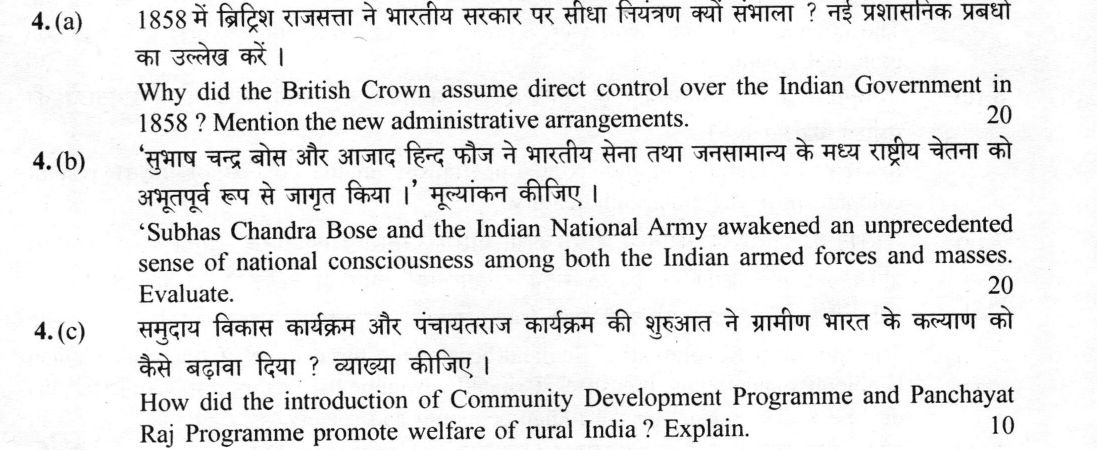
Why did the British Crown assume direct control over the Indian Government in 1858 ? Mention the new administrative arrangements. 20 marks
'Subhas Chandra Bose and the Indian National Army awakened an unprecedented sense of national consciousness among both the Indian armed forces and masses. Evaluate. 20 marks
How did the introduction of Community Development Programme and Panchayat Raj Programme promote welfare of rural India ? Explain. 10 marks
हिंदी में प्रश्न पढ़ें
1858 में ब्रिटिश राजसत्ता ने भारतीय सरकार पर सीधा नियंत्रण क्यों संभाला ? नए प्रशासनिक प्रबंधों का उल्लेख करें । (20 अंक)
'सुभाष चन्द्र बोस और आजाद हिन्द फौज ने भारतीय सेना तथा जनसमान्य के मध्य राष्ट्रीय चेतना को अभूतपूर्व रूप से जागृत किया ।' मूल्यांकन कीजिए । (20 अंक)
समुदाय विकास कार्यक्रम और पंचायतराज कार्यक्रम की शुरुआत ने ग्रामीण भारत के कल्याण को कैसे बढ़ावा दिया ? व्याख्या कीजिए । (10 अंक)
Model answer
Drafted with AI by UPSC Answer Check against this question's marking rubric, to the expected length. UPSC does not publish answers for Mains — this is one way to score well, not an official key. How we build rubrics and answers.
(a) The Crown's takeover of 1858 The revolt of 1857 was the occasion, but the transfer completed a long process.
Why: Parliament had steadily reduced the East India Company to an agent of the state, through the Regulating Act (1773), Pitt's India Act (1784) and the Charter Acts of 1813, 1833 and 1853. The revolt then exposed the Company's failures: an army that had mutinied, poor intelligence, annexations such as Awadh (1856) and the Doctrine of Lapse that alarmed princes and landholders, and policies seen as threats to religion and custom. In Britain, a trading company ruling a vast empire now looked indefensible, and the Crown wished to restore confidence among Indian elites.
New arrangements: the Government of India Act (2 August 1858) ended Company rule and abolished the Court of Directors and the Board of Control. A Secretary of State for India, a Cabinet minister answerable to Parliament (Lord Stanley first), was assisted by a 15-member Council of India. Canning became the Crown's representative, styled Viceroy and Governor-General in the Queen's Proclamation read at Allahabad on 1 November 1858. The Proclamation renounced further annexation, promised to respect princes' rights, religious non-interference and equal eligibility for office, and offered amnesty.
Consolidation followed. The army was reorganised on the Peel Commission's advice (1859), with a higher proportion of European troops and European control of artillery. The Indian Councils Act (1861) introduced the portfolio system and nominated Indian members for legislation, and the Indian Civil Service Act (1861), the Indian Penal Code (1860) and the High Courts Act (1861) standardised administration and law. Thomas Metcalf's Aftermath of Revolt shows much continuity in personnel and methods: the change was in sovereignty and caution more than in the machinery of rule.
(b) Bose, the INA and national consciousness The claim is largely valid for 1945-46, though the INA's effect was catalytic rather than solitary.
The INA: Mohan Singh formed the first INA in 1942 under Rash Behari Bose's Indian Independence League. After Subhas Chandra Bose arrived in 1943, he revived it and proclaimed the Provisional Government of Azad Hind at Singapore on 21 October 1943, with the slogans "Delhi Chalo" and "Jai Hind" and the women's Rani of Jhansi Regiment. Militarily it failed: the Imphal-Kohima campaign of 1944 collapsed, and it depended on Japan.
The masses: the Red Fort trials from November 1945 of Shah Nawaz Khan, P. K. Sahgal and G. S. Dhillon, a Muslim, a Hindu and a Sikh, united opinion across communities and parties. Bhulabhai Desai, Nehru and Tej Bahadur Sapru defended them; INA Weeks, funds and demonstrations spread, and Calcutta saw violent clashes in November 1945 and February 1946. The commander-in-chief, Auchinleck, commuted the sentences in January 1946.
The armed forces: for the first time the loyalty of Indian soldiers became doubtful. The Royal Indian Navy mutiny of February 1946 in Bombay and Karachi, and unrest in the air force, showed the INA example at work, and British officials reported that the Indian Army could no longer be relied on.
Evaluation: the consciousness among soldiers was indeed unprecedented. Among the masses, the INA upsurge built on the Quit India movement and Congress organisation, which remained the main political force. Bose and the INA did not win independence militarily, but they helped convince Britain that its hold on India had become untenable.
(c) Community Development and Panchayati Raj The Community Development Programme (CDP) began on 2 October 1952, drawing on Albert Mayer's Etawah pilot (1948) and Nilokheri. Development blocks were run by a Block Development Officer with Village Level Workers, and the National Extension Service (1953) spread the model. It promoted agricultural extension, minor irrigation, wells, roads, drinking water, schools, health centres and cooperatives. But it became bureaucratic, drew little participation and helped larger farmers most. The Balwantrai Mehta Committee (1957) therefore proposed three-tier democratic decentralisation, and Panchayati Raj was inaugurated at Nagaur, Rajasthan, on 2 October 1959. Elected panchayats gave villagers a say in local works and welfare. Weak funds, irregular elections and elite capture limited them, as the Ashok Mehta Committee (1978) noted, until the 73rd Amendment (1992) gave panchayats constitutional status.
How this answer will be evaluated
What earns full marks: Comprehensive, analytical, and well-supported with specific examples and evidence.
Evaluation rubric
Each sub-part is marked on its own, against the marks and word limit printed on the paper.
- (a) Explain why the Crown took over the government of India in 1858 - the revolt of 1857 as the occasion and long-standing parliamentary criticism and control of Company rule as the deeper cause - and set out the new administrative arrangements under the Government of India Act 1858 and the Queen's Proclamation, with the consolidation that followed. 20 marks
explain— definition/context → points in order → small example → short close
Must cover
- Revolt of 1857 as the immediate occasion; the Company's failures of military control, intelligence and policy (annexation of Awadh, Doctrine of Lapse)
- Long-run parliamentary control: Regulating Act 1773, Pitt's India Act 1784, Charter Acts 1813, 1833, 1853
- Government of India Act, 2 August 1858: Company rule ended; Court of Directors and Board of Control abolished
- Secretary of State for India (Lord Stanley first) with a 15-member Council of India
- Governor-General also styled Viceroy (Canning) as the Crown's representative
- Queen's Proclamation, 1 November 1858 (Allahabad): no further annexation, princes' rights respected, religious non-interference, equal eligibility for office, amnesty
Loses marks
- Narrating the 1857 revolt without linking it to the 1858 changes
- Claiming the Queen became 'Empress of India' in 1858 - that title dates from the Royal Titles Act of 1876
- Dating the Act or the Proclamation wrongly (Act 2 August 1858; Proclamation 1 November 1858)
- Listing the changes without explaining why they were made
Earns more
- Army reorganisation after the Peel Commission (1859): higher European-Indian ratio, European monopoly of artillery, recruitment policy
- Indian Councils Act 1861: portfolio system; nominated additional (including Indian) members for legislation; legislative powers restored to Bombay and Madras
- Indian Civil Service Act 1861 and open competition; Indian Penal Code 1860, Criminal Procedure Code 1861, High Courts Act 1861
- Policy shift towards the princes: end of annexation, Doctrine of Lapse abandoned, adoption sanads; James Wilson's budget and income tax of 1860
Extra mark
- Historiographical note on continuity rather than rupture - e.g. Thomas Metcalf, The Aftermath of Revolt
- Noting that the title 'Empress of India' came only with the Royal Titles Act of 1876, not in 1858
- (b) Evaluate the claim that Subhas Chandra Bose and the INA awakened an unprecedented national consciousness among both the armed forces and the masses: outline the INA's formation and campaign, show its effect in 1945-46 on soldiers, sailors and the public, and judge how far the effect was 'unprecedented' and decisive relative to other forces in the national movement. 20 marks
evaluate— criteria → evidence → balanced judgment
Must cover
- Mohan Singh's first INA (1942) and Rash Behari Bose's Indian Independence League; Bose's arrival (1943) and revival of the INA
- Provisional Government of Azad Hind, Singapore, 21 October 1943; 'Delhi Chalo', 'Jai Hind'
- Imphal-Kohima campaign of 1944 and military failure; Rani of Jhansi Regiment
- Red Fort trials from November 1945 - Shah Nawaz Khan, P. K. Sahgal, G. S. Dhillon; defence by Bhulabhai Desai, Nehru, Tej Bahadur Sapru
- Mass agitation: INA Week, Calcutta disturbances of November 1945 and February 1946; commutation of sentences (January 1946)
- Effect on the armed forces: RIN mutiny of February 1946; unrest in the air force; British doubts about the Indian Army's loyalty
Loses marks
- A biographical sketch of Bose with no analysis of consciousness among the forces and the masses
- Ignoring either the armed forces or the masses, which the statement names separately
- Presenting the INA as a military success or as the sole cause of independence
- Wrong chronology - e.g. dating the Azad Hind government to 1942, or placing the Red Fort trials before the end of the war
Earns more
- Cross-community appeal - a Muslim, a Hindu and a Sikh tried together; support across party lines
- Official alarm - Auchinleck's commutation of sentences and intelligence reports on army morale
- Balanced verdict: militarily unsuccessful and dependent on Japan, but politically catalytic; the Congress remained the main organised force and Quit India had already mobilised the masses
Extra mark
- Named historians on the 1945-46 upsurge - Sumit Sarkar, Bipan Chandra; Peter Ward Fay, The Forgotten Army
- Bose's Rangoon appeal of July 1944 ('Give me blood and I will give you freedom') used as evidence of mass appeal, correctly contextualised
- (c) Explain how the Community Development Programme (1952) and Panchayati Raj (from 1959) were meant to promote, and did promote, rural welfare - their aims, organisation, achievements and limits. 10 marks
explain— definition/context → points in order → small example → short close
Must cover
- CDP launched 2 October 1952, building on the Etawah pilot (Albert Mayer, 1948) and Nilokheri
- Development blocks with a Block Development Officer and Village Level Workers; National Extension Service (1953)
- Balwantrai Mehta Committee (1957) - three-tier democratic decentralisation
- Panchayati Raj inaugurated at Nagaur, Rajasthan, 2 October 1959
Loses marks
- Describing the programmes without linking them to welfare outcomes
- Confusing the CDP (1952) with Panchayati Raj (1959), or dating Panchayati Raj only from the 73rd Amendment
- Uncritical praise with no note of limitations
Earns more
- Welfare fields: agricultural extension, minor irrigation, wells, roads, drinking water, primary schools, health centres, cooperatives
- Limits: bureaucratic, top-down character; benefits skewed to larger farmers; weak participation; Ashok Mehta Committee (1978)
- Later strengthening by the 73rd Constitutional Amendment (1992)
Extra mark
- Link to the shift of emphasis towards the Intensive Agricultural District Programme and the Green Revolution in the 1960s
What "Mention" is asking you to do
Put specific factual content on record — the names, features, targets or instances the stem asks for. Mention is usually the subordinate half of a larger question, so it must be done fully but quickly, leaving room for the part that carries the main directive.
Structure that answers it
The items named directly, without preamble → one qualifying detail against each → straight on to the part of the stem the marks actually sit in
Where marks are lost
Gesturing at the category instead of naming the particulars, or expanding it until the analytical half of the question is squeezed.
Practice this exact question
Write your answer and it is marked point by point against the model answer above — what you covered, what you missed, what you got wrong.
Evaluate my answer →More from History 2026 Paper II
- Q1 Critically examine the following statements in about 150 words each : (a) “Superior Marit…
- Q2 (a) Underline the various factors for decline of the Indian cottage industries during the…
- Q3 (a) ‘Raja Rammohan Roy stands in history as the living bridge over which India marches fr…
- Q4 (a) Why did the British Crown assume direct control over the Indian Government in 1858 ?…
- Q5 Critically examine the following statements in about 150 words each : (a) "Immanuel Kant…
- Q6 (a) The Vienna Settlement of 1815 was based on three principles, restoration, legitimacy…
- Q7 (a) The Industrial Revolution in England accelerated the decline of traditional Indian ha…