Paper II — Q7
(a) The Industrial Revolution in England accelerated the decline of traditional Indian handicrafts and cottage Industries…
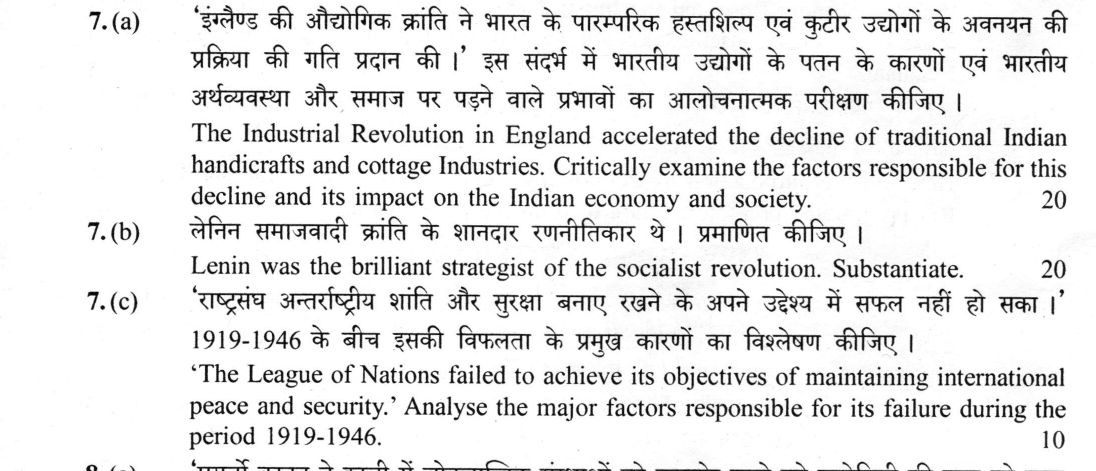
The Industrial Revolution in England accelerated the decline of traditional Indian handicrafts and cottage Industries. Critically examine the factors responsible for this decline and its impact on the Indian economy and society. 20 marks
Lenin was the brilliant strategist of the socialist revolution. Substantiate. 20 marks
'The League of Nations failed to achieve its objectives of maintaining international peace and security.' Analyse the major factors responsible for its failure during the period 1919-1946. 10 marks
हिंदी में प्रश्न पढ़ें
'इंग्लैंड की औद्योगिक क्रांति ने भारत के पारम्परिक हस्तशिल्प एवं कुटीर उद्योगों के अवनयन की प्रक्रिया की गति प्रदान की ।' इस संदर्भ में भारतीय उद्योगों के पतन के कारणों एवं भारतीय अर्थव्यवस्था और समाज पर पड़ने वाले प्रभावों का आलोचनात्मक परीक्षण कीजिए । (20 अंक)
लेनिन समाजवादी क्रांति के शानदार रणनीतिकार थे । प्रमाणित कीजिए । (20 अंक)
'राष्ट्रसंघ अन्तर्राष्ट्रीय शांति और सुरक्षा बनाए रखने के अपने उद्देश्य में सफल नहीं हो सका ।' 1919-1946 के बीच इसकी विफलता के प्रमुख कारणों का विश्लेषण कीजिए । (10 अंक)
Model answer
Drafted with AI by UPSC Answer Check against this question's marking rubric, to the expected length. UPSC does not publish answers for Mains — this is one way to score well, not an official key. How we build rubrics and answers.
(a) Industrial Revolution and the decline of Indian crafts Factors: Lancashire's machine-spun yarn and cloth were far cheaper than hand products, but colonial power shaped the contest. In Bengal after 1757 the Company's dadni and gomasta system forced weavers to sell at low prices. As the Mughal, Maratha, Mysore and Awadh courts fell, luxury crafts lost their patrons. The Charter Act of 1813 ended the Company's Indian trade monopoly (1833 ended its trading role altogether), opening India to British goods, which paid low duties while Indian cloth faced heavy duties in Britain. Cotton import duties in India were abolished in 1882, and the countervailing excise of 1896 penalised Indian mills. Railways from the Bombay-Thane line (16 April 1853) and the Suez Canal (1869) carried imports into the interior. The state offered no protection or technical education.
Impact on the economy: centres such as Dacca, Murshidabad and Surat decayed; displaced artisans crowded into agriculture, a "ruralisation" that raised pressure on land; and India became an exporter of raw cotton, jute and indigo and an importer of manufactures. Dadabhai Naoroji and R. C. Dutt linked this to the drain of wealth and to poverty.
Impact on society: artisan communities were impoverished, women lost spinning incomes, and many migrated or went abroad as indentured labour. The experience fed the economic critique of empire and the swadeshi and charkha programmes.
Critical view: Amiya Kumar Bagchi's figures for Gangetic Bihar show a steep fall in industrial employment, but Morris D. Morris questioned the statistics and Tirthankar Roy shows handloom weaving surviving and even growing after 1900 by using mill yarn. The decline was severe and uneven, not total.
(b) Lenin as strategist of revolution Lenin's brilliance lay in adapting Marxism to a largely peasant Russia and in knowing when to advance and when to retreat.
Theory: What Is To Be Done? (1902) called for a disciplined vanguard party of professional revolutionaries, which produced the Bolshevik-Menshevik split of 1903. Two Tactics of Social Democracy (1905) proposed a "revolutionary democratic dictatorship of the proletariat and peasantry", fitting strategy to Russian conditions. Imperialism, the Highest Stage of Capitalism (1916) argued that revolution could break the capitalist chain at its weakest link.
Seizing power: his April Theses (April 1917) rejected support for the Provisional Government and demanded "All power to the Soviets", with slogans of "Peace, Land, Bread" that matched popular demands. He pressed for insurrection, which succeeded on 25 October (7 November) 1917; Trotsky and the Military Revolutionary Committee organised it.
Holding power: the Decrees on Peace and Land met soldiers' and peasants' wishes; the Constituent Assembly was dissolved in January 1918; and the Treaty of Brest-Litovsk (3 March 1918) gave up vast territory to win a breathing space, a gamble justified when Germany's defeat annulled it that November. After War Communism provoked the Kronstadt rebellion and peasant risings, the New Economic Policy (March 1921) replaced requisitioning with a tax in kind. Abroad he founded the Comintern (1919).
The costs were real: the Cheka and Red Terror, suppression of other socialists, and the 1921 ban on factions, criticised as early as 1918 by Rosa Luxemburg. Lenin's strategy was brilliant in winning and keeping power, but it also laid the foundations of one-party dictatorship.
(c) Why the League of Nations failed The League, whose Covenant formed Part I of the Treaty of Versailles (28 June 1919) and which began work on 10 January 1920, failed for structural and political reasons. Structurally, the US Senate refused ratification; decisions of the Council needed unanimity; and the collective security of Articles 10 and 16 had no standing force behind it. Politically, the League was tied to the resented Versailles order, great powers preferred to act outside it (Locarno 1925, Kellogg-Briand 1928, Munich 1938), and the Depression and the failed Disarmament Conference (1932-34) sharpened rivalries. It failed its tests: after the Manchurian crisis (1931) and the Lytton Report, Japan left (1933), as did Germany; over Abyssinia (invaded 3 October 1935), sanctions excluded oil and the Hoare-Laval Pact (December 1935) undermined them, and Italy left in 1937. Yet it settled smaller disputes in the 1920s and its agencies, such as the ILO, did lasting work. It was formally wound up on 18 April 1946.
How this answer will be evaluated
Evaluation rubric
Each sub-part is marked on its own, against the marks and word limit printed on the paper.
- (a) A two-part 'critically examine': first the factors behind the decline of Indian handicrafts and cottage industries in the age of the English Industrial Revolution, and second the consequences of that decline for the Indian economy AND Indian society. The critical element requires engagement with the de-industrialisation debate rather than assertion. 20 marks
Must cover
- Charter Act 1813 and 1833
- abolition of import duties, 1882
- countervailing excise on Indian mill cloth, 1896
- dadni and gomasta system
- Bombay-Thane railway, 16 April 1853
- Suez Canal, 1869
- decay of Dacca, Murshidabad and Surat
- ruralisation / de-industrialisation
- Amiya Kumar Bagchi; Morris D. Morris; Tirthankar Roy
- Dadabhai Naoroji and R. C. Dutt
Loses marks
- Answering only the causes and ignoring the second half of the question on economic and social impact, which carries roughly half the marks
- Presenting the decline as complete - handloom weaving contracted and restructured but survived, and expanded again after 1900 on mill yarn
- Getting the tariff story backwards by suggesting the 1896 excise protected Indian industry; it penalised Indian mills
- Omitting the gender dimension: the loss of hand-spinning removed a principal source of rural women's earnings
- Treating de-industrialisation as an undisputed fact and offering no engagement with the historiographical controversy, which forfeits the 'critically' component
Earns more
- Political and institutional causes: loss of court patronage after the fall of the Mughal, Maratha, Mysore and Awadh states; the dadni/gomasta coercion of Bengal weavers; and the colonial state's refusal to protect, educate or purchase Indian manufactures
- Infrastructure that removed the protection of distance: railways from 16 April 1853 (Bombay-Thane), steam shipping and the Suez Canal (1869)
- Social consequences: pauperisation of artisan communities, loss of women's spinning incomes, migration and indenture, and the political birth of the economic critique of empire (Naoroji, R. C. Dutt, swadeshi, the charkha)
- Critical engagement with the de-industrialisation debate: Amiya Kumar Bagchi's Gangetic Bihar evidence against Morris D. Morris's statistical scepticism and Tirthankar Roy's evidence of handloom revival after 1900
- (b) 'Substantiate' means prove the claim with evidence: demonstrate Lenin's strategic brilliance through his specific theoretical innovations and tactical decisions from 1902 to 1921 - the vanguard party, the April Theses, the timing of October, Brest-Litovsk and the NEP - while noting honestly the costs and the contribution of others, above all Trotsky. 20 marks
Must cover
- What Is To Be Done? (1902)
- Bolshevik-Menshevik split, 1903
- Two Tactics of Social Democracy (1905)
- Imperialism, the Highest Stage of Capitalism (1916); weakest link
- April Theses, April 1917
- 'Peace, Land, Bread' and 'All power to the Soviets'
- October Revolution, 25 October (7 November) 1917
- Treaty of Brest-Litovsk, 3 March 1918
- Kronstadt rebellion and the New Economic Policy, March 1921
- Trotsky and the Military Revolutionary Committee
Loses marks
- Confusing the Old Style and New Style dates - the October Revolution is 25 October by the Julian calendar and 7 November by the Gregorian; giving only one without explanation is acceptable, giving 'October 7' is not
- Attributing the Military Revolutionary Committee and the organisation of the insurrection to Lenin personally - that was Trotsky's work, which a 'substantiate' answer should acknowledge
- Calling Brest-Litovsk a blunder without recognising the strategic calculation, or failing to note that it was annulled after Germany's defeat in November 1918
- Dating the NEP to 1922 or treating it as a betrayal rather than as the strategic response to Kronstadt and the peasant risings of 1920-21
- Writing a narrative of the Russian Revolution instead of an argument about Lenin's strategy
Earns more
- Strategy adapted to a backward country: 'Two Tactics' (1905) and the revolutionary democratic dictatorship of proletariat and peasantry; and the weakest-link argument of 'Imperialism, the Highest Stage of Capitalism' (1916)
- Strategic consolidation: Decrees on Peace and Land (26 October 1917), dissolution of the Constituent Assembly (January 1918), and the Treaty of Brest-Litovsk of 3 March 1918 as a calculated retreat for a breathing space
- Strategic adaptation after Kronstadt: the New Economic Policy at the Tenth Party Congress (March 1921) replacing requisition with a tax in kind; the Comintern (March 1919) and 'Left-Wing Communism' (1920)
- Critical balance: the Cheka and Red Terror, suppression of rival socialists and the 1921 ban on factions; Rosa Luxemburg's 1918 critique; and Trotsky's indispensable role in the insurrection and the Red Army
- (c) 'Analyse the major factors' behind the League of Nations' failure between 1919 and 1946: the answer must separate structural and constitutional defects from political and circumstantial ones, illustrate each with named crises, and - for balance - note the League's genuine achievements before concluding. 10 marks
Must cover
- Covenant as Part I of the Treaty of Versailles, 28 June 1919; League in being 10 January 1920
- United States Senate rejection
- unanimity rule; Article 10 and Article 16
- Manchurian crisis, 1931; Lytton Report
- Italian invasion of Abyssinia, 3 October 1935
- Hoare-Laval Pact, December 1935
- Japan and Germany withdraw, 1933
- dissolved 18 April 1946
- International Labour Organisation
Loses marks
- Saying the United States refused to join because Wilson opposed it - Wilson was the League's author; it was the Senate that refused ratification
- Dating the Abyssinian crisis to 1934 (the Wal Wal incident) rather than the invasion of 3 October 1935, or claiming sanctions included oil - they did not
- Ignoring the League's real successes in the 1920s and its technical agencies, which makes the analysis one-sided
- Confusing the League Council's unanimity rule with the UN Security Council veto - the mechanisms and their consequences are different
- Stating that the League was dissolved in 1945 - it transferred its functions in 1946 and was formally wound up on 18 April 1946
Earns more
- Identification with the Versailles settlement, great-power preference for action outside the League (Locarno 1925, Kellogg-Briand 1928, Munich 1938), and the effects of the Depression and the failed Disarmament Conference of 1932-34
What "Critically examine" is asking you to do
Test the proposition the question puts to you and return a finding on how far it holds. Examine stems carry a claim, or ask whether something has happened, and expect evidence weighed both ways before the extent is stated — often with remedial measures attached. “Critically” is not a section added at the end: name the yardstick you are judging by — the evidence, the stated objective, a constitutional principle, a rival explanation — and let a verdict close each part of the body. Where the question quotes a claim, that verdict must land on the claim itself, accepted, qualified or rejected, and not on the theme in general.
Structure that answers it
Restate the claim as the question frames it → evidence that supports it → evidence that undercuts it → the conditions under which it holds → verdict on how far it stands
Where marks are lost
Merits in one paragraph, demerits in the next, and a conclusion calling for a balanced and holistic approach. That is a survey with the judgement left out and it holds the answer in the middle band. The opposite error is reading “critically” as permission to attack — and with the odd pairings, critically describe or critically explain, the exposition still carries most of the marks, the judgement being a layer on it rather than a substitute for it.
Practice this exact question
Write your answer and it is marked point by point against the model answer above — what you covered, what you missed, what you got wrong.
Evaluate my answer →More from History 2026 Paper II
- Q4 (a) Why did the British Crown assume direct control over the Indian Government in 1858 ?…
- Q5 Critically examine the following statements in about 150 words each : (a) "Immanuel Kant…
- Q6 (a) The Vienna Settlement of 1815 was based on three principles, restoration, legitimacy…
- Q7 (a) The Industrial Revolution in England accelerated the decline of traditional Indian ha…
- Q8 (a) 'The Acerbo law played a crucial role in strengthening Mussolini's hold on power by u…