Paper II — Q8
(a) 'The Acerbo law played a crucial role in strengthening Mussolini's hold on power by undermining democratic institutions in…
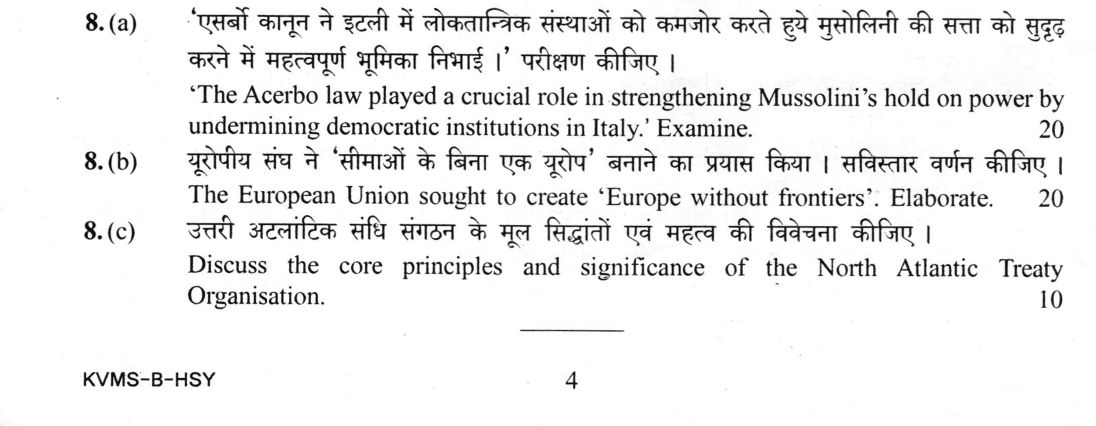
'The Acerbo law played a crucial role in strengthening Mussolini's hold on power by undermining democratic institutions in Italy.' Examine. 20 marks
The European Union sought to create 'Europe without frontiers'. Elaborate. 20 marks
Discuss the core principles and significance of the North Atlantic Treaty Organisation. 10 marks
हिंदी में प्रश्न पढ़ें
'एसर्बो कानून ने इटली में लोकतान्त्रिक संस्थाओं को कमजोर करते हुये मुसोलिनी की सत्ता को सुदृढ़ करने में महत्वपूर्ण भूमिका निभाई ।' परीक्षण कीजिए । (20 अंक)
यूरोपीय संघ ने 'सीमाओं के बिना एक यूरोप' बनाने का प्रयास किया । सविस्तार वर्णन कीजिए । (20 अंक)
उत्तरी अटलांटिक संधि संगठन के मूल सिद्धांतों एवं महत्व की विवेचना कीजिए । (10 अंक)
Model answer
Drafted with AI by UPSC Answer Check against this question's marking rubric, to the expected length. UPSC does not publish answers for Mains — this is one way to score well, not an official key. How we build rubrics and answers.
(a) The Acerbo Law and Mussolini's power The claim is valid, but the law worked alongside violence and collusion.
Background: after the March on Rome (28 October 1922), King Victor Emmanuel III refused to proclaim martial law and made Mussolini prime minister (31 October 1922), heading a coalition with a small Fascist bloc in the Chamber.
The law: drafted by Giacomo Acerbo and passed in 1923 with the votes of many liberals, it gave two-thirds of the seats to the list that won the most votes, provided it had at least 25 per cent. At the election of 6 April 1924 the Fascist-led listone, helped by squadrist intimidation and fraud, took about 65 per cent of the vote, so the bonus proved arithmetically unnecessary; its real effect was to signal that parliament would be remade in the government's favour.
Crisis and consolidation: Giacomo Matteotti denounced the violence on 30 May 1924 and was abducted on 10 June and murdered. The opposition withdrew in the Aventine Secession, but the King did not act. On 3 January 1925 Mussolini assumed responsibility for what had happened and launched open dictatorship. The leggi fascistissime (1925-26) made him answerable only to the King, abolished opposition parties (November 1926) and created the Special Tribunal and the OVRA secret police; the 1928 electoral law and the single-list plebiscite of 1929 ended competitive elections.
Assessment: historians such as Adrian Lyttelton, Denis Mack Smith and Renzo De Felice stress that squadrist violence, the King's choices, support from industrialists and landowners, and liberal hopes of "normalising" fascism mattered as much. The Acerbo Law was the legal hinge of this transformation, not its sole cause.
(b) Towards a "Europe without frontiers" Integration removed frontiers of several kinds, though not completely.
Economic frontiers: the Schuman Declaration (9 May 1950) led to the European Coal and Steel Community (Treaty of Paris, 1951). The Treaties of Rome (25 March 1957) created the EEC, whose customs union was completed on 1 July 1968. The Single European Act (1986) set the target of an internal market by 31 December 1992, with the "four freedoms" of goods, services, capital and persons.
Physical frontiers: the Schengen Agreement (14 June 1985), signed by five states outside the Community framework, and its 1990 convention led to the removal of internal border checks from 1995; the Treaty of Amsterdam brought Schengen into EU law.
Monetary frontiers: the Maastricht Treaty (signed 7 February 1992, in force 1 November 1993) created the European Union and set convergence criteria; the European Central Bank followed, and the euro began as account money on 1 January 1999, with notes and coins from 1 January 2002.
Personal and political frontiers: EU citizenship, a directly elected European Parliament (from 1979), Erasmus (1987), the European Arrest Warrant, the enlargement of 1 May 2004 and the Lisbon Treaty (2007, in force 2009) deepened integration.
Limits: Denmark and others stayed out of the euro and Ireland out of Schengen; the eurozone crisis from 2010 strained monetary union; the migration crisis of 2015 and the COVID-19 pandemic brought back border checks; and Brexit (referendum 23 June 2016, departure 31 January 2020) restored a frontier, including the Irish border problem. "Europe without frontiers" has been largely achieved inside the Union, but remains contested.
(c) NATO: principles and significance The North Atlantic Treaty was signed in Washington on 4 April 1949 by twelve states, after the Brussels Treaty (1948) and the Berlin blockade. Its principles: Article 2 commits members to free institutions; Article 3 to self-help and defence capacity; Article 4 to consultation when any member feels threatened; Article 5 treats an armed attack on one as an attack on all, each responding with "such action as it deems necessary"; and Article 10 keeps the door open to other European states. Its significance lies in the first peacetime US commitment to Europe and an integrated command under SACEUR. West Germany's admission in 1955 was followed by the Warsaw Pact (14 May 1955). After the Cold War it enlarged to 32 members (Finland 2023, Sweden 2024) and acted out of area, as in Kosovo (1999). Article 5 has been invoked only once, after 11 September 2001. Enlargement, relations with Russia and burden-sharing remain contested.
How this answer will be evaluated
Evaluation rubric
Each sub-part is marked on its own, against the marks and word limit printed on the paper.
- (a) 'Examine' the role of the Acerbo Law in consolidating Mussolini's power by undermining Italian democratic institutions: the answer must state the law's provisions and date accurately, trace what it produced at the 1924 election and in the Matteotti crisis, and then weigh it against the other instruments of fascist consolidation - violence, liberal collusion and the monarchy. 20 marks
Must cover
- Giacomo Acerbo
- Acerbo Law, 1923
- two-thirds of seats for the list with at least 25 per cent of the vote
- March on Rome, 28 October 1922; Mussolini PM 31 October 1922
- election of 6 April 1924 and the 'listone'
- Giacomo Matteotti, murdered June 1924
- Aventine Secession
- Mussolini's speech of 3 January 1925
- leggi fascistissime, 1925-26
- Victor Emmanuel III
Loses marks
- Mis-stating the threshold - the law gave two-thirds of the seats to the leading list provided it won at least 25 per cent of the votes; saying 'a simple majority' or 'one-third of the votes' is wrong
- Dating the law to 1924 - it was passed in 1923 and applied at the election of 6 April 1924
- Saying the Fascists needed the bonus to win in 1924 - they exceeded the threshold comfortably amid violence and fraud, which makes the law's significance constitutional and psychological as much as arithmetical
- Confusing the Aventine Secession (the opposition's withdrawal from the Chamber in 1924) with the March on Rome or with the abolition of parties in 1926
- Treating the law as the sole cause of fascist consolidation and ignoring squadrist violence, the King's role and liberal collusion
Earns more
- The Matteotti crisis: his denunciation of 30 May 1924, his abduction on 10 June and murder, the Aventine Secession, and Mussolini's speech of 3 January 1925 assuming responsibility and inaugurating the dictatorship
- The consolidation that followed: the leggi fascistissime of 1925-26, abolition of opposition parties in November 1926, OVRA and the Special Tribunal, the 1928 law making the Grand Council a constitutional organ, the single-list plebiscite of 1929 and the Lateran Treaty of 11 February 1929
- Critical weighing against the other instruments - squadrist violence from 1920-22, the King's refusal of martial law in October 1922, industrial and landed finance, and the liberal strategy of 'normalisation' (De Felice, Lyttelton, Mack Smith)
- (b) 'Elaborate' how the European integration project pursued a 'Europe without frontiers': trace the removal of economic, physical, monetary and personal frontiers through the treaties and programmes from 1951 to the present, and note honestly the frontiers that have persisted or returned. 20 marks
Must cover
- Schuman Declaration, 9 May 1950
- Treaty of Paris 1951 (ECSC)
- Treaties of Rome, 25 March 1957
- customs union completed 1 July 1968
- Single European Act 1986/1987 and the 1992 internal market deadline
- the four freedoms
- Schengen Agreement, 14 June 1985
- Maastricht Treaty, 7 February 1992 / in force 1 November 1993
- the euro, 1999 and 2002
- Brexit, 2016 referendum and 2020 departure
Loses marks
- Confusing the Single European Act (1986) with the Single Market's completion date (31 December 1992) or with the Maastricht Treaty (1992) - three distinct things
- Saying Schengen is an EU institution from the outset - it began in 1985 as a separate intergovernmental agreement among five states and was brought into EU law only by the Treaty of Amsterdam
- Assuming all EU members use the euro or belong to Schengen - Denmark, Sweden and several newer members are outside the euro, and Ireland is outside Schengen, while non-EU Norway, Iceland and Switzerland are inside it
- Dating the euro's introduction to 2002 only - it existed as scriptural money from 1 January 1999; notes and coin followed on 1 January 2002
- Omitting the reversals - Brexit, the 2015 reimposition of border checks, the eurozone crisis - which the phrase 'sought to create' invites the candidate to address
Earns more
- Monetary union: the Maastricht Treaty signed 7 February 1992 and in force 1 November 1993, the convergence criteria, the European Central Bank, and the euro from 1 January 1999 (notes and coin 1 January 2002)
- Personal, legal and institutional frontier-removal: EU citizenship, directly elected European Parliament (1979), direct effect and supremacy in Court of Justice jurisprudence, Erasmus (1987), the European Arrest Warrant, and successive enlargements including the ten states of 1 May 2004; the Lisbon Treaty of 2007/2009
- Honest account of the limits: opt-outs from Schengen and the euro, the eurozone crisis from 2010, the migration crisis of 2015 and reimposed border checks, COVID-19 closures, and Brexit (referendum 23 June 2016, departure 31 January 2020) with the Irish border problem
- (c) 'Discuss the core principles and significance' of NATO: the answer must state the founding facts, set out the substantive principles as they appear in the North Atlantic Treaty (especially Articles 3, 4, 5 and 10), and then assess the organisation's historical significance in the Cold War and after, including its criticisms. 10 marks
Must cover
- North Atlantic Treaty, 4 April 1949, Washington
- twelve founding members
- Article 5 collective defence
- Article 4 consultation; Article 3 self-help; Article 10 open door
- Brussels Treaty 1948 and the Berlin blockade
- Warsaw Pact, 14 May 1955
- West Germany admitted 1955
- Article 5 invoked after 11 September 2001
- Finland 2023 and Sweden 2024; 32 members
Loses marks
- Saying Article 5 obliges every member to go to war automatically - the text requires each to take 'such action as it deems necessary', which was the price of American ratification
- Dating NATO's foundation to 1948 (that is the Brussels Treaty) or 1955 (that is the Warsaw Pact and West German accession)
- Claiming Article 5 was invoked during the Cold War - its only invocation was after the attacks of 11 September 2001
- Confusing the number of founding members (twelve) with the current membership (32 after Sweden's accession in 2024)
- Describing NATO as purely military and omitting the Preamble's and Article 2's political commitments to democracy and the rule of law
Earns more
- Significance: the peacetime American commitment to Europe, integrated command under SACEUR, West German rearmament and membership (1955) provoking the Warsaw Pact (14 May 1955), enlargement to 32 members (Finland 2023, Sweden 2024), and the sole invocation of Article 5 after 11 September 2001
- Criticisms and controversies: enlargement and relations with Russia, burden-sharing and the two per cent target, France's withdrawal from integrated command (1966) and return (2009), and out-of-area operations such as Kosovo (1999)
What "Examine" is asking you to do
Test the proposition the question puts to you and return a finding on how far it holds. Examine stems carry a claim, or ask whether something has happened, and expect evidence weighed both ways before the extent is stated — often with remedial measures attached.
Structure that answers it
Restate the claim as the question frames it → evidence that supports it → evidence that undercuts it → the conditions under which it holds → verdict on how far it stands
Where marks are lost
Stopping at description. An examination has to reach a finding, and “examine with justification” means the extent must be stated, not implied.
Practice this exact question
Write your answer and it is marked point by point against the model answer above — what you covered, what you missed, what you got wrong.
Evaluate my answer →More from History 2026 Paper II
- Q5 Critically examine the following statements in about 150 words each : (a) "Immanuel Kant…
- Q6 (a) The Vienna Settlement of 1815 was based on three principles, restoration, legitimacy…
- Q7 (a) The Industrial Revolution in England accelerated the decline of traditional Indian ha…
- Q8 (a) 'The Acerbo law played a crucial role in strengthening Mussolini's hold on power by u…