Paper II — Q6
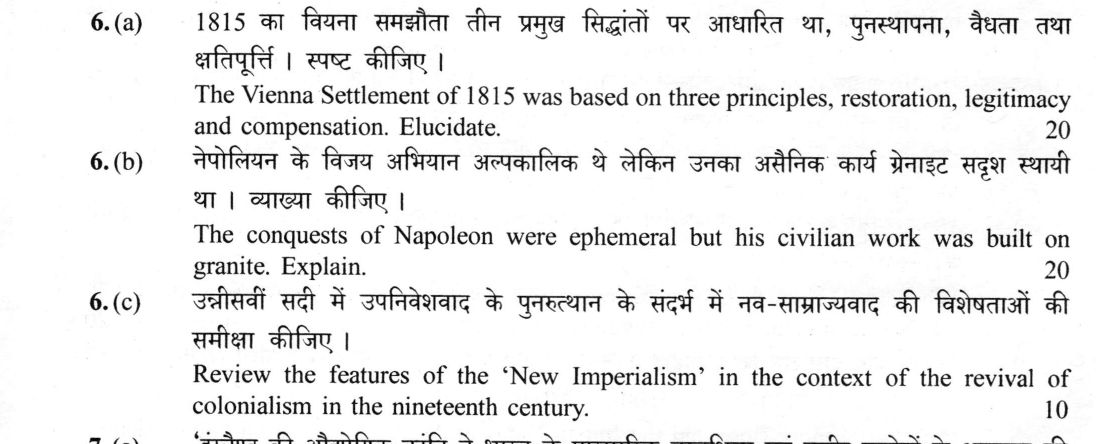
(a) The Vienna Settlement of 1815 was based on three principles, restoration, legitimacy and compensation. Elucidate. (20…
The Vienna Settlement of 1815 was based on three principles, restoration, legitimacy and compensation. Elucidate. 20 marks
The conquests of Napoleon were ephemeral but his civilian work was built on granite. Explain. 20 marks
Review the features of the 'New Imperialism' in the context of the revival of colonialism in the nineteenth century. 10 marks
हिंदी में प्रश्न पढ़ें
1815 का वियना समझौता तीन प्रमुख सिद्धांतों पर आधारित था, पुनःस्थापना, वैधता तथा क्षतिपूर्ति । स्पष्ट कीजिए । (20 अंक)
नेपोलियन के विजय अभियान अल्पकालिक थे लेकिन उनका असैनिक कार्य ग्रेनाइट सदृश स्थायी था । व्याख्या कीजिए । (20 अंक)
उन्नीसवीं सदी में उपनिवेशवाद के पुनरुत्थान के संदर्भ में नव-साम्राज्यवाद की विशेषताओं की समीक्षा कीजिए । (10 अंक)
Model answer
Drafted with AI by UPSC Answer Check against this question's marking rubric, to the expected length. UPSC does not publish answers for Mains — this is one way to score well, not an official key. How we build rubrics and answers.
(a) Principles of the Vienna Settlement The settlement, shaped by Metternich, Castlereagh, Tsar Alexander I, Hardenberg and Talleyrand, was framed by the First Treaty of Paris (30 May 1814), the Final Act of the Congress (9 June 1815, before Waterloo) and the Second Treaty of Paris (20 November 1815).
Restoration: rulers displaced by the Revolution and Napoleon returned: the Bourbons in France, Spain and Naples, the Pope to the Papal States, and the House of Orange in the Netherlands.
Legitimacy: Talleyrand used this principle to protect France and to argue that only rightful dynasties could give Europe stable government. But it was applied selectively. The old republics of Venice and Genoa were not restored, the Holy Roman Empire was replaced by a German Confederation of 39 states (Federal Act, 8 June 1815), and Belgium was handed to the Dutch king.
Compensation: powers were rewarded for their losses and their war effort. Austria took Lombardy and Venetia in place of the Austrian Netherlands; Prussia gained the Rhineland and about two-fifths of Saxony under the Polish-Saxon compromise; Russia received Congress Poland; Sweden gained Norway, and Britain kept strategic colonies such as the Cape and Ceylon.
Behind all three lay the balance of power and the containment of France, through barrier states such as the enlarged Netherlands, Piedmont-Sardinia and Prussia on the Rhine, and Swiss neutrality. The Holy Alliance (26 September 1815) and the Quadruple Alliance (20 November 1815), whose Article VI set up the Congress System, were to preserve it.
Assessment: the settlement prevented a general European war until the Crimean War (1853-56). But by ignoring nationalism and liberalism, in Belgium, Italy, Germany and Poland, it invited the revolutions of 1830 and 1848.
(b) Napoleon: ephemeral conquests, granite institutions The contrast is largely valid.
The ephemeral: after the coup of 18 Brumaire (9 November 1799), Napoleon's victories, from Austerlitz (2 December 1805) to the Treaty of Tilsit (7 July 1807), built an empire of satellite kingdoms. It rested on force and on the Continental System (Berlin Decree, 1806), which hurt European trade and bred resentment. Spain's resistance, the Russian campaign of 1812, Leipzig (16-19 October 1813) and Waterloo (18 June 1815) destroyed it, and the Vienna settlement redrew the map.
The granite: the Civil Code (21 March 1804) unified French law, secured equality before the law, property and the Revolution's land settlement, and was adopted or imitated across Europe and Latin America. Prefects (law of 17 February 1800) gave France a centralised administration that still exists. The Bank of France (1800) stabilised finance, and the Legion of Honour (1802) rewarded merit. The Concordat with Pius VII (15 July 1801) ended the religious schism, and the lycees (1802) and the Imperial University (1808) built a state education system. Abroad, occupation ended serfdom, feudal dues and guild restrictions in many lands, and the Holy Roman Empire vanished in 1806.
Qualifications: the Code subordinated married women, Napoleon restored colonial slavery in 1802, censorship and Fouche's police curbed freedom, and much of the Code built on Revolutionary drafts by Cambaceres and others. As Pieter Geyl's Napoleon: For and Against shows, historians still debate whether he consolidated or betrayed the Revolution. Yet his institutions, unlike his conquests, lasted.
(c) Features of the New Imperialism New Imperialism (c. 1870-1914) was a rapid, formal seizure of territory, unlike the older colonialism of trading posts and settlements. In Africa, European control rose from about a tenth of the continent in 1870 to almost all of it by 1914. The Berlin West Africa Conference (1884-85) set rules of "effective occupation" and recognised Leopold II's Congo Free State. Asia and the Pacific saw French Indochina, Dutch expansion in Indonesia and the American annexation of the Philippines. Steamships, the Suez Canal (1869), the telegraph, quinine and the Maxim gun made conquest cheap, while Social Darwinism and the "civilising mission", as in Kipling's "The White Man's Burden" (1899), justified it. Explanations differ: J. A. Hobson (1902) and Lenin (1916) stressed surplus capital, Gallagher and Robinson strategy and crises at the periphery, and Schumpeter atavistic militarism, while D. K. Fieldhouse doubted the investment link. Rivalry at Fashoda (1898) and in the Moroccan crises (1905, 1911) fed the tensions of 1914.
How this answer will be evaluated
Evaluation rubric
Each sub-part is marked on its own, against the marks and word limit printed on the paper.
- (a) 'Elucidate' the three organising principles of the Vienna Settlement - restoration, legitimacy and compensation - which means defining each principle and illustrating it with the actual territorial and dynastic decisions of 1814-15, and then assessing what the settlement achieved and what it ignored. 20 marks
Must cover
- Metternich, Castlereagh, Tsar Alexander I, Hardenberg, Talleyrand
- Final Act of the Congress of Vienna, 9 June 1815
- legitimacy, restoration, compensation, balance of power
- German Confederation of 39 states, Federal Act of 8 June 1815
- Lombardy and Venetia to Austria
- Congress Poland; Norway to Sweden; Belgium to the Netherlands
- First Treaty of Paris, 30 May 1814; Second Treaty of Paris, 20 November 1815
- Holy Alliance, 26 September 1815; Quadruple Alliance, 20 November 1815
- Crimean War 1853-56
Loses marks
- Dating the Final Act after Waterloo - it was signed on 9 June 1815, Waterloo was fought on 18 June
- Saying the settlement restored the Holy Roman Empire - it created the German Confederation of 39 states instead
- Confusing the Holy Alliance (Alexander I, 26 September 1815, a declaration of Christian principles) with the Quadruple Alliance (20 November 1815, the practical instrument of the Congress System)
- Claiming the Congress gave Belgium independence - Belgium was given to the Dutch Netherlands as a barrier state and only became independent through the revolution of 1830
- Treating legitimacy as consistently applied, when Venice, Genoa and Ragusa were extinguished and the German states drastically reduced
Earns more
- Identifies the balance of power and the containment of France as the unstated organising principle - the barrier states, Swiss neutrality, and the Polish-Saxon compromise of 3 January 1815
- Names the framework treaties and the Congress System: First Treaty of Paris (30 May 1814), Final Act (9 June 1815), Second Treaty of Paris (20 November 1815), Quadruple Alliance and Holy Alliance, and the congresses of 1818-1822
- Delivers a critical assessment - nationalism and liberalism disregarded, hence 1830 and 1848 - balanced against the durability of the equilibrium until the Crimean War of 1853-56
- (b) 'Explain' a contrast: demonstrate first that Napoleon's military and imperial conquests were transient - undone entirely by 1815 - and second that his civil institutions proved durable, naming the Codes, the administrative, financial, educational and religious settlements, and showing which of them survived. A critical answer will also note the authoritarian side and the debt to the Revolution's own jurists. 20 marks
Must cover
- 18 Brumaire, 9 November 1799
- Austerlitz, 2 December 1805
- Treaty of Tilsit, 7 July 1807
- Continental System / Berlin Decree 1806
- Leipzig, 16-19 October 1813; Waterloo, 18 June 1815
- Civil Code / Code Napoleon, 21 March 1804
- Concordat of 1801 with Pius VII
- prefects, law of 17 February 1800
- Bank of France 1800; Legion of Honour 1802
- Imperial University 1808 and the lycees
Loses marks
- Dating the Civil Code to 1800 or 1807 - it was drafted from 1800 and promulgated on 21 March 1804; 1807 is the year it was renamed the Code Napoleon
- Presenting the Code as uniformly progressive while omitting the legal subordination of married women and the restoration of slavery in the colonies in 1802
- Confusing the Concordat of 1801 with the Civil Constitution of the Clergy of 1790, which it was designed to supersede
- Writing an undifferentiated battle narrative - the question asks for a contrast between the military and the civil record, so the civil half must carry at least half the answer
- Claiming Napoleon personally invented the Code; much of it rested on Cambaceres's Revolutionary drafts and on the synthesis of Roman and customary law
Earns more
- Religious and educational settlement: the Concordat of 15 July 1801 with Pius VII, the lycees (1802) and the Imperial University (1808)
- Institutional legacy abroad - abolition of serfdom, feudal dues, seigneurial courts and guild restrictions in occupied Europe, the end of the Holy Roman Empire in 1806, and the paradox of provoking German and Spanish nationalism
- Critical balance: subordination of women in the Code, reinstatement of colonial slavery in 1802, censorship and Fouche's police, the human cost of conscription, and the debt to Cambaceres and Revolutionary jurists (Geyl's 'Napoleon: For and Against')
- (c) 'Review the features' of New Imperialism in the context of the nineteenth-century revival of colonialism: define the phenomenon and its period (c. 1870-1914), list its distinguishing characteristics against the older colonialism, and review the competing explanations of why it happened. 10 marks
Must cover
- Berlin West Africa Conference, 1884-85
- effective occupation
- Leopold II and the Congo Free State
- J. A. Hobson, Imperialism: A Study (1902)
- Lenin, Imperialism, the Highest Stage of Capitalism (1916)
- Gallagher and Robinson
- Social Darwinism; 'The White Man's Burden' (1899)
- Suez Canal 1869; Maxim gun
- Fashoda 1898; Moroccan crises 1905 and 1911
Loses marks
- Dating the Berlin Conference to 1885 alone or calling it the conference that 'partitioned Africa' - it set rules and recognised claims; the partition was effected by bilateral treaties before and after
- Presenting Hobson and Lenin as the only explanation and ignoring the strategic and peripheral counter-arguments, which the word 'review' requires
- Confusing old colonialism (mercantilist, settlement and trading-post based, sixteenth to eighteenth centuries) with the new formal territorial empire
- Omitting Asia and the Pacific entirely and writing only about Africa
- Attributing 'The White Man's Burden' to the scramble for Africa - Kipling wrote it in 1899 about the American annexation of the Philippines
Earns more
- Ideological and technological enablers: Social Darwinism and the civilising mission (Kipling's 'The White Man's Burden', 1899), missionary activity; steamships, the Suez Canal (1869), the telegraph, quinine and the Maxim gun
- Reviews the explanatory debate by name - Hobson (1902), Lenin (1916), Gallagher and Robinson's strategic/peripheral thesis, Schumpeter's atavism, Fieldhouse's investment objection - and links the rivalry to Fashoda, the Moroccan crises and 1914
What "Elucidate" is asking you to do
Make a stated proposition plain and then prove it with instances. Elucidate stems almost always carry a claim or a named concept, and very often the words “with examples” or “with suitable diagrams” — the illustration is part of the directive, not decoration.
Structure that answers it
Plain-language statement of what the proposition means → the part that is obscure, resolved → first illustration → second illustration → why the proposition holds
Where marks are lost
Adding terminology; elucidate rewards removing it. The commoner loss is a clean explanation with no example, when the stem asked for examples.
Practice this exact question
Write your answer and it is marked point by point against the model answer above — what you covered, what you missed, what you got wrong.
Evaluate my answer →More from History 2026 Paper II
- Q3 (a) ‘Raja Rammohan Roy stands in history as the living bridge over which India marches fr…
- Q4 (a) Why did the British Crown assume direct control over the Indian Government in 1858 ?…
- Q5 Critically examine the following statements in about 150 words each : (a) "Immanuel Kant…
- Q6 (a) The Vienna Settlement of 1815 was based on three principles, restoration, legitimacy…
- Q7 (a) The Industrial Revolution in England accelerated the decline of traditional Indian ha…
- Q8 (a) 'The Acerbo law played a crucial role in strengthening Mussolini's hold on power by u…