Paper II — Q3
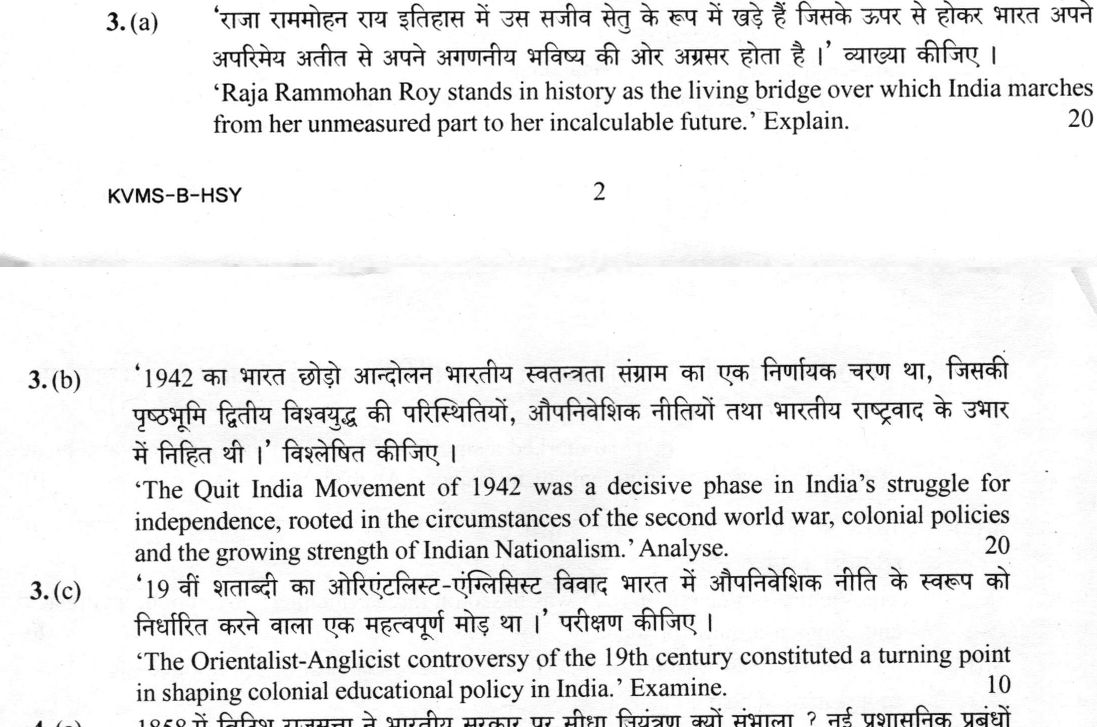
(a) ‘Raja Rammohan Roy stands in history as the living bridge over which India marches from her unmeasured part to her…
‘Raja Rammohan Roy stands in history as the living bridge over which India marches from her unmeasured part to her incalculable future.’ Explain. 20 marks
'The Quit India Movement of 1942 was a decisive phase in India's struggle for independence, rooted in the circumstances of the second world war, colonial policies and the growing strength of Indian Nationalism.' Analyse. 20 marks
'The Orientalist-Anglicist controversy of the 19th century constituted a turning point in shaping colonial educational policy in India.' Examine. 10 marks
हिंदी में प्रश्न पढ़ें
‘राजा राममोहन राय इतिहास में उस सजीव सेतु के रूप में खड़े हैं जिसके ऊपर से होकर भारत अपने अपरिमेय अतीत से अपने अगणनीय भविष्य की ओर अग्रसर होता है।’ व्याख्या कीजिए। (20 अंक)
'1942 का भारत छोड़ो आन्दोलन भारतीय स्वतन्त्रता संग्राम का एक निर्णायक चरण था, जिसकी पृष्ठभूमि द्वितीय विश्वयुद्ध की परिस्थितियों, औपनिवेशिक नीतियों तथा भारतीय राष्ट्रवाद के उभार में निहित थी ।' विश्लेषित कीजिए । (20 अंक)
'19 वीं शताब्दी का ओरिएंटलिस्ट-एंग्लिसिस्ट विवाद भारत में औपनिवेशिक शिक्षा नीति के स्वरूप को निर्धारित करने वाला एक महत्वपूर्ण मोड़ था ।' परीक्षण कीजिए । (10 अंक)
Model answer
Drafted with AI by UPSC Answer Check against this question's marking rubric, to the expected length. UPSC does not publish answers for Mains — this is one way to score well, not an official key. How we build rubrics and answers.
(a) Rammohan Roy as a living bridge The metaphor, from Sophia Dobson Collet's Life and Letters of Raja Rammohun Roy, fits because Rammohan (c. 1772-1833) reformed Indian society from within its own traditions while opening it to modern ideas.
The past pier: he argued from scripture. His Persian Tuhfat-ul-Muwahhidin (early 1800s) defended monotheism by reason, and his translations of the Vedanta (from 1815) and Upanishads claimed that the oldest Hindu texts taught one formless God. He founded the Atmiya Sabha (1815) and the Brahmo Sabha (20 August 1828), which became the Brahmo Samaj.
The future pier: The Precepts of Jesus (1820) presented an ethical, non-miraculous Christianity and led to debate with the missionaries. His campaign against sati, against the Dharma Sabha of Radhakanta Deb, supported Lord William Bentinck's Regulation XVII of 4 December 1829. He backed English and scientific education: he was part of the Hindu College (1817) circle with David Hare, though he stayed in the background, set up the Vedanta College (1825), and in his letter to Lord Amherst (11 December 1823) asked for Western science. Through Sambad Kaumudi (1821) and Mirat-ul-Akhbar (1822) he opposed the Press Regulation of 1823. He went to England in 1830 as envoy of the Mughal emperor Akbar II, welcomed the French July Revolution, and died at Bristol on 27 September 1833.
Qualification: essays in V. C. Joshi's edited volume, and Susobhan Sarkar, note his narrow elite base, his defence of zamindari property and the limits of a scripture-based method. The bridge was real, but it carried mainly the new Bengali middle class.
(b) The Quit India Movement, 1942 War, colonial policy and a matured nationalism converged.
War and policy: Japan's advance to Burma made Indian cooperation urgent. The Cripps Mission (arrived 22 March 1942) offered Dominion status only after the war and a provincial right to opt out, with no real Indian control of defence, and the Congress rejected it. The Working Committee resolved at Wardha on 14 July, and the AICC passed the Quit India resolution at Gowalia Tank, Bombay, on 8 August 1942, when Gandhi gave the call "Do or Die". Leaders were arrested on 9 August; Gandhi was held at the Aga Khan Palace and the Working Committee at Ahmednagar Fort.
Character: leaderless, the rising became spontaneous and often violent, attacking railways, telegraphs and police stations, especially in Bihar, eastern UP, Midnapore and Maharashtra. Jayaprakash Narayan, Ram Manohar Lohia and Aruna Asaf Ali worked underground, Usha Mehta ran the Congress Radio, and Matangini Hazra was shot at Tamluk on 29 September 1942. Parallel governments arose in Ballia (Chittu Pandey), Tamluk (the Jatiya Sarkar of Satish Chandra Samanta) and Satara (the Prati Sarkar of Nana Patil).
Repression and abstention: some 60,000 were arrested and official figures put deaths near 1,000 (Congress estimates were far higher). The Muslim League, the Communist Party (People's War line), the Hindu Mahasabha, Ambedkar and the princes stayed out, and C. Rajagopalachari had resigned from the Congress.
Assessment: Linlithgow called it the most serious rebellion since 1857. It showed India could no longer be ruled by consent, leading to the INA trials and the RIN mutiny of 1946. Yet it was crushed within months, and the League's unopposed growth meanwhile shaped the later partition. It was decisive for making British withdrawal a question of when rather than whether.
(c) The Orientalist-Anglicist controversy Section 43 of the Charter Act of 1813 set aside at least one lakh rupees a year for learning, without saying what kind. Charles Grant's Observations (1792) had already urged English and Christian instruction, while the General Committee of Public Instruction (1823) was led by Orientalists such as H. T. Prinsep and H. H. Wilson, who funded Sanskrit and Arabic learning. Anglicists, with Trevelyan, wanted Western knowledge in English. Macaulay's Minute (2 February 1835) and Bentinck's Resolution (7 March 1835) chose English and "downward filtration". This was a turning point: English became the language of employment and led on to Wood's Despatch (1854) and the universities of 1857. But continuities qualify it: fiscal and administrative motives weighed heavily, Oriental colleges survived, Rammohan Roy's 1823 letter to Amherst shows that Indians already demanded English, and Wood's Despatch favoured vernacular schools. Scholars such as David Kopf, Gauri Viswanathan, and Zastoupil and Moir debate how sharp the break was.
How this answer will be evaluated
Evaluation rubric
Each sub-part is marked on its own, against the marks and word limit printed on the paper.
- (a) 'Explain' Sophia Dobson Collet's metaphor of Rammohan Roy as a living bridge between India's past and future: the answer must demonstrate, with specific works, institutions and legislation, how Rammohan simultaneously drew on indigenous tradition and imported modern rationalism - and must also register the critiques that qualify the 'father of modern India' label. 20 marks
Must cover
- Sophia Dobson Collet, The Life and Letters of Raja Rammohun Roy (source of the metaphor)
- Tuhfat-ul-Muwahhidin
- Vedanta Sutra translation 1815
- The Precepts of Jesus, 1820
- Atmiya Sabha 1814-15
- Brahmo Sabha, 20 August 1828
- Regulation XVII of 1829 and Lord William Bentinck
- Dharma Sabha and Radhakanta Deb
- Sambad Kaumudi 1821 and Mirat-ul-Akhbar 1822
- letter to Lord Amherst, 11 December 1823
- Hindu College 1817 and David Hare
- died at Bristol, 27 September 1833
Loses marks
- Saying Rammohan founded the Brahmo Samaj under that name - he founded the Brahmo Sabha in 1828; the name Brahmo Samaj and the trust deed came in 1830 and the organisation was consolidated later by Debendranath Tagore
- Crediting him with founding Hindu College single-handedly - he was part of the founding milieu with David Hare and Radhakanta Deb, and withdrew from the front to avoid controversy
- Mis-dating the abolition of sati - Bentinck's Regulation XVII was of 4 December 1829, extended to Madras and Bombay in 1830
- Presenting him as an uncritical westerniser - his method was scriptural and Vedantic, which is exactly what the bridge metaphor captures
- Omitting the critical dimension altogether, so the answer becomes hagiography rather than explanation
- Attributing the "living bridge" metaphor to Rabindranath Tagore - it comes from Sophia Dobson Collet's biography of Rammohan.
Earns more
- Press freedom and civil liberty: Sambad Kaumudi (1821), Mirat-ul-Akhbar (1822) and the protest against the Press Regulation of 1823
- Modern education: association with Hindu College (1817) and David Hare, the Vedanta College (1825), and the letter to Lord Amherst of 11 December 1823 demanding Western science
- Internationalism and the critical qualification: the 1830 voyage to England as Akbar II's envoy, sympathy with the July Revolution of 1830, death at Bristol 1833; and the critiques of his elite base, his defence of zamindari and his scriptural method (V. C. Joshi, Susobhan Sarkar, Ashis Nandy)
- (b) 'Analyse' requires causal dissection, not narrative: show how the war situation, British colonial policy (especially the Cripps failure) and the accumulated strength of Indian nationalism converged in August 1942, describe the movement's distinctive character, and assess in what sense it was 'decisive'. 20 marks
Must cover
- Cripps Mission, 22 March 1942
- Wardha CWC resolution, 14 July 1942
- Gowalia Tank, Bombay, 8 August 1942
- 'Do or Die' / 'Karo ya Maro'
- arrests of 9 August 1942; Aga Khan Palace and Ahmednagar Fort
- Jayaprakash Narayan, Ram Manohar Lohia, Aruna Asaf Ali, Usha Mehta's Congress Radio
- parallel governments: Ballia (Chittu Pandey), Tamluk Jatiya Sarkar, Satara Prati Sarkar (Nana Patil)
- Matangini Hazra, 29 September 1942
- Muslim League and Communist Party abstention
- Linlithgow's description of it as the most serious rebellion since 1857
Loses marks
- Dating the Quit India resolution to 9 August - the AICC passed it on 8 August 1942 at Gowalia Tank; 9 August is the date of the arrests
- Stating as established fact that Gandhi called Cripps's offer 'a post-dated cheque on a crashing bank' - the 'post-dated cheque' phrase is Gandhi's, the added clause is of uncertain provenance and should be hedged
- Ignoring the abstentions, especially the Communist Party's People's War line after the German invasion of the USSR in June 1941
- Confusing the parallel governments - Chittu Pandey is Ballia, Nana Patil and Y. B. Chavan are Satara, Satish Chandra Samanta is Tamluk
- Treating the movement as Gandhian non-violence throughout - after 9 August it was largely spontaneous and often violent, which is precisely what makes it analytically interesting
Earns more
- Character and geography of the rising: attacks on railways, telegraph and police stations in Bihar, eastern UP, Midnapore, Maharashtra and Orissa; underground leadership (Jayaprakash Narayan, Lohia, Aruna Asaf Ali, Usha Mehta's Congress Radio) and the parallel governments of Ballia, Tamluk and Satara
- Repression and the pattern of abstention: some 60,000 arrests and about a thousand official deaths; the Muslim League, the Communist Party (People's War line), the Hindu Mahasabha, Ambedkar and the princes stayed out; Rajagopalachari's resignation
- Reasoned assessment of 'decisive', linking 1942 to the post-1945 collapse of British authority (INA trials, RIN mutiny of February 1946) while noting the costs - the League's unopposed expansion and the 1943 Bengal famine
- (c) 'Examine' whether the Orientalist-Anglicist controversy was a genuine turning point in colonial education policy: set out the two positions and the statutory context, describe the resolution of 1835, and then test the 'turning point' claim against the continuities before and after it. 10 marks
Must cover
- Charter Act 1813, Section 43
- General Committee of Public Instruction, 1823
- H. T. Prinsep and H. H. Wilson
- Charles Grant, Observations (1792)
- Macaulay's Minute, 2 February 1835
- Bentinck's Resolution, 7 March 1835
- downward filtration theory
- Wood's Despatch, 1854
- Rammohan Roy's letter to Lord Amherst, 1823
Loses marks
- Dating Macaulay's Minute to 1833 or 1834 - it is 2 February 1835, and Bentinck's Resolution followed on 7 March 1835
- Confusing Wood's Despatch (1854) with the Hunter Commission (1882) or with the Indian Universities Act (1904)
- Assuming all Indians opposed English education - Rammohan Roy's 1823 letter to Amherst argued the Anglicist case before Macaulay did
- Treating the controversy as purely ideological and ignoring the fiscal and employment logic behind the 1835 decision
- Omitting the Orientalist institutions and figures, which leaves only half the controversy
Earns more
- Evidence that it was a turning point - English as the medium and as the passport to employment, leading on to Wood's Despatch (1854) and the universities of 1857
- Evidence against a clean rupture: administrative motive, survival of Oriental institutions, Indian demand for English (Rammohan Roy's letter to Amherst, 11 December 1823), and Wood's Despatch abandoning downward filtration - with reference to Zastoupil and Moir, Viswanathan or Kopf
What "Explain" is asking you to do
Make the working of something clear — what sets it off, what follows from what, and what it produces. Explain is the Commission's mechanism word: it dominates the technical papers and the “explain why” stems, where the marks sit in the causal chain and not in the label.
Structure that answers it
State what it is → the initiating condition → the chain of cause, step by step → an instance where it plays out → what the chain produces
Where marks are lost
Describing what something looks like instead of why it works that way. Naming the stages without linking them reads as description too.
Practice this exact question
Write your answer and it is marked point by point against the model answer above — what you covered, what you missed, what you got wrong.
Evaluate my answer →More from History 2026 Paper II
- Q1 Critically examine the following statements in about 150 words each : (a) “Superior Marit…
- Q2 (a) Underline the various factors for decline of the Indian cottage industries during the…
- Q3 (a) ‘Raja Rammohan Roy stands in history as the living bridge over which India marches fr…
- Q4 (a) Why did the British Crown assume direct control over the Indian Government in 1858 ?…
- Q5 Critically examine the following statements in about 150 words each : (a) "Immanuel Kant…
- Q6 (a) The Vienna Settlement of 1815 was based on three principles, restoration, legitimacy…