Paper II — Q2
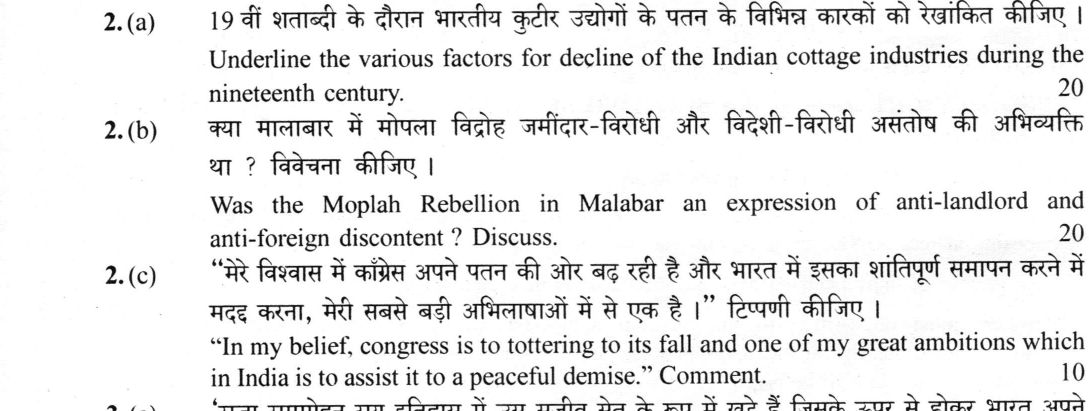
(a) Underline the various factors for decline of the Indian cottage industries during the nineteenth century. (20 marks) (b) Was…
Underline the various factors for decline of the Indian cottage industries during the nineteenth century. 20 marks
Was the Moplah Rebellion in Malabar an expression of anti-landlord and anti-foreign discontent ? Discuss. 20 marks
“In my belief, congress is to tottering to its fall and one of my great ambitions which in India is to assist it to a peaceful demise.” Comment. 10 marks
हिंदी में प्रश्न पढ़ें
19 वीं शताब्दी के दौरान भारतीय कुटीर उद्योगों के पतन के विभिन्न कारकों को रेखांकित कीजिए। (20 अंक)
क्या मालाबार में मोपला विद्रोह जमींदार-विरोधी और विदेशी-विरोधी असंतोष की अभिव्यक्ति था ? विवेचना कीजिए। (20 अंक)
“मेरे विश्वास में कांग्रेस अपने पतन की ओर बढ़ रही है और भारत में इसका शांतिपूर्ण समापन करने में मदद करना, मेरी सबसे बड़ी अभिलाषाओं में से एक है।” टिप्पणी कीजिए। (10 अंक)
Model answer
Drafted with AI by UPSC Answer Check against this question's marking rubric, to the expected length. UPSC does not publish answers for Mains — this is one way to score well, not an official key. How we build rubrics and answers.
(a) Decline of Indian cottage industries The decline was a cumulative process with political, fiscal, technological and social causes.
Political and commercial coercion: after Plassey (1757) the English Company replaced the dadni system of merchant advances with direct procurement through its own gomastas, imposing forced advances, low fixed prices and a monopsony that cost Bengal's weavers their independence. The loss of Indian courts as patrons, as princely states were annexed or reduced, destroyed markets for luxury crafts.
Fiscal policy: the Charter Act of 1813 ended the Company's trade monopoly and opened India to British manufactures. British goods entered at low duties while Indian cloth faced high duties in Britain; cotton import duties in India were abolished in 1882, and in 1896 a countervailing excise was placed on Indian mill cloth. Unlike Meiji Japan or protectionist Germany and the USA, the colonial state gave no tariff protection or technical education.
Technology and transport: Lancashire's machine-made cloth and yarn were cheaper. Railways, from the Bombay-Thane line of 16 April 1853, steam shipping and the Suez Canal (1869) removed the protection of distance and carried imports into the interior.
Social effects: old centres such as Dacca, Murshidabad and Surat decayed, and the collapse of hand-spinning removed a major source of women's earnings. Lord William Bentinck's report of 1834-35 noted the weavers' distress, and the new Western-educated class adopted foreign goods.
The extent of "de-industrialisation" is debated. Amiya Kumar Bagchi's figures for Gangetic Bihar show a sharp fall in the share of industrial workers, while Morris D. Morris and Tirthankar Roy argue that handloom weaving adapted and even expanded after 1900 by using cheap mill yarn. The decline was real and severe, though not total.
(b) The Mappila (Moplah) rebellion, 1921 The rising was rooted in agrarian and anti-colonial grievance, but it also turned violently against Hindu neighbours, and historians weigh these strands differently.
Agrarian roots: in south Malabar the jenmi-kanamdar-verumpattamdar tenure placed mostly Hindu landlords (jenmis) over largely Mappila tenants and cultivators. Colonial settlements from the 1790s treated the jenmi as absolute proprietor, and easy eviction and rack-renting provoked a long series of Mappila outbreaks from 1836.
Anti-foreign dimension: the Khilafat and Non-Cooperation movements brought mobilisation in 1920-21. After a police raid on the Tirurangadi mosque on 20 August 1921, rebels in Ernad and Valluvanad taluks attacked government offices, police and railways; Ali Musaliar and Variyankunnath Kunjahammad Haji set up rebel administrations.
The communal turn: in many places rebels also killed Hindus, carried out forced conversions and attacked temples, which Annie Besant and sections of the Congress condemned. Repression was severe: martial law, heavy casualties and the Wagon Tragedy of 19-20 November 1921, when some 70 Mappila prisoners suffocated in a closed goods wagon between Tirur and Podanur.
Historiography: K. N. Panikkar (Against Lord and State) and Conrad Wood stress agrarian causes; Stephen Dale sees a tradition of frontier Islamic militancy; D. N. Dhanagare examines the Khilafat-Congress link. The Malabar Tenancy Act (1929) addressed tenant grievances.
Verdict: the rebellion was primarily an expression of anti-landlord and anti-colonial discontent, but its communal violence is well documented and must be part of any honest account.
(c) Curzon's prophecy on the Congress The words are Lord Curzon's, in a letter of 18 November 1900 to the Secretary of State, Lord George Hamilton. Curzon thought the Congress, then a moderate body of petitioners, was weak and divided, and his policies narrowed its space: the Calcutta Municipal Amendment Act (1899) cut elected members, and the Indian Universities Act (1904) tightened official control. (The phrase "microscopic minority" for educated Indians was Lord Dufferin's in 1888.)
His own actions falsified the prophecy. The Partition of Bengal, announced in July 1905 and effective from 16 October 1905, provoked the Swadeshi and Boycott movement, and at the Calcutta session of 1906 Dadabhai Naoroji declared swaraj the goal. The partition was annulled at the Delhi Durbar in December 1911. Curzon's administrative record, including the Ancient Monuments Preservation Act (1904), was real, but his political judgement of the Congress was a serious miscalculation.
How this answer will be evaluated
Evaluation rubric
Each sub-part is marked on its own, against the marks and word limit printed on the paper.
- (a) 'Underline the various factors' requires a systematically classified account of why Indian cottage and handicraft industry declined across the nineteenth century - political, commercial-tariff, technological, infrastructural and social causes - supported by dates and concrete instances, and closing with a note on the de-industrialisation debate. 20 marks
Must cover
- dadni and gomasta system
- Charter Act 1813
- abolition of import duties 1882
- countervailing excise on Indian mill cloth 1896
- Bombay-Thane railway, 16 April 1853
- Suez Canal 1869
- decay of Dacca, Murshidabad and Surat
- Lord William Bentinck's 1834-35 report on the weavers
- Amiya Kumar Bagchi
- Morris D. Morris / Tirthankar Roy
Loses marks
- Writing only about machine competition and ignoring the tariff and political causes, which is where the marks concentrate
- Claiming Britain imposed protective tariffs to help Indian industry - the 1896 excise did the opposite
- Dating the first Indian railway wrongly; the first passenger line was Bombay to Thane, 16 April 1853
- Treating the decline as total - handloom weaving survived and even expanded after 1900 using cheap mill yarn, a point Tirthankar Roy stresses
- Omitting the gendered impact - the loss of hand-spinning wiped out a major source of women's earnings
Earns more
- Company-era coercion of artisans: dadni/gomasta system, forced advances, price-fixing and monopsony in Bengal after 1757
- Infrastructure that annihilated the protection of distance: railways from the Bombay-Thane line of 16 April 1853, steam shipping and the Suez Canal (1869)
- Absence of state protection, technical education or government stores purchase in India, contrasted with Meiji Japan / protectionist Germany and the USA, plus the urban decay of Dacca, Murshidabad and Surat and the de-industrialisation debate (Bagchi versus Morris D. Morris and Tirthankar Roy)
- (b) 'Discuss' with a direct question means the candidate must take a position: was the Moplah (Mappila) rebellion of 1921-22 an agrarian and anti-colonial movement, or something else? The answer must establish the agrarian structure and the Khilafat-Non-Cooperation context, acknowledge the communal dimension, and reach a reasoned, evidenced verdict. 20 marks
Must cover
- Mappila / Moplah rebellion, August 1921
- Ernad and Valluvanad taluks, south Malabar
- jenmi-kanamdar-verumpattamdar tenure
- Ali Musaliar
- Variyankunnath Kunjahammad Haji
- Tirurangadi, 20 August 1921
- Khilafat and Non-Cooperation Movement
- Wagon Tragedy, 19-20 November 1921
- Malabar Tenancy Act 1929
- K. N. Panikkar, Against Lord and State
Loses marks
- Dating the rebellion to 1920 or 1922 alone - the main rising ran from August 1921 into early 1922, with a long prehistory of outbreaks from 1836
- Presenting it as a purely communal riot with no agrarian content, or conversely suppressing the documented conversions and attacks on Hindus - both are failures of evidence
- Confusing the Wagon Tragedy's location or date (19-20 November 1921, prisoners moved from Tirur towards Podanur/Coimbatore)
- Calling Variyankunnath Kunjahammad Haji a Khilafat Committee office-bearer of the Congress - he led an independent rebel administration
- Ignoring the colonial land-revenue settlements of the 1790s that created the jenmi's absolute proprietorship, which is the causal core of the agrarian argument
Earns more
- Honestly registers the communal turn - forced conversions, attacks on Hindu families and temples, condemnation by Annie Besant and sections of the Congress press
- Repression and aftermath: martial law, heavy casualties, the Wagon Tragedy of 19-20 November 1921, and the Malabar Tenancy Act of 1929
- Cites the historiographical debate by name - K. N. Panikkar and Conrad Wood (agrarian) versus Stephen Dale (frontier Islamic militancy), with D. N. Dhanagare on Gandhian politics - and delivers a reasoned verdict
- (c) Identify the speaker and context of this remark - Lord Curzon writing to the Secretary of State, Lord George Hamilton, in November 1900 - and comment on it: explain why Curzon believed the Congress was dying, what he did that bore on it, and how spectacularly the prophecy was falsified by the Swadeshi upsurge his own Partition of Bengal provoked. 10 marks
Must cover
- Lord Curzon
- Lord George Hamilton
- 1900
- Calcutta Municipal Amendment Act 1899
- Indian Universities Act 1904
- Partition of Bengal, 16 October 1905
- Swadeshi and Boycott movement
- Calcutta Congress 1906, Dadabhai Naoroji, swaraj
- annulment of the partition, 1911
Loses marks
- Failing to identify the speaker at all, or attributing the remark to Dufferin (whose separate jibe was the 'microscopic minority')
- Dating the Partition of Bengal to 1906 or 1907 - it was announced in July 1905 and took effect on 16 October 1905
- Writing a general essay on Curzon's reforms without connecting them to the quotation's claim about the Congress
- Saying the partition was annulled in 1905 or 1912 - it was announced as annulled at the Delhi Durbar in December 1911
- Ignoring Curzon's constructive work, which makes the comment one-sided
Earns more
- Curzon's anti-representative measures: Calcutta Municipal Amendment Act 1899, Indian Universities Act 1904, Official Secrets (Amendment) Act 1904
- Delivers the verdict with the annulment of 1911 and a fair note on Curzon's genuine administrative achievements (Ancient Monuments Preservation Act 1904, Archaeological Survey under John Marshall, Punjab Land Alienation Act 1900, NWFP 1901)
What "Discuss" is asking you to do
Lay the issue out from more than one side — how it arose, what is claimed for it, what is held against it, and where it now stands. UPSC attaches discuss to broad topics with several live dimensions, so coverage of the dimensions earns more than the strength of your opinion.
Structure that answers it
Set the issue up → the case as it is made → the case against → the dimension both sides leave out → where the balance now lies
Where marks are lost
Listing facts with no thread between them, or arguing one side throughout and calling it a discussion.
Practice this exact question
Write your answer and it is marked point by point against the model answer above — what you covered, what you missed, what you got wrong.
Evaluate my answer →More from History 2026 Paper II
- Q1 Critically examine the following statements in about 150 words each : (a) “Superior Marit…
- Q2 (a) Underline the various factors for decline of the Indian cottage industries during the…
- Q3 (a) ‘Raja Rammohan Roy stands in history as the living bridge over which India marches fr…
- Q4 (a) Why did the British Crown assume direct control over the Indian Government in 1858 ?…
- Q5 Critically examine the following statements in about 150 words each : (a) "Immanuel Kant…