Paper II — Q5
(a) "Immanuel Kant was an advocate of liberalism and nationalism." (10 marks) (b) "The rise of the Cordelier Club in France was…
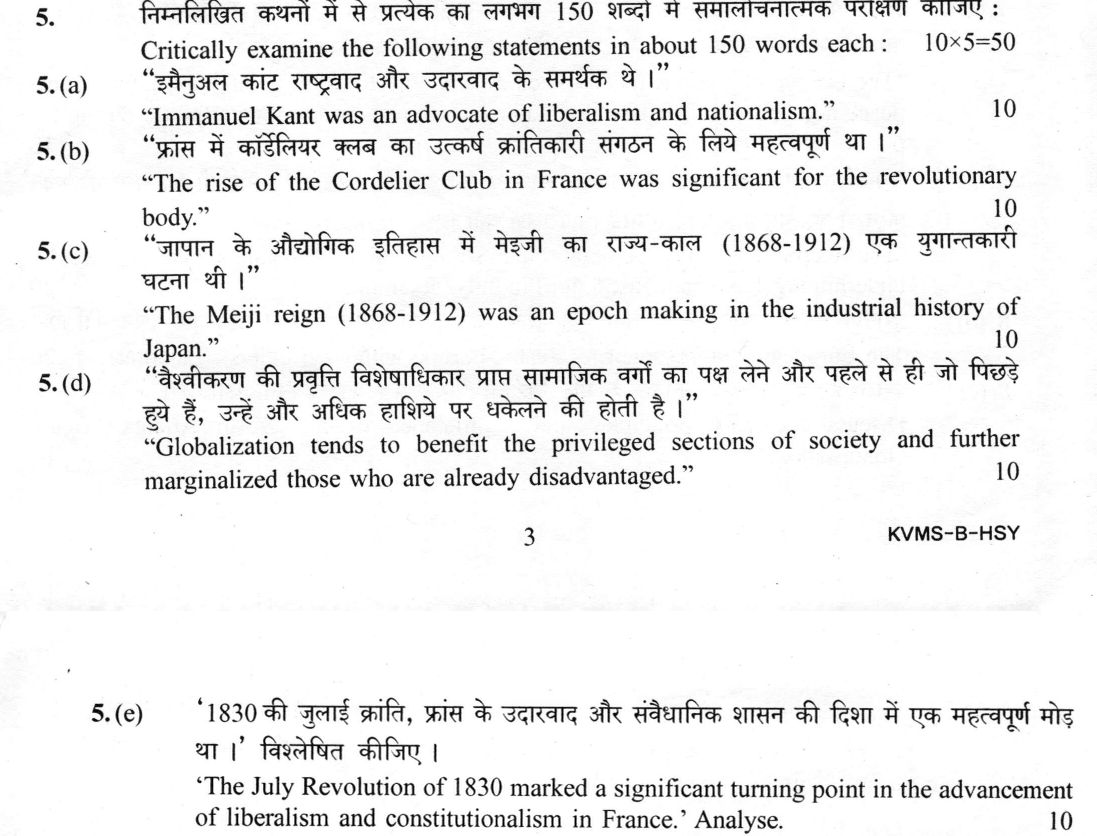
Critically examine the following statements in about 150 words each :
"Immanuel Kant was an advocate of liberalism and nationalism." 10 marks
"The rise of the Cordelier Club in France was significant for the revolutionary body." 10 marks
"The Meiji reign (1868-1912) was an epoch making in the industrial history of Japan." 10 marks
"Globalization tends to benefit the privileged sections of society and further marginalized those who are already disadvantaged." 10 marks
'The July Revolution of 1830 marked a significant turning point in the advancement of liberalism and constitutionalism in France.' Analyse. 10 marks
हिंदी में प्रश्न पढ़ें
निम्नलिखित कथनों में से प्रत्येक का लगभग 150 शब्दों में समालोचनात्मक परीक्षण कीजिए :
"इमैनुअल कांट राष्ट्रवाद और उदारवाद के समर्थक थे ।" (10 अंक)
"फ्रांस में कॉर्डेलियर क्लब का उत्कर्ष क्रांतिकारी संगठन के लिये महत्वपूर्ण था ।" (10 अंक)
"जापान के औद्योगिक इतिहास में मेइजी का राज्य-काल (1868-1912) एक युगान्तकारी घटना थी ।" (10 अंक)
"वैश्वीकरण की प्रवृत्ति विशेषाधिकार प्राप्त सामाजिक वर्गों का पक्ष लेने और पहले से ही जो पिछड़े हुए हैं, उन्हें और अधिक हाशिये पर धकेलने की होती है ।" (10 अंक)
'1830 की जुलाई क्रांति, फ्रांस के उदारवाद और संवैधानिक शासन की दिशा में एक महत्वपूर्ण मोड़ था ।' विश्लेषित कीजिए । (10 अंक)
Model answer
Drafted with AI by UPSC Answer Check against this question's marking rubric, to the 150-word length. UPSC does not publish answers for Mains — this is one way to score well, not an official key. How we build rubrics and answers.
(a) Kant, liberalism and nationalism The first half of the statement holds with qualifications; the second does not. Kant (1724-1804) was a founder of liberal thought. What is Enlightenment? (1784) urged sapere aude, "dare to use your own reason", and defended the public use of reason; the Groundwork of the Metaphysics of Morals (1785) grounded the dignity of persons in the categorical imperative; Theory and Practice (1793) defended the "freedom of the pen". He favoured a republican constitution with separation of powers. But his liberalism was limited: he denied any right of rebellion and excluded "passive citizens" (women, servants, dependants) from voting. He was not a nationalist. Perpetual Peace (1795) proposed a federation of free states and a "cosmopolitan right" of hospitality, not the nation as the highest political unit. German nationalism came from Herder's cultural idea of the Volk and Fichte's Addresses to the German Nation (1807-08), written after Kant's death. At most, his idea of self-determination later fed national thinking indirectly.
(b) The Cordeliers Club The Society of the Friends of the Rights of Man and of the Citizen, meeting in the former Cordeliers convent in Paris from April 1790, was more popular and radical than the Jacobins, with low fees and a sans-culotte following. Its leaders included Danton, Marat (L'Ami du Peuple), Desmoulins, Hebert (Le Pere Duchesne) and Chaumette. Its significance lay in pushing the Revolution leftward. After the king's flight to Varennes (20-21 June 1791) it demanded a republic, and its petition led to the Champ de Mars massacre of 17 July 1791. It helped mobilise the sections for the insurrection of 10 August 1792 that overthrew the monarchy, and the Hebertists pressed for the maximum, de-Christianisation and the Terror. Its limits were equally clear: it split into Hebertist and Dantonist factions, and Robespierre's Committee of Public Safety had the Hebertists executed on 24 March 1794 and Danton on 5 April 1794. Popular club politics then gave way to the Committee's control.
(c) The Meiji era and industry The claim is largely valid. After the Restoration of 1868 and the Charter Oath, the land tax reform of 1873 gave the state a steady revenue for investment under the slogan fukoku kyohei ("rich country, strong army"). The Ministry of Industry (Kobusho, 1870) built model enterprises: the Tomioka silk mill and the Tokyo-Yokohama railway (both 1872), mines and shipyards. During the Matsukata deflation (1881-85) many state enterprises were sold cheaply to private firms, strengthening the zaibatsu (Mitsui, Mitsubishi, Sumitomo, Yasuda). Shibusawa Eiichi's Osaka Spinning Mill (1883) led the cotton boom, and the state-built Yawata Iron and Steel Works (1901) began heavy industry. But in 1912 Japan was still largely agrarian, heavy industry grew mainly after 1914, and the costs were high: rising tenancy, the exploitation of young women in textile mills, and pollution such as the Ashio copper mine case taken up by Tanaka Shozo. It was epoch-making as a beginning rather than a completed transformation.
(d) Globalisation and inequality The claim is partly true. Since the 1990s, market reforms following the Washington Consensus and the World Trade Organization (1995) widened trade and capital flows. Thomas Piketty shows rising returns to capital and top incomes, and Joseph Stiglitz argues that global rules and volatile finance, as in the East Asian crisis of 1997, hurt the weak. Branko Milanovic's "elephant curve" shows big gains for the global top 1 per cent and for Asia's new middle classes, but stagnation for lower-middle groups in rich countries. Yet Jagdish Bhagwati points out that extreme poverty has fallen sharply since 1990, largely in China and India, and inequality between countries has narrowed. In India, the post-1991 reforms brought IT and services growth alongside agrarian distress and a large informal sector. Dani Rodrik and Amartya Sen stress that outcomes depend on domestic institutions: land reform, education and social protection. So globalisation tends to widen gaps within countries unless policy spreads its gains.
(e) The July Revolution of 1830 The revolution was a real but limited advance. Charles X and the Polignac ministry (1829) issued the Ordinances of Saint-Cloud (25-26 July 1830), dissolving the newly elected Chamber, narrowing the franchise and suspending press freedom. Paris rose in the Trois Glorieuses (27-29 July); Charles X abdicated, and liberal deputies led by Thiers, with Lafayette's backing, made Louis-Philippe "King of the French" (9 August 1830), a title implying sovereignty from the nation. The revised Charter of 1830 ended press censorship, dropped Catholicism as the state religion, restored the tricolour and roughly doubled the electorate. The revolution also inspired the Belgian revolution of 1830 and risings in Poland and Italy. But the July Monarchy served a narrow propertied class: the electorate stayed below about 200,000, workers were excluded, as the Lyon silk-workers' risings of 1831 and 1834 showed, and Guizot resisted reform, leading to the Revolution of February 1848. Liberalism advanced, but constitutional democracy did not.
How this answer will be evaluated
Evaluation rubric
Each sub-part is marked on its own, against the marks and word limit printed on the paper.
- (a) Critically examine a compound claim about Immanuel Kant (1724-1804). The two halves must be judged separately: the liberal half is largely defensible with qualifications, while the nationalist half is questionable, since Kant's political philosophy is explicitly cosmopolitan and federal rather than national. A candidate who endorses both halves without discrimination has not examined the statement. 10 marks · 150 words
Must cover
- What is Enlightenment? (1784), sapere aude
- Groundwork of the Metaphysics of Morals (1785), categorical imperative
- Perpetual Peace (1795)
- federation of free states / cosmopolitan right
- republican constitution and separation of powers
- Kant's denial of a right of rebellion
- active and passive citizens
- Fichte, Addresses to the German Nation (1807-08)
- Herder
- 'On the Common Saying' / 'Theory and Practice' (1793) - freedom of the pen
Loses marks
- Accepting both halves of the statement uncritically and turning Kant into a German nationalist, which reverses his actual argument
- Confusing Kant with Fichte or Hegel - the nationalist 'Addresses' are Fichte's, and the glorification of the state is Hegelian, not Kantian
- Omitting 'Perpetual Peace', which is the single most relevant text for both halves of the question
- Presenting Kant as a democrat without noting his exclusion of passive citizens from the franchise and his rejection of a right of revolution
- Writing about Kant's epistemology (the Critiques, the categories, the noumenon) instead of his political philosophy
Earns more
- Distinguishes Kant from the actual founders of German nationalism - Herder's cultural nationalism and Fichte's 'Addresses to the German Nation' (1807-08)
- (b) Critically examine the significance of the Cordeliers Club for the revolutionary movement in France: identify what it was, who led it, its distinctive social composition, the specific interventions that made it matter (1791-1794), and the limits of its significance, including its destruction in 1794. 10 marks · 150 words
Must cover
- Society of the Friends of the Rights of Man and of the Citizen
- founded April 1790, Cordeliers convent
- Danton, Marat, Desmoulins, Hebert, Chaumette
- L'Ami du Peuple and Le Pere Duchesne
- Champ de Mars petition and massacre, 17 July 1791
- flight to Varennes, 20-21 June 1791
- insurrection of 10 August 1792
- execution of the Hebertists, 24 March 1794
- sans-culottes
Loses marks
- Confusing the Cordeliers with the Jacobin Club - the Jacobins were the Society of the Friends of the Constitution, with a high subscription and a national network of affiliates
- Dating the foundation to 1789 or 1791 - the club was constituted in April 1790
- Dating the Champ de Mars massacre to 1792; it was 17 July 1791, following Varennes
- Treating the club as a single ideological bloc, when Danton and Hebert led opposed factions that destroyed each other in 1794
- Naming Robespierre as a Cordelier - he was the leading Jacobin and it was his Committee that destroyed both Cordelier factions
Earns more
- Specific decisive interventions: republican petition and the Champ de Mars massacre of 17 July 1791 after Varennes; mobilisation for the insurrection of 10 August 1792; Hebertist pressure for the maximum, de-Christianisation and the Terror
- Limits and end: factionalism, the execution of Hebert and his followers on 24 March 1794 and of Danton on 5 April 1794, and the eclipse of popular politics by the Committee of Public Safety
- (c) Critically examine whether the Meiji era (1868-1912) was genuinely epoch-making for Japanese industry: establish the state-led industrialisation with specific institutions, dates and firms, then qualify the claim by noting how much of Japan remained agrarian and what the social costs were. 10 marks · 150 words
Must cover
- Meiji Restoration 1868; Charter Oath
- land tax reform 1873
- Kobusho (Ministry of Industry) 1870
- Tomioka silk mill 1872
- Tokyo-Yokohama railway 1872
- Matsukata deflation 1881-85 and sale of state enterprises
- zaibatsu: Mitsui, Mitsubishi, Sumitomo, Yasuda
- Shibusawa Eiichi, Osaka Spinning Mill 1883
- Yawata Iron and Steel Works 1901
- fukoku kyohei
Loses marks
- Treating industrialisation as purely private enterprise, when the state built the first plants and then sold them
- Dating the zaibatsu's rise to the 1870s - the decisive transfers followed the Matsukata deflation of the 1880s
- Claiming Japan was a fully industrial economy by 1912; agriculture still employed the majority and heavy industry expanded mainly after 1914
- Confusing the land tax reform of 1873 with the abolition of samurai stipends (commuted to bonds in 1876) - both mattered, but they are different measures
- Omitting the social costs (tenancy, female mill labour, Ashio pollution), which the word 'critically' requires
Earns more
- Measurable outcomes by 1912: silk and cotton yarn exports, gold standard (1897), revision of the unequal treaties (extraterritoriality 1894, tariff autonomy 1911), and mass primary education from the 1872 Education Order
- Critical qualification: Japan still predominantly agrarian in 1912, weak heavy industry before the First World War, high tenancy, exploitation of indentured female textile labour, the Ashio copper pollution case and Tanaka Shozo, and the Factory Act of 1911 effective only from 1916
- (d) Critically examine the claim that globalisation systematically favours the privileged and further marginalises the disadvantaged. The answer must present the evidence and theorists on both sides - rising within-country inequality against falling absolute poverty and narrowing between-country gaps - and reach a qualified conclusion about when and why globalisation produces each outcome. 10 marks · 150 words
Must cover
- WTO, 1 January 1995 (GATT 1947)
- Washington Consensus
- Thomas Piketty
- Joseph Stiglitz
- Branko Milanovic / elephant curve
- Jagdish Bhagwati
- Amartya Sen or Dani Rodrik
- East Asian financial crisis, 1997
- fall in extreme poverty since 1990
Loses marks
- Writing a purely rhetorical denunciation of globalisation with no mechanism, no data and no named authority
- Citing precise poverty or inequality statistics with false confidence - these are estimates on shifting definitions and should be stated as approximations
- Conflating within-country inequality (which generally rose) with between-country inequality (which generally narrowed after 1990) - the distinction is the analytical core of the question
- Treating globalisation as a purely post-1991 phenomenon and ignoring the earlier nineteenth-century globalisation of trade, capital and migration
- Offering no conclusion, or a conclusion unconnected to the evidence presented
Earns more
- Identifies domestic institutions as the mediating variable - land reform, mass education, industrial policy and social protection in East Asia versus elite capture elsewhere - with reference to Dani Rodrik or Amartya Sen
- (e) Analyse - and critically examine, given the printed stem - whether the July Revolution of 1830 marked a significant advance for liberalism and constitutionalism in France. The answer must explain the immediate cause (the Ordinances of Saint-Cloud), the events of the Trois Glorieuses, the constitutional changes under the July Monarchy, and the clear limits that make the advance partial. 10 marks · 150 words
Must cover
- Charles X
- Polignac ministry, 1829
- Ordinances of Saint-Cloud, 25-26 July 1830
- Les Trois Glorieuses, 27-29 July 1830
- Adolphe Thiers
- Lafayette
- Louis Philippe, 'King of the French', 9 August 1830
- Charter of 1830
- July Monarchy
- Belgian revolution of 1830
- Revolution of February 1848
Loses marks
- Confusing the July Revolution of 1830 with the February Revolution of 1848 - 1830 produced the July Monarchy, 1848 produced the Second Republic
- Calling Louis Philippe 'King of France' - the constitutional point is precisely that he was 'King of the French', ruling by national choice
- Omitting the Ordinances of Saint-Cloud, which are the immediate cause and the strongest evidence of the constitutional issue at stake
- Overstating the democratic gain - the electorate roughly doubled but remained a tiny propertied fraction of the population
- Attributing the revolution to industrial working-class action alone; the barricades were largely artisan and student, but power passed to the liberal bourgeois deputies
Earns more
- European repercussions: the Belgian revolution of 1830, the Polish November Uprising, risings in Italy, the German states and Switzerland, and the breach in the Vienna principle of legitimacy
- The limits: an electorate of only about 170,000-200,000, exclusion of workers and republicans, the Lyon risings of 1831 and 1834, Guizot's 'enrichissez-vous', and the path to February 1848
What "Discuss" is asking you to do
Lay the issue out from more than one side — how it arose, what is claimed for it, what is held against it, and where it now stands. UPSC attaches discuss to broad topics with several live dimensions, so coverage of the dimensions earns more than the strength of your opinion.
Structure that answers it
Set the issue up → the case as it is made → the case against → the dimension both sides leave out → where the balance now lies
Where marks are lost
Listing facts with no thread between them, or arguing one side throughout and calling it a discussion.
Practice this exact question
Write your answer and it is marked point by point against the model answer above — what you covered, what you missed, what you got wrong.
Evaluate my answer →More from History 2026 Paper II
- Q2 (a) Underline the various factors for decline of the Indian cottage industries during the…
- Q3 (a) ‘Raja Rammohan Roy stands in history as the living bridge over which India marches fr…
- Q4 (a) Why did the British Crown assume direct control over the Indian Government in 1858 ?…
- Q5 Critically examine the following statements in about 150 words each : (a) "Immanuel Kant…
- Q6 (a) The Vienna Settlement of 1815 was based on three principles, restoration, legitimacy…
- Q7 (a) The Industrial Revolution in England accelerated the decline of traditional Indian ha…
- Q8 (a) 'The Acerbo law played a crucial role in strengthening Mussolini's hold on power by u…