Paper I — Q1
(a) Do you think that the traditional roles of managers are still relevant in today's digital and remote work environment ?…
Answer the following questions in about 150 words each :
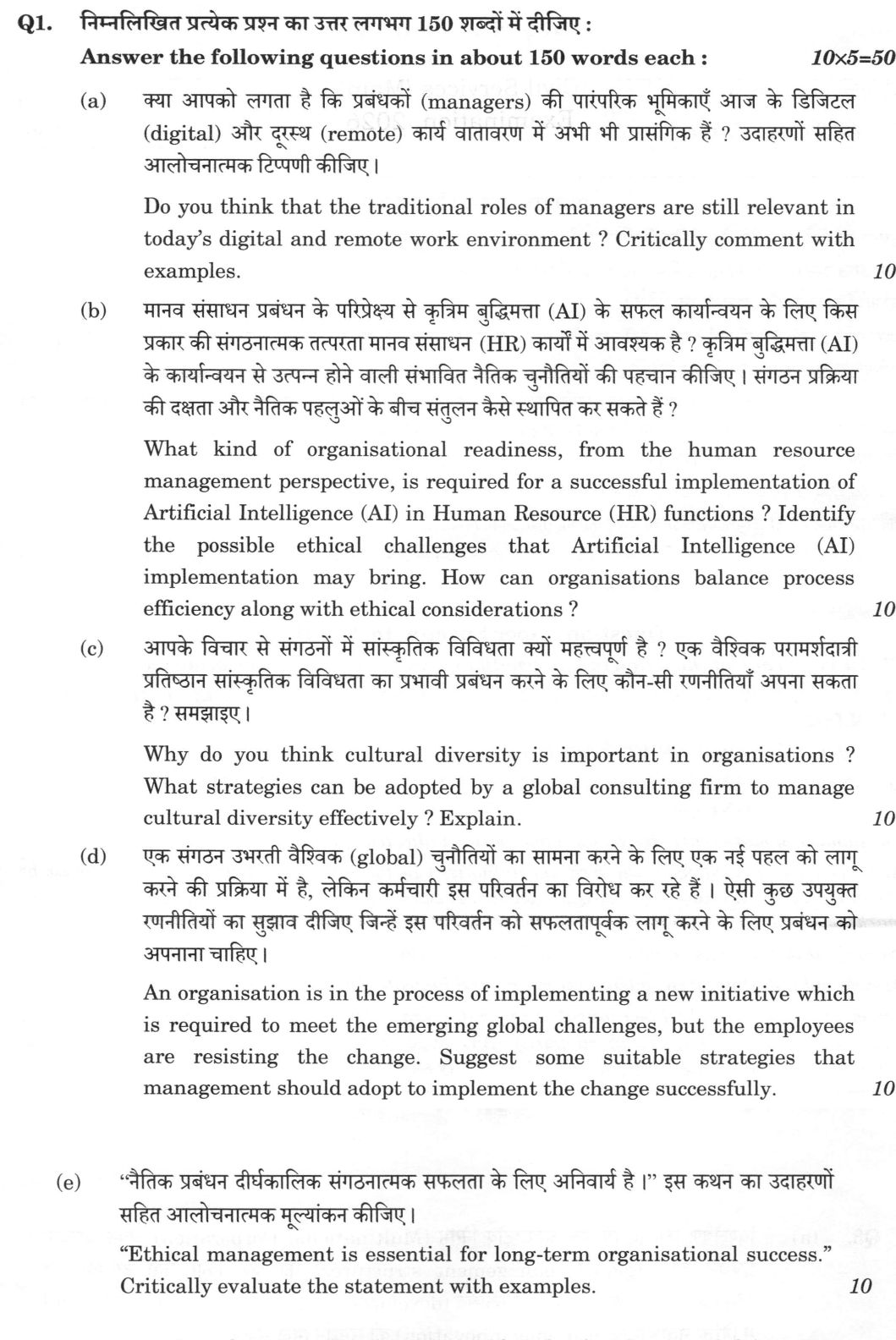
Do you think that the traditional roles of managers are still relevant in today's digital and remote work environment ? Critically comment with examples. 10 marks
What kind of organisational readiness, from the human resource management perspective, is required for a successful implementation of Artificial Intelligence (AI) in Human Resource (HR) functions ? Identify the possible ethical challenges that Artificial Intelligence (AI) implementation may bring. How can organisations balance process efficiency along with ethical considerations ? 10 marks
Why do you think cultural diversity is important in organisations ? What strategies can be adopted by a global consulting firm to manage cultural diversity effectively ? Explain. 10 marks
An organisation is in the process of implementing a new initiative which is required to meet the emerging global challenges, but the employees are resisting the change. Suggest some suitable strategies that management should adopt to implement the change successfully. 10 marks
“Ethical management is essential for long-term organisational success.” Critically evaluate the statement with examples. 10 marks
हिंदी में प्रश्न पढ़ें
निम्नलिखित प्रत्येक प्रश्न का उत्तर लगभग 150 शब्दों में दीजिए :
क्या आपको लगता है कि प्रबंधकों (managers) की पारंपरिक भूमिकाएँ आज के डिजिटल (digital) और दूरस्थ (remote) कार्य वातावरण में अभी भी प्रासंगिक हैं ? उदाहरणों सहित आलोचनात्मक टिप्पणी कीजिए । (10 अंक)
मानव संसाधन प्रबंधन के परिप्रेक्ष्य से कृत्रिम बुद्धिमत्ता (AI) के सफल कार्यान्वयन के लिए किस प्रकार की संगठनात्मक तत्परता मानव संसाधन (HR) कार्यों में आवश्यक है ? कृत्रिम बुद्धिमत्ता (AI) के कार्यान्वयन से उत्पन्न होने वाली संभावित नैतिक चुनौतियों की पहचान कीजिए । संगठन प्रक्रिया की दक्षता और नैतिक पहलुओं के बीच संतुलन कैसे स्थापित कर सकते हैं ? (10 अंक)
आपके विचार से संगठनों में सांस्कृतिक विविधता क्यों महत्त्वपूर्ण है ? एक वैश्विक परामर्शदात्री प्रतिष्ठान सांस्कृतिक विविधता का प्रभावी प्रबंधन करने के लिए कौन-सी रणनीतियाँ अपना सकता है ? समझाइए । (10 अंक)
एक संगठन उभरती वैश्विक (global) चुनौतियों का सामना करने के लिए एक नई पहल को लागू करने की प्रक्रिया में है, लेकिन कर्मचारी इस परिवर्तन का विरोध कर रहे हैं । ऐसी कुछ उपयुक्त रणनीतियों का सुझाव दीजिए जिन्हें इस परिवर्तन को सफलतापूर्वक लागू करने के लिए प्रबंधन को अपनाना चाहिए । (10 अंक)
“नैतिक प्रबंधन दीर्घकालिक संगठनात्मक सफलता के लिए अनिवार्य है।” इस कथन का उदाहरणों सहित आलोचनात्मक मूल्यांकन कीजिए। (10 अंक)
Model answer
Drafted with AI by UPSC Answer Check against this question's marking rubric, to the 150-word length. UPSC does not publish answers for Mains — this is one way to score well, not an official key. How we build rubrics and answers.
(a) Traditional Managerial Roles in Digital and Remote Work The traditional roles of managers remain relevant in digital and remote work, but their execution has changed. Henri Fayol's functions (planning, organising, commanding, coordinating, controlling) and Henry Mintzberg's ten roles (interpersonal, informational, decisional) still describe what managers do; the medium has shifted from physical presence to digital platforms. The "liaison" and "figurehead" roles now run through video conferencing, while commanding and controlling have moved from proximity-based supervision to outcome-based control through dashboards and OKRs.
GitLab, an all-remote company, codifies planning and coordination in a public handbook. TCS announced a "25/25" model in 2020 (no more than 25% of staff in office at a time) but later asked employees back to office, showing that face-to-face supervision and culture-building have not vanished. Critically, some roles are strained: proximity bias, digital-surveillance ethics and burnout demand trust, psychological safety and asynchronous communication. The roles endure; the supervisory style must change.
(b) AI in HR: Readiness, Ethical Challenges and Balance Organisational readiness: clean, integrated HRIS data; HR staff with analytics and AI literacy; leadership sponsorship and a clear change narrative; governance policies on data use; and employee consultation so that AI is trusted rather than feared.
Ethical challenges: algorithmic bias in shortlisting (Amazon scrapped an experimental recruiting tool that penalised women's CVs); opaque decisions that cannot be explained; employee data privacy and consent under the Digital Personal Data Protection Act, 2023; intrusive productivity surveillance; and job displacement.
Balancing efficiency and ethics: a "human-in-the-loop" model where AI recommends and humans decide on hiring, promotion and exit; periodic bias audits; explainability standards; data minimisation; and an AI ethics committee. The EU AI Act classifies employment AI as high-risk, a useful benchmark. Ethical design is not merely a trade-off: it builds employee trust, eases adoption and reduces litigation risk, thereby protecting efficiency and the employer brand.
(c) Cultural Diversity in a Global Consulting Firm Cultural diversity matters because varied perspectives improve problem-solving and reduce groupthink, mirror a global client base and widen the talent pool. McKinsey's "Diversity Matters" research reports a correlation between diverse leadership teams and above-average profitability. Diversity is double-edged, though: communication gaps, stereotyping and coordination costs arise if it is unmanaged. Geert Hofstede's cultural dimensions (power distance, individualism, uncertainty avoidance, masculinity, long-term orientation, indulgence) explain, for instance, why a consultant from a high power-distance culture may hesitate to challenge a partner.
Strategies for a global consulting firm:
- Cultural intelligence (CQ) and unconscious-bias training before cross-border assignments.
- Inclusive staffing: mixed-nationality project teams paired with local-market experts.
- Process norms: a common working language and rotating meeting times across time zones.
- Global mobility and mentoring so that diverse talent reaches partnership.
- Inclusion over representation: resource groups and grievance mechanisms so that people feel they belong.
(d) Managing Resistance to Change Management should first diagnose resistance through Kurt Lewin's force-field analysis: weaken restraining forces (fear of job loss, skill obsolescence, loss of status, distrust) and strengthen driving forces. Then it should follow Lewin's unfreeze–change–refreeze model, supported by Kotter's eight steps:
- Unfreeze: create urgency by sharing data on global competitive threats; form a guiding coalition and communicate a clear vision.
- Change: apply Kotter and Schlesinger's (1979) methods — education and communication, participation and involvement, facilitation and support (reskilling), negotiation and agreement (e.g., with unions); keep manipulation, co-optation and coercion as last resorts.
- Short-term wins: run pilots and use change champions to demonstrate early success.
- Refreeze: embed the change in KPIs, appraisal, rewards and SOPs, with feedback loops to prevent regression.
Visible leadership sponsorship and two-way communication throughout secure the buy-in needed for the initiative to meet global challenges.
(e) Ethical Management and Long-term Success For the statement: R. Edward Freeman's stakeholder theory holds that a firm creates lasting value only by serving employees, customers, suppliers, communities and shareholders. Johnson & Johnson's 1982 Tylenol recall, guided by its Credo, was costly in the short run but restored trust; the Tata group's reputation for integrity underpins its long-term brand equity.
Against: ethics can impose short-term costs, and unethical firms sometimes prosper for years — Enron and Satyam reported strong growth until their frauds were exposed, while Volkswagen survived "dieselgate" (2015) through market strength. The evidence linking ethics to profitability is largely correlational.
Evaluation: Enron (2001) and Satyam (2009) nonetheless collapsed once the fraud surfaced, losing their licence to operate. Ethics is therefore necessary, though not sufficient, for long-term success, and must be institutionalised through a code of conduct, the vigil mechanism under section 177 of the Companies Act, 2013, independent audit committees and SEBI's BRSR disclosures.
How this answer will be evaluated
Evaluation rubric
Each sub-part is marked on its own, against the marks and word limit printed on the paper.
- (a) 'Critically comment' means take a position on whether the classical managerial roles still hold in digital/remote work, and support BOTH sides — what endures and what has been displaced — with concrete examples. The answer must engage explicitly with the traditional role framework (Fayol's functions and/or Mintzberg's ten roles) rather than talk about remote work generically. 10 marks · 150 words
Must cover
- Henri Fayol — five functions of management
- Henry Mintzberg (1973) — ten managerial roles: interpersonal / informational / decisional
- outcome-based or OKR-based control replacing presence-based supervision
- at least two real organisational examples of hybrid/remote work
Loses marks
- Describing remote work generally without ever naming Fayol or Mintzberg, so the 'traditional roles' anchor is missing
- One-sided answer — only 'yes still relevant' or only 'no, obsolete' — which fails the directive 'critically'
- Attributing the ten managerial roles to Drucker or Katz instead of Mintzberg, or the five functions to Taylor instead of Fayol
- Giving no examples, or inventing company policies that do not exist
- Turning a 150-word note into a long essay on the pandemic and losing the role analysis
Earns more
- Identifies new competencies/risks: digital and data literacy, asynchronous communication, trust and psychological safety, surveillance ethics, proximity bias, remote onboarding and burnout
- At least two concrete named examples (e.g., TCS 25/25 model and its later return-to-office, GitLab all-remote handbook, Microsoft Teams/Viva analytics, Infosys or Wipro hybrid policy)
- (b) Three distinct sub-parts must all be answered: (i) what organisational readiness from an HRM perspective AI adoption in HR functions needs, (ii) identification of the ethical challenges AI in HR raises, and (iii) how efficiency and ethics can be balanced. Omitting any one sub-part caps the score. 10 marks · 150 words
Must cover
- algorithmic bias / discrimination in AI-based shortlisting
- explainability and human-in-the-loop oversight
- employee data privacy and consent (Digital Personal Data Protection Act, 2023)
- HR analytics capability and data quality as readiness pre-conditions
Loses marks
- Answering only the ethics part and skipping organisational readiness, or vice versa — all three sub-parts are compulsory
- Listing AI applications in HR (chatbots, resume parsing) instead of readiness conditions
- Vague balancing advice ('follow ethics') with no mechanism such as bias audit, human-in-the-loop or an ethics committee
- Misciting law — e.g., calling it the 'Data Protection Act 2019' or attributing GDPR provisions to India
- Over-running the 150-word limit with generic AI hype
Earns more
- Reference to a real standard or case — Digital Personal Data Protection Act 2023, EU AI Act (employment as high-risk), NITI Aayog Responsible AI for All, or Amazon's scrapped biased recruiting tool
- States the integrative argument that ethical design is itself efficiency-enhancing (trust, adoption, employer brand, litigation avoidance) rather than a pure trade-off
- (c) Two linked sub-parts: (i) why cultural diversity matters to organisations — benefits and the costs/risks — and (ii) the specific strategies a GLOBAL CONSULTING FIRM can adopt to manage it. The answer must be set in the consulting-firm context (client-facing, project-based, globally staffed), not in the abstract. 10 marks · 150 words
Must cover
- Geert Hofstede's cultural dimensions (power distance, individualism-collectivism, uncertainty avoidance, masculinity-femininity, long-term orientation, indulgence)
- inclusion as the necessary complement to diversity
- cross-cultural training / cultural intelligence (CQ)
- at least one global consulting example (McKinsey, BCG, Deloitte, Accenture, EY) or comparable MNC
Loses marks
- Listing benefits of diversity only and never answering the 'what strategies' half of the question
- Generic HR advice that could apply to any firm, with no consulting-specific element (project staffing, client-facing teams, global mobility)
- Misattributing the cultural dimensions — e.g., crediting the six dimensions to Trompenaars or Schein instead of Hofstede
- Confusing diversity (representation) with inclusion (experience of belonging) and treating them as one
- Adding an unasked, lengthy history of the diversity movement and exceeding the word limit
Earns more
- Acknowledges the costs/risks side — communication breakdown, coordination cost, stereotyping, conflict, faultlines — i.e., diversity as a double-edged sword requiring management
- Process/behavioural strategies: cross-cultural and unconscious-bias training, cultural intelligence (CQ) building, inclusive multi-time-zone meeting norms, common language policy, grievance and anti-discrimination redressal
- (d) A short applied case: employees resist a change driven by global competitive pressure. 'Suggest suitable strategies' requires a diagnosis of the causes of resistance followed by specific, named change-management strategies the management should adopt — a change model must anchor the answer. 10 marks · 150 words
Must cover
- diagnosis of the causes of resistance (e.g., Lewin's force-field analysis)
- at least one correctly attributed change model — Kurt Lewin's unfreeze–change (move)–refreeze or John P. Kotter's eight-step model
- Kotter and Schlesinger (1979) — methods of overcoming resistance to change (education/communication, participation, facilitation, negotiation, manipulation/co-optation, coercion)
- employee participation and two-way communication as the primary strategies
Loses marks
- Jumping straight to solutions without diagnosing why employees resist, so the strategies look arbitrary
- Naming no model at all, or garbling attribution (e.g., 'Lewin's eight steps', 'Kotter's unfreeze-refreeze')
- Recommending coercion or top-down imposition as the first option without noting it is a last resort
- Stopping at implementation with no reinforcement stage, so the answer ignores relapse risk
- Writing an essay on globalisation instead of on managing the change
Earns more
- Concrete implementation levers: pilot runs and short-term wins, reskilling and training, change champions, revised reward system, union/works-committee consultation, visible leadership sponsorship
- Provides for reinforcement and institutionalisation — embedding in appraisal, SOPs and culture, with feedback monitoring so the change does not regress
- (e) 'Critically evaluate' a normative claim: examine the evidence and arguments FOR ethical management driving long-term success, present the counter-arguments (unethical firms that prospered, ethics as cost, short-term trade-offs), and arrive at a reasoned verdict — all supported by named examples. 10 marks · 150 words
Must cover
- at least two named corporate ethics failures with correct year (Enron 2001, Satyam 2009, Volkswagen 2015, PNB-Nirav Modi 2018, IL&FS 2018)
- R. Edward Freeman's stakeholder theory or Archie Carroll's pyramid of CSR
- a positive exemplar (Tata group, Infosys, Johnson and Johnson's Tylenol recall)
- verdict that ethics is necessary but not sufficient for long-term success
Loses marks
- Purely one-sided moral exhortation with no counter-argument, which fails the 'critically' directive
- Examples asserted without facts, or factually wrong (e.g., dating Satyam to 2012 or attributing dieselgate to BMW)
- Confusing CSR/philanthropy with ethical management of the core business
- Claiming a proven causal link between ethics and profitability, when the evidence is correlational and disputed
- No framework or theorist named, leaving the evaluation ungrounded
Earns more
- Uses a named ethics/CSR framework — Freeman's stakeholder theory, Carroll's pyramid of CSR, or a deontological-vs-utilitarian contrast — rather than assertion alone
- Recommends institutional mechanisms: code of conduct, whistle-blower policy (Companies Act 2013 vigil mechanism), independent directors and audit committee, SEBI LODR disclosure/BRSR reporting, ethics training
What "Critically comment" is asking you to do
Take a position on the statement and support it. Comment usually attaches to a quoted line in the short slots, so the reasoning must be compressed — an opening view, a few load-bearing reasons, and the limit of the claim. “Critically” is not a section added at the end: name the yardstick you are judging by — the evidence, the stated objective, a constitutional principle, a rival explanation — and let a verdict close each part of the body. Where the question quotes a claim, that verdict must land on the claim itself, accepted, qualified or rejected, and not on the theme in general.
Structure that answers it
Unpack what the statement asserts → your stance → two or three supporting reasons → the qualification that limits it
Where marks are lost
Merits in one paragraph, demerits in the next, and a conclusion calling for a balanced and holistic approach. That is a survey with the judgement left out and it holds the answer in the middle band. The opposite error is reading “critically” as permission to attack — and with the odd pairings, critically describe or critically explain, the exposition still carries most of the marks, the judgement being a layer on it rather than a substitute for it.
Practice this exact question
Write your answer and it is marked point by point against the model answer above — what you covered, what you missed, what you got wrong.
Evaluate my answer →More from Management 2026 Paper I
- Q1 Answer the following questions in about 150 words each : (a) Do you think that the tradit…
- Q2 (a) How do core management processes influence each stage of the value chain ? How can mi…
- Q3 (a) Analyze how a Multinational Corporation can design its global management structures t…
- Q4 (a) Do modern management approaches represent a true evolution or just a modification of…