Paper I — Q2
(a) How do core management processes influence each stage of the value chain ? How can misalignment between them reduce overall…
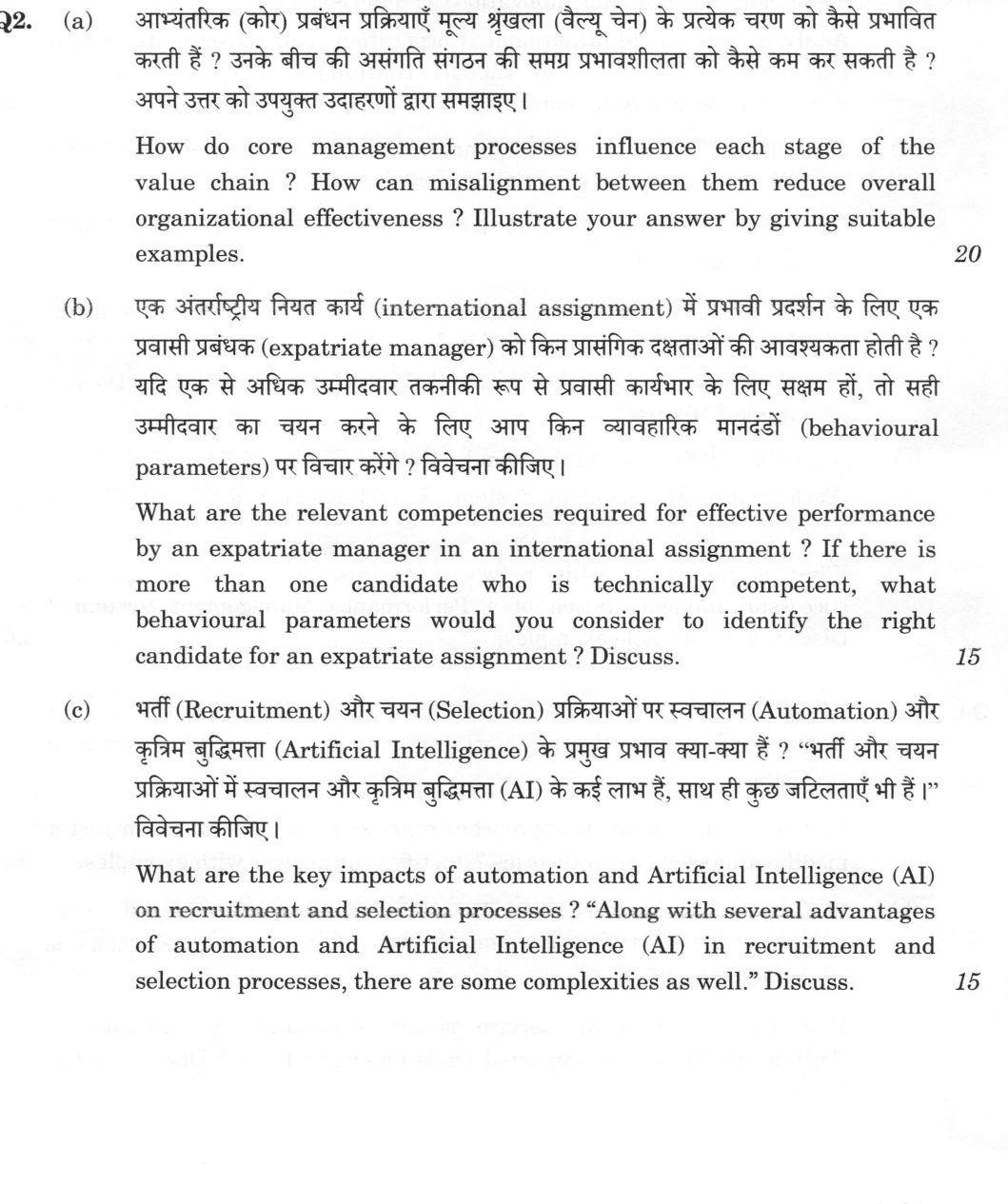
How do core management processes influence each stage of the value chain ? How can misalignment between them reduce overall organizational effectiveness ? Illustrate your answer by giving suitable examples. 20 marks
What are the relevant competencies required for effective performance by an expatriate manager in an international assignment ? If there is more than one candidate who is technically competent, what behavioural parameters would you consider to identify the right candidate for an expatriate assignment ? Discuss. 15 marks
What are the key impacts of automation and Artificial Intelligence (AI) on recruitment and selection processes ? “Along with several advantages of automation and Artificial Intelligence (AI) in recruitment and selection processes, there are some complexities as well.” Discuss. 15 marks
हिंदी में प्रश्न पढ़ें
आभ्यंतरिक (कोर) प्रबंधन प्रक्रियाएँ मूल्य श्रृंखला (वैल्यू चेन) के प्रत्येक चरण को कैसे प्रभावित करती हैं ? उनके बीच की असंगति संगठन की समग्र प्रभावशीलता को कैसे कम कर सकती है ? अपने उत्तर को उपयुक्त उदाहरणों द्वारा समझाइए। (20 अंक)
एक अंतर्राष्ट्रीय नियत कार्य (international assignment) में प्रभावी प्रदर्शन के लिए एक प्रवासी प्रबंधक (expatriate manager) को किन प्रासंगिक दक्षताओं की आवश्यकता होती है ? यदि एक से अधिक उम्मीदवार तकनीकी रूप से प्रवासी कार्यभार के लिए सक्षम हों, तो सही उम्मीदवार का चयन करने के लिए आप किन व्यावहारिक मानदंडों (behavioural parameters) पर विचार करेंगे ? विवेचना कीजिए। (15 अंक)
भर्ती (Recruitment) और चयन (Selection) प्रक्रियाओं पर स्वचालन (Automation) और कृत्रिम बुद्धिमत्ता (Artificial Intelligence) के प्रमुख प्रभाव क्या-क्या हैं ? “भर्ती और चयन प्रक्रियाओं में स्वचालन और कृत्रिम बुद्धिमत्ता (AI) के कई लाभ हैं, साथ ही कुछ जटिलताएँ भी हैं।” विवेचना कीजिए। (15 अंक)
Model answer
Drafted with AI by UPSC Answer Check against this question's marking rubric, to the expected length. UPSC does not publish answers for Mains — this is one way to score well, not an official key. How we build rubrics and answers.
(a) Management Processes and the Value Chain Core management processes — planning, organising, staffing, directing and controlling (Koontz and O'Donnell's adaptation of Henri Fayol's five functions), together with decision-making and coordination — drive every stage of Michael E. Porter's value chain (Competitive Advantage, 1985). The chain has five primary activities (inbound logistics, operations, outbound logistics, marketing and sales, service) and four support activities (firm infrastructure, human resource management, technology development, procurement).
Process-to-stage influence:
- Planning sets demand forecasts, procurement schedules and capacity for inbound logistics and operations.
- Organising designs plant layout, distribution networks and sales territories for operations and outbound logistics.
- Staffing builds the sales force and service teams that deliver marketing and after-sales service.
- Directing motivates shop-floor and front-line staff, shaping productivity and service quality.
- Controlling enforces quality control in operations, inventory control in logistics and credit control in sales.
Porter locates much of competitive advantage in the linkages between activities. Maruti Suzuki's planning and coordination with a supplier base clustered near its plants synchronises inbound logistics with operations, cutting inventory and improving quality. Amazon integrates demand forecasting with warehouse automation, linking marketing, operations and outbound logistics.
Misalignment breaks these linkages. When marketing plans promise what operations cannot deliver, the result is stock-outs, delays and lost customers. Nokia's failure to translate its technology development into competitive smartphones contributed to a steep loss of market share. Boeing's 787 programme outsourced large sections to suppliers without adequate coordination and control, causing years of delays and cost overruns. In such cases departments reach local optima at the expense of the system, producing the bullwhip effect, excess inventory or budget slack — and lower overall organisational effectiveness.
(b) Expatriate Manager: Competencies and Behavioural Selection Effective performance on an international assignment needs more than technical expertise. The core competency is cultural intelligence (CQ), defined by Earley and Ang as the capability to function effectively across cultures. Mendenhall and Oddou identify four dimensions of expatriate acculturation: self-orientation, others-orientation, perceptual dimension and cultural toughness. Tolerance for ambiguity, host-language skills, relationship-building and stress resilience complete the profile.
When several candidates are technically competent, the selector should compare behavioural parameters:
- Family adjustment: Rosalie Tung's studies found the spouse's inability to adjust a leading cause of expatriate failure, so spouse interviews and a "look-see" visit are essential.
- Personality: Big Five openness and emotional stability, measured with psychometrics, the CQ Scale or the Intercultural Development Inventory.
- Past behaviour: behavioural-event interviews using the STAR method to probe earlier cross-cultural experience.
- Observed adaptability: assessment centres with in-basket exercises and cross-cultural role-plays.
- Motivation: genuine interest in the assignment rather than escape or pay alone.
A realistic job preview, pre-departure training and a repatriation plan complete the process and reduce premature return.
(c) Automation and AI in Recruitment and Selection Impacts across stages:
- Sourcing: programmatic job advertising and AI search of talent pools widen reach.
- Screening: applicant tracking systems (ATS) parse and rank résumés; chatbots answer queries and pre-screen candidates.
- Assessment: online, gamified tests and AI-scored video interviews evaluate larger pools consistently.
- Scheduling and onboarding: automated interview scheduling and digital onboarding.
These tools reduce time-to-hire and cost-per-hire and let organisations handle high volumes with greater consistency.
The complexities are real. Algorithmic bias is the most serious: a model trained on historical hiring data reproduces and scales past prejudice — Amazon scrapped an experimental recruiting tool that penalised résumés containing the word "women's". Opaque scoring is hard to explain to rejected candidates, and HireVue dropped facial analysis from its assessments in 2021 after criticism. Candidates may "game" keyword filters, and automated processes can feel impersonal, hurting the employer brand. Legal exposure is rising: the Digital Personal Data Protection Act, 2023 requires lawful processing of candidates' personal data, the EU AI Act classifies employment AI as high-risk, and New York City's Local Law 144 mandates bias audits of automated hiring tools.
Organisations should therefore use AI to augment, not replace, human judgment: a human-in-the-loop for final decisions, periodic bias audits and validation, disclosure of AI use with an appeal route, and a structured human final interview.
How this answer will be evaluated
Evaluation rubric
Each sub-part is marked on its own, against the marks and word limit printed on the paper.
- (a) Two linked demands: (i) show how the core management processes (planning, organising, staffing, leading/directing, controlling, plus decision-making and coordination) act on EACH stage of Porter's value chain, and (ii) show how misalignment between these processes degrades overall organisational effectiveness — with illustrative examples throughout. 20 marks
Must cover
- Michael E. Porter — value chain, Competitive Advantage (1985)
- the five primary and four support activities by name
- Fayol's management functions: planning, organising, commanding/directing, coordinating, controlling (staffing added later by Koontz and O'Donnell)
- linkages within the value chain and the extended value system
- at least one named example of misalignment and its consequence
Loses marks
- Listing the value chain and the management functions separately without ever mapping one to the other — the question asks precisely for the interaction
- Getting the value-chain taxonomy wrong, e.g., putting HRM or procurement among primary activities, or omitting 'service'
- Attributing the value chain to Porter's five forces or to the resource-based view
- Treating 'misalignment' abstractly with no named consequence such as stock-outs, bullwhip effect or budget slack
- Spending most of a 300-word answer on generic definitions, leaving the misalignment half thin
Earns more
- Names the core management processes — planning, organising, commanding/directing, coordinating, controlling — attributed to Fayol's functional tradition, plus decision-making, coordination and staffing (staffing added later by Koontz and O'Donnell, not part of Fayol's five)
- Recognises the value of LINKAGES between activities (Porter's point that advantage often lies in linkages and in the wider value system of suppliers, channels and buyers)
- At least two real, correctly described company examples illustrating alignment and misalignment (e.g., Maruti Suzuki supplier clusters, Amazon forecasting-fulfilment integration, Nokia's smartphone transition, Boeing 787 outsourcing delays)
- (b) Two parts: (i) the competencies an expatriate manager needs for effective performance on an international assignment, and (ii) given several technically competent candidates, the BEHAVIOURAL parameters you would use to select the right one. The second part is the discriminating half and must go beyond technical skill. 15 marks
Must cover
- cultural intelligence (CQ) — Earley and Ang
- Mendenhall and Oddou's dimensions of expatriate acculturation (self-orientation, others-orientation, perceptual dimension, cultural toughness)
- spouse/family adjustment as a major determinant of expatriate success or failure
- behavioural-event interviewing and assessment centres as selection tools
- repatriation planning
Loses marks
- Listing technical and managerial skills only, ignoring the question's explicit demand for BEHAVIOURAL discriminators
- Omitting family/spousal adjustment, which the expatriate literature identifies as a principal failure cause
- Naming no framework, or garbling attribution (e.g., crediting EPRG to Hofstede instead of Perlmutter, or CQ to Goleman)
- Confusing cultural intelligence (CQ) with emotional intelligence (EQ) and using the terms interchangeably without distinction
- Ignoring how the parameters would actually be measured, so the selection advice is unusable
Earns more
- Correctly attributed theoretical anchor — Mendenhall and Oddou's four dimensions of expatriate acculturation, or Black-Mendenhall-Oddou adjustment framework, or Earley and Ang's cultural intelligence, or Perlmutter's EPRG staffing orientations
- Assessment methods specified: behavioural-event/STAR interviews, cross-cultural assessment centre and in-basket simulation, psychometrics (Big Five openness and emotional stability, CQ Scale, Intercultural Development Inventory), realistic job preview, look-see visit, spouse interview
- Support architecture: pre-departure cross-cultural and language training, host-country mentor, repatriation and career plan, hardship and cost-of-living compensation
- (c) Two parts: (i) the key impacts of automation and AI on the recruitment and selection process, stage by stage, and (ii) a balanced discussion of the advantages AND the complexities/limitations the quoted statement points to. Both halves must be developed; a one-sided answer fails the 'discuss' directive. 15 marks
Must cover
- applicant tracking system (ATS) resume parsing and ranking
- algorithmic bias from historical training data (Amazon's abandoned experimental recruiting tool)
- time-to-hire and cost-per-hire as the efficiency metrics affected
- human-in-the-loop / augmentation rather than full automation of the selection decision
Loses marks
- Writing only the benefits half, ignoring the 'there are some complexities as well' clause the question quotes
- Describing AI in HR generally (payroll, L and D, engagement) instead of recruitment and selection specifically
- Asserting AI removes bias, without recognising that biased training data reproduces and scales discrimination
- No stage-wise structure, so the 'key impacts' half reads as a list of adjectives
- Fabricating statistics on time or cost savings; approximate directional claims are safer
Earns more
- Legal, privacy and governance dimension: consent and data protection (DPDP Act 2023), EU AI Act treating employment uses as high-risk, NYC Local Law 144 bias-audit mandate, accountability for adverse decisions
- Prescriptive balance — human-in-the-loop augmentation, periodic bias audit and criterion validation, candidate disclosure and appeal route, structured human final interview, recruiter reskilling
What "Illustrate" is asking you to do
Carry the point with concrete cases rather than assert it, so the examples do the work of proving it. In the technical papers illustrate is often literal — a labelled diagram, a map, a graph — and an answer without the figure has not complied with the instruction.
Structure that answers it
The point stated → example 1 with the feature it demonstrates → example 2 → example 3 or the required diagram → what the set of examples establishes
Where marks are lost
Examples named and then abandoned. A case listed without the sentence showing what it demonstrates is marked as recall of information, not as illustration.
Practice this exact question
Write your answer and it is marked point by point against the model answer above — what you covered, what you missed, what you got wrong.
Evaluate my answer →More from Management 2026 Paper I
- Q1 Answer the following questions in about 150 words each : (a) Do you think that the tradit…
- Q2 (a) How do core management processes influence each stage of the value chain ? How can mi…
- Q3 (a) Analyze how a Multinational Corporation can design its global management structures t…
- Q4 (a) Do modern management approaches represent a true evolution or just a modification of…
- Q5 Answer the following questions in about 150 words each : (a) Analyse the impact of adopti…