Paper I — Q5
(a) Analyse the impact of adopting historical cost and fair value methods on the reliability and relevance of financial…
Answer the following questions in about 150 words each :
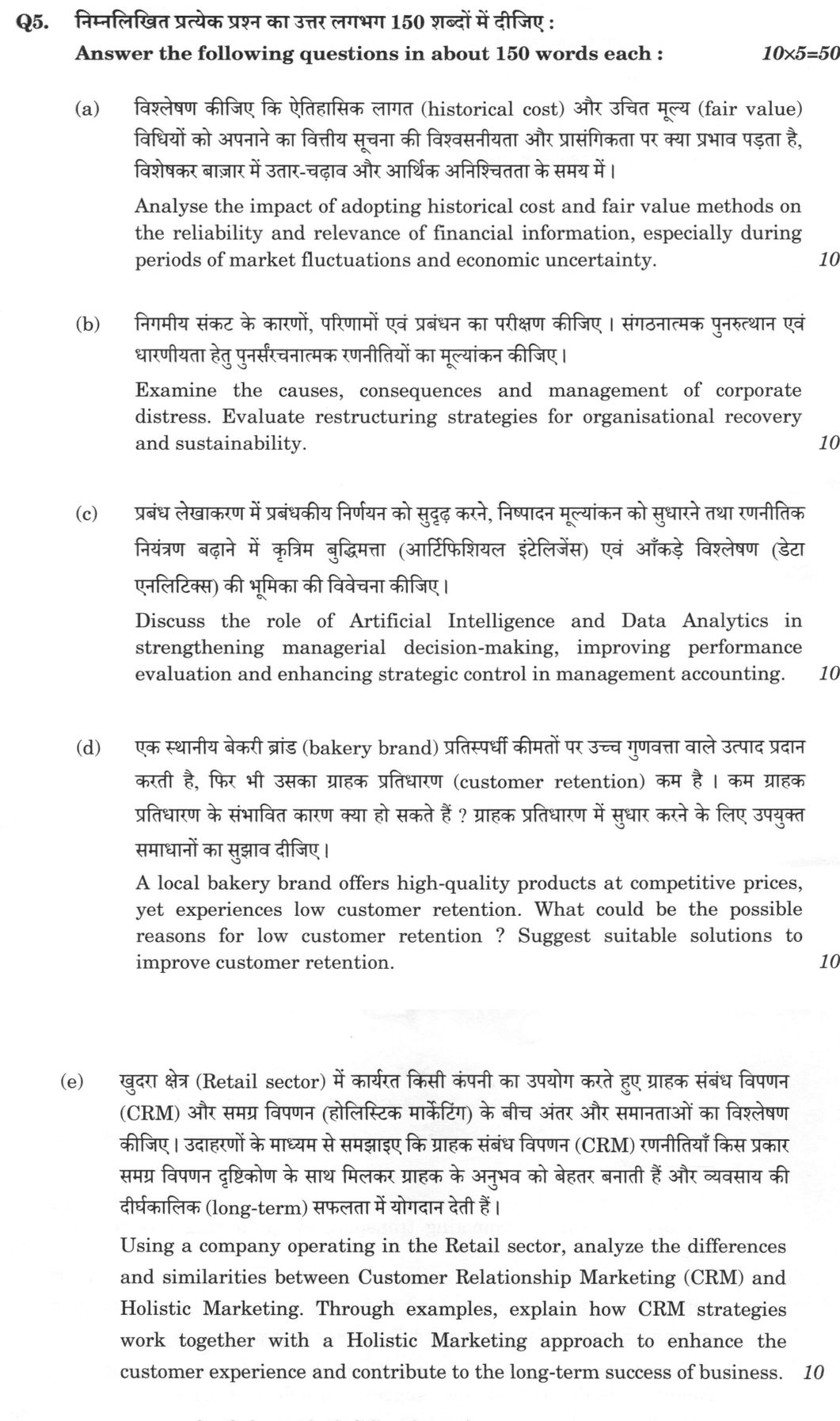
Analyse the impact of adopting historical cost and fair value methods on the reliability and relevance of financial information, especially during periods of market fluctuations and economic uncertainty. 10 marks
Examine the causes, consequences and management of corporate distress. Evaluate restructuring strategies for organisational recovery and sustainability. 10 marks
Discuss the role of Artificial Intelligence and Data Analytics in strengthening managerial decision-making, improving performance evaluation and enhancing strategic control in management accounting. 10 marks
A local bakery brand offers high-quality products at competitive prices, yet experiences low customer retention. What could be the possible reasons for low customer retention ? Suggest suitable solutions to improve customer retention. 10 marks
Using a company operating in the Retail sector, analyze the differences and similarities between Customer Relationship Marketing (CRM) and Holistic Marketing. Through examples, explain how CRM strategies work together with a Holistic Marketing approach to enhance the customer experience and contribute to the long-term success of business. 10 marks
हिंदी में प्रश्न पढ़ें
निम्नलिखित प्रत्येक प्रश्न का उत्तर लगभग 150 शब्दों में दीजिए :
विश्लेषण कीजिए कि ऐतिहासिक लागत (historical cost) और उचित मूल्य (fair value) विधियों को अपनाने का वित्तीय सूचना की विश्वसनीयता और प्रासंगिकता पर क्या प्रभाव पड़ता है, विशेषकर बाज़ार में उतार-चढ़ाव और आर्थिक अनिश्चितता के समय में । (10 अंक)
निगमीय संकट के कारणों, परिणामों एवं प्रबंधन का परीक्षण कीजिए । संगठनात्मक पुनरुत्थान एवं धारणीयता हेतु पुनर्संरचनात्मक रणनीतियों का मूल्यांकन कीजिए । (10 अंक)
प्रबंध लेखाकरण में प्रबंधकीय निर्णयन को सुदृढ़ करने, निष्पादन मूल्यांकन को सुधारने तथा रणनीतिक नियंत्रण बढ़ाने में कृत्रिम बुद्धिमत्ता (आर्टिफिशियल इंटेलिजेंस) एवं आँकड़े विश्लेषण (डेटा एनलिटिक्स) की भूमिका की विवेचना कीजिए । (10 अंक)
एक स्थानीय बेकरी ब्रांड (bakery brand) प्रतिस्पर्धी कीमतों पर उच्च गुणवत्ता वाले उत्पाद प्रदान करती है, फिर भी उसका ग्राहक प्रतिधारण (customer retention) कम है । कम ग्राहक प्रतिधारण के संभावित कारण क्या हो सकते हैं ? ग्राहक प्रतिधारण में सुधार करने के लिए उपयुक्त समाधानों का सुझाव दीजिए । (10 अंक)
खुदरा क्षेत्र (Retail sector) में कार्यरत किसी कंपनी का उपयोग करते हुए ग्राहक संबंध विपणन (CRM) और समग्र विपणन (होलिस्टिक मार्केटिंग) के बीच अंतर और समानताओं का विश्लेषण कीजिए । उदाहरणों के माध्यम से समझाइए कि ग्राहक संबंध विपणन (CRM) रणनीतियाँ किस प्रकार समग्र विपणन दृष्टिकोण के साथ मिलकर ग्राहक के अनुभव को बेहतर बनाती हैं और व्यवसाय की दीर्घकालिक (long-term) सफलता में योगदान देती हैं । (10 अंक)
Model answer
Drafted with AI by UPSC Answer Check against this question's marking rubric, to the 150-word length. UPSC does not publish answers for Mains — this is one way to score well, not an official key. How we build rubrics and answers.
(a) Historical Cost versus Fair Value Historical cost offers high reliability (faithful representation) because it is verifiable and free of estimates, but in volatile or uncertain periods it loses relevance: it conceals asset deterioration, understates appreciated assets and delays loss recognition. Fair value — defined in Ind AS 113 (IFRS 13) as the exit price in an orderly transaction between market participants at the measurement date — is more relevant because it reflects current conditions.
Under market fluctuation, however, fair value is pro-cyclical: it amplifies earnings and equity volatility and, as debated during the 2008 financial crisis, can trigger fire-sale spirals when markets are illiquid. Its reliability depends on the fair-value hierarchy: Level 1 (quoted prices) is objective, Level 2 uses observable inputs, and Level 3 relies on unobservable, model-based inputs open to management bias.
Ind AS therefore uses a mixed measurement model: Ind AS 109 classifies financial assets at amortised cost, FVOCI or FVTPL with expected-credit-loss provisioning, Ind AS 36 requires impairment testing, and disclosures of valuation techniques and hierarchy levels restore users' confidence.
(b) Corporate Distress and Restructuring Causes: excessive leverage, asset-liability and cash-flow mismatches, over-expansion, weak governance and external shocks. Early warning comes from Edward Altman's Z-score (below 1.81 distress; 1.81–2.99 grey zone) and falling interest cover.
Consequences: defaults, job losses, value destruction and contagion — the IL&FS default in 2018 froze funding for NBFCs.
Management: financial restructuring (debt rescheduling, debt-equity swaps, asset sales) and operational restructuring (cost cuts, portfolio pruning, process redesign). The RBI's Prudential Framework of 7 June 2019 allows lender-led resolution plans; the Insolvency and Bankruptcy Code, 2016 provides the Corporate Insolvency Resolution Process with a Section 14 moratorium, a resolution professional, a committee of creditors and a 330-day outer limit including litigation, with liquidation as the fallback. Pre-packaged insolvency (2021) serves MSMEs.
Evaluation: IBC works where assets are viable and creditors cohesive — Tata Steel's acquisition of Bhushan Steel (2018) is an example — but litigation delays and deep haircuts weaken it. Financial restructuring alone only buys time; sustainable recovery needs an operational turnaround and governance reform.
(c) AI and Data Analytics in Management Accounting AI and data analytics move management accounting along the analytics ladder — descriptive, diagnostic, predictive and prescriptive — and turn the management accountant from score-keeper into finance business partner.
Managerial decision-making: predictive models generate rolling forecasts that replace static annual budgets; scenario simulation supports make-or-buy, pricing and capacity decisions; activity-based costing becomes cheaper to run with automated data capture.
Performance evaluation: automated variance analysis flags price, usage and efficiency variances in near real time; Kaplan and Norton's balanced scorecard can be fed with live data across its four perspectives (financial, customer, internal process, learning and growth), and responsibility centres are compared on granular metrics.
Strategic control: anomaly detection and early-warning dashboards signal deviations from strategic targets, enabling corrective action before period-end.
Limitations: poor data quality and integration, "black-box" models that hinder explainability and auditability, the risk of confusing correlation with causation, implementation cost, skills gaps and data-privacy obligations. AI therefore supports, but does not replace, managerial judgment.
(d) Low Customer Retention at a Local Bakery Since quality and price are satisfactory, the causes lie elsewhere:
- Service-quality gaps (SERVQUAL): unreliable availability of popular items, slow service or indifferent staff (empathy).
- Weak convenience: limited hours, no online ordering or absence from delivery aggregators.
- Poor service recovery: complaints ignored, so dissatisfied customers leave silently.
- No relationship mechanism: no loyalty scheme, reminders or personal engagement; competitors with similar products win on habit.
- Limited variety or ambience, making visits routine rather than memorable.
Diagnosis first: short post-purchase surveys, Net Promoter Score, online-review monitoring and tracking repeat purchase rates.
Solutions:
- A simple punch-card or app-based loyalty scheme and birthday/occasion offers.
- A WhatsApp-based customer list for order reminders, pre-orders and personalised offers.
- Consistent stock of best-sellers and staff training in courteous, quick service.
- Listing on aggregators and offering subscription options (daily bread, weekend cakes).
- A clear complaint-handling promise to recover dissatisfied customers.
Retention is cheaper than acquisition and raises customer lifetime value (CLV), measured through repeat-purchase and churn rates.
(e) CRM and Holistic Marketing in Retail Customer Relationship Marketing (CRM) manages long-term relationships with individual customers through data, segmentation, personalisation and service recovery, aiming at retention and customer lifetime value (CLV). Holistic marketing (Kotler and Keller) is a broader philosophy with four components: relationship marketing, integrated marketing, internal marketing and performance marketing (including social responsibility).
Similarities: both are customer-centric, long-term and value-focused. Differences: CRM is a component and a data-driven programme; holistic marketing is an organisation-wide orientation that also covers communication integration, employees and societal impact.
Shoppers Stop illustrates the fit. Its First Citizen loyalty programme, with tiered membership, points, previews and a co-branded credit card, generates purchase data for personalised offers (CRM). Holistic marketing ensures these offers are consistent across stores, app and website (integrated marketing), that store staff recognise and serve members well (internal marketing), and that results are tracked through sales, share of wallet and brand trust (performance marketing).
Together, CRM supplies the insight and holistic marketing supplies the consistent experience, raising retention, advocacy and long-term success.
How this answer will be evaluated
Evaluation rubric
Each sub-part is marked on its own, against the marks and word limit printed on the paper.
- (a) Analyse the trade-off between historical cost and fair value measurement on the two qualitative characteristics named in the question — RELIABILITY (faithful representation) and RELEVANCE — with specific attention to periods of market volatility and economic uncertainty. Both bases and both characteristics must be addressed. 10 marks · 150 words
Must cover
- Ind AS 113 / IFRS 13 fair value definition — exit price, orderly transaction, measurement date
- fair-value hierarchy: Level 1 / Level 2 / Level 3
- reliability (faithful representation) versus relevance trade-off
- pro-cyclicality of fair-value accounting and the 2008 financial-crisis debate
- mixed measurement model (Ind AS 109: amortised cost, FVOCI, FVTPL)
Loses marks
- Defining fair value as market value or replacement cost rather than as an exit price at the measurement date
- Discussing only one basis, or listing merits and demerits without connecting them to reliability and relevance as the question demands
- Ignoring the volatility/uncertainty condition that the question explicitly specifies
- Not knowing the fair-value hierarchy, which is the crux of the reliability argument
- Asserting that Indian GAAP or Ind AS uses one basis exclusively; the model is mixed
Earns more
- Analyses behaviour under volatility: pro-cyclicality of fair value, earnings and equity volatility, fire-sale dynamics debated after the 2008 global financial crisis, versus historical cost concealing deterioration and delaying loss recognition
- Notes the mixed-measurement resolution and safeguards: Ind AS 109 classification into amortised cost, FVOCI and FVTPL; expected credit loss provisioning; Ind AS 36 impairment testing; mandatory disclosure of valuation techniques and hierarchy level
- (b) Four demands in one note: causes of corporate distress, its consequences, how distress is managed, and an evaluation of restructuring strategies for recovery and sustainability. All four must appear; the evaluative element on restructuring is the differentiator. 10 marks · 150 words
Must cover
- Edward Altman's Z-score and its distress cut-offs
- Insolvency and Bankruptcy Code, 2016 — CIRP, moratorium, committee of creditors, resolution professional
- RBI Prudential Framework for Resolution of Stressed Assets, 7 June 2019
- distinction between financial restructuring and operational/business restructuring
- at least one Indian distress example (IL&FS 2018, DHFL, Jet Airways, Bhushan Steel resolution)
Loses marks
- Answering only causes and consequences, and skipping the evaluation of restructuring strategies, which carries the analytical marks
- Misstating the Altman Z-score cut-offs or applying the public-manufacturing model to a service or private firm without qualification
- Confusing financial restructuring (capital structure) with operational restructuring (cost and process), or treating restructuring as a synonym for retrenchment
- IBC details wrong — e.g., giving the outer limit as 180 days without the extension, or omitting that 330 days includes time spent in litigation
- Listing strategies with no evaluation of when each works and when it fails
Earns more
- Uses a recognised distress-prediction tool — Edward Altman's Z-score with its cut-offs (above 2.99 safe, 1.81-2.99 grey, below 1.81 distress), Beaver's ratios or Ohlson's O-score — and/or early-warning signals such as interest-coverage decline and SMA classification
- Cites the statutory resolution route: Insolvency and Bankruptcy Code, 2016 — CIRP, Section 14 moratorium, committee of creditors, resolution professional, 330-day outer limit, liquidation fallback, pre-packaged insolvency for MSMEs (2021)
- (c) Three specified roles of AI and data analytics inside MANAGEMENT ACCOUNTING must each be discussed: strengthening managerial decision-making, improving performance evaluation, and enhancing strategic control. The answer must stay within the management-accounting domain, not drift into general business analytics. 10 marks · 150 words
Must cover
- predictive analytics for forecasting and budgeting; rolling forecasts replacing static budgets
- automated variance analysis
- Kaplan and Norton's balanced scorecard (four perspectives)
- descriptive - diagnostic - predictive - prescriptive analytics progression
- data quality, explainability and auditability as limitations
Loses marks
- Writing a generic essay on AI in business without anchoring to management-accounting tools (variance analysis, budgeting, costing, responsibility accounting, balanced scorecard)
- Covering only one or two of the three demands the question names
- Confusing management accounting with financial accounting/audit reporting to external users
- Listing only benefits with no limitation, which weakens an otherwise sound answer
- Misattributing the balanced scorecard (it is Robert Kaplan and David Norton, 1992)
Earns more
- Uses an organising frame — descriptive, diagnostic, predictive and prescriptive analytics maturity — and notes the management accountant's shift from score-keeper to finance business partner
- States the limitations honestly: data quality and integration, black-box explainability and auditability, implementation cost, skills gap, correlation-versus-causation risk, privacy and governance obligations
- (d) A diagnostic mini-case: despite good quality and competitive prices a bakery brand has low customer retention. The answer must (i) diagnose plausible causes beyond product and price, and (ii) propose specific, implementable retention solutions for a LOCAL bakery, not a generic marketing lecture. 10 marks · 150 words
Must cover
- loyalty programme / CRM database for a small local retailer
- SERVQUAL dimensions or an equivalent service-quality framework
- customer lifetime value (CLV) and retention versus acquisition cost
- service recovery for complaint handling
- delivery aggregator / digital ordering channel presence
Loses marks
- Blaming price or quality despite the question stating both are satisfactory — the diagnosis must look elsewhere
- Generic marketing-mix recitation instead of retention-specific diagnosis and solutions
- Proposing solutions with no way of diagnosing the cause or measuring the improvement
- Suggesting enterprise-scale tools (a full CRM suite, loyalty analytics platform) disproportionate to a single local bakery
- Ignoring the digital and aggregator channel, which is where much bakery repeat purchase now happens
Earns more
- Uses a recognised service framework such as the SERVQUAL gaps model (Parasuraman, Zeithaml and Berry — tangibles, reliability, responsiveness, assurance, empathy), the service-profit chain, or customer-satisfaction/loyalty linkage, rather than ad hoc guesses
- Proposes a diagnostic step before prescribing: post-purchase and exit surveys, NPS tracking, mystery shopping, transaction-based churn analysis, review monitoring
- Specifies the metrics by which retention will be judged — retention and repeat-purchase rate, purchase frequency, churn rate, Net Promoter Score and customer lifetime value (CLV) — and notes retention costs less than acquisition
- (e) Three demands: (i) analyse DIFFERENCES and SIMILARITIES between Customer Relationship Marketing (CRM) and Holistic Marketing, (ii) do so using a named company operating in the RETAIL sector, and (iii) explain through examples how CRM works together with holistic marketing to improve customer experience and long-term business success. 10 marks · 150 words
Must cover
- Philip Kotler and Kevin Lane Keller — holistic marketing and its four components
- the four components named: relationship, integrated, internal and performance marketing
- customer lifetime value (CLV) / retention as the CRM metric
- a named retail company with its actual loyalty or CRM programme
Loses marks
- Listing the four components of holistic marketing wrongly, e.g., substituting 'digital marketing' for 'performance marketing', or omitting integrated or internal marketing (the older-edition label 'socially responsible marketing' in place of performance marketing is acceptable)
- Treating CRM as merely a software package rather than a marketing strategy
- Presenting CRM and holistic marketing as opposites, when relationship marketing is a constituent of holistic marketing
- No retail company named, despite the question requiring one, or a company named without any actual programme detail
- Writing only differences and omitting similarities, or vice versa
Earns more
- Defines CRM as the management of long-term individual customer relationships through data, segmentation, personalisation and service recovery, oriented to retention and customer lifetime value
- Explains the joint working with examples and names the outcomes — personalised offers plus consistent cross-channel communication plus empowered store staff plus responsible sourcing, producing higher retention, share of wallet, CLV, advocacy and brand trust
What "Analyse" is asking you to do
Break the subject into its working parts and show how they act on each other. The marks are in the interconnections — which factor drives which, and what the resulting structure explains — not in the inventory of factors.
Structure that answers it
Define the whole → separate it into its parts → show which part drives which → what that interaction produces → what the structure implies
Where marks are lost
A flat list of causes with no account of which drives which. An answer of neatly separated headings, each self-contained, scores as description.
Practice this exact question
Write your answer and it is marked point by point against the model answer above — what you covered, what you missed, what you got wrong.
Evaluate my answer →More from Management 2026 Paper I
- Q2 (a) How do core management processes influence each stage of the value chain ? How can mi…
- Q3 (a) Analyze how a Multinational Corporation can design its global management structures t…
- Q4 (a) Do modern management approaches represent a true evolution or just a modification of…
- Q5 Answer the following questions in about 150 words each : (a) Analyse the impact of adopti…
- Q6 (a) A company operates under the following conditions : Selling Price = ₹ 60 Variable Cos…
- Q7 A manufacturing enterprise is evaluating a long-term investment proposal for the modernis…
- Q8 (a) A manufacturing organisation processes its product through Process-I during May 2026.…