Paper I — Q8
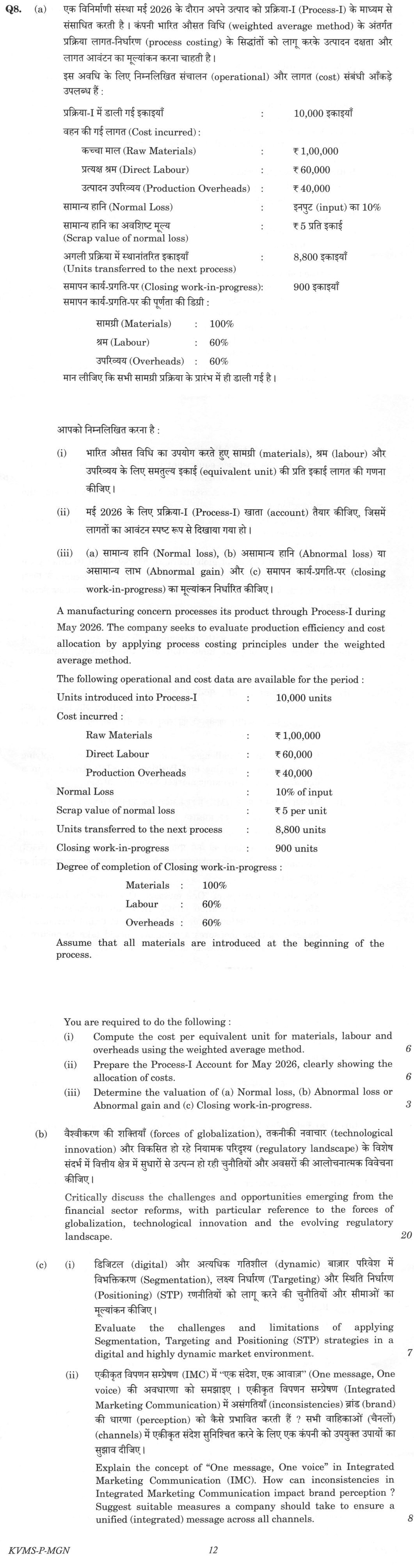
(a) A manufacturing organisation processes its product through Process-I during May 2026. The company wants to apply the…
A manufacturing organisation processes its product through Process-I during May 2026. The company wants to apply the principles of process costing under the weighted average method to evaluate production efficiency and cost allocation. The following operational and cost data are available for the period : Units introduced in Process-I : 10,000 units Cost incurred : Raw Materials : ₹ 1,00,000 Direct Labour : ₹ 60,000 Production Overheads : ₹ 40,000 Normal Loss : 10% of input Scrap value of normal loss : ₹ 5 per unit Units transferred to the next process : 8,800 units Closing work-in-progress : 900 units Degree of completion of closing work-in-progress : Materials : 100% Labour : 60% Overheads : 60% Assume that all materials are introduced at the beginning of the process. You are required to do the following : Compute the cost per equivalent unit for materials, labour and overheads using the weighted average method.
Prepare the Process-I Account for May 2026, clearly showing the allocation of costs.
Determine the valuation of (a) Normal loss, (b) Abnormal loss or Abnormal gain and (c) Closing work-in-progress. 15 marks
Critically discuss the challenges and opportunities emerging from the financial sector reforms, with particular reference to the forces of globalization, technological innovation and the evolving regulatory landscape. 20 marks
Evaluate the challenges and limitations of applying Segmentation, Targeting and Positioning (STP) strategies in a digital and highly dynamic market environment. 7 marks
Explain the concept of “One message, One voice” in Integrated Marketing Communication (IMC). How can inconsistencies in Integrated Marketing Communication impact brand perception ? Suggest suitable measures a company should take to ensure a unified (integrated) message across all channels. 8 marks
हिंदी में प्रश्न पढ़ें
एक विनिर्माणी संस्था मई 2026 के दौरान अपने उत्पाद को प्रक्रिया-I (Process-I) के माध्यम से संसाधित करती है । कंपनी भारित औसत विधि (weighted average method) के अंतर्गत प्रक्रिया लागत-निर्धारण (process costing) के सिद्धांतों को लागू करके उत्पादन दक्षता और लागत आवंटन का मूल्यांकन करना चाहती है । इस अवधि के लिए निम्नलिखित संचालन (operational) और लागत (cost) संबंधी आँकड़े उपलब्ध हैं : प्रक्रिया-I में डाली गई इकाइयाँ : 10,000 इकाइयाँ वहन की गई लागत (Cost incurred) : कच्चा माल (Raw Materials) : ₹ 1,00,000 प्रत्यक्ष श्रम (Direct Labour) : ₹ 60,000 उत्पादन उपरिव्यय (Production Overheads) : ₹ 40,000 सामान्य हानि (Normal Loss) : इनपुट (input) का 10% सामान्य हानि का अवशिष्ट मूल्य (Scrap value of normal loss) : ₹ 5 प्रति इकाई अगली प्रक्रिया में स्थानांतरित इकाइयाँ (Units transferred to the next process) : 8,800 इकाइयाँ समापन कार्य-प्रगति-पर (Closing work-in-progress): 900 इकाइयाँ समापन कार्य-प्रगति-पर की पूर्णता की डिग्री : सामग्री (Materials) : 100% श्रम (Labour) : 60% उपरिव्यय (Overheads) : 60% मान लीजिए कि सभी सामग्री प्रक्रिया के प्रारंभ में ही डाली गई है । आपको निम्नलिखित करना है : भारित औसत विधि का प्रयोग करते हुए सामग्री, श्रम एवं उपरिव्यय के लिए प्रति समतुल्य इकाई लागत की गणना कीजिए।
मई 2026 के लिए प्रक्रम-I खाता तैयार कीजिए, जिसमें लागतों का आवंटन स्पष्ट रूप से दर्शाया गया हो।
(a) सामान्य हानि, (b) असामान्य हानि अथवा असामान्य लाभ तथा (c) अंतिम कार्य-अधीन-प्रगति का मूल्यांकन निर्धारित कीजिए। (15 अंक)
वैश्वीकरण की शक्तियाँ (forces of globalization), तकनीकी नवाचार (technological innovation) और विकसित हो रहे नियामक परिदृश्य (regulatory landscape) के विशेष संदर्भ में वित्तीय क्षेत्र में सुधारों से उत्पन्न हो रही चुनौतियों और अवसरों की आलोचनात्मक विवेचना कीजिए। (20 अंक)
डिजिटल (digital) और अत्यधिक गतिशील (dynamic) बाजार परिवेश में विभक्तिकरण (Segmentation), लक्ष्य निर्धारण (Targeting) और स्थिति निर्धारण (Positioning) (STP) रणनीतियों को लागू करने की चुनौतियों और सीमाओं का मूल्यांकन कीजिए। (7 अंक)
एकीकृत विपणन सम्प्रेषण (IMC) में “एक संदेश, एक आवाज़” (One message, One voice) की अवधारणा को समझाइए । एकीकृत विपणन सम्प्रेषण (Integrated Marketing Communication) में असंगतियाँ (inconsistencies) ब्रांड (brand) की धारणा (perception) को कैसे प्रभावित करती हैं ? सभी वाहिकाओं (चैनलों) (channels) में एकीकृत संदेश सुनिश्चित करने के लिए एक कंपनी को उपयुक्त उपायों का सुझाव दीजिए। (8 अंक)
Model answer
Drafted with AI by UPSC Answer Check against this question's marking rubric, to the expected length. UPSC does not publish answers for Mains — this is one way to score well, not an official key. How we build rubrics and answers.
(a) Process Costing: Weighted Average Method Unit reconciliation: normal loss = 10% of 10,000 = 1,000 units, so expected output = 9,000 units. Actual output = 8,800 transferred + 900 closing WIP = 9,700 units. Actual exceeds expected, giving an abnormal gain of 700 units.
(i) Cost per equivalent unit
Equivalent units (abnormal gain deducted at 100%): Materials = 8,800 + 900 − 700 = 9,000; Labour and overheads = 8,800 + 540 (60% of 900) − 700 = 8,640.
Net material cost = ₹1,00,000 − scrap of normal loss (1,000 × ₹5 = ₹5,000) = ₹95,000.
Materials: ₹95,000 ÷ 9,000 = ₹10.5556 Labour: ₹60,000 ÷ 8,640 = ₹6.9444 Overheads: ₹40,000 ÷ 8,640 = ₹4.6296 Total cost per equivalent unit = ₹22.1296 (≈ ₹22.13)
(ii) Process-I Account for May 2026
| Particulars | Units | ₹ | Particulars | Units | ₹ |
|---|---|---|---|---|---|
| To Raw materials | 10,000 | 1,00,000 | By Normal loss (scrap) | 1,000 | 5,000 |
| To Direct labour | 60,000 | By Transfer to Process-II | 8,800 | 1,94,740.74 | |
| To Production overheads | 40,000 | By Closing WIP | 900 | 15,750.00 | |
| To Abnormal gain | 700 | 15,490.74 | |||
| Total | 10,700 | 2,15,490.74 | Total | 10,700 | 2,15,490.74 |
Transfer = 8,800 × ₹22.1296 = ₹1,94,740.74.
(iii) Valuation (a) Normal loss: at scrap value only, 1,000 × ₹5 = ₹5,000. (b) Abnormal gain: 700 × ₹22.1296 = ₹15,490.74 (debited to Process-I). Since 700 fewer units are scrapped, ₹3,500 (700 × ₹5) of scrap income is forgone and transferred to the Normal Loss Account, so the net abnormal gain credited to Costing P&L is ₹11,990.74. (c) Closing WIP: materials 900 × ₹10.5556 = ₹9,500; labour 540 × ₹6.9444 = ₹3,750; overheads 540 × ₹4.6296 = ₹2,500; total ₹15,750.
The abnormal gain shows that process efficiency was better than the normal-loss standard.
(b) Financial Sector Reforms: Challenges and Opportunities India's financial sector reforms began with the Narasimham Committee (1991) and its second report (1998): lower SLR and CRR, deregulated interest rates, prudential norms on capital adequacy and asset classification, and entry of private and foreign banks. Later milestones include SEBI's statutory status (1992), FEMA (1999), the Insolvency and Bankruptcy Code (2016) and flexible inflation targeting (2016).
Globalisation. Opportunities: access to foreign capital through FPI and FDI, GIFT City's International Financial Services Centre, and inclusion of Indian government bonds in JP Morgan's emerging-market bond index from 2024. Basel III norms (capital conservation buffer, leverage ratio, liquidity coverage and net stable funding ratios) have strengthened bank resilience. Challenges: exposure to volatile capital flows, global contagion and competition from foreign institutions.
Technological innovation. Opportunities: UPI and the India Stack (Aadhaar e-KYC, Account Aggregator, OCEN) have transformed payments, inclusion and cash-flow-based lending; fintechs widen access. Challenges: cyber-fraud, data-privacy obligations under the Digital Personal Data Protection Act, 2023, unregulated digital lending (prompting RBI's 2022 digital-lending guidelines) and a digital divide.
Regulatory landscape. Opportunities: IBC and the Prompt Corrective Action framework improved credit discipline, and gross NPAs have fallen sharply from their 2018 peak. Challenges: supervisory failures such as IL&FS (2018), PMC Bank (2019) and Yes Bank (2020), overlapping regulators, and rising compliance costs.
Critical assessment: reforms have improved capital adequacy, asset quality and payment efficiency, but risk has migrated to less-regulated NBFCs and fintechs, MSME and farm credit remain constrained, and the non-digital population risks exclusion. The task ahead is to balance innovation with stability and inclusion.
(c)(i) STP in a Digital, Dynamic Market Segmentation (demographic, psychographic, behavioural bases), targeting and positioning presume stable, identifiable, reachable segments. Digital markets strain each stage:
- Segmentation: consent requirements under the DPDP Act, 2023 and GDPR, and browser restrictions on third-party cookies, limit data; behaviour shifts faster than periodic segmentation studies.
- Targeting: segments are unstable and personalisation drives them toward a "segment of one", while algorithmic targeting can be opaque or biased.
- Positioning: brands lose message control to user-generated content, reviews and influencers, and rivals copy points of difference quickly.
STP is not obsolete; it must become continuous, cohort-based and built on consented first-party data.
(c)(ii) "One Message, One Voice" in IMC Integrated Marketing Communication (Don E. Schultz) coordinates advertising, sales promotion, PR, digital, social media and personal selling so that every touchpoint delivers one consistent message and brand personality. Coordinated messages create synergy: their combined effect exceeds that of uncoordinated ones.
Inconsistencies — a premium advertisement contradicted by poor service, or different promises on different channels — blur positioning, confuse customers, erode trust and dilute brand equity.
Measures for a unified message:
- A message architecture and brand guidelines with a single owner of brand communication.
- An approval workflow covering agencies, social media and influencers.
- Internal marketing so that frontline staff, service scripts and CRM messages match the brand promise.
- Periodic brand audits tracking message recall, brand-attribute association and NPS.
How this answer will be evaluated
Evaluation rubric
Each sub-part is marked on its own, against the marks and word limit printed on the paper.
- (a) A three-part process-costing numerical under the weighted average method: (i) compute cost per equivalent unit for materials, labour and overheads; (ii) prepare the Process-I Account for May 2026 showing cost allocation; and (iii) value normal loss, abnormal loss or abnormal gain, and closing work-in-progress. The reconciliation of units reveals an ABNORMAL GAIN, which is the crux of the problem. 15 marks
Must cover
- ABNORMAL GAIN of 700 units (not an abnormal loss)
- Equivalent units: materials 9,000; labour and overheads 8,640
- Cost per equivalent unit: materials Rs 10.56, labour Rs 6.94, overheads Rs 4.63, total Rs 22.13
- Transfer to next process 8,800 units = Rs 1,94,740.74
- Closing WIP = Rs 15,750 (materials Rs 9,500 + labour Rs 3,750 + overheads Rs 2,500)
- Normal loss valued at scrap only = Rs 5,000; abnormal gain valued at Rs 15,490.74; Process-I Account totals Rs 2,15,490.74 on both sides
Loses marks
- Concluding there is an abnormal LOSS: the units accounted for (9,700) exceed expected output (9,000), so it is an abnormal GAIN of 700 units
- Failing to DEDUCT abnormal gain equivalent units when computing equivalent production, which understates the cost per equivalent unit
- Not deducting the Rs 5,000 scrap value of normal loss from material cost before computing the material cost per equivalent unit
- Applying the 60 per cent completion factor to materials as well, when the question states all materials are introduced at the beginning (so materials are 100 per cent complete in closing WIP)
- Placing abnormal gain on the credit side of the Process Account instead of the debit side, or valuing normal loss at full cost instead of scrap value
Earns more
- Correct equivalent units with abnormal gain DEDUCTED — materials 8,800 + 900 - 700 = 9,000; labour and overheads 8,800 + 540 - 700 = 8,640
- Scrap value of normal loss (1,000 x Rs 5 = Rs 5,000) deducted from material cost, giving net material cost of Rs 95,000 for apportionment
- Process-I Account for May 2026 prepared in proper two-sided form, with abnormal gain of 700 units (Rs 15,490.74) on the DEBIT side, and normal loss Rs 5,000, transfer 8,800 units Rs 1,94,740.74 and closing WIP 900 units Rs 15,750 on the CREDIT side, both sides totalling 10,700 units and Rs 2,15,490.74
- (b) 'Critically discuss' both the CHALLENGES and the OPPORTUNITIES arising from financial-sector reforms, organised around three specified forces: globalization, technological innovation and the evolving regulatory landscape. All three forces and both sides of the ledger must appear. 20 marks
Must cover
- Narasimham Committee reports of 1991 and 1998
- Basel III norms — capital conservation buffer, leverage ratio, liquidity coverage ratio, net stable funding ratio
- UPI and the India Stack (Aadhaar e-KYC, Account Aggregator, OCEN)
- Insolvency and Bankruptcy Code, 2016 and the Prompt Corrective Action framework
- Digital Personal Data Protection Act, 2023 and cybersecurity risk
- at least one supervisory failure case — IL&FS 2018, PMC Bank 2019 or Yes Bank 2020
Loses marks
- Listing reform measures chronologically without organising them under the three forces the question names
- Presenting only opportunities or only challenges, which defeats the 'critically discuss' directive
- Factual errors on committees and dates — attributing the 1991 reforms to the Raghuram Rajan Committee, misdating Narasimham II, or crediting Basel norms to the RBI rather than the Basel Committee on Banking Supervision
- Omitting the technology dimension, or treating it only as UPI without the wider India Stack, regulatory and cyber-risk implications
- Quoting precise NPA or credit-growth figures without certainty; directional claims are safer than invented statistics
Earns more
- Establishes the reform baseline accurately: 1991 liberalisation, Narasimham Committee I (1991) and II (1998) on capital adequacy, prudential norms, income recognition and asset classification, SLR/CRR reduction, interest-rate deregulation and private/foreign bank entry; SEBI statutory in 1992; FEMA 1999; IRDA Act 1999; IBC 2016; MPC and flexible inflation targeting (2016)
- Delivers a genuine critical synthesis with evidence: gains in asset quality (gross NPAs down sharply from the 2017-18 peak), capital adequacy and payment volumes, set against uneven financial deepening, constrained MSME and agricultural credit, migration of risk to less-regulated segments, and the exclusion of the non-digital population
- (c)(i) Evaluate the CHALLENGES and LIMITATIONS of applying STP in a digital, highly dynamic market. The answer must first show correct command of segmentation, targeting and positioning, then critique each stage under digital-market conditions — not simply describe STP. 7 marks
Must cover
- the three stages named and correctly understood: segmentation, targeting, positioning
- privacy and data regulation constraining segmentation data (DPDP Act 2023, GDPR consent, browser restrictions on third-party cookies)
- segment instability / segment-of-one personalisation as the core structural challenge
- loss of brand message control to user-generated content, reviews and social media
Loses marks
- Describing STP at length and never evaluating its challenges and limitations, which is what the question asks
- Treating only segmentation and ignoring the targeting and positioning stages
- Ignoring the privacy and regulatory dimension, which is the most material recent constraint on digital segmentation
- Concluding that STP is obsolete, rather than that it must become continuous and consent-based
- Drifting into a general essay on digital marketing instead of evaluating STP
Earns more
- Demonstrates correct command of STP — segmentation bases (geographic, demographic, psychographic, behavioural), targeting strategies (undifferentiated, differentiated, concentrated, micromarketing) and positioning as a distinctive point of difference in the consumer's mind
- States the cross-cutting structural limitation — STP presumes stable, identifiable, reachable segments, a premise strained when personalisation drives segment size toward one and the framework's periodic cadence meets continuous markets — and offers a mitigation such as continuous segmentation, first-party/zero-party data or cohort-based approaches
- (c)(ii) Three sub-demands, all compulsory: (i) explain the 'one message, one voice' concept in Integrated Marketing Communication, (ii) explain how inconsistency in IMC damages brand perception, and (iii) suggest measures to ensure a unified message across all channels. 8 marks
Must cover
- Integrated Marketing Communication — coordination of the full communication mix for a single consistent voice (Don E. Schultz)
- synergy: the combined effect of coordinated messages exceeds the sum of uncoordinated ones
- consequences of inconsistency — blurred positioning, loss of trust, diluted brand equity
- brand guidelines / message architecture and a single owner of brand communication
- internal marketing: employees and frontline staff as communication channels
Loses marks
- Listing promotional tools without explaining the integration principle that makes them one voice
- Answering only one or two of the three sub-demands; all three are printed and all carry marks
- Confusing IMC with advertising or with multi-channel presence, when the point is CONSISTENCY across channels, not mere presence
- Omitting internal and frontline alignment, though service experience contradicting advertising is the commonest source of inconsistency
- Proposing measures with no governance mechanism — guidelines without an owner, approval workflow or audit do not produce consistency
Earns more
- Adds INTERNAL alignment and MEASUREMENT: internal marketing and frontline staff training as a communication channel, consistent CRM and service scripts, social-media and influencer governance, periodic communication/brand audits, and tracking of message recall, brand-attribute association and NPS
What "Calculate" is asking you to do
Apply the standard formula or schedule to data the question has already supplied — a table of readings, cost records, a balance sheet — and produce the number. The method is rarely in doubt; the marks sit in the named intermediate quantities, each of which has to appear as a labelled line.
Structure that answers it
Data as given → formula or standard treatment, named → substitution → each intermediate, labelled → result with units
Where marks are lost
Omitting an intermediate the marking scheme pays for separately, or rounding at an intermediate line so the final figure drifts. In commerce and accountancy, any figure in a statement that no numbered working note supports is treated as unearned.
Practice this exact question
Write your answer and it is marked point by point against the model answer above — what you covered, what you missed, what you got wrong.
Evaluate my answer →More from Management 2026 Paper I
- Q5 Answer the following questions in about 150 words each : (a) Analyse the impact of adopti…
- Q6 (a) A company operates under the following conditions : Selling Price = ₹ 60 Variable Cos…
- Q7 A manufacturing enterprise is evaluating a long-term investment proposal for the modernis…
- Q8 (a) A manufacturing organisation processes its product through Process-I during May 2026.…