Paper I — Q7
A manufacturing enterprise is evaluating a long-term investment proposal for the modernisation of its production facilities. This…
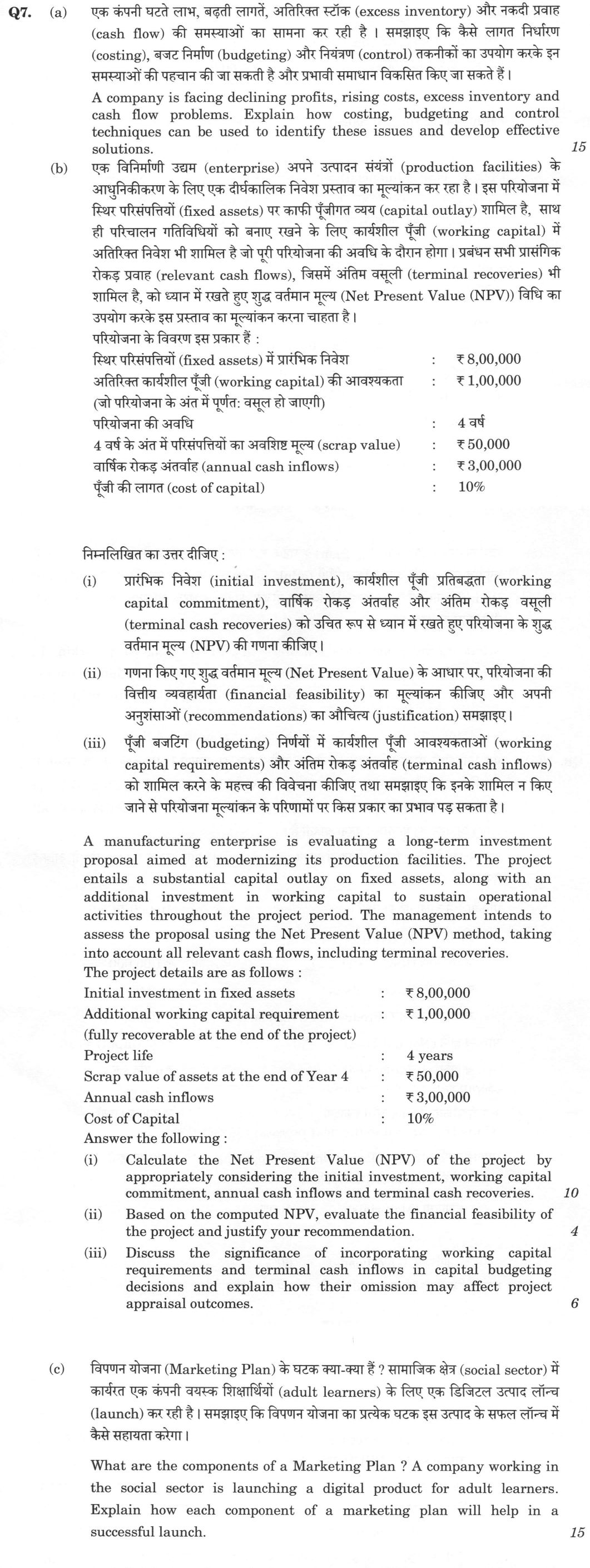
A manufacturing enterprise is evaluating a long-term investment proposal for the modernisation of its production facilities. This project involves a substantial capital outlay on fixed assets, along with an additional investment in working capital that will be required to keep the operations running throughout the life of the project. The management wants to evaluate this proposal using the Net Present Value (NPV) method, keeping in view all the relevant cash flows, including terminal recoveries. The details of the project are as follows : Initial investment in fixed assets : ₹ 8,00,000 Requirement of additional working capital : ₹ 1,00,000 (which will be fully recovered at the end of the project) Duration of the project : 4 years Scrap value of assets at the end of 4 years : ₹ 50,000 Annual cash inflows : ₹ 3,00,000 Cost of capital : 10% Answer the following :
A company is facing declining profits, rising costs, excess inventory and cash flow problems. Explain how costing, budgeting and control techniques can be used to identify these issues and develop effective solutions. 15 marks
Calculate the Net Present Value (NPV) of the project by appropriately considering the initial investment, working capital commitment, annual cash inflows and terminal cash recoveries. 10 marks
Based on the computed NPV, evaluate the financial feasibility of the project and justify your recommendation. 4 marks
Discuss the significance of incorporating working capital requirements and terminal cash inflows in capital budgeting decisions and explain how their omission may affect project appraisal outcomes. 6 marks
What are the components of a Marketing Plan ? A company working in the social sector is launching a digital product for adult learners. Explain how each component of a marketing plan will help in a successful launch. 15 marks
हिंदी में प्रश्न पढ़ें
एक विनिर्माणी उद्यम (enterprise) अपने उत्पादन संयंत्रों (production facilities) के आधुनिकीकरण के लिए एक दीर्घकालिक निवेश प्रस्ताव का मूल्यांकन कर रहा है। इस परियोजना में स्थिर परिसंपत्तियों (fixed assets) पर काफी पूँजीगत व्यय (capital outlay) शामिल है, साथ ही परिचालन गतिविधियों को बनाए रखने के लिए कार्यशील पूँजी (working capital) में अतिरिक्त निवेश भी शामिल है जो पूरी परियोजना की अवधि के दौरान होगा। प्रबंधन सभी प्रासंगिक रोकड़ प्रवाह (relevant cash flows), जिसमें अंतिम वसूली (terminal recoveries) भी शामिल है, को ध्यान में रखते हुए शुद्ध वर्तमान मूल्य (Net Present Value (NPV)) विधि का उपयोग करके इस प्रस्ताव का मूल्यांकन करना चाहता है। परियोजना के विवरण इस प्रकार हैं : स्थिर परिसंपत्तियों (fixed assets) में प्रारंभिक निवेश : ₹ 8,00,000 अतिरिक्त कार्यशील पूँजी (working capital) की आवश्यकता : ₹ 1,00,000 (जो परियोजना के अंत में पूर्णतः वसूल हो जाएगी) परियोजना की अवधि : 4 वर्ष 4 वर्ष के अंत में परिसंपत्तियों का अवशिष्ट मूल्य (scrap value) : ₹ 50,000 वार्षिक रोकड़ अंतर्वाह (annual cash inflows) : ₹ 3,00,000 पूँजी की लागत (cost of capital) : 10% निम्नलिखित का उत्तर दीजिए :
एक कंपनी घटते लाभ, बढ़ती लागतें, अतिरिक्त स्टॉक (excess inventory) और नकदी प्रवाह (cash flow) की समस्याओं का सामना कर रही है। समझाइए कि कैसे लागत निर्धारण (costing), बजट निर्माण (budgeting) और नियंत्रण (control) तकनीकों का उपयोग करके इन समस्याओं की पहचान की जा सकती है और प्रभावी समाधान विकसित किए जा सकते हैं। (15 अंक)
प्रारंभिक निवेश (initial investment), कार्यशील पूँजी प्रतिबद्धता (working capital commitment), वार्षिक रोकड़ अंतर्वाह और अंतिम रोकड़ वसूली (terminal cash recoveries) को उचित रूप से ध्यान में रखते हुए परियोजना के शुद्ध वर्तमान मूल्य (NPV) की गणना कीजिए। (10 अंक)
गणना किए गए शुद्ध वर्तमान मूल्य (Net Present Value) के आधार पर, परियोजना की वित्तीय व्यवहार्यता (financial feasibility) का मूल्यांकन कीजिए और अपनी अनुशंसाओं (recommendations) का औचित्य (justification) समझाइए। (4 अंक)
पूँजी बजटिंग (budgeting) निर्णयों में कार्यशील पूँजी आवश्यकताओं (working capital requirements) और अंतिम रोकड़ अंतर्वाह (terminal cash inflows) को शामिल करने के महत्त्व की विवेचना कीजिए तथा समझाइए कि इनके शामिल न किए जाने से परियोजना मूल्यांकन के परिणामों पर किस प्रकार का प्रभाव पड़ सकता है। (6 अंक)
विपणन योजना (Marketing Plan) के घटक क्या-क्या हैं ? सामाजिक क्षेत्र (social sector) में कार्यरत एक कंपनी वयस्क शिक्षार्थियों (adult learners) के लिए एक डिजिटल उत्पाद लॉन्च (launch) कर रही है । समझाइए कि विपणन योजना का प्रत्येक घटक इस उत्पाद के सफल लॉन्च में कैसे सहायता करेगा । (15 अंक)
Model answer
Drafted with AI by UPSC Answer Check against this question's marking rubric, to the expected length. UPSC does not publish answers for Mains — this is one way to score well, not an official key. How we build rubrics and answers.
(a) Costing, Budgeting and Control for Four Symptoms Costing, budgeting and control techniques together diagnose each symptom and point to its remedy; responsibility accounting assigns each problem to a named manager.
- Declining profits. Diagnose with marginal costing (contribution and P/V ratio by product) and activity-based costing (Cooper and Kaplan), which reveal loss-making products, customers or high-cost activities. Remedy: drop or reprice low-contribution lines, redesign costly activities, and hold profit-centre managers accountable.
- Rising costs. Diagnose with standard costing and variance analysis (material price and usage, labour rate and efficiency, overhead variances), applying management by exception to significant variances. Remedy: investigate root causes; use flexible budgets to separate volume effects and zero-base budgeting (Peter Pyhrr) to justify every expense afresh; target costing and value analysis for redesign.
- Excess inventory. Diagnose with ABC (Always Better Control) and VED analysis, inventory turnover, days-inventory-outstanding and slow/non-moving stock reports. Remedy: economic order quantity, re-order levels and safety stock, JIT or vendor-managed inventory, and disposal of obsolete stock.
- Cash-flow problems. Diagnose with a cash budget and the cash conversion cycle (DIO + DSO − DPO) to locate where cash is trapped. Remedy: tighten credit policy using receivable ageing, negotiate longer supplier terms, release cash from inventory, defer non-essential capital expenditure and arrange working-capital finance.
Regular budget-versus-actual reports and key ratios then keep all four under control.
(b)(i) Net Present Value Initial outlay (t = 0) = Fixed assets ₹8,00,000 + Working capital ₹1,00,000 = ₹9,00,000.
PV of annual inflows (years 1–4) = ₹3,00,000 × PVAF(10%, 4 years) 3.1699 = ₹9,50,970.
Terminal inflow (year 4) = Scrap ₹50,000 + Working-capital recovery ₹1,00,000 = ₹1,50,000; PV = 1,50,000 × 0.6830 = ₹1,02,450.
Total PV of inflows = 9,50,970 + 1,02,450 = ₹10,53,420.
NPV = 10,53,420 − 9,00,000 = ₹1,53,420 (₹1,53,412 with unrounded factors).
(b)(ii) Financial Feasibility NPV is positive (₹1,53,420), so the project should be accepted: it earns more than the 10% cost of capital and adds about ₹1.53 lakh to shareholder wealth in present-value terms. The profitability index is 10,53,420 ÷ 9,00,000 = 1.17, the IRR is about 17.2%, and the discounted payback is about 3.5 years. Because most of the surplus arrives in year 4, management should test sensitivity to a shortfall in annual inflows.
(b)(iii) Working Capital and Terminal Flows Working capital is a genuine cash investment at t = 0 that is locked up for the project's life and released at the end; terminal inflows (scrap value plus working-capital release) are the final cash returns. Both must be included because NPV is based on all incremental cash flows at their correct timing.
Omission distorts appraisal in both directions. Ignoring working capital altogether overstates NPV — here to ₹1,85,120 instead of ₹1,53,420 — because the time value of money on the ₹1,00,000 locked up is lost. Omitting only the recovery understates NPV to ₹85,120, and ignoring all terminal inflows cuts it to ₹50,970. Such errors can reverse accept-reject decisions on marginal projects, distort rankings under capital rationing and cause liquidity stress during execution.
(c) Marketing Plan for a Digital Product for Adult Learners Following Kotler and Keller, a marketing plan contains: executive summary, situation analysis, objectives, segmentation-targeting-positioning (STP), marketing strategy and mix, action programmes, budget, and implementation and controls.
Application to the launch:
- Situation analysis: maps the adult literacy and skilling gap, smartphone and data access, low digital literacy and alternatives such as the government's ULLAS app (New India Literacy Programme) and Skill India Digital Hub, identifying the product's niche.
- Objectives: SMART targets on enrolment, completion, learning outcomes and cost per learner, not revenue alone.
- STP: segments such as first-generation adult learners, women in self-help groups and informal workers seeking skills; positioning as an accessible, vernacular, low-cost learning companion.
- Marketing mix (7Ps of services): product — low-bandwidth, voice-led, mobile-first content; price — free or freemium, funded by CSR, grants or employers; place — app plus community centres and self-help groups; promotion — community influencers, NGOs and local radio; people — mentors and volunteers; process — simple onboarding with assisted registration; physical evidence — certificates and digital badges.
- Action programmes and budget: a phased pilot-to-scale rollout with budgets for content, technology, field mobilisation and support.
- Implementation and controls: track activation, weekly active learners, completion and drop-off points, cost per completed learner and learning or livelihood outcomes, with contingency plans.
How this answer will be evaluated
Evaluation rubric
Each sub-part is marked on its own, against the marks and word limit printed on the paper.
- (a) Four specific symptoms are named — declining profits, rising costs, excess inventory and cash-flow problems. The answer must show, symptom by symptom, how COSTING, BUDGETING and CONTROL techniques identify each problem and then generate solutions. All three technique families must be covered. 15 marks
Must cover
- marginal costing / contribution and P/V ratio; activity-based costing (Cooper and Kaplan)
- standard costing and variance analysis; management by exception
- cash budget and the cash conversion cycle (DIO + DSO - DPO)
- inventory control: ABC/VED analysis, economic order quantity, JIT, inventory turnover ratio
- zero-base budgeting (Peter Pyhrr) and flexible budgeting
- responsibility accounting / responsibility centres
Loses marks
- Listing techniques without connecting any of them to the four symptoms the question actually names
- Covering costing only and neglecting budgeting or control, when all three are named in the question
- Omitting inventory or cash-flow tools, although both are explicitly among the stated problems
- Confusing standard costing with budgetary control, or treating variance analysis as an end rather than a trigger for investigation
- Misattributing techniques — ABC to Porter, zero-base budgeting to Drucker, the balanced scorecard to Deming
Earns more
- Addresses EXCESS INVENTORY specifically with inventory-control tools: ABC and VED analysis, economic order quantity, re-order level and safety stock, JIT and vendor-managed inventory, inventory turnover and days-inventory-outstanding, slow- and non-moving stock reports
- Addresses CASH FLOW specifically: cash budget, cash conversion cycle (DIO plus DSO minus DPO), receivable ageing and credit-policy tightening, supplier-term negotiation, capex deferral, working-capital financing
- Maps each of the four named symptoms to its diagnostic technique AND its corrective action, rather than listing techniques in the abstract, and assigns ownership through responsibility accounting
- (b)(i) Compute the NPV of the modernisation project at a 10 per cent cost of capital, treating the working capital of Rs 1,00,000 as an outflow at time zero and as a terminal recovery in year 4, along with the Rs 50,000 scrap value, and discounting the Rs 3,00,000 annual inflows over 4 years. 10 marks
Must cover
- Initial outlay Rs 9,00,000 (fixed assets Rs 8,00,000 + working capital Rs 1,00,000)
- PVAF (10 per cent, 4 years) = 3.1699; PV factor year 4 = 0.6830
- Terminal inflow Rs 1,50,000 = scrap Rs 50,000 + working capital recovery Rs 1,00,000
- PV of total inflows = Rs 10,53,420 with four-decimal table factors (Rs 10,53,412 unrounded)
- FINAL ANSWER: NPV = Rs 1,53,420 with table factors 3.1699 and 0.6830 (Rs 1,53,412 unrounded), positive
Loses marks
- Omitting the Rs 1,00,000 working capital from the initial outlay, which understates the outflow and overstates NPV by Rs 1,00,000
- Omitting the working-capital recovery in year 4, or discounting it at the wrong year's factor
- Adding the scrap value to the annual inflows instead of treating it as a single year-4 terminal receipt
- Discounting the working capital that is both invested at t = 0 and recovered at t = 4 as if it were cost-free, or netting the two without discounting the recovery
- Deducting depreciation from the given cash inflows — the Rs 3,00,000 is already a CASH inflow, so no depreciation adjustment is warranted
Earns more
- Correct PV annuity factor at 10 per cent for 4 years = 3.1699, giving PV of operating inflows = 3,00,000 x 3.1699 = Rs 9,50,970
- (b)(ii) Using the NPV computed in part (i), state whether the project is financially feasible and justify the recommendation using the NPV decision rule and, ideally, a supporting indicator such as the profitability index. 4 marks
Must cover
- NPV greater than zero implies accept
- NPV = approximately Rs 1,53,400 (positive)
- the project earns above the 10 per cent cost of capital and increases shareholder wealth
- supporting indicator: Profitability Index 1.17 (or IRR of roughly 17 per cent)
Loses marks
- Giving a verdict without quoting the computed NPV figure
- Stating the rule backwards, or treating a positive NPV as merely 'satisfactory' rather than value-adding
- Carrying forward a wrong NPV from part (i) and not noticing that the conclusion changes
- Writing a long essay on capital budgeting instead of a brief, justified recommendation
- Claiming the project is feasible because the payback period is short, when the question specifically asks for an NPV-based evaluation
Earns more
- States the NPV decision rule correctly — accept when NPV is positive, reject when negative, indifferent at zero
- Justifies economically — the project earns above the 10 per cent cost of capital and raises shareholder wealth by about Rs 1,53,400 in present-value terms — with a supporting indicator such as Profitability Index 1.17, IRR of roughly 17 per cent or discounted payback of about 3.5 years, plus a sensitivity caveat
- (b)(iii) Two demands: (i) explain WHY working-capital requirements and terminal cash inflows must be incorporated in capital budgeting, and (ii) explain HOW omitting them distorts project appraisal — ideally quantified against the figures in this very case. 6 marks
Must cover
- working capital as an incremental cash outflow at time zero and a recovery at the end of the project
- terminal cash inflows = salvage/scrap value plus working-capital release
- omission overstates NPV in one direction and understates it in the other
- risk of an incorrect accept-reject decision or distorted project ranking
Loses marks
- Treating working capital as a revenue expense or as part of operating cost rather than as an investment recovered at the end
- Asserting that omission always overstates NPV, when omitting the terminal recovery understates it
- Giving a purely theoretical answer with no link to the Rs 1,00,000 and Rs 1,50,000 figures in this case
- Confusing salvage value with book value or with written-down value for tax purposes
- Drifting into a general essay on capital budgeting techniques instead of addressing working capital and terminal flows
Earns more
- Notes the decision consequences: accept-reject reversal on marginal projects, distorted ranking under capital rationing, bias against long-lived or working-capital-intensive projects, and liquidity stress during execution if working capital is not planned
- (c) Two demands: (i) list and explain the components of a marketing plan, and (ii) apply EACH component to a specific case — a social-sector company launching a digital product for adult learners — showing how it contributes to a successful launch. Generic listing without application will not suffice. 15 marks
Must cover
- the standard marketing-plan components (Kotler and Keller): situation analysis, objectives, STP, strategy, action programmes, budget, implementation and controls
- segmentation-targeting-positioning applied to adult learners
- the 7Ps of services marketing (product, price, place, promotion, people, process, physical evidence)
- control metrics beyond downloads — activation, completion rate, cost per completed learner, learning outcome
- a social-sector funding/pricing model (freemium, CSR, grant, government or employer-sponsored)
Loses marks
- Listing the components generically and never applying them to the adult-learner digital product, which is half the question
- Using the 4Ps for what is a service and omitting people, process and physical evidence
- Assuming a conventional commercial pricing model without addressing who pays in a social-sector context
- Designing an urban, English-language, high-bandwidth product that ignores the target segment's language, literacy and device constraints
- Setting downloads as the success metric rather than activation, completion and learning or livelihood outcomes
Earns more
- Applies SITUATION ANALYSIS and OBJECTIVES to the case with real content: adult literacy and skilling gap, smartphone and data penetration, digital literacy constraints, competing platforms (the ULLAS app under the New India Literacy Programme, Skill India Digital Hub, SWAYAM, NGO and private offerings), and SMART objectives framed on enrolment, completion, learning outcome and cost per learner rather than revenue alone
- Applies BUDGET, TIMELINE and CONTROL: phased pilot-to-scale rollout, cost heads for content, technology, field mobilisation and support, and launch metrics — activation, weekly active learners, completion rate, drop-off points, cost per completed learner, assessment and livelihood outcomes — with contingency plans
What "Identify" is asking you to do
Pick out the particular instances that satisfy the question's test and name them precisely, with just enough against each to show it qualifies. A wrong pick earns nothing however well written, so the selection itself is the exercise.
Structure that answers it
The test an instance has to meet → instance named → the single line showing it meets the test → the same for each further instance
Where marks are lost
Describing the instances at length while never establishing why each one belongs in the set.
Practice this exact question
Write your answer and it is marked point by point against the model answer above — what you covered, what you missed, what you got wrong.
Evaluate my answer →More from Management 2026 Paper I
- Q4 (a) Do modern management approaches represent a true evolution or just a modification of…
- Q5 Answer the following questions in about 150 words each : (a) Analyse the impact of adopti…
- Q6 (a) A company operates under the following conditions : Selling Price = ₹ 60 Variable Cos…
- Q7 A manufacturing enterprise is evaluating a long-term investment proposal for the modernis…
- Q8 (a) A manufacturing organisation processes its product through Process-I during May 2026.…