Paper I — Q6
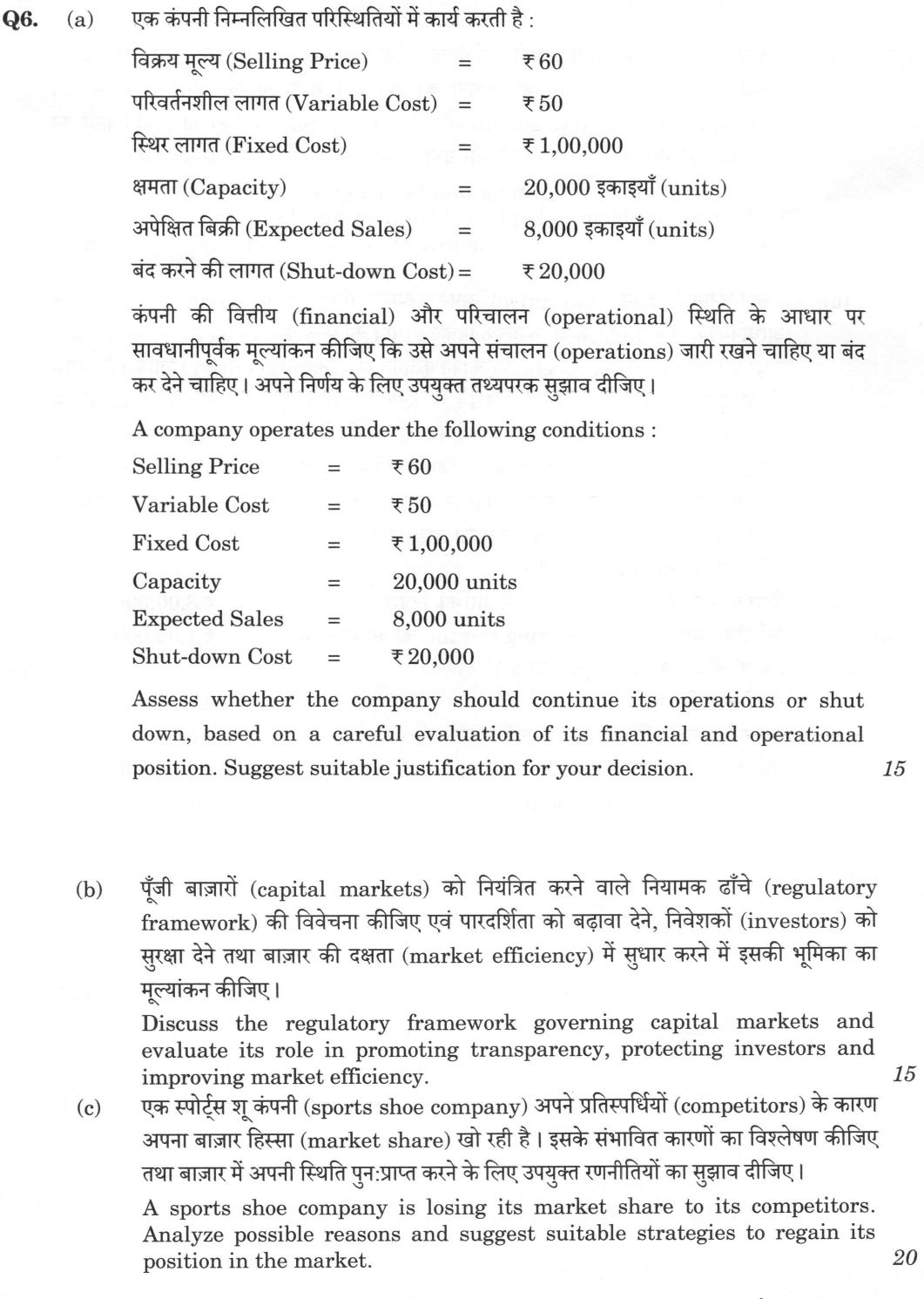
(a) A company operates under the following conditions : Selling Price = ₹ 60 Variable Cost = ₹ 50 Fixed Cost = ₹…
A company operates under the following conditions : Selling Price = ₹ 60 Variable Cost = ₹ 50 Fixed Cost = ₹ 1,00,000 Capacity = 20,000 units Expected Sales = 8,000 units Shut-down Cost = ₹ 20,000 Assess whether the company should continue its operations or shut down, based on a careful evaluation of its financial and operational position. Suggest suitable justification for your decision. 15 marks
Discuss the regulatory framework governing capital markets and evaluate its role in promoting transparency, protecting investors and improving market efficiency. 15 marks
A sports shoe company is losing its market share to its competitors. Analyze possible reasons and suggest suitable strategies to regain its position in the market. 20 marks
हिंदी में प्रश्न पढ़ें
एक कंपनी निम्नलिखित परिस्थितियों में कार्य करती है : विक्रय मूल्य (Selling Price) = ₹ 60 परिवर्तनशील लागत (Variable Cost) = ₹ 50 स्थिर लागत (Fixed Cost) = ₹ 1,00,000 क्षमता (Capacity) = 20,000 इकाइयाँ (units) अपेक्षित बिक्री (Expected Sales) = 8,000 इकाइयाँ (units) बंद करने की लागत (Shut-down Cost) = ₹ 20,000 कंपनी की वित्तीय (financial) और परिचालन (operational) स्थिति के आधार पर सावधानीपूर्वक मूल्यांकन कीजिए कि उसे अपने संचालन (operations) जारी रखने चाहिए या बंद कर देने चाहिए । अपने निर्णय के लिए उपयुक्त तथ्यपरक सुझाव दीजिए । (15 अंक)
पूँजी बाजारों (capital markets) को नियंत्रित करने वाले नियामक ढाँचे (regulatory framework) की विवेचना कीजिए एवं पारदर्शिता को बढ़ावा देने, निवेशकों (investors) को सुरक्षा देने तथा बाजार की दक्षता (market efficiency) में सुधार करने में इसकी भूमिका का मूल्यांकन कीजिए। (15 अंक)
एक स्पोर्ट्स शू कंपनी (sports shoe company) अपने प्रतिस्पर्धियों (competitors) के कारण अपना बाज़ार हिस्सा (market share) खो रही है। इसके संभावित कारणों का विश्लेषण कीजिए तथा बाजार में अपनी स्थिति पुनःप्राप्त करने के लिए उपयुक्त रणनीतियों का सुझाव दीजिए। (20 अंक)
Model answer
Drafted with AI by UPSC Answer Check against this question's marking rubric, to the expected length. UPSC does not publish answers for Mains — this is one way to score well, not an official key. How we build rubrics and answers.
(a) Continue or Shut Down: Marginal-Costing Decision Assumption: the fixed cost of ₹1,00,000 is incurred if operations continue; ₹20,000 is the total cost incurred if operations are suspended.
- Contribution per unit = Selling price − Variable cost = ₹60 − ₹50 = ₹10.
- P/V ratio = 10/60 × 100 = 16.67%.
- Break-even point = Fixed cost ÷ Contribution per unit = 1,00,000 ÷ 10 = 10,000 units (₹6,00,000 of sales).
- Capacity utilisation at expected sales = 8,000 ÷ 20,000 = 40%; expected sales are 2,000 units below break-even.
- If operations continue: Contribution = 8,000 × ₹10 = ₹80,000; Profit = 80,000 − 1,00,000 = loss of ₹20,000.
- If operations shut down: loss = shut-down cost = ₹20,000 (no contribution earned).
- Shut-down point = (Fixed cost − Shut-down cost) ÷ Contribution per unit = (1,00,000 − 20,000) ÷ 10 = 8,000 units.
Decision: expected sales equal the shut-down point, so the company is financially indifferent — it loses ₹20,000 either way.
Recommendation: continue operations, because:
- Every unit sold above 8,000 adds ₹10 of contribution, so any improvement in sales reduces the loss, whereas shutting down locks in the ₹20,000 loss.
- Skilled labour is retained and retrenchment costs are avoided.
- Market share and customer, dealer and supplier relationships are preserved; a closure would damage goodwill.
- Restarting later would involve additional start-up costs.
At the same time, management should pursue higher volume (only 40% of capacity is used), a better price or lower variable cost to reach the 10,000-unit break-even; if sales are expected to fall below 8,000 units for a sustained period, shutting down becomes preferable.
(b) Regulatory Framework of Capital Markets Framework: in India, the Securities and Exchange Board of India (constituted 1988, statutory under the SEBI Act, 1992) is the principal regulator, working with the Securities Contracts (Regulation) Act, 1956, the Depositories Act, 1996 and the Companies Act, 2013 (MCA/NCLT). Key regulations include the LODR Regulations, 2015, the ICDR Regulations, 2018 and the Prohibition of Insider Trading Regulations, 2015. Regulation shifted after 1992 from merit-based control by the Controller of Capital Issues to disclosure-based regulation. Appeals lie to the Securities Appellate Tribunal (SAT); the RBI (government securities, money markets), IRDAI and PFRDA regulate adjacent segments, coordinated through the FSDC; stock exchanges act as front-line self-regulatory organisations.
Transparency: LODR mandates periodic results, material-event disclosure and related-party approvals; top listed companies file Business Responsibility and Sustainability Reports (BRSR).
Investor protection: dematerialisation, KYC, client-fund segregation, margin norms, the Investor Protection and Education Fund, and SCORES with online dispute resolution for grievances.
Market efficiency: screen-based nationwide trading, clearing-corporation guaranteed settlement and T+1 settlement (fully implemented January 2023), with optional T+0 introduced later, have improved price discovery and lowered costs.
Evaluation: the framework has made Indian markets broadly transparent and efficient, but gaps remain. A SEBI study (September 2024) found that 93% of individual equity F&O traders lost money between FY22 and FY24, showing limits to investor protection; enforcement is slow, SAT carries a backlog, and algorithmic and finfluencer-driven risks outpace rules. Regulation is therefore effective but must keep evolving.
(c) Sports Shoe Company Losing Market Share Diagnosis should use Porter's five forces, a 4P/7P marketing audit and customer-funnel analysis to locate where share is leaking.
Possible reasons:
- Competition: global brands (Nike, Adidas, Puma, Skechers, Asics) and domestic players (Campus Activewear, Bata, Relaxo) plus D2C start-ups have intensified rivalry.
- Market shift: sneaker culture and athleisure have blurred categories; the brand may be seen as purely functional or dated.
- Product: slow design refresh, weak technology story (cushioning, running performance) and narrow range.
- Brand: limited athlete, sports-property or influencer presence compared with rivals.
- Channel: weak D2C and marketplace presence, so the firm lacks first-party customer data; stock-outs in key sizes.
- Pricing: perpetual discounting that erodes brand equity, or a gap in the value segment where Campus competes.
Strategies to regain position:
- Repositioning through a fresh segmentation-targeting-positioning exercise, for example performance running for urban young adults and value athleisure for tier-2 cities.
- Product: faster design cycles, limited-edition collaborations and credible performance technology.
- Brand: sponsorship of athletes and leagues, running-club communities and influencer marketing to build authenticity.
- Channel: omnichannel with a D2C app and website for first-party data, stronger marketplace presence and exclusive brand outlets, with harmonised pricing.
- Pricing: a "good-better-best" ladder instead of permanent discounts.
- Operations: demand sensing, assortment planning and faster supply chains to cut stock-outs.
Measure recovery through market share, share of search, Net Promoter Score, repeat-purchase rate and sell-through.
How this answer will be evaluated
Evaluation rubric
Each sub-part is marked on its own, against the marks and word limit printed on the paper.
- (a) A marginal-costing shut-down decision. Compute contribution per unit and P/V ratio, break-even point, the loss on continuing at expected sales, compare it with the loss on shutting down, locate the shut-down point in units, and then recommend with financial and non-financial justification. 15 marks
Must cover
- Contribution per unit = Rs 10; P/V ratio = 16.67 per cent
- Break-even point = 10,000 units = Rs 6,00,000
- Loss on continuing = Rs 20,000; loss on shutting down = Rs 20,000
- Shut-down point = (Fixed cost minus Shut-down cost) / Contribution per unit = 8,000 units
- FINAL ANSWER: the two alternatives are financially indifferent (Rs 20,000 loss each); recommend CONTINUE operations on non-financial grounds and for the upside above 8,000 units
Loses marks
- Comparing total cost with total revenue and concluding 'shut down' without computing the shut-down point, thereby missing the indifference result
- Treating the whole fixed cost of Rs 1,00,000 as the loss on shutting down, when the shut-down cost of Rs 20,000 is the stated cost of that alternative
- Using absorption costing and apportioning fixed cost per unit, which is invalid for a shut-down decision — only contribution and avoidable costs are relevant
- Computing the break-even point as 8,000 units by confusing expected sales with BEP
- Giving a bare numerical answer with no recommendation, or a recommendation with no non-financial justification, when the question explicitly asks for justification
Earns more
- Break-even point = Rs 1,00,000 / Rs 10 = 10,000 units (Rs 6,00,000 in value); expected sales of 8,000 units lie 2,000 units below BEP, and capacity utilisation is only 40 per cent
- Loss if operations SHUT DOWN = shut-down cost of Rs 20,000 (no contribution earned)
- Reasoned recommendation with non-financial justification — retain skilled labour and avoid retrenchment cost, preserve market share, customer, dealer and supplier relationships, avoid restart cost and goodwill loss, and capture Rs 10 contribution on every unit sold above 8,000 — hence CONTINUE, while pursuing volume, price or cost improvement to reach the 10,000-unit break-even
- (b) Two demands: (i) describe the regulatory framework governing capital markets (in India, with global reference as relevant), and (ii) EVALUATE its role against three stated objectives — transparency, investor protection and market efficiency — which requires both achievements and shortcomings. 15 marks
Must cover
- SEBI Act, 1992 (SEBI constituted 1988, statutory from 1992)
- Securities Contracts (Regulation) Act, 1956 and Depositories Act, 1996
- SEBI LODR Regulations 2015 and ICDR Regulations 2018; Prohibition of Insider Trading Regulations 2015
- shift from merit-based (Controller of Capital Issues) to disclosure-based regulation after 1992
- Securities Appellate Tribunal; SCORES investor grievance redressal; T+1 settlement
Loses marks
- Describing SEBI's functions only and never evaluating performance against transparency, protection and efficiency as the question requires
- Statutory errors — dating the SEBI Act to 1988, calling SCRA 1957, or attributing government securities regulation to SEBI rather than RBI
- Omitting the critique entirely, producing a promotional account of the regulator
- Confusing SEBI regulations — e.g., naming 'SEBI Listing Agreement' as current when LODR Regulations 2015 replaced it, or citing ICDR 2009 rather than the 2018 version
- Ignoring the institutional plurality (RBI, IRDAI, PFRDA, MCA, SAT, FSDC) and treating SEBI as the sole regulator
Earns more
- Names the institutional architecture accurately: SEBI (SEBI Act 1992; body constituted 1988), RBI, IRDAI, PFRDA, MCA/NCLT under the Companies Act 2013, Securities Appellate Tribunal, exchanges as SROs, depositories under the Depositories Act 1996, and FSDC for coordination
- Evaluates INVESTOR PROTECTION: dematerialisation, SCORES and Online Dispute Resolution, Investor Protection and Education Fund, KYC, client-fund segregation, margin norms, Investor Charter
- Evaluates MARKET EFFICIENCY: screen-based nationwide trading, T+1 settlement (equities, January 2023) and the move toward T+0, clearing-corporation guaranteed settlement, lower impact cost and improved price discovery, with the semi-strong-form efficiency argument
- (c) A two-part applied case on a sports shoe company losing market share: (i) analyse the possible reasons for the loss, diagnosing across product, brand, channel, pricing, competition and internal capability, and (ii) suggest suitable strategies to regain position. Both halves carry marks; the strategies must follow from the diagnosis. 20 marks
Must cover
- Porter's five forces or an equivalent structured competitive diagnosis
- segmentation-targeting-positioning / repositioning as the core strategic response
- omnichannel and D2C channel strategy with first-party data
- named competitors in the athletic footwear market (Nike, Adidas, Puma, Skechers, Campus Activewear, Bata, Relaxo)
- measurable recovery indicators — market share, share of search, NPS, repeat-purchase rate
Loses marks
- Jumping to remedies such as 'increase advertising' or 'reduce price' without diagnosing why share was lost
- Recommending price cuts as the primary strategy, which in a brand-led category erodes equity and invites a price war
- Ignoring channel and distribution entirely, though this is where much footwear share is actually lost
- Writing generic marketing theory with no reference to the footwear category, its competitors or consumer trends
- Offering no way to measure whether the strategy is working
Earns more
- Applies a structured diagnostic framework rather than listing guesses — Porter's five forces, a 4Ps/7Ps marketing audit, SWOT, BCG portfolio position, or funnel/customer-journey analysis to locate where share is leaking
- Names the actual competitive set and market shift: Nike, Adidas, Puma, Skechers, Asics and New Balance alongside Bata, Campus Activewear, Relaxo and Liberty plus D2C entrants; the rise of sneaker culture and athleisure blurring category lines; counterfeits and low-cost imports
- Proposes brand, channel and pricing strategies: athlete and sports-property sponsorship, influencer and running-community marketing, limited-edition collaborations, D2C app with first-party data, marketplace and EBO expansion, harmonised cross-channel pricing, a good-better-best price ladder instead of permanent discounting
- Specifies recovery metrics and the operational enablers: market share, share of search, NPS, repeat-purchase rate, sell-through and stock-out rate; supported by demand sensing, assortment planning, supply-chain speed and quality control
What "Suggest" is asking you to do
Propose measures that attach to the causes the question has just had you identify. Each should name who acts, on what, and why it would work; a measure with no actor behind it is a wish rather than a suggestion.
Structure that answers it
The problem in one line → measure 1 with the cause it addresses → measure 2 → measure 3 → how it would be implemented and what it requires
Where marks are lost
Prescriptions that would fit any question on any subject — awareness campaigns, capacity building, better coordination. The examiner checks whether each measure is traceable to a cause the answer itself named.
Practice this exact question
Write your answer and it is marked point by point against the model answer above — what you covered, what you missed, what you got wrong.
Evaluate my answer →More from Management 2026 Paper I
- Q3 (a) Analyze how a Multinational Corporation can design its global management structures t…
- Q4 (a) Do modern management approaches represent a true evolution or just a modification of…
- Q5 Answer the following questions in about 150 words each : (a) Analyse the impact of adopti…
- Q6 (a) A company operates under the following conditions : Selling Price = ₹ 60 Variable Cos…
- Q7 A manufacturing enterprise is evaluating a long-term investment proposal for the modernis…
- Q8 (a) A manufacturing organisation processes its product through Process-I during May 2026.…