Paper I — Q3
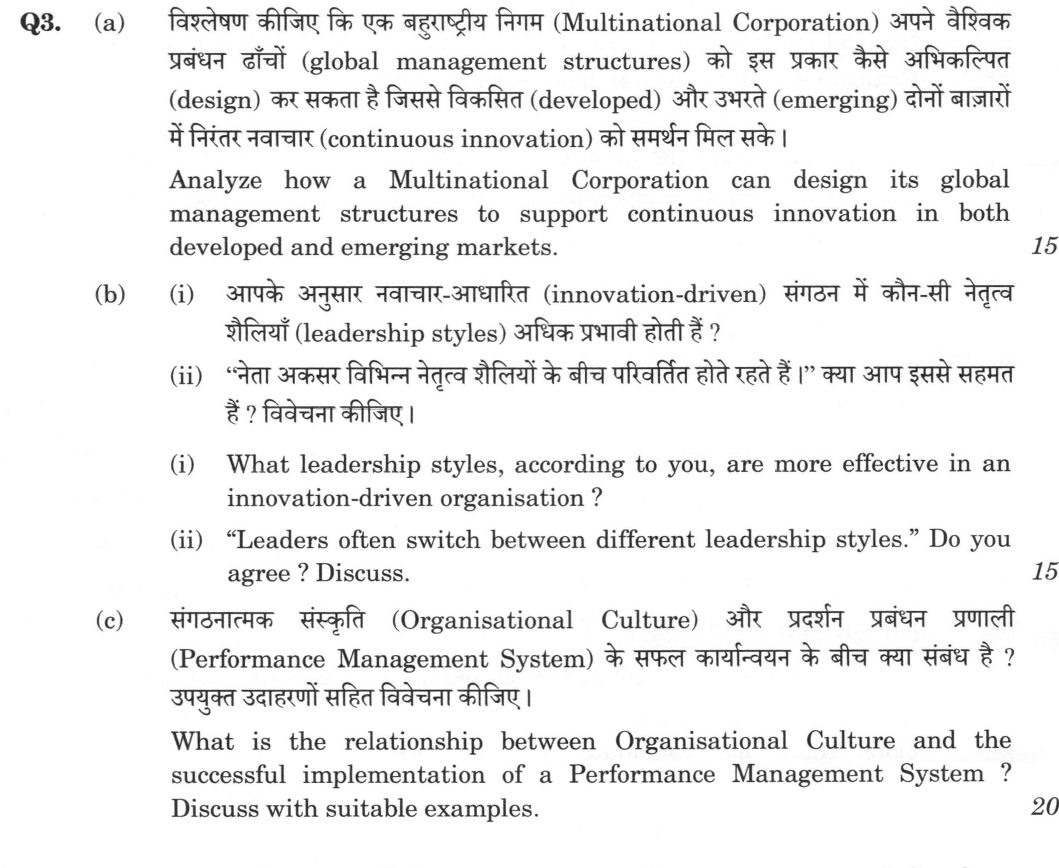
(a) Analyze how a Multinational Corporation can design its global management structures to support continuous innovation in both…
Analyze how a Multinational Corporation can design its global management structures to support continuous innovation in both developed and emerging markets. 15 marks
What leadership styles, according to you, are more effective in an innovation-driven organisation ?
“Leaders often switch between different leadership styles.” Do you agree ? Discuss. 15 marks
What is the relationship between Organisational Culture and the successful implementation of a Performance Management System ? Discuss with suitable examples. 20 marks
हिंदी में प्रश्न पढ़ें
विश्लेषण कीजिए कि एक बहुराष्ट्रीय निगम (Multinational Corporation) अपने वैश्विक प्रबंधन ढाँचों (global management structures) को इस प्रकार कैसे अभिकल्पित (design) कर सकता है जिससे विकसित (developed) और उभरते (emerging) दोनों बाजारों में निरंतर नवाचार (continuous innovation) को समर्थन मिल सके। (15 अंक)
आपके अनुसार नवाचार-आधारित (innovation-driven) संगठन में कौन-सी नेतृत्व शैलियाँ (leadership styles) अधिक प्रभावी होती हैं ?
“नेता अकसर विभिन्न नेतृत्व शैलियों के बीच परिवर्तित होते रहते हैं।” क्या आप इससे सहमत हैं ? विवेचना कीजिए। (15 अंक)
संगठनात्मक संस्कृति (Organisational Culture) और प्रदर्शन प्रबंधन प्रणाली (Performance Management System) के सफल कार्यान्वयन के बीच क्या संबंध है ? उपयुक्त उदाहरणों सहित विवेचना कीजिए। (20 अंक)
Model answer
Drafted with AI by UPSC Answer Check against this question's marking rubric, to the expected length. UPSC does not publish answers for Mains — this is one way to score well, not an official key. How we build rubrics and answers.
(a) Global Structures for Continuous Innovation To support continuous innovation across geographies, a Multinational Corporation (MNC) should design a transnational organisation (Bartlett and Ghoshal) — an integrated network that balances global integration with local responsiveness. Prahalad and Doz's integration-responsiveness framework warns against pure centralisation or pure decentralisation; lateral integrating mechanisms such as global product councils, cross-border project teams, knowledge-management platforms and expatriate/inpatriate rotation reconcile the two.
Developed markets: innovation is largely incremental and technology-led, so global R&D centres and product platforms exploit scale, with subsidiaries acting as lead markets for premium products.
Emerging markets: they must be treated as sources of innovation, not low-cost bases. Local growth teams with their own budget and decision rights pursue frugal innovation and bottom-of-the-pyramid needs. Reverse innovation (Govindarajan and Trimble) then carries such products to rich markets, as with GE Healthcare's low-cost ECG and portable ultrasound devices developed in India and China.
Organisational ambidexterity (O'Reilly and Tushman) links the two: exploratory units are kept separate from the exploitative core but integrated at senior level. Centres of excellence, specific subsidiary innovation mandates and a governance regime that tolerates intelligent failure sustain continuous innovation.
(b) Leadership Styles for Innovation (i) Transformational leadership (Burns; Bass and Avolio) is the most effective. Its "four I's" — idealised influence, inspirational motivation, intellectual stimulation and individualised consideration — encourage employees to challenge the status quo. Amy Edmondson's psychological safety lets teams take risks without fear of punishment. Robert House's path-goal theory suggests participative and achievement-oriented styles suit complex, creative tasks. Some transactional discipline is still needed so that ideas are commercialised on time and budget.
(ii) I agree that leaders often switch styles. Hersey and Blanchard's situational leadership matches style (telling, selling, participating, delegating) to follower readiness: a new R&D recruit needs direction; a proven team needs delegation. Goleman's research likewise found that leaders using several styles achieve better climate and results. The counterpoint is Fred Fiedler's contingency model, which holds, through the LPC scale, that style is relatively fixed and the situation should be engineered to fit the leader. Frequent, inauthentic switching can also read as inconsistency and damage trust. Flexibility is therefore desirable but must rest on a consistent core of values.
(c) Organisational Culture and Performance Management The relationship between organisational culture and a performance management system (PMS) — the cycle of goal setting, feedback, appraisal, development and reward — runs both ways.
Culture shapes PMS success. Edgar Schein describes culture at three levels: artefacts, espoused values and basic underlying assumptions. A PMS succeeds only when it fits those assumptions. Using Cameron and Quinn's Competing Values Framework, a clan culture suits a development-oriented, feedback-rich PMS; a market culture accepts differentiated ratings and pay-for-performance; a hierarchy culture prefers standardised appraisal; an adhocracy needs flexible, goal-based reviews. In high power-distance cultures (Hofstede), upward or 360-degree feedback may be resisted.
PMS shapes culture. Measured and rewarded behaviour signals what the organisation truly values; Steven Kerr's "On the folly of rewarding A, while hoping for B" shows how rewarding individual output erodes teamwork.
Examples: Microsoft abandoned "stack ranking" in 2013 because forced ranking bred internal competition that clashed with the collaboration it wanted. Adobe replaced annual reviews with frequent "Check-in" conversations in 2012, reinforcing agility and transparency.
Implications: diagnose culture first; align rating philosophy and feedback frequency with it; train managers for feedback conversations; phase in differentiation; and provide review and grievance routes, so that the PMS reinforces the desired values rather than defeating them.
How this answer will be evaluated
Evaluation rubric
Each sub-part is marked on its own, against the marks and word limit printed on the paper.
- (a) 'Analyze how' an MNC can DESIGN its global management structures so that continuous innovation is supported in developed AND emerging markets simultaneously. The answer must deal with organisational structure and design choices, and must address both market types distinctly — including reverse innovation and frugal innovation for emerging markets. 15 marks
Must cover
- Christopher Bartlett and Sumantra Ghoshal — transnational organisation/integrated network
- C. K. Prahalad and Yves Doz — integration-responsiveness framework
- Vijay Govindarajan and Chris Trimble — reverse innovation (GE Healthcare example)
- organisational ambidexterity (exploration vs exploitation)
- centres of excellence and subsidiary innovation mandates
Loses marks
- Writing about innovation management in general and never addressing STRUCTURE and organisation design, which the question asks for
- Treating emerging markets only as low-cost manufacturing bases rather than as sources of innovation
- Misattributing the transnational model to Porter or Perlmutter instead of Bartlett and Ghoshal, or reverse innovation to Prahalad instead of Govindarajan and Trimble
- Recommending pure centralisation or pure decentralisation without addressing the integrating mechanisms that reconcile them
- Omitting frugal innovation and the bottom-of-the-pyramid logic that is central to the emerging-market half
Earns more
- Applies the global integration versus local responsiveness framework (Prahalad and Doz) and/or Perlmutter's EPRG geocentric orientation as the design diagnostic
- Specifies lateral integrating mechanisms: global product/platform councils, cross-border project teams, knowledge-management platforms, expatriate/inpatriate rotation, internal venture funds, collaboration-linked incentives
- Builds in organisational ambidexterity — separating exploratory units from exploitative core operations while linking them at senior level (March; O'Reilly and Tushman) — and a governance regime with subsidiary mandates, decision rights near the market and tolerance of failure
- (b) Two printed sub-parts, both compulsory: (i) which leadership styles are more effective in an innovation-driven organisation, with reasons; and (ii) whether you agree that leaders frequently switch between styles — requiring engagement with contingency/situational leadership theory. 15 marks
Must cover
- transformational leadership — James MacGregor Burns; Bernard Bass and Bruce Avolio; the four I's
- Hersey and Blanchard situational leadership (telling, selling, participating, delegating)
- Robert House — path-goal theory (directive, supportive, participative, achievement-oriented)
- Fred Fiedler's contingency model and its LPC premise that style is relatively fixed
- psychological safety — Amy Edmondson
Loses marks
- Answering only sub-part (i) or only (ii) — both are printed and both carry marks
- Listing styles with no reason why they suit an INNOVATION-driven setting specifically
- Attribution errors: transformational leadership credited to Fiedler, situational leadership to House, path-goal to Blanchard, or the six styles to Bass instead of Goleman
- Asserting that autocratic or transactional leadership has no place at all, ignoring crisis and commercialisation discipline
- Answering (ii) as a bare 'yes I agree' with no theory and no example
Earns more
- (i) Links style to innovation mechanisms: psychological safety (Amy Edmondson), autonomy and intrinsic motivation (self-determination theory; Herzberg's motivators), idea championing, tolerance of intelligent failure; notes that pure laissez-faire causes drift and transactional discipline is still needed for commercialisation
- (ii) Offers the qualification/counterpoint — Fiedler's position that style is relatively stable and the situation should be engineered instead; and the risk that inauthentic switching reads as inconsistency and damages trust
- (c) Establish the relationship — in both directions — between organisational culture and successful implementation of a performance management system (PMS): how culture enables or defeats a PMS, and how a PMS in turn shapes culture. 'Discuss with suitable examples' makes named organisational illustrations compulsory. 20 marks
Must cover
- Edgar Schein — three levels of organisational culture
- Cameron and Quinn Competing Values Framework, or Charles Handy's four culture types, or Hofstede's power distance
- forced ranking / bell curve / stack ranking and the shift to continuous feedback
- Steven Kerr — 'On the folly of rewarding A, while hoping for B'
- at least two named company examples
Loses marks
- Treating PMS as only the annual appraisal form, and ignoring goal setting, continuous feedback, development and reward linkage
- Discussing culture in one paragraph and PMS in another with no relationship established between them
- Arguing culture-to-PMS only, and missing that the PMS itself reshapes culture
- Attribution errors — the three levels of culture credited to Hofstede instead of Schein, or the Competing Values Framework to Deal and Kennedy
- Generic examples with no company named, or examples described inaccurately (e.g., claiming Microsoft still uses stack ranking)
Earns more
- Defines both constructs correctly, citing Edgar Schein's three levels of culture (artefacts, espoused values, basic underlying assumptions) and PMS as a continuous cycle of goal setting, feedback, appraisal, development and reward linkage
- Uses a named culture typology to match PMS design to culture type — Cameron and Quinn's Competing Values Framework (clan, adhocracy, market, hierarchy), Handy's four types, or Hofstede's dimensions — rather than discussing culture generically
- Establishes the reverse direction: the PMS shapes culture because measured and rewarded behaviour signals values; cites Steven Kerr's 'On the folly of rewarding A, while hoping for B'
- Draws implementation implications: diagnose culture first, align rating philosophy and feedback frequency, train managers in feedback conversations, phase in differentiation, provide grievance/review routes
What "Analyse" is asking you to do
Break the subject into its working parts and show how they act on each other. The marks are in the interconnections — which factor drives which, and what the resulting structure explains — not in the inventory of factors.
Structure that answers it
Define the whole → separate it into its parts → show which part drives which → what that interaction produces → what the structure implies
Where marks are lost
A flat list of causes with no account of which drives which. An answer of neatly separated headings, each self-contained, scores as description.
Practice this exact question
Write your answer and it is marked point by point against the model answer above — what you covered, what you missed, what you got wrong.
Evaluate my answer →More from Management 2026 Paper I
- Q1 Answer the following questions in about 150 words each : (a) Do you think that the tradit…
- Q2 (a) How do core management processes influence each stage of the value chain ? How can mi…
- Q3 (a) Analyze how a Multinational Corporation can design its global management structures t…
- Q4 (a) Do modern management approaches represent a true evolution or just a modification of…
- Q5 Answer the following questions in about 150 words each : (a) Analyse the impact of adopti…
- Q6 (a) A company operates under the following conditions : Selling Price = ₹ 60 Variable Cos…