Paper I — Q4
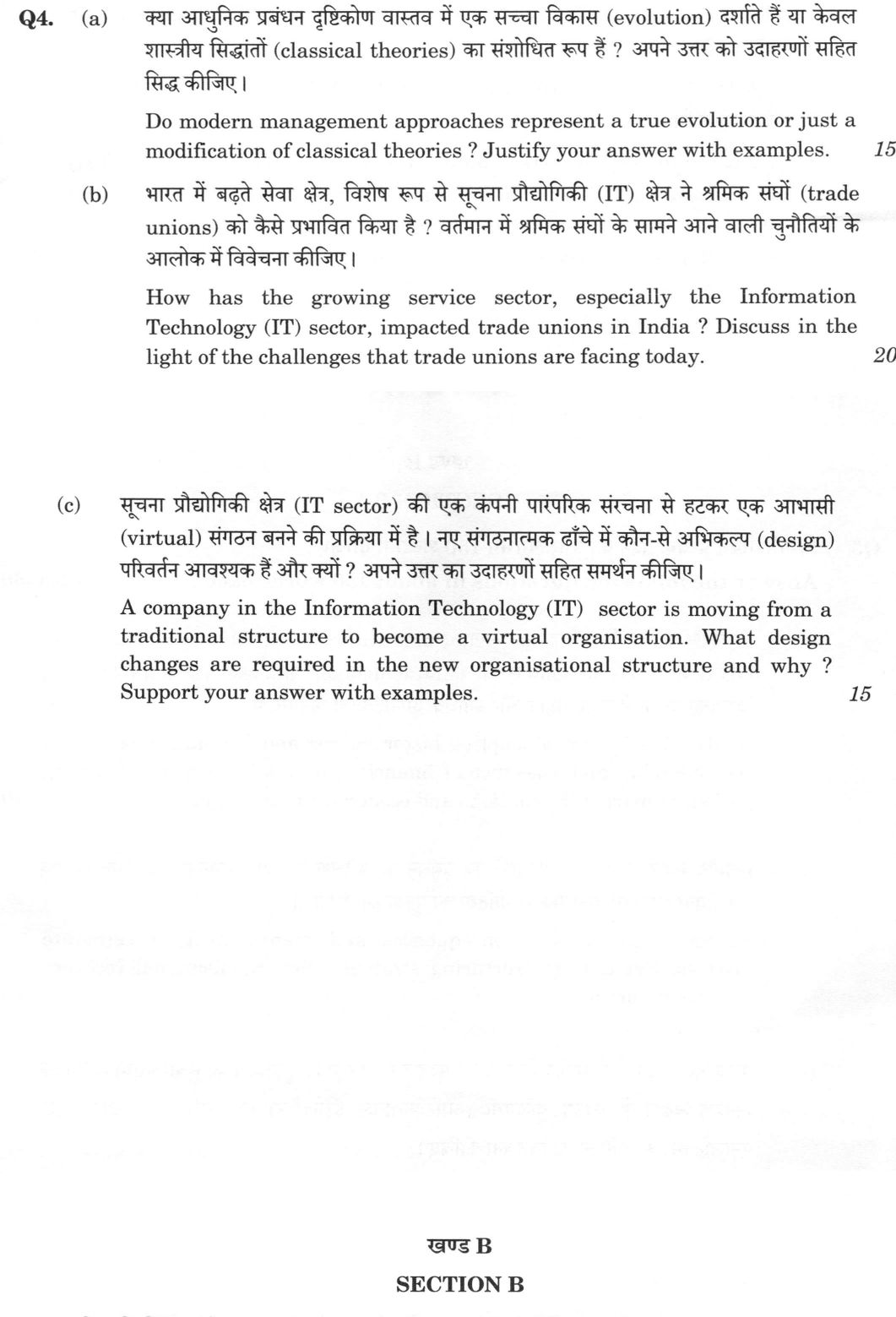
(a) Do modern management approaches represent a true evolution or just a modification of classical theories ? Justify your answer…
Do modern management approaches represent a true evolution or just a modification of classical theories ? Justify your answer with examples. 15 marks
How has the growing service sector, especially the Information Technology (IT) sector, impacted trade unions in India ? Discuss in the light of the challenges that trade unions are facing today. 20 marks
A company in the Information Technology (IT) sector is moving from a traditional structure to become a virtual organisation. What design changes are required in the new organisational structure and why ? Support your answer with examples. 15 marks
हिंदी में प्रश्न पढ़ें
क्या आधुनिक प्रबंधन दृष्टिकोण वास्तव में एक सच्चा विकास (evolution) दर्शाते हैं या केवल शास्त्रीय सिद्धांतों (classical theories) का संशोधित रूप हैं ? अपने उत्तर को उदाहरणों सहित सिद्ध कीजिए। (15 अंक)
भारत में बढ़ते सेवा क्षेत्र, विशेष रूप से सूचना प्रौद्योगिकी (IT) क्षेत्र ने श्रमिक संघों (trade unions) को कैसे प्रभावित किया है ? वर्तमान में श्रमिक संघों के सामने आने वाली चुनौतियों के आलोक में विवेचना कीजिए। (20 अंक)
सूचना प्रौद्योगिकी क्षेत्र (IT sector) की एक कंपनी पारंपरिक संरचना से हटकर एक आभासी (virtual) संगठन बनने की प्रक्रिया में है। नए संगठनात्मक ढाँचे में कौन-से अभिकल्प (design) परिवर्तन आवश्यक हैं और क्यों ? अपने उत्तर का उदाहरणों सहित समर्थन कीजिए। (15 अंक)
Model answer
Drafted with AI by UPSC Answer Check against this question's marking rubric, to the expected length. UPSC does not publish answers for Mains — this is one way to score well, not an official key. How we build rubrics and answers.
(a) Modern Management: Evolution or Modification? Modern management is best seen as a true evolution that nonetheless builds on classical foundations.
Classical theories — F. W. Taylor's scientific management (1911), Henri Fayol's 14 principles and five functions, and Max Weber's bureaucracy — assumed an "economic man", a stable environment and "one best way" achieved through control and specialisation.
Points of genuine break:
- Elton Mayo's Hawthorne studies (1924–32) and Mary Parker Follett introduced the "social man": informal groups and attitudes drive productivity.
- Douglas McGregor's Theory Y rejected the assumption that workers inherently dislike work.
- Contingency theory (Burns and Stalker; Lawrence and Lorsch; Joan Woodward) replaced "one best way" with fit between structure and environment — mechanistic for stable, organic for dynamic settings.
- Peter Drucker's "knowledge worker" and the resource-based view moved the focus from controlling labour to building intangible capabilities.
Points of continuity: TQM and lean (Toyota Production System) still rely on Taylor-style measurement and standard work; Google's OKRs descend from Drucker's management by objectives; algorithmic scheduling in warehouses and gig platforms is often called "digital Taylorism".
Verdict: the assumptions about people, environment and sources of value have changed fundamentally, so modern approaches are an evolution — but one that absorbs and re-purposes classical tools rather than discarding them.
(b) Service Sector, IT and Trade Unions in India The growth of services, especially IT/ITeS, has shifted employment from organised, plant-based manufacturing towards a dispersed, white-collar, mobile and largely individual-contract workforce, weakening traditional trade unionism.
Impact on unions:
- Low density: IT professionals see themselves as "professionals", not "workers"; merit-based pay, frequent job-hopping and project-based teams make collective identity weak.
- Legal status: under the Industrial Relations Code, 2020 — in force since 21 November 2025, replacing the Trade Unions Act, 1926 and the Industrial Disputes Act, 1947 — "worker" excludes those employed mainly in managerial or administrative roles and supervisors earning over ₹18,000 a month, so many IT staff fall outside dispute-resolution protection.
- Recognition hurdles: a union needs 51% membership to be the sole negotiating union, otherwise a negotiating council is formed; fragmented IT unions rarely reach such levels.
- Employer flexibility: the threshold for prior government permission for lay-offs and retrenchment, and for standing orders, rose from 100 to 300 workers; strikes now need 14 days' notice.
IT unions have emerged nonetheless: the Forum for IT Employees (FITE), the Karnataka State IT/ITeS Employees Union (KITU) and NITES took up TCS's 2025 plan to cut about 12,000 jobs and alleged forced resignations with labour departments, yet their membership remains small.
Wider challenges: declining union density, contractualisation, multiplicity of politically affiliated central unions, and the gig economy; the Code on Social Security, 2020 recognises gig and platform workers but grants social-security schemes, not bargaining rights.
To stay relevant, unions must shift to profession- and skill-based organising, digital mobilisation, issue-based campaigns (layoffs, working hours, mental health, non-compete clauses) and services such as reskilling and legal aid.
(c) Designing a Virtual IT Organisation A virtual organisation is a small strategic core linked by ICT to dispersed employees, contractors and partners across permeable boundaries. Moving to it requires these design changes:
- Flatter structure and project teams. Replace vertical chains with cross-functional, self-managing teams and wider spans of control. Why: layers slow communication across time zones. Example: GitLab organises all-remote teams around a "handbook-first" system of written processes.
- Outcome-based control. Shift from attendance-based supervision to OKRs and SLAs. Why: direct observation is impossible, so trust, psychological safety and empowering leadership become the control mechanisms. Example: TCS's Secure Borderless Workspaces model manages delivery by outputs and security compliance rather than location.
- Technology as structure. Cloud and virtual desktops, collaboration and knowledge-management platforms, identity management and zero-trust security. Why: in a virtual firm the IT architecture is the structure, and data-loss prevention protects client IP across a distributed, contractor-heavy workforce.
- Coordination and culture roles. Documented decision rights, asynchronous communication norms, periodic in-person meet-ups and virtual onboarding and mentoring. Why: to prevent culture dilution and loss of tacit learning for juniors. Example: Automattic (WordPress.com) runs a fully distributed workforce with such norms.
- Network governance. Contracts and SLAs with partners, plus multi-jurisdiction labour and data-protection compliance (e.g., the DPDP Act, 2023). Why: much work shifts to the periphery.
How this answer will be evaluated
Evaluation rubric
Each sub-part is marked on its own, against the marks and word limit printed on the paper.
- (a) A judgement question: decide whether modern management approaches are a genuine evolution or merely a modification of classical theory, and JUSTIFY with examples. The answer must actually specify the classical theories and the modern approaches, identify points of continuity and points of genuine break, and reach a defended verdict. 15 marks
Must cover
- F. W. Taylor — The Principles of Scientific Management (1911)
- Henri Fayol — 14 principles / five functions; Max Weber — bureaucracy
- Elton Mayo — Hawthorne studies (1924-32)
- contingency theory — Burns and Stalker (mechanistic vs organic), Lawrence and Lorsch, Joan Woodward
- Douglas McGregor — Theory X and Theory Y; Peter Drucker — the knowledge worker
Loses marks
- Narrating the history of management thought chronologically without ever answering the evolution-versus-modification question
- Date and attribution errors — Hawthorne credited to Taylor, the 14 principles to Weber, Theory X and Y to Maslow, or scientific management dated to the 1930s
- Presenting one side only; the question's structure demands both continuity and break be weighed
- No examples, so 'justify your answer with examples' is unmet
- Confusing Weber's ideal-type bureaucracy (an analytical construct) with a prescription for red tape
Earns more
- States modern approaches accurately with attribution: systems theory (Bertalanffy; Katz and Kahn), contingency theory (Burns and Stalker mechanistic-organic; Lawrence and Lorsch; Joan Woodward), behavioural science (Maslow, Herzberg, McGregor Theory X/Y), TQM and lean (Deming, Juran, Ishikawa, Toyota Production System), BPR (Hammer and Champy), RBV and core competence (Barney; Prahalad and Hamel), learning organisation (Senge; Nonaka and Takeuchi)
- Notes the neo-classical bridge — Mayo's Hawthorne studies (1924-32), Mary Parker Follett, Chester Barnard — as the transition mechanism between the two schools
- Reaches an explicit, defended verdict rather than sitting on the fence, and supports it with at least two concrete organisational examples
- (b) Trace how the growth of India's service sector, especially IT/ITeS, has affected trade unions, and discuss it in the light of the wider challenges unions face today. Requires knowledge of Indian industrial relations institutions, the legal framework including the new Labour Codes, and the specific unionisation experience of IT workers. 20 marks
Must cover
- Trade Unions Act, 1926 and Industrial Disputes Act, 1947 — repealed and subsumed in the Industrial Relations Code, 2020 (in force 21 November 2025)
- Industrial Relations Code, 2020 — negotiating union / negotiating council, 51 per cent threshold, 300-worker threshold, 14-day strike notice
- Code on Social Security, 2020 — gig and platform workers defined and brought into social security
- Forum for IT Employees (FITE) and Karnataka State IT/ITeS Employees Union (KITU)
- declining union density, contractualisation and multiplicity of politically affiliated central trade unions
Loses marks
- Writing a general essay on trade unions in India with no IT-sector specificity, which is the question's core
- Claiming IT employees are legally barred from unionising — they are not; the Trade Unions Act 1926 applies, and IT unions are registered
- Getting Labour Code details wrong — e.g., stating the negotiating-union threshold as 75 per cent, the retrenchment threshold as 100 (it was raised to 300 in the IR Code), or treating the Trade Unions Act 1926 / Industrial Disputes Act 1947 as still in force after 21 November 2025
- Omitting gig and platform workers, which is the live frontier of the same structural question
- Listing challenges without connecting them to the service-sector growth the question asks about
Earns more
- Names actual IT-sector unions and mobilisations: Forum for IT Employees (FITE), Karnataka State IT/ITeS Employees Union (KITU), NDLF-IT, UNITES Professionals; campaigns around layoffs and forced resignations at TCS, Cognizant, Wipro and Infosys — while noting membership remains marginal
- Suggests adaptive strategies: skill- and profession-based organising, digital/social-media organising, issue-based campaigns (layoffs, moonlighting and non-compete clauses, night-shift safety, working hours, mental health), service provision such as reskilling and legal aid, organising gig workers, links with global union federations
- (c) An applied organisation-design question: for an IT company moving from a traditional to a virtual organisation, specify WHAT design changes are needed and WHY each is needed, supported by examples. Both the 'what' and the 'why' must be present for each change. 15 marks
Must cover
- virtual/network organisation — dispersed, ICT-linked, permeable boundaries, small strategic core
- shift from behaviour/attendance control to outcome-based control (OKRs, SLAs)
- flatter hierarchy, wider span of control, cross-functional project teams
- trust, psychological safety and empowering leadership as substitutes for direct supervision
- information security, data-loss prevention and IP protection across a distributed workforce
- at least one named example (GitLab, Automattic, TCS Secure Borderless Workspaces)
Loses marks
- Listing collaboration tools only, with no organisational DESIGN change — the question asks about structure, not software procurement
- Giving the 'what' without the 'why', when the question explicitly asks for both
- Ignoring control-system redesign, so the answer implicitly keeps attendance-based supervision in a virtual firm
- Overlooking security, IP and compliance risks of a distributed, contractor-heavy model
- No example, or an invented one; fabricated company policies should be penalised
Earns more
- Defines the virtual/network organisation accurately — dispersed, technology-linked, permeable-boundary network with a small strategic core and contracted or outsourced peripheries — and contrasts it with the traditional hierarchy
- Technology and information architecture specified: cloud/VDI, collaboration and knowledge-management stack, single sign-on and identity management, zero-trust security and data-loss prevention — with the point that in a virtual firm the IT architecture IS the organisational structure
- Identifies the risks to design against: coordination failure, loss of tacit knowledge transfer and junior learning, culture dilution, information security and IP leakage through contractors, vendor dependency, multi-jurisdiction compliance
- At least one correctly described real example of a virtual/distributed IT organisation — GitLab's handbook-first all-remote model, Automattic, TCS Secure Borderless Workspaces / 25x25
What "Justify" is asking you to do
Defend a position with reasons that carry evidence, and show why the contrary view does not hold. Where the stem runs as a question and asks you to justify your answer, the position is yours to choose and the marks lie wholly in the defence.
Structure that answers it
Position stated plainly → reason 1 with evidence → reason 2 with evidence → strongest objection, met → position restated as qualified
Where marks are lost
Reasons stated and none of them evidenced. The other standard loss is fence-sitting — an answer that finds merit on both sides and commits to neither has justified nothing.
Practice this exact question
Write your answer and it is marked point by point against the model answer above — what you covered, what you missed, what you got wrong.
Evaluate my answer →More from Management 2026 Paper I
- Q1 Answer the following questions in about 150 words each : (a) Do you think that the tradit…
- Q2 (a) How do core management processes influence each stage of the value chain ? How can mi…
- Q3 (a) Analyze how a Multinational Corporation can design its global management structures t…
- Q4 (a) Do modern management approaches represent a true evolution or just a modification of…
- Q5 Answer the following questions in about 150 words each : (a) Analyse the impact of adopti…
- Q6 (a) A company operates under the following conditions : Selling Price = ₹ 60 Variable Cos…
- Q7 A manufacturing enterprise is evaluating a long-term investment proposal for the modernis…