Paper I — Q1
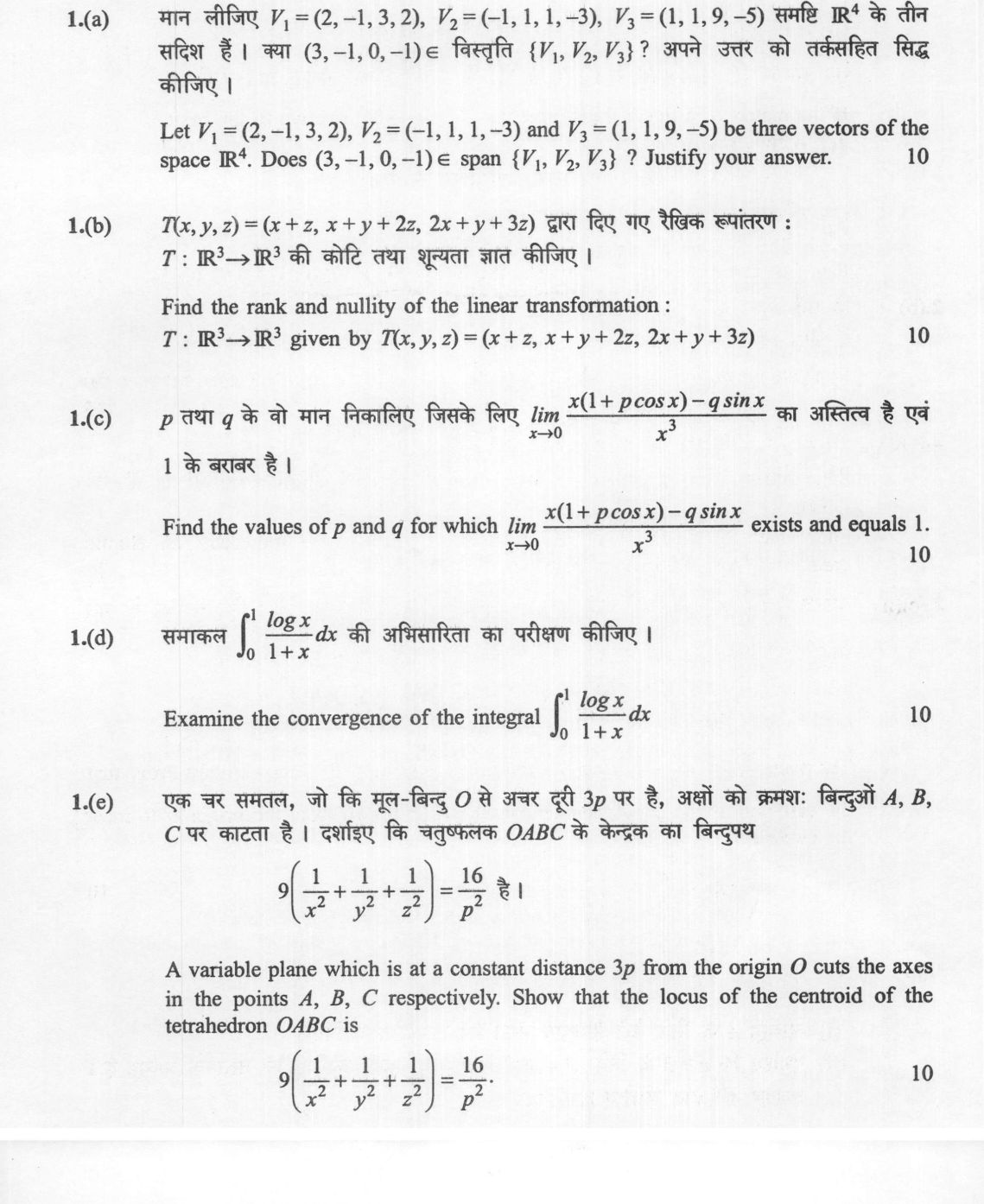
(a) Let V₁ = (2, -1, 3, 2), V₂ = (-1, 1, 1, -3) and V₃ = (1, 1, 9, -5) be three vectors of the space ℝ⁴. Does (3, -1, 0, -1) ∈…
Let V₁ = (2, -1, 3, 2), V₂ = (-1, 1, 1, -3) and V₃ = (1, 1, 9, -5) be three vectors of the space ℝ⁴. Does (3, -1, 0, -1) ∈ span {V₁, V₂, V₃} ? Justify your answer. 10 marks
Find the rank and nullity of the linear transformation : T : ℝ³ → ℝ³ given by T(x, y, z) = (x + z, x + y + 2z, 2x + y + 3z) 10 marks
Find the values of p and q for which limₓ→₀ [x(1 + p cos x) - q sin x]/x³ exists and equals 1. 10 marks
Examine the convergence of the integral ∫₀¹ (log x)/(1+x) dx 10 marks
A variable plane which is at a constant distance 3p from the origin O cuts the axes in the points A, B, C respectively. Show that the locus of the centroid of the tetrahedron OABC is 9(1/x² + 1/y² + 1/z²) = 16/p². 10 marks
हिंदी में प्रश्न पढ़ें
मान लीजिए V₁ = (2, -1, 3, 2), V₂ = (-1, 1, 1, -3), V₃ = (1, 1, 9, -5) समष्टि ℝ⁴ के तीन सदिश हैं । क्या (3, -1, 0, -1) ∈ विस्तृति {V₁, V₂, V₃} ? अपने उत्तर को तर्कसहित सिद्ध कीजिए । (10 अंक)
T(x, y, z) = (x + z, x + y + 2z, 2x + y + 3z) द्वारा दिए गए रैखिक रूपांतरण : T : ℝ³ → ℝ³ की कोटि तथा शून्यता ज्ञात कीजिए । (10 अंक)
p तथा q के वो मान निकालिए जिसके लिए limₓ→₀ [x(1 + p cos x) - q sin x]/x³ का अस्तित्व है एवं 1 के बराबर है । (10 अंक)
समाकल ∫₀¹ (log x)/(1+x) dx की अभिसारिता का परीक्षण कीजिए । (10 अंक)
एक चर समतल, जो कि मूल-बिंदु O से अचर दूरी 3p पर है, अक्षों को क्रमशः बिंदुओं A, B, C पर काटता है । दर्शाइए कि चतुष्फलक OABC के केंद्रक का बिंदुपथ 9(1/x² + 1/y² + 1/z²) = 16/p² है । (10 अंक)
Model answer
Written by UPSC Answer Check against this question's marking rubric, to the expected length. UPSC does not publish answers for Mains — this is one way to score well, not an official key.
(a) Let w = (3, −1, 0, −1). Suppose w ∈ span {V₁, V₂, V₃}. Then there exist real numbers α, β, γ such that αV₁ + βV₂ + γV₃ = w. Equating coordinates gives the system 2α − β + γ = 3 −α + β + γ = −1 3α + β + 9γ = 0 2α − 3β − 5γ = −1
From the second equation, β = α − γ − 1. Substituting in the first equation: 2α − (α − γ − 1) + γ = 3 ⇒ α + 2γ = 2. Substituting in the third equation: 3α + (α − γ − 1) + 9γ = 0 ⇒ 4α + 8γ − 1 = 0 ⇒ 4(α + 2γ) = 1. But α + 2γ = 2 gives 4(α + 2γ) = 8, not 1. Hence the system is inconsistent. Therefore no such α, β, γ exist. So (3, −1, 0, −1) is not in span {V₁, V₂, V₃}.
(b) The standard matrix of T : ℝ³ → ℝ³ is A = [1 0 1] [1 1 2] [2 1 3]
Use row reduction. R₂ → R₂ − R₁, R₃ → R₃ − 2R₁: [1 0 1] [0 1 1] [0 1 1]
Then R₃ → R₃ − R₂: [1 0 1] [0 1 1] [0 0 0]
There are two nonzero rows, so rank(T) = 2. By the rank-nullity theorem for T : ℝ³ → ℝ³, nullity(T) = dim ℝ³ − rank(T) = 3 − 2 = 1.
For the kernel, solve T(x, y, z) = (0, 0, 0): x + z = 0 x + y + 2z = 0 2x + y + 3z = 0
From x + z = 0, z = −x. Then x + y + 2(−x) = 0 gives y = x. The third equation is then automatically satisfied. Hence ker T = {t(1, 1, −1) : t ∈ ℝ}. Therefore rank = 2 and nullity = 1.
(c) Let N(x) = x(1 + p cos x) − q sin x. Use the Taylor expansions cos x = 1 − x²/2 + x⁴/24 − ⋯ sin x = x − x³/6 + x⁵/120 − ⋯
Then x(1 + p cos x) = x + p x cos x = x + p(x − x³/2 + x⁵/24 − ⋯) = (1 + p)x − (p/2)x³ + (p/24)x⁵ − ⋯
Also q sin x = qx − (q/6)x³ + (q/120)x⁵ − ⋯
Therefore N(x) = (1 + p − q)x + (−p/2 + q/6)x³ + (p/24 − q/120)x⁵ + ⋯
For limₓ→₀ N(x)/x³ to exist finitely, the coefficient of x must vanish: 1 + p − q = 0 ⇒ q = 1 + p.
For the limit to equal 1, the coefficient of x³ must be 1: −p/2 + q/6 = 1.
Substitute q = 1 + p: −p/2 + (1 + p)/6 = 1 Multiply by 6: −3p + 1 + p = 6 ⇒ −2p = 5 ⇒ p = −5/2.
Then q = 1 + p = 1 − 5/2 = −3/2.
Thus p = −5/2 and q = −3/2.
(d) Consider I = ∫₀¹ (log x)/(1 + x) dx. The integrand has a logarithmic singularity at x = 0. For 0 < x ≤ 1, |(log x)/(1 + x)| = (−log x)/(1 + x) ≤ −log x.
Now ∫₀¹ (−log x) dx = [x − x log x]₀¹ = 1, since x log x → 0 as x → 0⁺. By the comparison test for improper integrals, ∫₀¹ |(log x)/(1 + x)| dx converges. Hence the given integral converges absolutely.
Its value may also be found by using 1/(1 + x) = 1 − x + x² − x³ + ⋯. For n ≥ 0, ∫₀¹ xⁿ log x dx = −1/(n + 1)². Therefore I = −Σₙ₌₀∞ (−1)ⁿ/(n + 1)² = −(1 − 1/2² + 1/3² − 1/4² + ⋯) = −π²/12.
So the integral converges absolutely, and its value is −π²/12.
(e) Let the plane cut the coordinate axes at A = (a, 0, 0), B = (0, b, 0), C = (0, 0, c). Its intercept form is x/a + y/b + z/c = 1.
The perpendicular distance from the origin O to this plane is d = 1 / √(1/a² + 1/b² + 1/c²). Given that this distance is 3p, 1 / √(1/a² + 1/b² + 1/c²) = 3p ⇒ 1/a² + 1/b² + 1/c² = 1/(9p²).
The centroid G of the tetrahedron OABC is G = (O + A + B + C)/4 = (a/4, b/4, c/4). Let G = (x, y, z). Then a = 4x, b = 4y, c = 4z.
Substitute these into the distance condition: 1/(4x)² + 1/(4y)² + 1/(4z)² = 1/(9p²) ⇒ (1/16)(1/x² + 1/y² + 1/z²) = 1/(9p²).
Multiplying by 16, 1/x² + 1/y² + 1/z² = 16/(9p²). Multiplying by 9, 9(1/x² + 1/y² + 1/z²) = 16/p².
Hence the locus of the centroid is exactly 9(1/x² + 1/y² + 1/z²) = 16/p². This holds for p > 0 and x, y, z ≠ 0.
What "Solve" is asking you to do
Choose the method, then carry it through to a final answer. Identifying what kind of problem this is and why that method applies is the first thing marked; a correct figure arrived at invisibly earns almost nothing.
Structure that answers it
Given data and what is required → method chosen, with the reason it applies → set-up (equation, circuit, free body, trial balance) → working, step by step → answer with units and any condition of validity
Where marks are lost
Doing the middle steps mentally and writing only the result. In mathematics papers, a further loss comes from giving a decimal where the exact value in surds or fractions was wanted, or from skipping the justification a part explicitly asks for.
How this answer will be evaluated
Approach
(a) justify: claim > 3-4 reasons > evidence > conclusion | (b) calculate: given > formula > substitution > result with units > interpretation | (c) calculate: given > formula > substitution > result with units > interpretation | (d) examine: intro > how/why with reasoning > evidence > conclusion | (e) derive: given > assumptions > stepwise derivation > result > check Full marks: Complete stepwise derivation with named theorems and verification.
Key points expected
- Set up linear combination equation
- Formulate system of linear equations
- Solve system (e.g., Gaussian elimination)
- State conclusion based on consistency
- Write standard matrix of T
- Calculate rank of matrix
- Apply Rank-Nullity Theorem
- State final rank and nullity
Evaluation rubric
Each sub-part is marked on its own, against the marks and word limit printed on the paper.
- (a) Determine if the vector is in the span of the given set. 10 marks
justify— claim → 3-4 reasons → evidence → conclusion
Must cover
- Set up linear combination equation
- Formulate system of linear equations
- Solve system (e.g., Gaussian elimination)
- State conclusion based on consistency
Loses marks
- Answer without working
- Skipping intermediate steps
Earns more
- Explicitly check for consistency
- Show row reduction steps
Extra mark
- Alternative method noted
- (b) Find the rank and nullity of the linear transformation. 10 marks
calculate— given → formula → substitution → result with units → interpretation
Must cover
- Write standard matrix of T
- Calculate rank of matrix
- Apply Rank-Nullity Theorem
- State final rank and nullity
Loses marks
- Answer without working
- Skipping intermediate steps
Earns more
- State Rank-Nullity Theorem by name
- Show row reduction for rank
Extra mark
- Alternative method noted
- (c) Find values of p and q for the limit to equal 1. 10 marks
calculate— given → formula → substitution → result with units → interpretation
Must cover
- Expand numerator using Taylor series
- Equate coefficients of x and x^2 to zero
- Equate coefficient of x^3 to 1
- Solve for p and q
Loses marks
- Answer without working
- Skipping intermediate steps
Earns more
- State Taylor series used
- Show stepwise simplification
Extra mark
- Alternative method noted
- (d) Examine the convergence of the improper integral. 10 marks
examine— intro → how/why with reasoning → evidence → conclusion
Must cover
- Identify singularity at x=0
- Apply limit comparison test
- Compare with known convergent integral
- State conclusion on convergence
Loses marks
- Answer without working
- Skipping intermediate steps
Earns more
- State comparison test by name
- Show limit calculation
Extra mark
- Alternative method noted
- (e) Show the locus of the centroid of the tetrahedron. 10 marks
derive— given → assumptions → stepwise derivation → result → check
Must cover
- Write equation of variable plane
- Find intercepts A, B, C
- Find coordinates of centroid
- Substitute into distance formula to derive locus
Loses marks
- Answer without working
- Skipping intermediate steps
Earns more
- State distance formula used
- Show stepwise algebraic manipulation
Extra mark
- Neat figure of tetrahedron
Practice this exact question
Write your answer and it is marked point by point against the model answer above — what you covered, what you missed, what you got wrong.
Evaluate my answer →More from Mathematics 2023 Paper I
- Q1 (a) Let V₁ = (2, -1, 3, 2), V₂ = (-1, 1, 1, -3) and V₃ = (1, 1, 9, -5) be three vectors o…
- Q2 (a) If the matrix of a linear transformation T : IR³→IR³ relative to the basis (1, 0, 0),…
- Q3 Let A = 1 & 0 & 0 1 & 0 & 1 0 & 1 & 0 (i) Verify the Cayley-Hamilton theorem for the matr…
- Q4 Find the rank of the matrix A = 1 & 2 & -1 & 0 -1 & 3 & 0 & -4 2 & 1 & 3 & -2 1 & 1 & 1 &…