Paper I — Q4
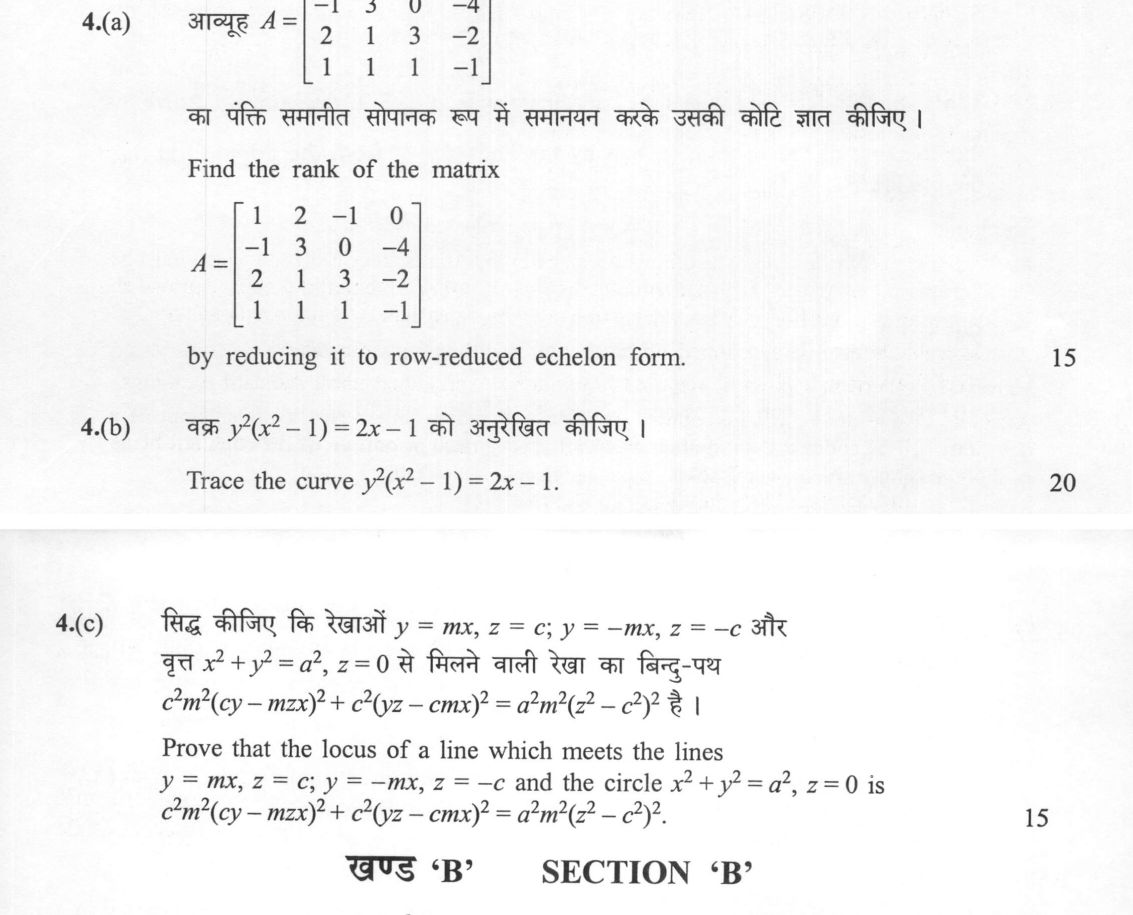
Find the rank of the matrix A = 1 & 2 & -1 & 0 -1 & 3 & 0 & -4 2 & 1 & 3 & -2 1 & 1 & 1 & -1 by reducing it to row-reduced…
Find the rank of the matrix
A = 1 & 2 & -1 & 0 -1 & 3 & 0 & -4 2 & 1 & 3 & -2 1 & 1 & 1 & -1
by reducing it to row-reduced echelon form. 15 marks
Trace the curve y²(x² - 1) = 2x - 1. 20 marks
Prove that the locus of a line which meets the lines y = mx, z = c; y = -mx, z = -c and the circle x² + y² = a², z = 0 is c²m²(cy - mzx)² + c²(yz - cmx)² = a²m²(z² - c²)². 15 marks
हिंदी में प्रश्न पढ़ें
आव्यूह A = 1 & 2 & -1 & 0 -1 & 3 & 0 & -4 2 & 1 & 3 & -2 1 & 1 & 1 & -1
का पंक्ति समानतित सोपानक रूप में समान्यन करके उसकी कोटि ज्ञात कीजिए। 15
वक्र y²(x² - 1) = 2x - 1 को अनुरेखित कीजिए। 20
सिद्ध कीजिए कि रेखाओं y = mx, z = c; y = -mx, z = -c और वृत्त x² + y² = a², z = 0 से मिलने वाली रेखा का विद्यु-पथ c²m²(cy - mzx)² + c²(yz - cmx)² = a²m²(z² - c²)² है। 15
Model answer
Written by UPSC Answer Check against this question's marking rubric, to the expected length. UPSC does not publish answers for Mains — this is one way to score well, not an official key.
(a) Use Gaussian elimination to reduce A to row-reduced echelon form.
A = [1 2 -1 0; -1 3 0 -4; 2 1 3 -2; 1 1 1 -1].
Apply:
- R2 → R2 + R1 = (0,5,-1,-4)
- R3 → R3 − 2R1 = (0,-3,5,-2)
- R4 → R4 − R1 = (0,-1,2,-1)
Now swap R2 and R4: [1 2 -1 0; 0 -1 2 -1; 0 -3 5 -2; 0 5 -1 -4].
Then R2 → −R2: [1 2 -1 0; 0 1 -2 1; 0 -3 5 -2; 0 5 -1 -4].
Eliminate the second column:
- R1 → R1 − 2R2 = (1,0,3,-2)
- R3 → R3 + 3R2 = (0,0,-1,1)
- R4 → R4 − 5R2 = (0,0,9,-9)
So: [1 0 3 -2; 0 1 -2 1; 0 0 -1 1; 0 0 9 -9].
Now R3 → −R3 = (0,0,1,-1). Eliminate the third column:
- R1 → R1 − 3R3 = (1,0,0,1)
- R2 → R2 + 2R3 = (0,1,0,-1)
- R4 → R4 − 9R3 = (0,0,0,0)
Hence the row-reduced echelon form is [1 0 0 1; 0 1 0 -1; 0 0 1 -1; 0 0 0 0].
There are 3 non-zero rows. Therefore rank(A) = 3.
(b) The curve is y²(x² − 1) = 2x − 1.
Since only y² appears, the curve is symmetric about the x-axis.
Write y² = (2x − 1)/(x² − 1).
Intercepts:
- On the x-axis, y = 0 gives 2x − 1 = 0, so x = 1/2. Point: (1/2,0).
- On the y-axis, x = 0 gives −y² = −1, so y = ±1. Points: (0,±1).
Asymptotes:
- x = 1 and x = −1 make the denominator zero while the numerator is non-zero, so these are vertical asymptotes.
- As x → +∞, y² = (2x − 1)/(x² − 1) → 0, so y = 0 is a horizontal asymptote in the positive x-direction.
Region of existence: y² ≥ 0. The quotient is positive only for −1 < x ≤ 1/2 or x > 1. There is no real curve for x < −1 or 1/2 < x < 1.
Monotonicity: Let q(x) = (2x − 1)/(x² − 1). Then q′(x) = [2(x² − 1) − (2x − 1)2x]/(x² − 1)² = (−2x² + 2x − 2)/(x² − 1)² = −2(x² − x + 1)/(x² − 1)². But x² − x + 1 = (x − 1/2)² + 3/4 > 0, so q′(x) < 0 wherever defined. Thus |y| decreases on each interval.
Trace:
- For −1 < x ≤ 1/2, the curve comes from x = −1 with y → ±∞, passes through (0,±1), and meets the x-axis at (1/2,0) with a vertical tangent.
- For x > 1, the curve comes from x = 1 with y → ±∞ and tends to the x-axis y = 0 as x → +∞.
- The upper and lower halves are mirror images about the x-axis.
- The vertical lines x = −1 and x = 1 are asymptotes, and the x-axis is an asymptote for the right branch as x → +∞.
Thus the curve consists of two symmetric branches, one between x = −1 and x = 1/2, and the other for x > 1.
(c) Let the variable line meet L1: y = mx, z = c at P = (p, mp, c) and L2: y = −mx, z = −c at Q = (q, −mq, −c).
Let R = (x,y,z) be any point on the line PQ. Then R = P + t(Q − P).
Since z = c(1 − 2t), we get t = (c − z)/(2c), 1 − t = (c + z)/(2c).
Put S = p + q and D = p − q. Then 2cx = cS + zD, 2cy/m = zS + cD.
Solving these two equations: S = 2c(cmx − zy)/(m(c² − z²)), D = 2c(cy − mzx)/(m(c² − z²)).
The line meets the circle x² + y² = a², z = 0 at the point where t = 1/2. At z = 0, the coordinates of intersection are x₀ = S/2, y₀ = mD/2. Since this point lies on the circle, (S/2)² + (mD/2)² = a², so S² + m²D² = 4a².
Substitute the values of S and D: 4c²(cmx − zy)²/[m²(c² − z²)²] + 4c²(cy − mzx)²/(c² − z²)² = 4a².
Multiplying by m²(c² − z²)² gives c²(cmx − zy)² + c²m²(cy − mzx)² = a²m²(c² − z²)².
Since (cmx − zy)² = (yz − cmx)² and (c² − z²)² = (z² − c²)², this becomes c²m²(cy − mzx)² + c²(yz − cmx)² = a²m²(z² − c²)².
This is exactly the required locus equation.
What "Solve" is asking you to do
Choose the method, then carry it through to a final answer. Identifying what kind of problem this is and why that method applies is the first thing marked; a correct figure arrived at invisibly earns almost nothing.
Structure that answers it
Given data and what is required → method chosen, with the reason it applies → set-up (equation, circuit, free body, trial balance) → working, step by step → answer with units and any condition of validity
Where marks are lost
Doing the middle steps mentally and writing only the result. In mathematics papers, a further loss comes from giving a decimal where the exact value in surds or fractions was wanted, or from skipping the justification a part explicitly asks for.
How this answer will be evaluated
Approach
(a) calculate: given > formula > substitution > result with units > interpretation | (b) trace: start point > the stages in sequence > end point > what changed | (c) justify: claim > 3-4 reasons > evidence > conclusion Full marks: Complete working, correct results, clear presentation, and verification steps.
Key points expected
- Perform elementary row operations to reach RREF
- Show intermediate matrices or steps clearly
- Count non-zero rows to determine rank
- State the final rank explicitly
- Determine domain of x (where 2x-1 ≥ 0)
- Find x and y intercepts
- Analyze symmetry and asymptotes
- Sketch the curve with key features labeled
Evaluation rubric
Each sub-part is marked on its own, against the marks and word limit printed on the paper.
- (a) Determine the rank of the given 4x4 matrix via row-reduced echelon form. 15 marks
calculate— given → formula → substitution → result with units → interpretation
Must cover
- Perform elementary row operations to reach RREF
- Show intermediate matrices or steps clearly
- Count non-zero rows to determine rank
- State the final rank explicitly
Loses marks
- Skipping intermediate row operation steps
- Arithmetic errors in row reduction
- Stating rank without showing RREF
Earns more
- Verify rank by checking minors of that order
- Identify pivot columns correctly
Extra mark
- Mention determinant is zero for rank < 4
- (b) Analyze and sketch the curve defined by y²(x² - 1) = 2x - 1. 20 marks
trace— start point → the stages in sequence → end point → what changed
Must cover
- Determine domain of x (where 2x-1 ≥ 0)
- Find x and y intercepts
- Analyze symmetry and asymptotes
- Sketch the curve with key features labeled
Loses marks
- Missing domain analysis
- Incorrect or missing sketch
- Failing to identify asymptotes
Earns more
- Calculate turning points via differentiation
- Analyze behavior at infinity
Extra mark
- Provide a neat, labeled diagram
- (c) Prove the equation of the locus of a line meeting two given lines and a circle. 15 marks
justify— claim → 3-4 reasons → evidence → conclusion
Must cover
- Define the general equation of the line
- Apply intersection conditions with the two given lines
- Apply intersection condition with the circle
- Derive the final locus equation algebraically
Loses marks
- Skipping algebraic derivation steps
- Incorrect application of intersection conditions
- Failing to reach the exact given equation
Earns more
- Use vector or parametric form for the line
- Clearly state the geometric conditions used
Extra mark
- Geometric interpretation of the locus
Practice this exact question
Write your answer and it is marked point by point against the model answer above — what you covered, what you missed, what you got wrong.
Evaluate my answer →More from Mathematics 2023 Paper I
- Q1 (a) Let V₁ = (2, -1, 3, 2), V₂ = (-1, 1, 1, -3) and V₃ = (1, 1, 9, -5) be three vectors o…
- Q2 (a) If the matrix of a linear transformation T : IR³→IR³ relative to the basis (1, 0, 0),…
- Q3 Let A = 1 & 0 & 0 1 & 0 & 1 0 & 1 & 0 (i) Verify the Cayley-Hamilton theorem for the matr…
- Q4 Find the rank of the matrix A = 1 & 2 & -1 & 0 -1 & 3 & 0 & -4 2 & 1 & 3 & -2 1 & 1 & 1 &…
- Q5 (a) Obtain the solution of the initial-value problem dy/dx - 2xy = 2, y(0) = 1 in the for…
- Q6 (a) Solve the differential equation: d³y/dx³ - 3d²y/dx² + 4dy/dx - 2y = eˣ + cos x. (15 m…
- Q7 (a)(i) Find the solution of the differential equation : dy/dx=-(2xy³+2)/(3x^2y²+8e^4y) 10…