Paper I — Q5
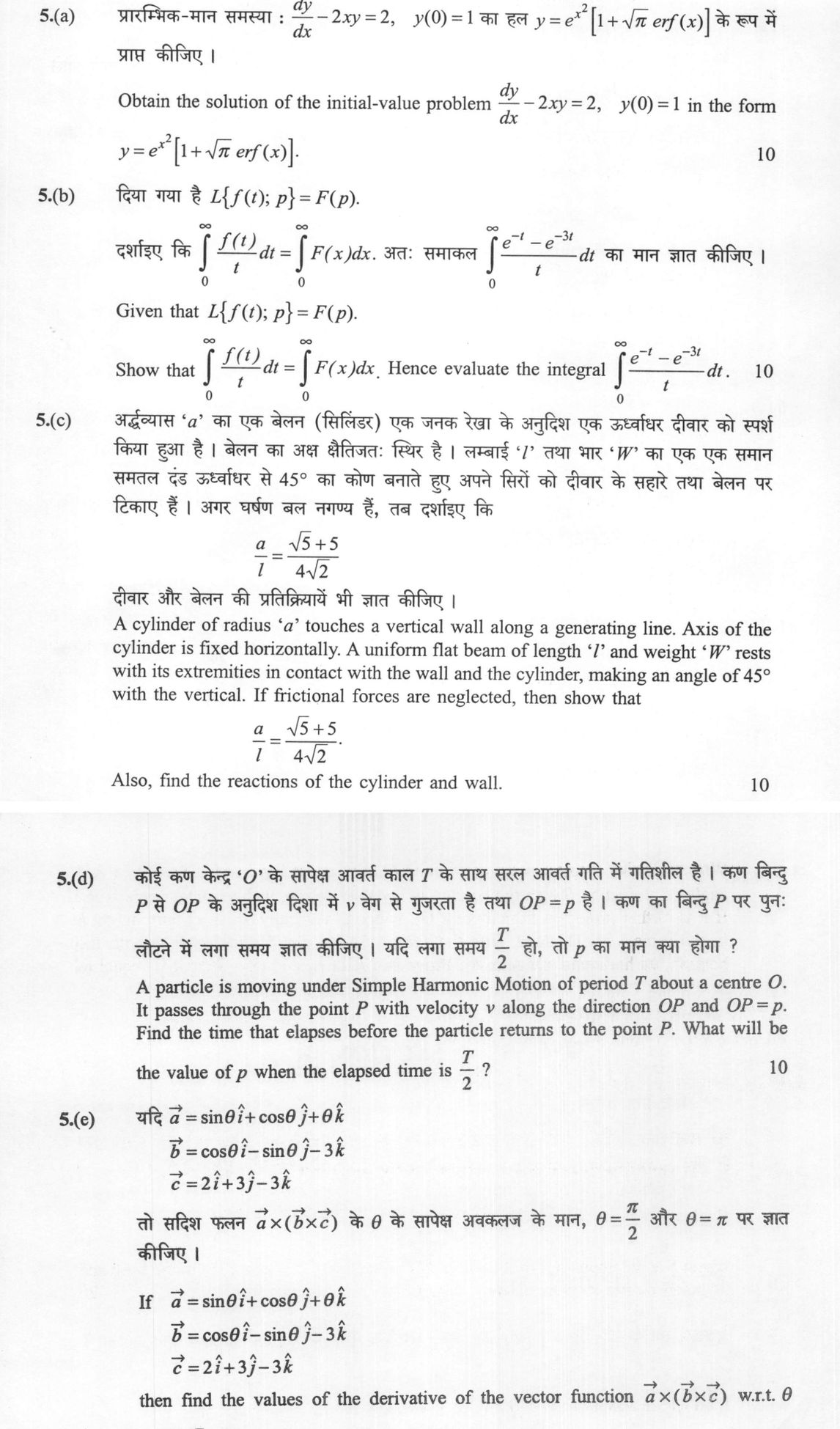
(a) Obtain the solution of the initial-value problem dy/dx - 2xy = 2, y(0) = 1 in the form y = eˣ²[1 + √π erf(x)]. (10…
Obtain the solution of the initial-value problem dy/dx - 2xy = 2, y(0) = 1 in the form y = eˣ²[1 + √π erf(x)]. 10 marks
Given that L{f(t); p} = F(p). Show that ∫₀^∞ f(t)/t dt = ∫₀^∞ F(x)dx. Hence evaluate the integral ∫₀^∞ (e⁻ᵗ - e⁻³ᵗ)/t dt. 10 marks
A cylinder of radius 'a' touches a vertical wall along a generating line. Axis of the cylinder is fixed horizontally. A uniform flat beam of length 'l' and weight 'W' rests with its extremities in contact with the wall and the cylinder, making an angle of 45° with the vertical. If frictional forces are neglected, then show that a/l = (√5 + 5)/(4√2). Also, find the reactions of the cylinder and wall. 10 marks
A particle is moving under Simple Harmonic Motion of period T about a centre O. It passes through the point P with velocity v along the direction OP and OP = p. Find the time that elapses before the particle returns to the point P. What will be the value of p when the elapsed time is T/2 ? 10 marks
If ā = sinθî + cosθĵ + θk̂, b̄ = cosθî - sinθĵ - 3k̂, c̄ = 2î + 3ĵ - 3k̂, then find the values of the derivative of the vector function ā × (b̄ × c̄) w.r.t. θ at θ = π/2 and θ = π. 10 marks
हिंदी में प्रश्न पढ़ें
प्रारंभिक-मान समस्या : dy/dx - 2xy = 2, y(0) = 1 का हल y = eˣ²[1 + √π erf(x)] के रूप में प्राप्त कीजिए। (10 अंक)
दिया गया है L{f(t); p} = F(p). दर्शाइए कि ∫₀^∞ f(t)/t dt = ∫₀^∞ F(x)dx. अतः समाकल ∫₀^∞ (e⁻ᵗ - e⁻³ᵗ)/t dt का मान ज्ञात कीजिए। (10 अंक)
अर्ध्व्यास 'a' का एक बेलन (सिलिंडर) एक जनक रेखा के अनुदिश एक उद्वाधर दीवार को स्पर्श किया हुआ है। बेलन का अक्ष क्षैतिजतः स्थिर है। लम्बाई 'l' तथा भार 'W' का एक एक समान समतल दंड उद्वाधर से 45° का कोण बनाते हुए अपने सिरों को दीवार के सहारे तथा बेलन पर टिकाए है। अगर घर्षण बल नगण्य हैं, तब दर्शाइए कि a/l = (√5 + 5)/(4√2). दीवार और बेलन की प्रतिक्रियाएँ भी ज्ञात कीजिए। (10 अंक)
कोई कण केन्द्र 'O' के सापेक्ष आवर्त काल T के साथ सरल आवर्त गति में गतिशील है। कण बिन्दु P से OP के अनुदिश दिशा में v वेग से गुजरता है तथा OP = p है। कण का बिन्दु P पर पुनः लौटने में लगा समय ज्ञात कीजिए। यदि लगा समय T/2 हो, तो p का मान क्या होगा ? (10 अंक)
यदि ā = sinθî + cosθĵ + θk̂, b̄ = cosθî - sinθĵ - 3k̂, c̄ = 2î + 3ĵ - 3k̂, तो सदिश फलन ā × (b̄ × c̄) के θ के सापेक्ष अवकलज के मान, θ = π/2 और θ = π पर ज्ञात कीजिए। (10 अंक)
Model answer
Written by UPSC Answer Check against this question's marking rubric, to the expected length. UPSC does not publish answers for Mains — this is one way to score well, not an official key.
(a) The equation is linear: dy/dx - 2xy = 2. Integrating factor: μ = e^(∫ -2x dx) = e^(-x²).
Multiply the equation by e^(-x²): d/dx [y e^(-x²)] = 2 e^(-x²).
Integrate: y e^(-x²) = ∫ 2 e^(-x²) dx + C.
Since erf(x) = (2/√π) ∫₀ˣ e^(-t²) dt, we have ∫ 2 e^(-x²) dx = √π erf(x) + C.
Thus y e^(-x²) = √π erf(x) + C, so y = e^(x²)[√π erf(x) + C].
Using y(0)=1 and erf(0)=0: 1 = e⁰[0 + C] = C. Hence C = 1.
Final answer: y = e^(x²)[1 + √π erf(x)].
(b) Given L{f(t); p} = F(p), where F(p) = ∫₀^∞ e^(-pt) f(t) dt.
Using the standard Laplace-transform property for division by t: L{f(t)/t; p} = ∫_p^∞ F(x) dx.
Proof: ∫_p^∞ F(x) dx = ∫_p^∞ ∫₀^∞ e^(-xt) f(t) dt dx. Interchanging the order of integration, = ∫₀^∞ f(t) [∫_p^∞ e^(-xt) dx] dt = ∫₀^∞ f(t) e^(-pt)/t dt = L{f(t)/t; p}.
Putting p = 0 gives ∫₀^∞ f(t)/t dt = ∫₀^∞ F(x) dx.
Now take f(t) = e^(-t) - e^(-3t). Then F(x) = 1/(x+1) - 1/(x+3).
Therefore, ∫₀^∞ (e^(-t) - e^(-3t))/t dt = ∫₀^∞ [1/(x+1) - 1/(x+3)] dx = [ln((x+1)/(x+3))]₀^∞ = 0 - ln(1/3) = ln 3.
Final answer: ln 3.
(c) Let the vertical wall be x = 0. In cross-section, the cylinder is a circle of radius a with centre C = (a, 0). Let the beam touch the wall at A and the cylinder at B. Take the beam sloping downward from the wall to the cylinder. Let B = (l/√2, y). Then A = (0, y + l/√2).
Let r = a/l. Since friction is neglected, the reaction at A is horizontal, and the reaction at B is along the radius CB. The weight W acts vertically through the midpoint M.
For equilibrium of three forces, their lines of action must be concurrent. The weight acts through M = (l/(2√2), y + l/(2√2)). The wall reaction is horizontal through A, so the intersection point is Q = (l/(2√2), y + l/√2).
Since Q lies on CB, vectors BQ and CB are collinear: (B - Q) × (C - B) = 0.
Here B - Q = (l/(2√2), -l/√2), C - B = (a - l/√2, -y).
Thus (l/(2√2))(-y) - (-l/√2)(a - l/√2) = 0, which simplifies to y = 2a - √2 l.
Also B lies on the circle: (l/√2 - a)² + y² = a².
Substitute y = 2a - √2 l. Dividing throughout by l² and writing r = a/l, (1/√2 - r)² + (2r - √2)² = r².
Let d = r - 1/√2. Then d² + 4d² = r², so 5d² = r².
Since r > 1/√2, we take √5(r - 1/√2) = r. Hence r(√5 - 1) = √5/√2, so r = √5/[√2(√5 - 1)] = (5 + √5)/(4√2).
Therefore, a/l = (√5 + 5)/(4√2).
Now let R_c be the cylinder reaction. Its direction is along C → B. The unit normal is (-î + 2ĵ)/√5. Let R_c = k(-î + 2ĵ)/√5.
Vertical equilibrium: 2k/√5 = W, so k = W√5/2. Thus the cylinder reaction has magnitude R_c = W√5/2, with horizontal component W/2 toward the wall and vertical component W upward.
Horizontal equilibrium gives the wall reaction R_w: R_w - W/2 = 0, so R_w = W/2.
Final answers: cylinder reaction = W√5/2, directed along (-î + 2ĵ)/√5; wall reaction = W/2, directed away from the wall.
(d) Let the SHM be x = A sin(ωt + α), where ω = 2π/T.
At t = 0, the particle is at P, so x = p and velocity is v along OP. Hence p = A sin α, v = Aω cos α. Therefore tan α = pω/v = 2πp/(vT).
The particle next returns to P with velocity reversed when the phase becomes π - α. Hence the time elapsed is τ = (π - 2α)/ω = T/2 - (T/π) tan⁻¹(2πp/(vT)).
If τ = T/2, then T/2 = T/2 - (T/π) tan⁻¹(2πp/(vT)), so tan⁻¹(2πp/(vT)) = 0. Thus 2πp/(vT) = 0, giving p = 0.
Final answers: time = T/2 - (T/π) tan⁻¹(2πp/(vT)); when time = T/2, p = 0.
(e) Use the vector triple product identity: ā × (b̄ × c̄) = (ā·c̄)b̄ - (ā·b̄)c̄.
Given ā = sinθ î + cosθ ĵ + θ k̂, b̄ = cosθ î - sinθ ĵ - 3k̂, c̄ = 2î + 3ĵ - 3k̂.
Compute: ā·b̄ = sinθ cosθ - cosθ sinθ - 3θ = -3θ, ā·c̄ = 2 sinθ + 3 cosθ - 3θ.
Therefore, V(θ) = ā × (b̄ × c̄) = (2 sinθ + 3 cosθ - 3θ)b̄ + 3θ c̄.
Differentiate with respect to θ: V'(θ) = (2 cosθ - 3 sinθ - 3)b̄ + (2 sinθ + 3 cosθ - 3θ)(-sinθ î - cosθ ĵ) + 3(2î + 3ĵ - 3k̂).
At θ = π/2: sinθ = 1, cosθ = 0, b̄ = -ĵ - 3k̂. Thus V'(π/2) = -6(-ĵ - 3k̂) + (2 - 3π/2)(-î) + 6î + 9ĵ - 9k̂ = (4 + 3π/2)î + 15ĵ + 9k̂.
At θ = π: sinθ = 0, cosθ = -1, b̄ = -î - 3k̂. Thus V'(π) = -5(-î - 3k̂) + (-3 - 3π)ĵ + 6î + 9ĵ - 9k̂ = 11î + (6 - 3π)ĵ + 6k̂.
Final answers:
- At θ = π/2: V' = (4 + 3π/2)î + 15ĵ + 9k̂
- At θ = π: V' = 11î + (6 - 3π)ĵ + 6k̂
What "Solve" is asking you to do
Choose the method, then carry it through to a final answer. Identifying what kind of problem this is and why that method applies is the first thing marked; a correct figure arrived at invisibly earns almost nothing.
Structure that answers it
Given data and what is required → method chosen, with the reason it applies → set-up (equation, circuit, free body, trial balance) → working, step by step → answer with units and any condition of validity
Where marks are lost
Doing the middle steps mentally and writing only the result. In mathematics papers, a further loss comes from giving a decimal where the exact value in surds or fractions was wanted, or from skipping the justification a part explicitly asks for.
How this answer will be evaluated
Approach
Framework: UPSC Mathematics Paper 1. (a) derive: given > assumptions > stepwise derivation > result > check | (b) derive: given > assumptions > stepwise derivation > result > check | (c) derive: given > assumptions > stepwise derivation > result > check | (d) calculate: given > formula > substitution > result with units > interpretation | (e) calculate: given > formula > substitution > result with units > interpretation Full marks: All parts fully derived with correct methods, no errors, and clear presentation.
Key points expected
- Identifies integrating factor e^(-x^2)
- Integrates to get y = e^(x^2) ∫e^(-t^2)dt + C
- Applies y(0)=1 to determine constant C=1
- Expresses result using error function erf(x)
- Uses L{f(t)/t} = ∫₀^∞ F(x)dx property
- Justifies the interchange of integration order
- Identifies F(p) for f(t) = e^(-t) - e^(-3t)
- Evaluates ∫₀^∞ (1/(p+1) - 1/(p+3))dp
Evaluation rubric
Each sub-part is marked on its own, against the marks and word limit printed on the paper.
- (a) Solve the IVP dy/dx - 2xy = 2, y(0)=1 in the specified form. 10 marks
derive— given → assumptions → stepwise derivation → result → check
Must cover
- Identifies integrating factor e^(-x^2)
- Integrates to get y = e^(x^2) ∫e^(-t^2)dt + C
- Applies y(0)=1 to determine constant C=1
- Expresses result using error function erf(x)
Loses marks
- Incorrect integrating factor
- Failure to apply initial condition y(0)=1
- Algebraic errors in the final expression
Earns more
- Correct definition of erf(x) = (2/√π)∫₀ˣ e^(-t^2)dt
- Verification by differentiating the final solution
Extra mark
- Alternative method using variation of parameters
- (b) Prove the integral identity and evaluate the specific integral. 10 marks
derive— given → assumptions → stepwise derivation → result → check
Must cover
- Uses L{f(t)/t} = ∫₀^∞ F(x)dx property
- Justifies the interchange of integration order
- Identifies F(p) for f(t) = e^(-t) - e^(-3t)
- Evaluates ∫₀^∞ (1/(p+1) - 1/(p+3))dp
Loses marks
- Incorrect Laplace transform of f(t)
- Failure to justify the integral identity
- Calculation error in the final integral
Earns more
- Correct evaluation of the logarithmic integral
- Final answer ln(3)
Extra mark
- Alternative method using Frullani's integral
- (c) Show the ratio a/l and find the reactions of the cylinder and wall. 10 marks
derive— given → assumptions → stepwise derivation → result → check
Must cover
- Draws a free-body diagram of the beam
- Applies equilibrium of forces (ΣFx = 0, ΣFy = 0)
- Applies equilibrium of moments (ΣM = 0)
- Derives the ratio a/l = (√5 + 5)/(4√2)
Loses marks
- Incorrect free-body diagram
- Failure to apply moment equilibrium
- Algebraic errors in deriving the ratio
Earns more
- Correct calculation of reaction at the wall
- Correct calculation of reaction at the cylinder
Extra mark
- Alternative method using virtual work
- (d) Find the time to return to P and the value of p for T/2. 10 marks
calculate— given → formula → substitution → result with units → interpretation
Must cover
- Uses SHM equation x = A sin(ωt + φ)
- Relates velocity v to position p and amplitude A
- Calculates the time interval for return to P
- Finds p when elapsed time is T/2
Loses marks
- Incorrect SHM equation
- Failure to relate v, p, and A
- Calculation error in the time interval
Earns more
- Correct expression for time interval
- Correct value of p for T/2
Extra mark
- Alternative method using energy conservation
- (e) Find the derivative of the vector function at θ = π/2 and θ = π. 10 marks
calculate— given → formula → substitution → result with units → interpretation
Must cover
- Calculates b × c first
- Calculates a × (b × c) using vector triple product
- Differentiates the resulting vector function w.r.t. θ
- Evaluates the derivative at θ = π/2 and θ = π
Loses marks
- Incorrect vector triple product
- Differentiation error in any component
- Evaluation error at the specified angles
Earns more
- Correct vector triple product expansion
- Correct differentiation of each component
Extra mark
- Alternative method using component-wise differentiation
Practice this exact question
Write your answer and it is marked point by point against the model answer above — what you covered, what you missed, what you got wrong.
Evaluate my answer →More from Mathematics 2023 Paper I
- Q2 (a) If the matrix of a linear transformation T : IR³→IR³ relative to the basis (1, 0, 0),…
- Q3 Let A = 1 & 0 & 0 1 & 0 & 1 0 & 1 & 0 (i) Verify the Cayley-Hamilton theorem for the matr…
- Q4 Find the rank of the matrix A = 1 & 2 & -1 & 0 -1 & 3 & 0 & -4 2 & 1 & 3 & -2 1 & 1 & 1 &…
- Q5 (a) Obtain the solution of the initial-value problem dy/dx - 2xy = 2, y(0) = 1 in the for…
- Q6 (a) Solve the differential equation: d³y/dx³ - 3d²y/dx² + 4dy/dx - 2y = eˣ + cos x. (15 m…
- Q7 (a)(i) Find the solution of the differential equation : dy/dx=-(2xy³+2)/(3x^2y²+8e^4y) 10…
- Q8 (a) Solve the following initial value problem by using Laplace transform technique : (d^2…