Paper I — Q7
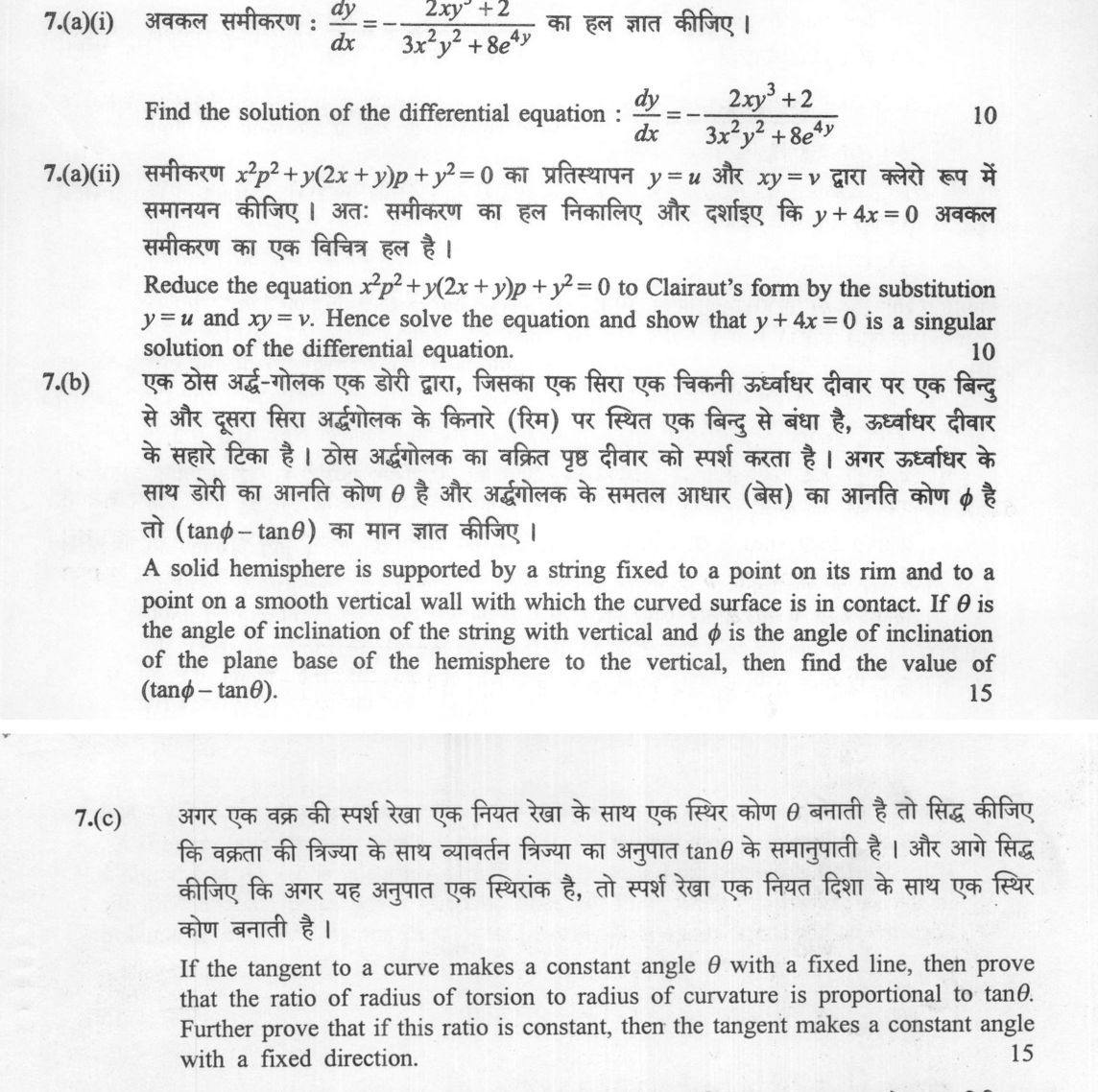
(a)(i) Find the solution of the differential equation : dy/dx=-(2xy³+2)/(3x^2y²+8e^4y) 10 (a)(ii) Reduce the equation…
Find the solution of the differential equation : dy/dx=-(2xy³+2)/(3x^2y²+8e^4y) 10 marks
Reduce the equation x^2p²+y(2x+y)p+y²=0 to Clairaut's form by the substitution y=u and xy=v. Hence solve the equation and show that y+4x=0 is a singular solution of the differential equation. 10 marks
A solid hemisphere is supported by a string fixed to a point on its rim and to a point on a smooth vertical wall with which the curved surface is in contact. If θ is the angle of inclination of the string with vertical and φ is the angle of inclination of the plane base of the hemisphere to the vertical, then find the value of (tanφ-tanθ). 15 marks
If the tangent to a curve makes a constant angle θ with a fixed line, then prove that the ratio of radius of torsion to radius of curvature is proportional to tanθ. Further prove that if this ratio is constant, then the tangent makes a constant angle with a fixed direction. 15 marks
हिंदी में प्रश्न पढ़ें
अवकल समीकरण : dy/dx=-(2xy³+2)/(3x^2y²+8e^4y) का हल ज्ञात कीजिए। 10
समीकरण x^2p²+y(2x+y)p+y²=0 का प्रतिस्थापन y=u और xy=v द्वारा क्लेरो रूप में समान्यन कीजिए। अतः समीकरण का हल निकालिए और दर्शाइए कि y+4x=0 अवकल समीकरण का एक विचित्र हल है। 10
एक ठोस अर्ध-गोलक एक डोरी द्वारा, जिसका एक सिरा एक चिकनी उच्चाधर दीवार पर एक बिंदु से और दूसरा सिरा अर्धगोलक के किनारे (रिम) पर स्थित एक बिंदु से बंधा है, उच्चाधर दीवार के सहारे टिका है। ठोस अर्धगोलक का वक्रित पृष्ठ दीवार को स्पर्श करता है। अगर उच्चाधर के साथ डोरी का आनति कोण θ है और अर्धगोलक के समतल आधार (बेस) का आनति कोण φ है तो (tanφ-tanθ) का मान ज्ञात कीजिए। 15
अगर एक वक्र की स्पर्श रेखा एक नियत रेखा के साथ एक स्थिर कोण θ बनाती है तो सिद्ध कीजिए कि वक्रता की त्रिज्या के साथ व्यवर्तन त्रिज्या का अनुपात tanθ के समानुपाती है। और आगे सिद्ध कीजिए कि अगर यह अनुपात एक स्थिरांक है, तो स्पर्श रेखा एक नियत दिशा के साथ एक स्थिर कोण बनाती है। 15
Model answer
Written by UPSC Answer Check against this question's marking rubric, to the expected length. UPSC does not publish answers for Mains — this is one way to score well, not an official key.
(a)(i) Put (3x²y²+8e^(4y))dy+(2xy³+2)dx=0. Let M=2xy³+2, N=3x²y²+8e^(4y). Then ∂M/∂y=6xy²=∂N/∂x, so the equation is exact. Hence F_x=M and F_y=N. Integrating F_x with respect to x, F=x²y³+2x+g(y). Then F_y=3x²y²+g'(y)=N, so g'(y)=8e^(4y) and g(y)=2e^(4y). Thus x²y³+2x+2e^(4y)=C.
(a)(ii) Let p=dy/dx, put y=u and xy=v, and write P=dv/du. Since v=ux, dv/dx=u+xp, but also dv/dx=Pp; hence xp=Pp−u. Also x=v/u, so dx/du=(uP−v)/u² and p=du/dx=u²/(uP−v). Therefore xp=uv/(uP−v). The given equation is x²p²+y(2x+y)p+y²=(xp)²+(2v+u²)p+u²=0. For u≠0 and finite p, uP−v≠0. Substituting p and xp, dividing by u² and multiplying by (uP−v)² gives v²+(2v+u²)(uP−v)+(uP−v)²=0. Expanding, v²+2uvP+u³P−2v²−u²v+u²P²−2uvP+v²=0, so u²(uP+P²−v)=0. Thus v=uP+P², which is Clairaut's form. (u=0 gives y=0, included below.) Taking P=a gives v=au+a², so xy=ay+a², i.e. y=a²/(x−a) (a=0 gives y=0). Differentiate v=uP+P²: P=P+(u+2P)dP/du, so (u+2P)dP/du=0. The singular branch u+2P=0 gives v=−u²/4, hence xy=−y²/4 and y+4x=0. Direct substitution with p=−4 gives 16x²−32x²+16x²=0.
(b) Let R be the radius (m) and W the weight (N); all coordinates are in metres. Work in the vertical plane through the centre O, the contact point C with the wall, and the string. Since the curved surface touches the smooth vertical wall at C, OC is horizontal. Take C=(0,0), the wall x=0, x horizontal away from the wall, z upward; then O=(R,0). Let A be the attached rim point in this plane on the wall side. If the base diameter makes angle φ with the vertical, A=(R(1−sinφ), Rcosφ). For a solid hemisphere, the centre of mass G is on the normal to the base at OG=3R/8 towards the curved surface. Since C lies on the curved surface, the horizontal component of OG towards the wall is (3R/8)cosφ, so G_x=R−(3R/8)cosφ. The forces are W downward at G, the smooth-wall reaction H (N) horizontal at C, and tension T (N) along the string. Vertical equilibrium gives Tcosθ=W. Taking moments about C, H has no moment. Equating the moment of W to that of T, Tcosθ A_x+Tsinθ A_z=WG_x. Using Tcosθ=W, A_x+A_z tanθ=G_x. Substitute the coordinates: R(1−sinφ)+Rcosφ tanθ=R−(3R/8)cosφ. Cancel R and divide by cosφ: tanθ=tanφ−3/8. Therefore tanφ−tanθ=3/8. Valid for tanφ>3/8; the result is dimensionless.
(c) Let s be arc length, T the unit tangent, N the principal normal, B the binormal, κ curvature and τ torsion (both m⁻¹). Prime denotes d/ds. The Frenet-Serret formulas are T'=κN, N'=−κT+τB, B'=−τN. The radius of curvature is ρ=1/κ (m) and the radius of torsion is σ=1/τ (m), so σ/ρ=κ/τ. Suppose T makes a constant angle θ with a fixed unit vector a. Then T·a=cosθ. Differentiating, κN·a=0, so N·a=0. Differentiating N·a=0, (−κT+τB)·a=0, so τB·a=κcosθ. Since a is a unit vector orthogonal to N, a=cosθT+(a·B)B, and (a·B)²=1−cos²θ=sin²θ. Thus a·B=±sinθ and κ/τ=±tanθ. Hence σ/ρ=±tanθ, i.e. the ratio is proportional to tanθ. Conversely, suppose σ/ρ=κ/τ=c is constant. Define a=(T+cB)/√(1+c²). Then a'=(κN−cτN)/√(1+c²)=0, so a is a fixed unit vector. Also T·a=(1+cT·B)/√(1+c²)=1/√(1+c²), which is constant. Therefore T makes a constant angle θ with the fixed direction a, where cosθ=1/√(1+c²) and tanθ=|c|. The proof assumes κ>0 and τ≠0; plane or straight limiting cases follow by continuity.
What "Solve" is asking you to do
Choose the method, then carry it through to a final answer. Identifying what kind of problem this is and why that method applies is the first thing marked; a correct figure arrived at invisibly earns almost nothing.
Structure that answers it
Given data and what is required → method chosen, with the reason it applies → set-up (equation, circuit, free body, trial balance) → working, step by step → answer with units and any condition of validity
Where marks are lost
Doing the middle steps mentally and writing only the result. In mathematics papers, a further loss comes from giving a decimal where the exact value in surds or fractions was wanted, or from skipping the justification a part explicitly asks for.
How this answer will be evaluated
Approach
(a(i)) derive: given > assumptions > stepwise derivation > result > check | (a(ii)) derive: given > assumptions > stepwise derivation > result > check | (b) calculate: given > formula > substitution > result with units > interpretation | (c) justify: claim > 3-4 reasons > evidence > conclusion Full marks: Complete derivations with all steps shown, correct results, clear notation, and verification where appropriate.
Key points expected
- Identify equation as exact differential equation
- Verify exactness condition (∂M/∂y = ∂N/∂x)
- Integrate to find potential function F(x,y)
- State general solution F(x,y) = C
- Apply substitution y=u, xy=v correctly
- Transform equation to Clairaut's form v = uP + f(P)
- Derive general solution from Clairaut's form
- Show y+4x=0 is singular solution via envelope
Evaluation rubric
Each sub-part is marked on its own, against the marks and word limit printed on the paper.
- (a(i)) General solution of the given first-order differential equation. 10 marks
derive— given → assumptions → stepwise derivation → result → check
Must cover
- Identify equation as exact differential equation
- Verify exactness condition (∂M/∂y = ∂N/∂x)
- Integrate to find potential function F(x,y)
- State general solution F(x,y) = C
Loses marks
- Skipping exactness verification
- Incorrect integration of terms
- Missing constant of integration
Earns more
- Correct identification of M and N terms
- Clear step-by-step integration process
- Verification of solution by differentiation
Extra mark
- Alternative method noted briefly
- (a(ii)) Reduction to Clairaut's form, general solution, and singular solution verification. 10 marks
derive— given → assumptions → stepwise derivation → result → check
Must cover
- Apply substitution y=u, xy=v correctly
- Transform equation to Clairaut's form v = uP + f(P)
- Derive general solution from Clairaut's form
- Show y+4x=0 is singular solution via envelope
Loses marks
- Incorrect substitution application
- Missing singular solution derivation
- Algebraic errors in transformation
Earns more
- Clear transformation steps shown
- Correct identification of P = dy/dx
- Proper envelope calculation for singular solution
Extra mark
- Geometric interpretation of singular solution
- (b) Value of (tanφ - tanθ) for the hemisphere-string-wall system. 15 marks
calculate— given → formula → substitution → result with units → interpretation
Must cover
- Draw free body diagram of hemisphere
- Identify all forces: weight, tension, normal reaction
- Apply equilibrium conditions (ΣF=0, ΣM=0)
- Derive relationship between θ and φ
Loses marks
- Missing or incorrect free body diagram
- Incorrect force identification
- Algebraic errors in equilibrium equations
Earns more
- Clear force resolution into components
- Correct moment equation setup
- Systematic algebraic manipulation
Extra mark
- Physical interpretation of result
- Special case verification
- (c) Proof of radius of torsion/curvature ratio proportional to tanθ, and converse. 15 marks
justify— claim → 3-4 reasons → evidence → conclusion
Must cover
- Define radius of torsion and radius of curvature
- Establish relationship with tangent angle θ
- Prove ratio ∝ tanθ using differential geometry
- Prove converse: constant ratio implies constant angle
Loses marks
- Missing definitions of key terms
- Incomplete proof in either direction
- Incorrect application of differential geometry
Earns more
- Clear definitions of geometric quantities
- Proper use of Frenet-Serret formulas
- Logical flow in both directions of proof
Extra mark
- Geometric interpretation of torsion
- Example curve illustrating the result
Practice this exact question
Write your answer and it is marked point by point against the model answer above — what you covered, what you missed, what you got wrong.
Evaluate my answer →More from Mathematics 2023 Paper I
- Q4 Find the rank of the matrix A = 1 & 2 & -1 & 0 -1 & 3 & 0 & -4 2 & 1 & 3 & -2 1 & 1 & 1 &…
- Q5 (a) Obtain the solution of the initial-value problem dy/dx - 2xy = 2, y(0) = 1 in the for…
- Q6 (a) Solve the differential equation: d³y/dx³ - 3d²y/dx² + 4dy/dx - 2y = eˣ + cos x. (15 m…
- Q7 (a)(i) Find the solution of the differential equation : dy/dx=-(2xy³+2)/(3x^2y²+8e^4y) 10…
- Q8 (a) Solve the following initial value problem by using Laplace transform technique : (d^2…