Paper I — Q6
(a) Solve the differential equation: d³y/dx³ - 3d²y/dx² + 4dy/dx - 2y = eˣ + cos x. (15 marks) (b) When a particle is projected…
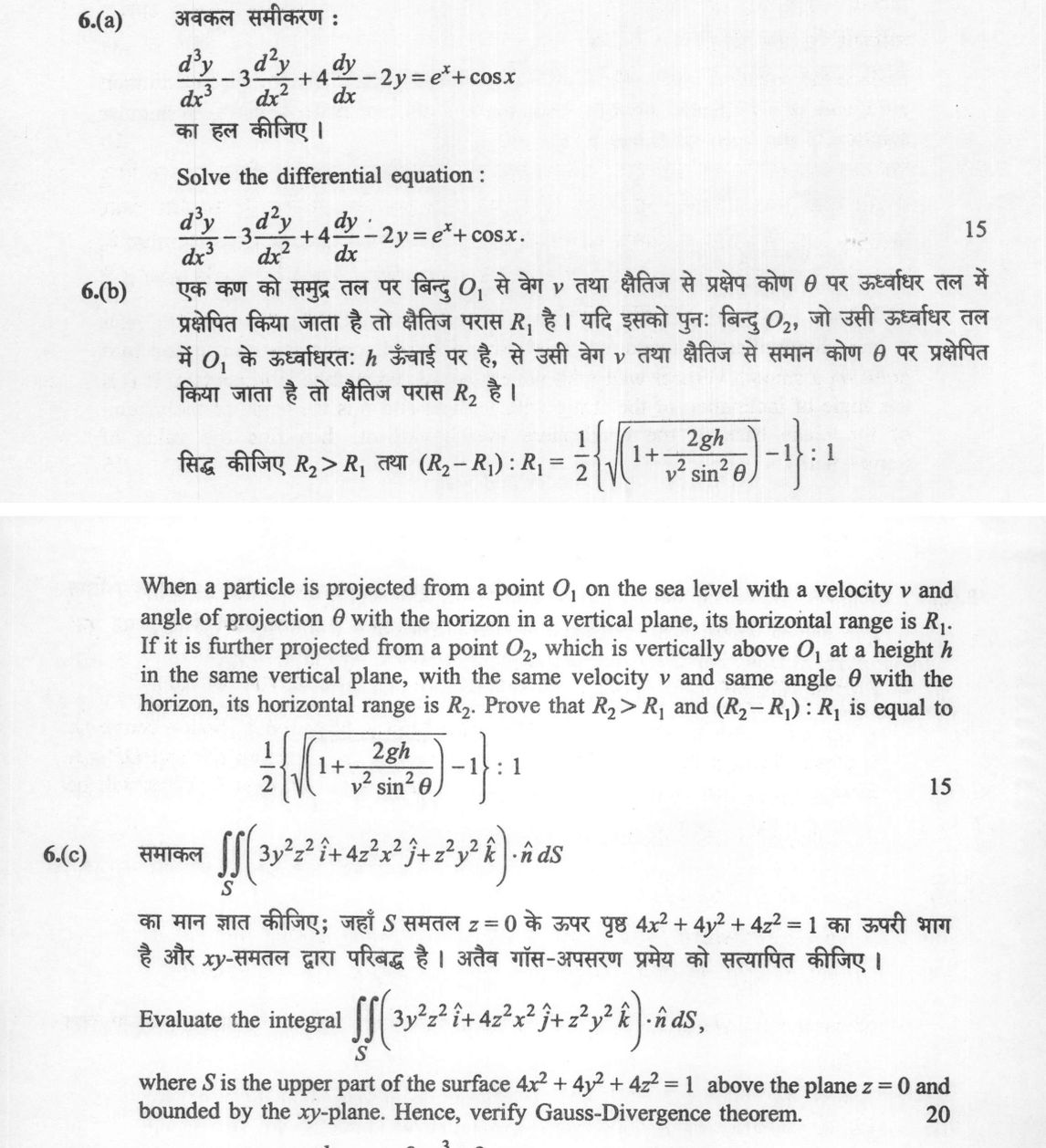
Solve the differential equation: d³y/dx³ - 3d²y/dx² + 4dy/dx - 2y = eˣ + cos x. 15 marks
When a particle is projected from a point O₁ on the sea level with a velocity v and angle of projection θ with the horizon in a vertical plane, its horizontal range is R₁. If it is further projected from a point O₂, which is vertically above O₁ at a height h in the same vertical plane, with the same velocity v and same angle θ with the horizon, its horizontal range is R₂. Prove that R₂ > R₁ and (R₂-R₁):R₁ is equal to (1/2){√(1 + 2gh/v²sin²θ) - 1}:1. 15 marks
Evaluate the integral ∬ₛ (3y²z²î + 4z²x²ĵ + z²y²k̂)·n̂ dS, where S is the upper part of the surface 4x² + 4y² + 4z² = 1 above the plane z = 0 and bounded by the xy-plane. Hence, verify Gauss-Divergence theorem. 20 marks
हिंदी में प्रश्न पढ़ें
अवकल समीकरण : d³y/dx³ - 3d²y/dx² + 4dy/dx - 2y = eˣ + cos x का हल कीजिए। (15 अंक)
एक कण को समुद्र तल पर बिन्दु O₁ से वेग v तथा क्षैतिज से प्रक्षेप कोण θ पर उद्वाधर तल में प्रक्षेपित किया जाता है तो क्षैतिज परास R₁ है। यदि इसको पुनः बिन्दु O₂, जो उसी उद्वाधर तल में O₁ के उद्वाधरतः h ऊँचाई पर है, से उसी वेग v तथा क्षैतिज से समान कोण θ पर प्रक्षेपित किया जाता है तो क्षैतिज परास R₂ है। सिद्ध कीजिए R₂ > R₁ तथा (R₂ - R₁) : R₁ = (1/2){√(1 + 2gh/v²sin²θ) - 1} : 1. (15 अंक)
समाकल ∬ₛ (3y²z²î + 4z²x²ĵ + z²y²k̂)·n̂ dS का मान ज्ञात कीजिए; जहाँ S समतल z = 0 के ऊपर पृष्ठ 4x² + 4y² + 4z² = 1 का ऊपरी भाग है और xy-समतल द्वारा परिबद्ध है। अतः गॉस-अपसरण प्रमेय को सत्यापित कीजिए। (20 अंक)
Model answer
Written by UPSC Answer Check against this question's marking rubric, to the expected length. UPSC does not publish answers for Mains — this is one way to score well, not an official key.
(a) Let L = d³/dx³ - 3d²/dx² + 4d/dx - 2. The characteristic equation is r³ - 3r² + 4r - 2 = 0, i.e. (r - 1)(r² - 2r + 2) = 0. Hence r = 1, 1 ± i. Therefore the complementary function is y_c = C₁eˣ + eˣ(C₂ cos x + C₃ sin x).
For eˣ, since r = 1 is a simple root, take y_p1 = A x eˣ. Here P(r) = r³ - 3r² + 4r - 2, so P(1) = 0 and P′(1) = 1. Hence L(A x eˣ) = A eˣ, giving A = 1. Thus y_p1 = x eˣ.
For cos x, take y_p2 = B cos x + C sin x. Substitution gives L(y_p2) = (B + 3C) cos x + (C - 3B) sin x. Equating with cos x gives B + 3C = 1 and C - 3B = 0. Thus B = 1/10, C = 3/10, so y_p2 = (1/10)(cos x + 3 sin x).
Therefore the general solution is y = C₁eˣ + eˣ(C₂ cos x + C₃ sin x) + x eˣ + (1/10)(cos x + 3 sin x).
(b) Let O₁ be the origin, x horizontal and y vertical upward. For projection from sea level, y = v sinθ t - (1/2)gt², x = v cosθ t. Time of flight is T₁ = 2v sinθ/g, hence R₁ = v cosθ T₁ = v² sin2θ/g = 2v² sinθ cosθ/g.
For projection from O₂ at height h above O₁, y = h + v sinθ t - (1/2)gt². At sea level y = 0, so (1/2)gt² - v sinθ t - h = 0, giving the positive root t = [v sinθ + √(v² sin²θ + 2gh)]/g. Therefore R₂ = v cosθ t = (v² sinθ cosθ/g)[1 + √(1 + 2gh/(v² sin²θ))]. Since v² sinθ cosθ/g = R₁/2, R₂ = (R₁/2)[1 + √(1 + 2gh/(v² sin²θ))]. As h > 0, the square root is greater than 1, so R₂ > R₁. Also R₂ - R₁ = (R₁/2)[√(1 + 2gh/(v² sin²θ)) - 1]. Hence (R₂ - R₁):R₁ = (1/2)[√(1 + 2gh/(v² sin²θ)) - 1]:1. This assumes 0 < θ < π/2 and neglects air resistance.
(c) Write F = 3y²z² î + 4z²x² ĵ + z²y² k̂. The surface is the upper hemisphere of 4x² + 4y² + 4z² = 1, i.e. x² + y² + z² = a² with a = 1/2.
Parametrize S by r(φ,θ) = (a sinφ cosθ, a sinφ sinθ, a cosφ), where 0 ≤ φ ≤ π/2, 0 ≤ θ ≤ 2π. Then r_φ × r_θ = a² sinφ (sinφ cosθ î + sinφ sinθ ĵ + cosφ k̂), giving the outward normal. Computing F · (r_φ × r_θ), the terms involving cosθ and sinθ vanish after θ-integration from 0 to 2π. What remains is ∬ₛ F·n dS = a⁶ (∫₀^π/2 sin³φ cos³φ dφ)(∫₀^2π sin²θ dθ). Now ∫₀^π/2 sin³φ cos³φ dφ = 1/12, ∫₀^2π sin²θ dθ = π. Thus ∬ₛ F·n dS = a⁶π/12 = (1/64)π/12 = π/768.
To verify Gauss-Divergence theorem, take V as the upper half-ball bounded by S and the disk D: z = 0, x² + y² ≤ a². Now ∇·F = ∂(3y²z²)/∂x + ∂(4z²x²)/∂y + ∂(z²y²)/∂z = 2y²z. In spherical coordinates, ∭ᵥ 2y²z dV = ∫₀^a∫₀^π/2∫₀^2π 2(ρ² sin²φ sin²θ)(ρ cosφ)(ρ² sinφ) dθ dφ dρ = 2(a⁶/6)(1/4)(π) = a⁶π/12 = π/768. On D, z = 0, so F = 0 and ∬ᴅ F·n dS = 0. Therefore ∬ₛ F·n dS + ∬ᴅ F·n dS = π/768 + 0 = ∭ᵥ ∇·F dV. Hence Gauss-Divergence theorem is verified.
What "Solve" is asking you to do
Choose the method, then carry it through to a final answer. Identifying what kind of problem this is and why that method applies is the first thing marked; a correct figure arrived at invisibly earns almost nothing.
Structure that answers it
Given data and what is required → method chosen, with the reason it applies → set-up (equation, circuit, free body, trial balance) → working, step by step → answer with units and any condition of validity
Where marks are lost
Doing the middle steps mentally and writing only the result. In mathematics papers, a further loss comes from giving a decimal where the exact value in surds or fractions was wanted, or from skipping the justification a part explicitly asks for.
How this answer will be evaluated
Approach
(a) calculate: given > formula > substitution > result with units > interpretation | (b) justify: claim > 3-4 reasons > evidence > conclusion | (c) calculate: given > formula > substitution > result with units > interpretation Full marks: Flawless derivations, correct algebra, and clear verification of the theorem.
Key points expected
- Characteristic equation m³ - 3m² + 4m - 2 = 0
- Identification of root m=1 and quadratic factor m² - 2m + 2
- Complementary function y_c = c₁eˣ + e²ˣ(c₂cosx + c₃sinx)
- Particular integral for eˣ using x²eˣ/2
- Equation of trajectory for projection from height h
- Derivation of R₂ = (v²sin2θ + 2v²sin²θ√(1+2gh/v²sin²θ))/2g
- Derivation of R₁ = v²sin2θ/2g
- Algebraic simplification to the required ratio form
Evaluation rubric
Each sub-part is marked on its own, against the marks and word limit printed on the paper.
- (a) Complete solution of the third-order linear ODE with constant coefficients. 15 marks
calculate— given → formula → substitution → result with units → interpretation
Must cover
- Characteristic equation m³ - 3m² + 4m - 2 = 0
- Identification of root m=1 and quadratic factor m² - 2m + 2
- Complementary function y_c = c₁eˣ + e²ˣ(c₂cosx + c₃sinx)
- Particular integral for eˣ using x²eˣ/2
Loses marks
- Incorrect factorization of characteristic polynomial
- Missing x² factor in PI for eˣ
Earns more
- Particular integral for cosx using (cosx - 2sinx)/5
- Verification of final solution by substitution
Extra mark
- Alternative method for finding roots
- (b) Proof that R₂ > R₁ and derivation of the specific ratio formula. 15 marks
justify— claim → 3-4 reasons → evidence → conclusion
Must cover
- Equation of trajectory for projection from height h
- Derivation of R₂ = (v²sin2θ + 2v²sin²θ√(1+2gh/v²sin²θ))/2g
- Derivation of R₁ = v²sin2θ/2g
- Algebraic simplification to the required ratio form
Loses marks
- Incorrect time of flight calculation for height h
- Failure to isolate the ratio (R₂-R₁)/R₁
Earns more
- Explicit statement that R₂ > R₁ due to positive h term
- Clear definition of variables v, θ, h, g
Extra mark
- Neat diagram of the two trajectories
- (c) Evaluation of the surface integral and verification of Gauss-Divergence theorem. 20 marks
calculate— given → formula → substitution → result with units → interpretation
Must cover
- Surface integral calculation using projection on xy-plane
- Divergence calculation: ∇·F = 12x²z² + 8yz² + 2z²y²
- Volume integral setup in spherical coordinates
- Equating surface and volume integral results
Loses marks
- Incorrect divergence calculation
- Failure to verify the theorem by equating results
Earns more
- Correct handling of the normal vector n̂
- Explicit limits of integration for the volume integral
Extra mark
- Alternative method for surface integral
Practice this exact question
Write your answer and it is marked point by point against the model answer above — what you covered, what you missed, what you got wrong.
Evaluate my answer →More from Mathematics 2023 Paper I
- Q3 Let A = 1 & 0 & 0 1 & 0 & 1 0 & 1 & 0 (i) Verify the Cayley-Hamilton theorem for the matr…
- Q4 Find the rank of the matrix A = 1 & 2 & -1 & 0 -1 & 3 & 0 & -4 2 & 1 & 3 & -2 1 & 1 & 1 &…
- Q5 (a) Obtain the solution of the initial-value problem dy/dx - 2xy = 2, y(0) = 1 in the for…
- Q6 (a) Solve the differential equation: d³y/dx³ - 3d²y/dx² + 4dy/dx - 2y = eˣ + cos x. (15 m…
- Q7 (a)(i) Find the solution of the differential equation : dy/dx=-(2xy³+2)/(3x^2y²+8e^4y) 10…
- Q8 (a) Solve the following initial value problem by using Laplace transform technique : (d^2…