Paper I — Q2
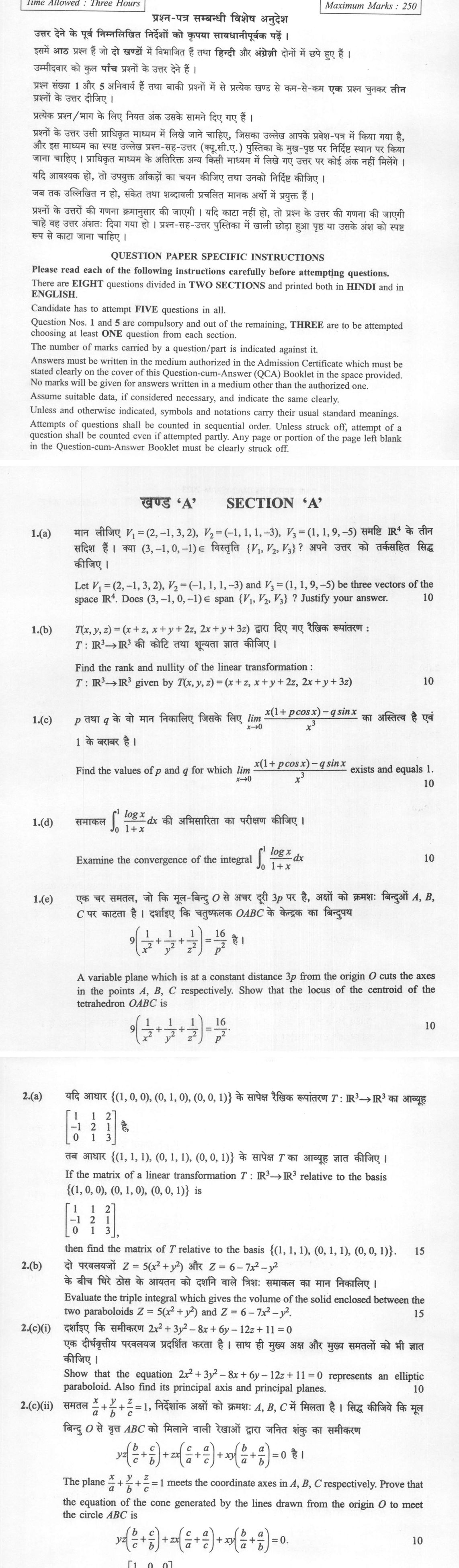
(a) If the matrix of a linear transformation T : IR³→IR³ relative to the basis (1, 0, 0), (0, 1, 0), (0, 0, 1) is 1 & 1 & 2 -1…
If the matrix of a linear transformation T : IR³→IR³ relative to the basis (1, 0, 0), (0, 1, 0), (0, 0, 1) is
1 & 1 & 2 -1 & 2 & 1 0 & 1 & 3 ,
then find the matrix of T relative to the basis (1, 1, 1), (0, 1, 1), (0, 0, 1). 15 marks
Evaluate the triple integral which gives the volume of the solid enclosed between the two paraboloids Z = 5(x² + y²) and Z = 6 – 7x² – y². 15 marks
Show that the equation 2x² + 3y² – 8x + 6y – 12z + 11 = 0 represents an elliptic paraboloid. Also find its principal axis and principal planes. 10 marks
The plane x/a+y/b+z/c=1 meets the coordinate axes in A, B, C respectively. Prove that the equation of the cone generated by the lines drawn from the origin O to meet the circle ABC is
yz(b/c+c/b)+zx(c/a+a/c)+xy(b/a+a/b)=0. 10 marks
हिंदी में प्रश्न पढ़ें
यदि आधार (1, 0, 0), (0, 1, 0), (0, 0, 1) के सापेक्ष रैखिक रूपांतरण T : IR³→IR³ का आव्यूह
1 & 1 & 2 -1 & 2 & 1 0 & 1 & 3
है, तब आधार (1, 1, 1), (0, 1, 1), (0, 0, 1) के सापेक्ष T का आव्यूह ज्ञात कीजिए। (15 अंक)
दो परवलयजों Z = 5(x² + y²) और Z = 6 – 7x² – y² के बीच घिरे ठोस के आयतन को दर्शाने वाले त्रिशः समाकल का मान निकालिए। (15 अंक)
दर्शाइए कि समीकरण 2x² + 3y² – 8x + 6y – 12z + 11 = 0 एक दीर्घवृत्तीय परवलयज प्रदर्शित करता है। साथ ही मुख्य अक्ष और मुख्य समतलों को भी ज्ञात कीजिए। (10 अंक)
समतल x/a+y/b+z/c=1, निर्देशांक अक्षों को क्रमशः A, B, C में मिलता है। सिद्ध कीजिए कि मूल बिंदु O से वृत्त ABC को मिलाने वाली रेखाओं द्वारा जनित शंकु का समीकरण
yz(b/c+c/b)+zx(c/a+a/c)+xy(b/a+a/b)=0
है। (10 अंक)
Model answer
Written by UPSC Answer Check against this question's marking rubric, to the expected length. UPSC does not publish answers for Mains — this is one way to score well, not an official key.
(a) Let A be the given matrix relative to the standard basis S. The new basis is B = {v₁, v₂, v₃}, where v₁=(1,1,1), v₂=(0,1,1), v₃=(0,0,1). The change-of-basis matrix is P = [v₁ v₂ v₃], so
P = [1 0 0; 1 1 0; 1 1 1].
Its inverse is
P⁻¹ = [1 0 0; -1 1 0; 0 -1 1].
The matrix relative to B is B = P⁻¹ A P. First,
A P = [4 3 2; 2 3 1; 4 4 3].
Therefore,
B = P⁻¹(A P) = [1 0 0; -1 1 0; 0 -1 1] [4 3 2; 2 3 1; 4 4 3] = [4 3 2; -2 0 -1; 2 1 2].
Final answer (a): [4 3 2; -2 0 -1; 2 1 2].
(b) The two paraboloids are z = 5(x²+y²) and z = 6−7x²−y². Their intersection satisfies
5(x²+y²) = 6−7x²−y² ⇒ 12x²+6y² = 6 ⇒ 2x²+y² = 1.
Thus the projection region D is the ellipse 2x²+y²≤1. At the origin, the lower surface is z=0 and the upper surface is z=6. Hence
V = ∭_D ∫_5(x²+y²)^6−7x²−y² dz dA = ∬_D [(6−7x²−y²) − 5(x²+y²)] dA = ∬_D (6−12x²−6y²) dA.
Put x = u/√2, y = v. Then 2x²+y² = u²+v², so D becomes u²+v²≤1, and dx dy = du dv/√2. The integrand becomes
6−12(u²/2)−6v² = 6(1−u²−v²).
Therefore,
V = (6/√2) ∬_u²+v²≤1 (1−u²−v²) du dv.
Use polar coordinates u = r cosθ, v = r sinθ. Then
V = (6/√2) ∫₀²π ∫₀¹ (1−r²) r dr dθ = (6/√2)(2π)(1/4) = 3π√2/2.
Final answer (b): V = 3π√2/2 cubic units.
(c)(i) The equation is
2x²+3y²−8x+6y−12z+11=0.
Complete squares:
2x²−8x = 2(x−2)²−8, 3y²+6y = 3(y+1)²−3.
Substituting,
2(x−2)²−8 + 3(y+1)²−3 −12z +11 = 0 ⇒ 2(x−2)²+3(y+1)²−12z = 0 ⇒ 2(x−2)²+3(y+1)² = 12z.
Put X=x−2, Y=y+1. Then
2X²+3Y² = 12z ⇒ z = X²/6 + Y²/4.
This is of the form z = X²/a² + Y²/b², hence it is an elliptic paraboloid opening along the positive z-axis. Its principal axis is the line X=0, Y=0, i.e.
x=2, y=−1.
The principal planes are the planes of symmetry X=0 and Y=0, i.e.
x=2 and y=−1.
Final answer (c)(i): Elliptic paraboloid; principal axis: x=2, y=−1; principal planes: x=2, y=−1.
(c)(ii) Assume a,b,c ≠ 0. The plane
x/a + y/b + z/c = 1
meets the coordinate axes at A=(a,0,0), B=(0,b,0), C=(0,0,c). The circle ABC lies in this plane and also on the sphere
x²+y²+z²−ax−by−cz=0,
because this sphere passes through A, B, C; its intersection with the plane is the unique circle through A, B, C.
Let (x,y,z) be a point on the cone. The ray from O through (x,y,z) meets the base plane at (λx, λy, λz), where
λ(x/a + y/b + z/c)=1.
Let D = x/a + y/b + z/c. Then λ = 1/D. Since the base point lies on the sphere,
λ²(x²+y²+z²) − λ(ax+by+cz)=0.
For λ≠0, this gives
λ(x²+y²+z²) = ax+by+cz.
Substitute λ=1/D:
x²+y²+z² = D(ax+by+cz).
Now
D(ax+by+cz) = (x/a + y/b + z/c)(ax+by+cz) = x²+y²+z² + xy(b/a + a/b) + xz(c/a + a/c) + yz(c/b + b/c).
Cancelling x²+y²+z² from both sides,
xy(b/a + a/b) + xz(c/a + a/c) + yz(c/b + b/c)=0.
Rearranging,
yz(b/c + c/b) + zx(c/a + a/c) + xy(b/a + a/b)=0.
Final answer (c)(ii): yz(b/c + c/b) + zx(c/a + a/c) + xy(b/a + a/b)=0.
What "Solve" is asking you to do
Choose the method, then carry it through to a final answer. Identifying what kind of problem this is and why that method applies is the first thing marked; a correct figure arrived at invisibly earns almost nothing.
Structure that answers it
Given data and what is required → method chosen, with the reason it applies → set-up (equation, circuit, free body, trial balance) → working, step by step → answer with units and any condition of validity
Where marks are lost
Doing the middle steps mentally and writing only the result. In mathematics papers, a further loss comes from giving a decimal where the exact value in surds or fractions was wanted, or from skipping the justification a part explicitly asks for.
How this answer will be evaluated
Approach
(a) calculate: given > formula > substitution > result with units > interpretation | (b) calculate: given > formula > substitution > result with units > interpretation | (c(i)) derive: given > assumptions > stepwise derivation > result > check | (c(ii)) derive: given > assumptions > stepwise derivation > result > check Full marks: Flawless execution of all methods with clear justification and verification.
Key points expected
- Construct transition matrix P from old to new basis
- Compute P⁻¹ (inverse of transition matrix)
- Apply similarity transformation P⁻¹AP
- Verify result by checking T(u1) or T(u2)
- Find intersection curve (circle) by equating Z values
- Set up triple integral in cylindrical coordinates
- Evaluate inner integral with respect to z
- Evaluate remaining double integral over disk
Evaluation rubric
Each sub-part is marked on its own, against the marks and word limit printed on the paper.
- (a) Matrix of T relative to the new basis {u1, u2, u3}. 15 marks
calculate— given → formula → substitution → result with units → interpretation
Must cover
- Construct transition matrix P from old to new basis
- Compute P⁻¹ (inverse of transition matrix)
- Apply similarity transformation P⁻¹AP
- Verify result by checking T(u1) or T(u2)
Loses marks
- Using P A P⁻¹ instead of P⁻¹ A P
- Arithmetic errors in matrix multiplication
- Failing to verify the final matrix
Earns more
- Explicitly define u1, u2, u3 vectors
- Show row-reduction steps for P⁻¹
- State change of basis formula clearly
Extra mark
- Alternative method using direct image calculation
- (b) Volume of solid between Z = 5(x²+y²) and Z = 6-7x²-y². 15 marks
calculate— given → formula → substitution → result with units → interpretation
Must cover
- Find intersection curve (circle) by equating Z values
- Set up triple integral in cylindrical coordinates
- Evaluate inner integral with respect to z
- Evaluate remaining double integral over disk
Loses marks
- Incorrect intersection radius calculation
- Using Cartesian coordinates unnecessarily
- Sign errors in the integrand
Earns more
- Sketch of the solid or intersection region
- Correct identification of upper and lower bounds
- Step-by-step integration of r² terms
Extra mark
- Alternative method using Pappus's theorem (if applicable)
- (c(i)) Show equation is elliptic paraboloid; find axis and planes. 10 marks
derive— given → assumptions → stepwise derivation → result → check
Must cover
- Complete the square for x and y terms
- Identify vertex and principal axis direction
- State principal planes (x=const, y=const)
- Write equation in standard form
Loses marks
- Failing to complete the square correctly
- Confusing principal axis with coordinate axes
- Missing the vertex calculation
Earns more
- Explicitly identifying the vertex coordinates
- Justifying the 'elliptic' classification via coefficients
Extra mark
- Sketch of the paraboloid
- (c(ii)) Prove equation of cone from origin to circle ABC. 10 marks
derive— given → assumptions → stepwise derivation → result → check
Must cover
- Parametrize line from origin to point (x,y,z)
- Substitute line equation into plane equation
- Use condition that point lies on circle ABC
- Eliminate parameter to get homogeneous equation
Loses marks
- Incorrect parametrization of the line
- Algebraic errors in substitution
- Failing to show the final homogeneous form
Earns more
- Clear definition of the circle ABC equation
- Step-by-step algebraic elimination
Extra mark
- Geometric interpretation of the cone
Practice this exact question
Write your answer and it is marked point by point against the model answer above — what you covered, what you missed, what you got wrong.
Evaluate my answer →More from Mathematics 2023 Paper I
- Q1 (a) Let V₁ = (2, -1, 3, 2), V₂ = (-1, 1, 1, -3) and V₃ = (1, 1, 9, -5) be three vectors o…
- Q2 (a) If the matrix of a linear transformation T : IR³→IR³ relative to the basis (1, 0, 0),…
- Q3 Let A = 1 & 0 & 0 1 & 0 & 1 0 & 1 & 0 (i) Verify the Cayley-Hamilton theorem for the matr…
- Q4 Find the rank of the matrix A = 1 & 2 & -1 & 0 -1 & 3 & 0 & -4 2 & 1 & 3 & -2 1 & 1 & 1 &…
- Q5 (a) Obtain the solution of the initial-value problem dy/dx - 2xy = 2, y(0) = 1 in the for…