Paper I — Q8
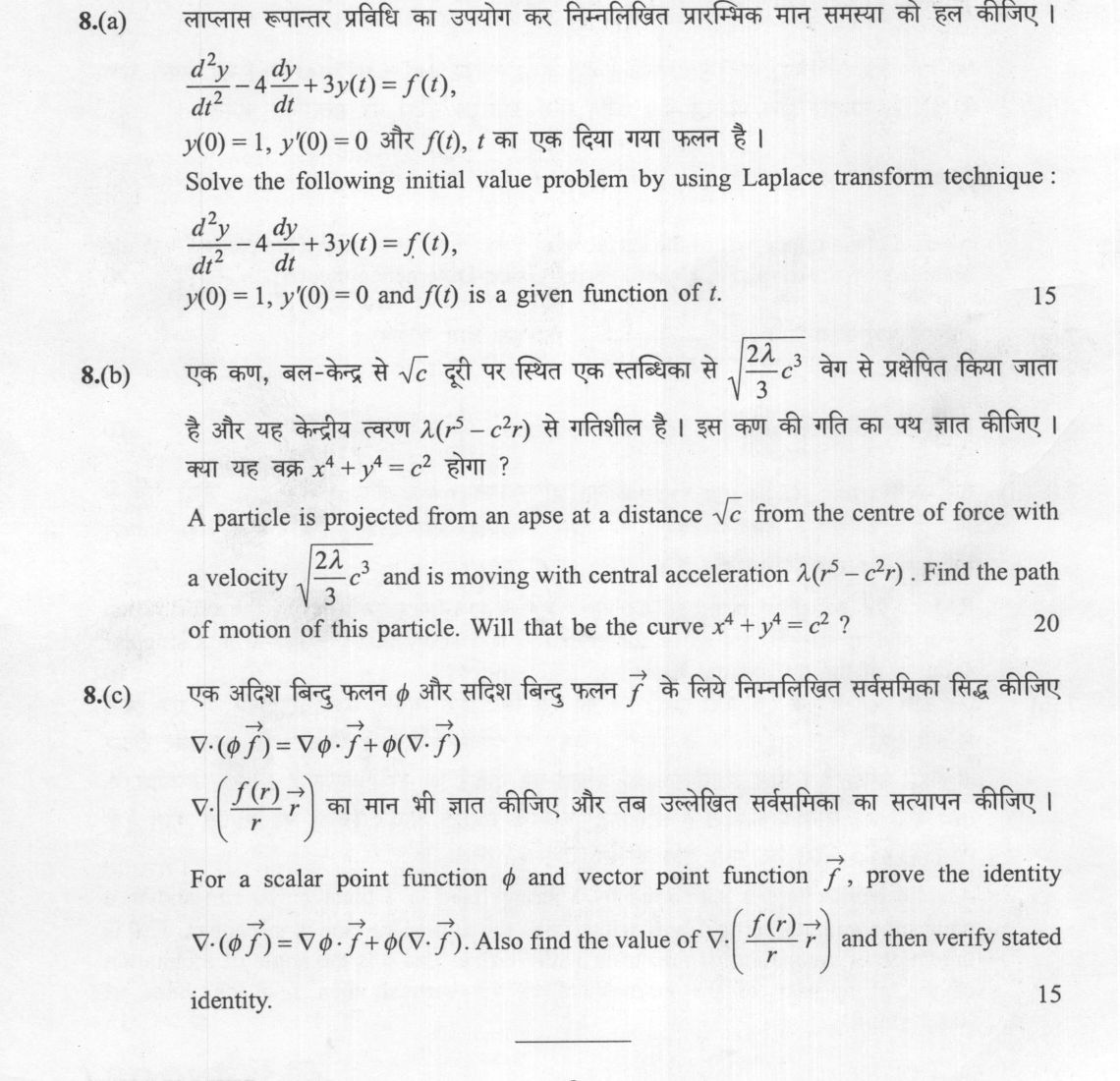
(a) Solve the following initial value problem by using Laplace transform technique : (d^2y)/(dt²) - 4dy/dt + 3y(t) = f(t), y(0)…
Solve the following initial value problem by using Laplace transform technique :
(d^2y)/(dt²) - 4dy/dt + 3y(t) = f(t),
y(0) = 1, y'(0) = 0 and f(t) is a given function of t. 15 marks
A particle is projected from an apse at a distance √c from the centre of force with a velocity √((2λ)/3c³) and is moving with central acceleration λ(r⁵ - c^2r). Find the path of motion of this particle. Will that be the curve x⁴ + y⁴ = c² ? 20 marks
For a scalar point function φ and vector point function f⃗, prove the identity ∇ · (phif⃗) = ∇φ · f⃗ + φ(∇ · f⃗). Also find the value of ∇ · ((f(r))/rr⃗) and then verify stated identity. 15 marks
हिंदी में प्रश्न पढ़ें
लाप्लास रूपांतर प्रविधि का उपयोग कर निम्नलिखित प्रारंभिक मान समस्या को हल कीजिए।
(d^2y)/(dt²) - 4dy/dt + 3y(t) = f(t),
y(0) = 1, y'(0) = 0 और f(t), t का एक दिया गया फलन है। 15
एक कण, बल-केंद्र से √c दूरी पर स्थित एक स्तब्धिका से √((2λ)/3c³) वेग से प्रक्षेपित किया जाता है और यह केंद्रीय त्वरण λ(r⁵ - c^2r) से गतिशील है। इस कण की गति का पथ ज्ञात कीजिए। क्या यह वक्र x⁴ + y⁴ = c² होगा ? 20 marks
एक अदिश बिंदु फलन φ और सदिश बिंदु फलन f⃗ के लिये निम्नलिखित सर्वसमिका सिद्ध कीजिए
∇ · (phif⃗) = ∇φ · f⃗ + φ(∇ · f⃗)
∇ · ((f(r))/rr⃗) का मान भी ज्ञात कीजिए और तब उल्लेखित सर्वसमिका का सत्यापन कीजिए। 15
Model answer
Written by UPSC Answer Check against this question's marking rubric, to the expected length. UPSC does not publish answers for Mains — this is one way to score well, not an official key.
(a) Let Y(s)=L{y(t)} and F(s)=L{f(t)}. Using the Laplace transform of derivatives, L{y'} = sY - y(0) = sY - 1, L{y''} = s²Y - s y(0) - y'(0) = s²Y - s. Substituting in the differential equation gives s²Y - s - 4(sY - 1) + 3Y = F(s). Thus (s² - 4s + 3)Y = F(s) + s - 4, so Y = F(s)/((s-1)(s-3)) + (s-4)/((s-1)(s-3)). Now (s-4)/((s-1)(s-3)) = (3/2)·1/(s-1) - (1/2)·1/(s-3), hence its inverse transform is (3/2) exp(t) - (1/2) exp(3t). Also 1/((s-1)(s-3)) = (1/2)(1/(s-3) - 1/(s-1)), whose inverse transform is g(t) = (1/2)(exp(3t) - exp(t)). By the convolution theorem, L⁻¹{F(s)/((s-1)(s-3))} = ∫₀ᵗ f(u)g(t-u)du = (1/2)∫₀ᵗ (exp(3(t-u)) - exp(t-u))f(u)du. Therefore y(t) = (3/2) exp(t) - (1/2) exp(3t) + (1/2)∫₀ᵗ (exp(3(t-u)) - exp(t-u))f(u)du. This holds whenever f is piecewise continuous and of exponential order so that its Laplace transform exists.
(b) Use polar coordinates with the centre of force as origin. Let h = r²(dθ/dt). At an apse the radial velocity is zero, so the whole velocity is transverse. Given r₀ = √c and v = √((2λ/3)c³), h = r₀v = √c·√((2λ/3)c³) = c²√(2λ/3), so h² = 2λc⁴/3.
Take the central acceleration directed towards the centre as F(r) = λ(r⁵ - c²r). Its potential is V(r) = ∫F(r)dr = λ(r⁶/6 - c²r²/2). At r₀ = √c, V(r₀) = λ(c³/6 - c³/2) = -λc³/3, and the kinetic energy is (1/2)v² = (1/2)·(2λc³/3) = λc³/3. Thus the total energy is E = 0. Hence (1/2)(dr/dt)² + h²/(2r²) + λ(r⁶/6 - c²r²/2) = 0. Substituting h², (dr/dt)² = λ/(3r²)(r⁴ - c²)(2c² - r⁴). Since dθ/dr = h/(r²(dr/dt)), we get dθ/dr = c²√2/[r√((r⁴ - c²)(2c² - r⁴))]. Put z = r⁴/c². Then dθ = (√2/4) dz/[z√((z-1)(2-z))]. Integrating from z = 1 at θ = 0 gives θ = (1/4) arccos(4/z - 3), so cos4θ = 4/z - 3, z = 4/(3 + cos4θ). Therefore r⁴ = 4c²/(3 + cos4θ). But cos⁴θ + sin⁴θ = (3 + cos4θ)/4. Thus r⁴(cos⁴θ + sin⁴θ) = c². Since x = r cosθ and y = r sinθ, x⁴ + y⁴ = c². Yes, the path is the curve x⁴ + y⁴ = c².
(c) Let f = f₁i + f₂j + f₃k. Then ∇·(φf) = ∂(φf₁)/∂x + ∂(φf₂)/∂y + ∂(φf₃)/∂z = (φ_x f₁ + φ_y f₂ + φ_z f₃) + φ(f₁_x + f₂_y + f₃_z) = ∇φ·f + φ∇·f. This proves the identity.
Now let r = xi + yj + zk, r = |r|. Then ∇·(f(r)/r·r) = ∇·(f(r)e_r), where e_r = r/r. In spherical coordinates, for a radial vector f(r)e_r, ∇·(f(r)e_r) = (1/r²) d/dr(r²f(r)) = f'(r) + 2f(r)/r. So ∇·(f(r)/r·r) = f'(r) + 2f(r)/r.
To verify the identity, take φ = f(r)/r and vector f = r. Then ∇φ = (d/dr(f/r))e_r = (rf'(r) - f(r))/r² e_r. Hence ∇φ·r = (rf'(r) - f(r))/r²·r = f'(r) - f(r)/r. Also ∇·r = 3. Therefore ∇φ·r + φ∇·r = f'(r) - f(r)/r + (f(r)/r)·3 = f'(r) + 2f(r)/r, which agrees with the direct value. The identity is verified.
What "Solve" is asking you to do
Choose the method, then carry it through to a final answer. Identifying what kind of problem this is and why that method applies is the first thing marked; a correct figure arrived at invisibly earns almost nothing.
Structure that answers it
Given data and what is required → method chosen, with the reason it applies → set-up (equation, circuit, free body, trial balance) → working, step by step → answer with units and any condition of validity
Where marks are lost
Doing the middle steps mentally and writing only the result. In mathematics papers, a further loss comes from giving a decimal where the exact value in surds or fractions was wanted, or from skipping the justification a part explicitly asks for.
How this answer will be evaluated
Approach
(a) calculate: given > formula > substitution > result with units > interpretation | (b) derive: given > assumptions > stepwise derivation > result > check | (c) derive: given > assumptions > stepwise derivation > result > check Full marks: Complete stepwise derivation with all justifications and verification
Key points expected
- Apply Laplace transform to the differential equation
- Substitute initial conditions y(0)=1, y'(0)=0
- Solve algebraically for Y(s) in terms of F(s)
- Express final solution y(t) using inverse transform
- Use Binet's equation for central force motion
- Substitute given acceleration λ(r⁵ - c²r)
- Apply initial conditions at apse (r=√c, v=√(2λ/3c³))
- Derive the path equation and verify x⁴ + y⁴ = c²
Evaluation rubric
Each sub-part is marked on its own, against the marks and word limit printed on the paper.
- (a) Solution of the IVP using Laplace transform technique. 15 marks
calculate— given → formula → substitution → result with units → interpretation
Must cover
- Apply Laplace transform to the differential equation
- Substitute initial conditions y(0)=1, y'(0)=0
- Solve algebraically for Y(s) in terms of F(s)
- Express final solution y(t) using inverse transform
Loses marks
- Skipping intermediate algebraic steps
- Incorrect application of Laplace transform properties
Earns more
- Correctly identify characteristic roots 1 and 3
- Use convolution theorem for the f(t) term
- Verify solution satisfies initial conditions
Extra mark
- Alternative method noted briefly
- (b) Path of motion and verification of the curve x⁴ + y⁴ = c². 20 marks
derive— given → assumptions → stepwise derivation → result → check
Must cover
- Use Binet's equation for central force motion
- Substitute given acceleration λ(r⁵ - c²r)
- Apply initial conditions at apse (r=√c, v=√(2λ/3c³))
- Derive the path equation and verify x⁴ + y⁴ = c²
Loses marks
- Incorrect use of Binet's equation
- Skipping integration steps without justification
Earns more
- Correctly identify apse conditions (dr/dt=0)
- Show step-by-step integration of Binet's equation
- Verify the derived path satisfies the given curve
Extra mark
- Neat figure of the path
- (c) Proof of vector identity and verification with specific function. 15 marks
derive— given → assumptions → stepwise derivation → result → check
Must cover
- Prove ∇ · (φf⃗) = ∇φ · f⃗ + φ(∇ · f⃗)
- Calculate ∇ · (f(r)/r r⃗) explicitly
- Verify the identity using the calculated value
- Show all vector calculus steps clearly
Loses marks
- Skipping intermediate vector calculus steps
- Incorrect application of divergence properties
Earns more
- Use product rule for divergence correctly
- Show explicit calculation of ∇ · (f(r)/r r⃗)
- Verify identity by substituting specific f(r)
Extra mark
- Alternative verification method noted
Practice this exact question
Write your answer and it is marked point by point against the model answer above — what you covered, what you missed, what you got wrong.
Evaluate my answer →More from Mathematics 2023 Paper I
- Q5 (a) Obtain the solution of the initial-value problem dy/dx - 2xy = 2, y(0) = 1 in the for…
- Q6 (a) Solve the differential equation: d³y/dx³ - 3d²y/dx² + 4dy/dx - 2y = eˣ + cos x. (15 m…
- Q7 (a)(i) Find the solution of the differential equation : dy/dx=-(2xy³+2)/(3x^2y²+8e^4y) 10…
- Q8 (a) Solve the following initial value problem by using Laplace transform technique : (d^2…