Paper II — Q1
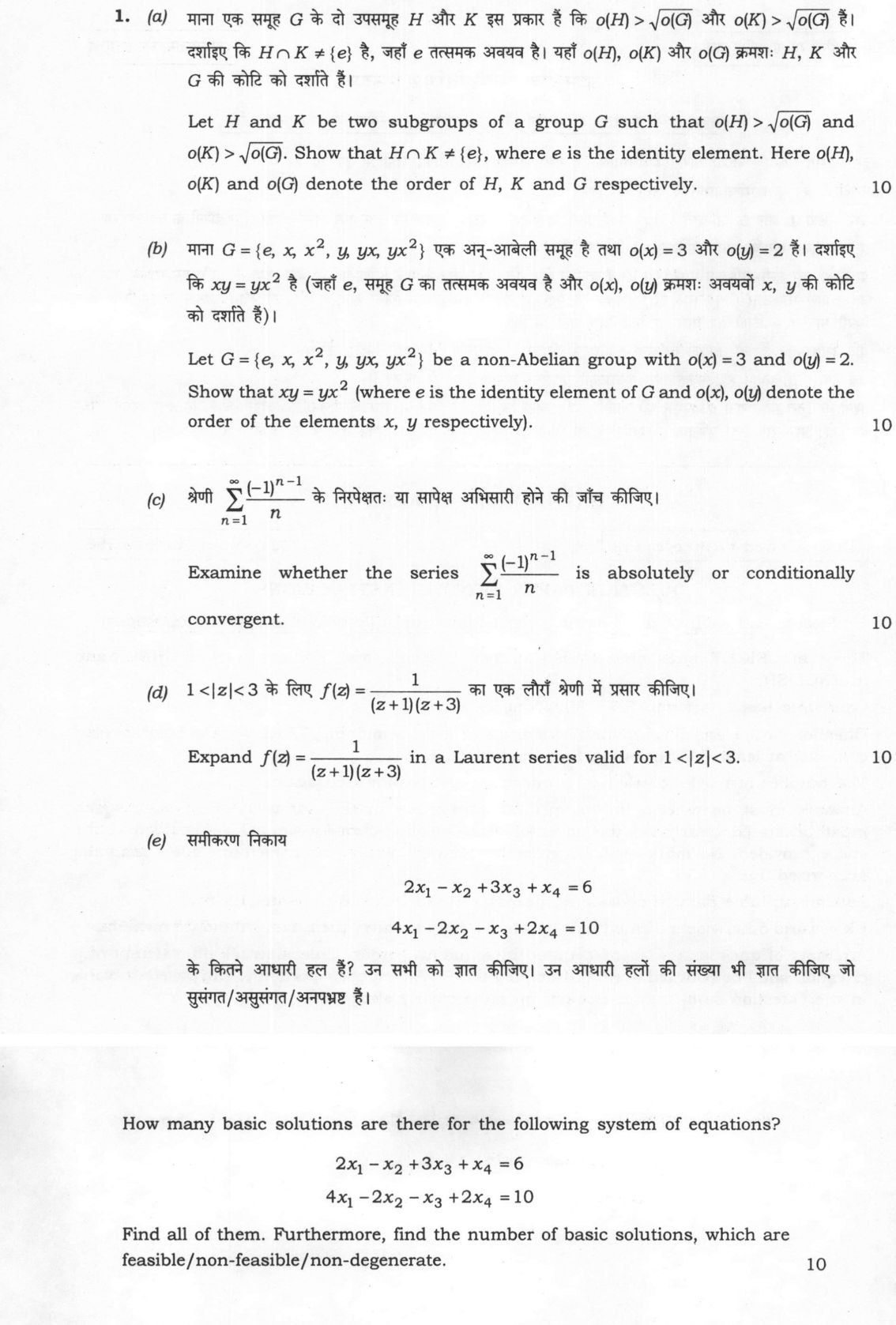
(a) Let H and K be two subgroups of a group G such that o(H) > √o(G) and o(K) > √o(G). Show that H ∩ K ≠ {e}, where e is the…
Let H and K be two subgroups of a group G such that o(H) > √o(G) and o(K) > √o(G). Show that H ∩ K ≠ {e}, where e is the identity element. Here o(H), o(K) and o(G) denote the order of H, K and G respectively. 10 marks
Let G = {e, x, x², y, yx, yx²} be a non-Abelian group with o(x) = 3 and o(y) = 2. Show that xy = yx² (where e is the identity element of G and o(x), o(y) denote the order of the elements x, y respectively). 10 marks
Examine whether the series Σₙ₌₁^∞ (-1)ⁿ⁻¹/n is absolutely or conditionally convergent. 10 marks
Expand f(z) = 1/(z+1)(z+3) in a Laurent series valid for 1 < |z| < 3. 10 marks
How many basic solutions are there for the following system of equations? 2x₁ - x₂ + 3x₃ + x₄ = 6 4x₁ - 2x₂ - x₃ + 2x₄ = 10 Find all of them. Furthermore, find the number of basic solutions, which are feasible/non-feasible/non-degenerate. 10 marks
हिंदी में प्रश्न पढ़ें
माना एक समूह G के दो उपसमूह H और K इस प्रकार हैं कि o(H) > √o(G) और o(K) > √o(G) है। दर्शाइए कि H ∩ K ≠ {e} है, जहाँ e तत्समक अवयव है। यहाँ o(H), o(K) और o(G) क्रमशः: H, K और G की कोटि को दर्शाते हैं। (10 अंक)
माना G = {e, x, x², y, yx, yx²} एक अन-आबेली समूह है तथा o(x) = 3 और o(y) = 2 है। दर्शाइए कि xy = yx² है (जहाँ e, समूह G का तत्समक अवयव है और o(x), o(y) क्रमशः: अवयवों x, y की कोटि को दर्शाते हैं)। (10 अंक)
श्रेणी Σₙ₌₁^∞ (-1)ⁿ⁻¹/n के निरपेक्षतः या सापेक्ष अभिसारी होने की जाँच कीजिए। (10 अंक)
1 < |z| < 3 के लिए f(z) = 1/(z+1)(z+3) का एक लॉरेंट श्रेणी में प्रसार कीजिए। (10 अंक)
समीकरण निकाय 2x₁ - x₂ + 3x₃ + x₄ = 6 4x₁ - 2x₂ - x₃ + 2x₄ = 10 के कितने आधारी हल हैं? उन सभी को ज्ञात कीजिए। उन आधारी हलों की संख्या भी ज्ञात कीजिए जो सुसंगत/असुसंगत/अनपघट्ट है। (10 अंक)
Model answer
Written by UPSC Answer Check against this question's marking rubric, to the expected length. UPSC does not publish answers for Mains — this is one way to score well, not an official key.
(a) Let d = o(H ∩ K). By the product formula for finite subgroups, o(HK) = o(H)o(K)/d. Since HK ⊆ G, we have o(HK) ≤ o(G). Hence o(H)o(K)/d ≤ o(G). Now o(H) > √o(G) and o(K) > √o(G), so o(H)o(K) > o(G). If d = 1, then o(HK) = o(H)o(K) > o(G), which contradicts o(HK) ≤ o(G). Therefore d ≠ 1. Since d = o(H ∩ K) is a positive integer, d ≥ 2. Hence H ∩ K contains at least two elements, so H ∩ K ≠ {e}.
Final: H ∩ K ≠ {e}.
(b) We are given G = {e, x, x², y, yx, yx²}, with o(x) = 3, o(y) = 2, and G non-Abelian.
Consider the element xy. Since G is closed, xy must be one of the six listed elements. It cannot be e, x, x², or y:
- xy = e would imply x = y⁻¹ = y, since o(y) = 2. But o(x) = 3 and o(y) = 2, impossible.
- xy = x implies y = e, impossible.
- xy = x² implies y = x, impossible.
- xy = y implies x = e, impossible.
Thus xy is either yx or yx².
If xy = yx, then x and y commute. Since every element of G is of the form e, x, x², y, yx, yx², all elements would commute, making G Abelian. But G is given non-Abelian. Therefore xy ≠ yx.
Hence the only remaining possibility is xy = yx².
Final: xy = yx².
(c) The series is Σₙ₌₁∞ (-1)ⁿ⁻¹/n = 1 - 1/2 + 1/3 - 1/4 + ...
First test absolute convergence. The absolute series is Σₙ₌₁∞ 1/n, which is the harmonic series. Since it is a p-series with p = 1, it diverges.
Now test convergence of the original alternating series. Let aₙ = 1/n. Then aₙ > 0, aₙ is decreasing, and limₙ→∞ aₙ = 0. By the alternating series test, the series Σₙ₌₁∞ (-1)ⁿ⁻¹/n converges.
Since it converges but does not converge absolutely, it is conditionally convergent.
Final: The series is conditionally convergent. Its sum is ln 2.
(d) Let f(z) = 1/((z+1)(z+3)). Use partial fractions: 1/((z+1)(z+3)) = A/(z+1) + B/(z+3). Then 1 = A(z+3) + B(z+1). Putting z = -1 gives 1 = 2A, so A = 1/2. Putting z = -3 gives 1 = -2B, so B = -1/2. Hence f(z) = 1/(2(z+1)) - 1/(2(z+3)).
We need the Laurent expansion valid for 1 < |z| < 3.
For |z| > 1, 1/(z+1) = 1/z · 1/(1 + 1/z) = Σₙ₌₀∞ (-1)ⁿ / zⁿ⁺¹ = Σₙ₌₁∞ (-1)ⁿ⁻¹ / zⁿ.
For |z| < 3, 1/(z+3) = 1/3 · 1/(1 + z/3) = Σₙ₌₀∞ (-1)ⁿ zⁿ / 3ⁿ⁺¹.
Therefore f(z) = 1/2 Σₙ₌₁∞ (-1)ⁿ⁻¹ / zⁿ - 1/2 Σₙ₌₀∞ (-1)ⁿ zⁿ / 3ⁿ⁺¹ = Σₙ₌₁∞ (-1)ⁿ⁻¹/(2 zⁿ) - Σₙ₌₀∞ (-1)ⁿ zⁿ/(2·3ⁿ⁺¹).
Final: f(z) = Σₙ₌₁∞ (-1)ⁿ⁻¹/(2 zⁿ) - Σₙ₌₀∞ (-1)ⁿ zⁿ/(2·3ⁿ⁺¹), valid for 1 < |z| < 3.
(e) The system is 2x₁ - x₂ + 3x₃ + x₄ = 6 4x₁ - 2x₂ - x₃ + 2x₄ = 10.
The coefficient matrix has columns c₁ = (2, 4), c₂ = (-1, -2), c₃ = (3, -1), c₄ = (1, 2).
Observe that c₂ = -(1/2)c₁, c₄ = (1/2)c₁. Thus c₁, c₂, c₄ are pairwise dependent. Also c₃ is not a scalar multiple of c₁. Hence the rank is 2, and every basic solution must use c₃ together with one of c₁, c₂, c₄. Therefore the possible basic variable sets are: {x₁, x₃}, {x₂, x₃}, {x₄, x₃}.
Case 1: Basic variables x₁, x₃; nonbasic x₂ = x₄ = 0. 2x₁ + 3x₃ = 6 4x₁ - x₃ = 10. Solving gives x₃ = 2/7 and x₁ = 18/7. So S₁ = (18/7, 0, 2/7, 0). All variables are nonnegative, so S₁ is feasible. Both basic variables are nonzero, so it is non-degenerate.
Case 2: Basic variables x₂, x₃; nonbasic x₁ = x₄ = 0.
- x₂ + 3x₃ = 6 -2x₂ - x₃ = 10. Solving gives x₃ = 2/7 and x₂ = -36/7. So S₂ = (0, -36/7, 2/7, 0). Here x₂ < 0, so S₂ is non-feasible. Both basic variables are nonzero, so it is non-degenerate.
Case 3: Basic variables x₄, x₃; nonbasic x₁ = x₂ = 0. 3x₃ + x₄ = 6
- x₃ + 2x₄ = 10. Solving gives x₃ = 2/7 and x₄ = 36/7. So S₃ = (0, 0, 2/7, 36/7). All variables are nonnegative, so S₃ is feasible. Both basic variables are nonzero, so it is non-degenerate.
Thus the basic solutions are:
- S₁ = (18/7, 0, 2/7, 0) — feasible, non-degenerate
- S₂ = (0, -36/7, 2/7, 0) — non-feasible, non-degenerate
- S₃ = (0, 0, 2/7, 36/7) — feasible, non-degenerate
Final: Number of basic solutions = 3. Feasible basic solutions = 2. Non-feasible basic solutions = 1. Non-degenerate basic solutions = 3. Degenerate basic solutions = 0.
What "Prove" is asking you to do
Establish that the statement holds for every case it claims, not for one representative case. The argument must be closed: each line follows from a definition, a hypothesis, or a named theorem you are entitled to use.
Structure that answers it
Given and to prove, restated → theorem or construction to be used, named → the argument line by line → conclusion stated as proved
Where marks are lost
Testing one example, which illustrates but proves nothing. On an if and only if claim, proving one direction and stopping forfeits that half outright, and degenerate cases — zero, the empty set, the equality case — have to be disposed of rather than assumed away.
How this answer will be evaluated
Approach
(a) justify: claim > 3-4 reasons > evidence > conclusion | (b) justify: claim > 3-4 reasons > evidence > conclusion | (c) examine: intro > how/why with reasoning > evidence > conclusion | (d) derive: given > assumptions > stepwise derivation > result > check | (e) calculate: given > formula > substitution > result with units > interpretation Full marks: Rigorous proofs with all steps justified; correct classification of all solutions.
Key points expected
- State Lagrange's theorem for subgroups of G
- Use the given inequalities o(H) > √o(G) and o(K) > √o(G)
- Apply the formula o(H)·o(K) = o(H∩K)·o(HK)
- Conclude o(H∩K) > 1 implies H∩K ≠ {e}
- List the six elements of G explicitly
- Use o(x)=3 and o(y)=2 to constrain powers
- Show xy is not in {e, x, x², y, yx}
- Conclude xy must equal yx² by elimination
Evaluation rubric
Each sub-part is marked on its own, against the marks and word limit printed on the paper.
- (a) Prove that the intersection of H and K contains more than the identity element. 10 marks
justify— claim → 3-4 reasons → evidence → conclusion
Must cover
- State Lagrange's theorem for subgroups of G
- Use the given inequalities o(H) > √o(G) and o(K) > √o(G)
- Apply the formula o(H)·o(K) = o(H∩K)·o(HK)
- Conclude o(H∩K) > 1 implies H∩K ≠ {e}
Loses marks
- Assuming H∩K is non-trivial without proof
- Failing to use the specific square root bounds
Earns more
- Explicitly define o(H), o(K), o(G) as orders
- Note that H∩K is a subgroup of G
Extra mark
- Mention the result holds for finite groups
- (b) Prove the relation xy = yx² in the given non-Abelian group. 10 marks
justify— claim → 3-4 reasons → evidence → conclusion
Must cover
- List the six elements of G explicitly
- Use o(x)=3 and o(y)=2 to constrain powers
- Show xy is not in {e, x, x², y, yx}
- Conclude xy must equal yx² by elimination
Loses marks
- Assuming commutativity (xy = yx)
- Skipping the elimination of other elements
Earns more
- Verify yx² is distinct from other elements
- Check consistency with group closure
Extra mark
- Note this is the presentation of S₃
- (c) Determine if the alternating harmonic series is absolutely or conditionally convergent. 10 marks
examine— intro → how/why with reasoning → evidence → conclusion
Must cover
- Apply Leibniz test for conditional convergence
- Test absolute convergence of Σ 1/n
- Identify Σ 1/n as the harmonic series
- Conclude the series is conditionally convergent
Loses marks
- Claiming absolute convergence without checking Σ 1/n
- Failing to verify the limit of terms is 0
Earns more
- State that terms decrease monotonically to 0
- Cite the p-series test for divergence
Extra mark
- Mention the sum is ln(2)
- (d) Find the Laurent series expansion of f(z) for the annulus 1 < |z| < 3. 10 marks
derive— given → assumptions → stepwise derivation → result → check
Must cover
- Perform partial fraction decomposition of f(z)
- Expand 1/(z+1) as a geometric series in 1/z
- Expand 1/(z+3) as a geometric series in z
- Combine terms to form the final Laurent series
Loses marks
- Expanding both terms in positive powers of z
- Expanding both terms in negative powers of z
Earns more
- State the convergence conditions for each geometric series
- Show the range 1 < |z| < 3 satisfies both
Extra mark
- Write the first few terms explicitly
- (e) Find all basic solutions and classify them as feasible, non-feasible, or non-degenerate. 10 marks
calculate— given → formula → substitution → result with units → interpretation
Must cover
- Identify the 2 basic variables for each of 6 combinations
- Solve the 2x2 linear systems for each combination
- Check non-negativity to determine feasibility
- Identify non-degenerate solutions (all basic vars > 0)
Loses marks
- Missing any of the 6 basic variable combinations
- Failing to check the non-negativity constraint
Earns more
- List all 6 basic solutions explicitly
- Clearly separate feasible from non-feasible counts
Extra mark
- Present results in a summary table
Practice this exact question
Write your answer and it is marked point by point against the model answer above — what you covered, what you missed, what you got wrong.
Evaluate my answer →More from Mathematics 2025 Paper II
- Q1 (a) Let H and K be two subgroups of a group G such that o(H) > √o(G) and o(K) > √o(G). Sh…
- Q2 (a) Define Cauchy sequence and prove that every convergent sequence of real numbers is a…
- Q3 (a) Evaluate the integral ∮_C e^z/(z²(z+1)³) dz, C : |z| = 2. (15 marks) (b) Show that th…
- Q4 (a) Examine whether the mapping φ: Z[x] → Z defined by φ(f(x)) = f(0), for f(x) ∈ Z[x], i…